
SCADA-Based Water Treatment Control for Data Centers: What Standard Skids Cover and What Needs Custom Engineering

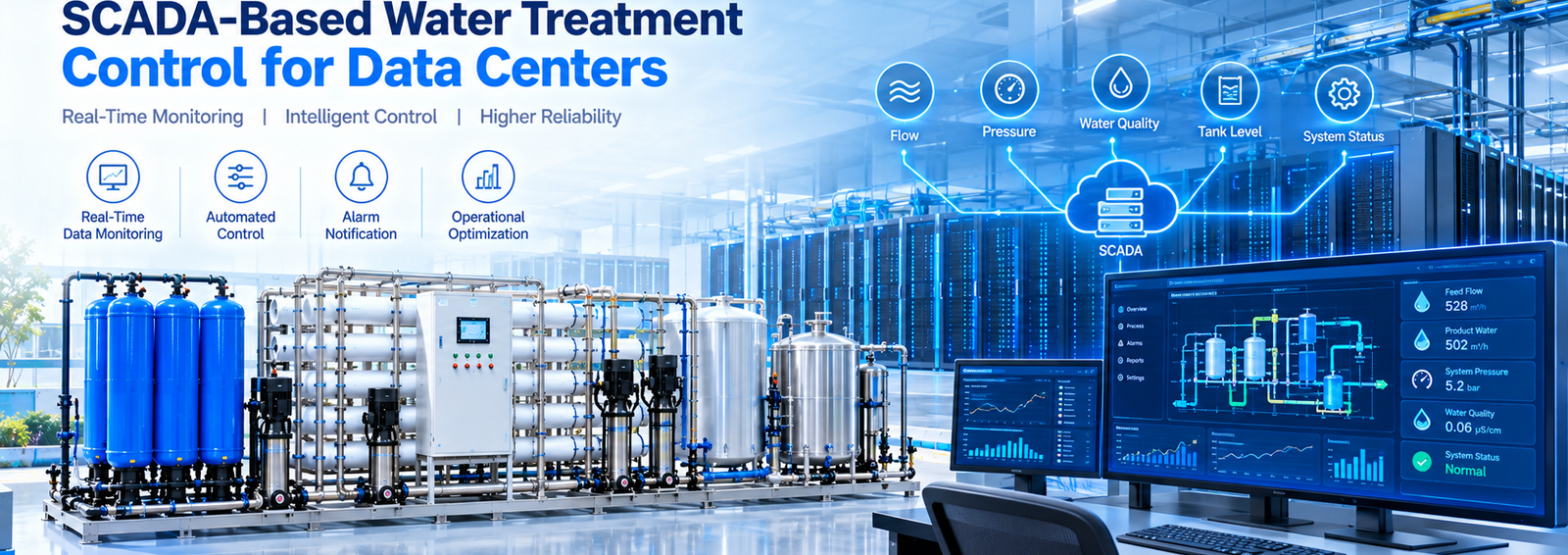
Every industrial RO skid ships with a PLC. Almost none of them ship with SCADA. Conflating the two at RFQ stage is how facilities teams end up specifying — and paying for — the wrong thing.
Before deciding whether a project needs SCADA integration, lock down these distinctions:
- PLC scope: local automation — backwash sequencing, membrane protection interlocks, real-time PSI and flow readout at the skid
- SCADA scope: facility-wide visibility — trending, alarm routing, historian logging, and tie-in to the building management system (BMS) across every mechanical system, not just water
- Protocol compatibility: confirm whether the skid’s PLC and the facility’s BMS speak the same communication protocol before assuming integration is a wiring exercise
- OT network segmentation: water treatment control data has to enter the facility network without becoming an attack surface into the broader operational technology (OT) environment
- Lead time impact: SCADA/BMS integration is engineered-to-order work, not a checkbox on a standard skid configurator
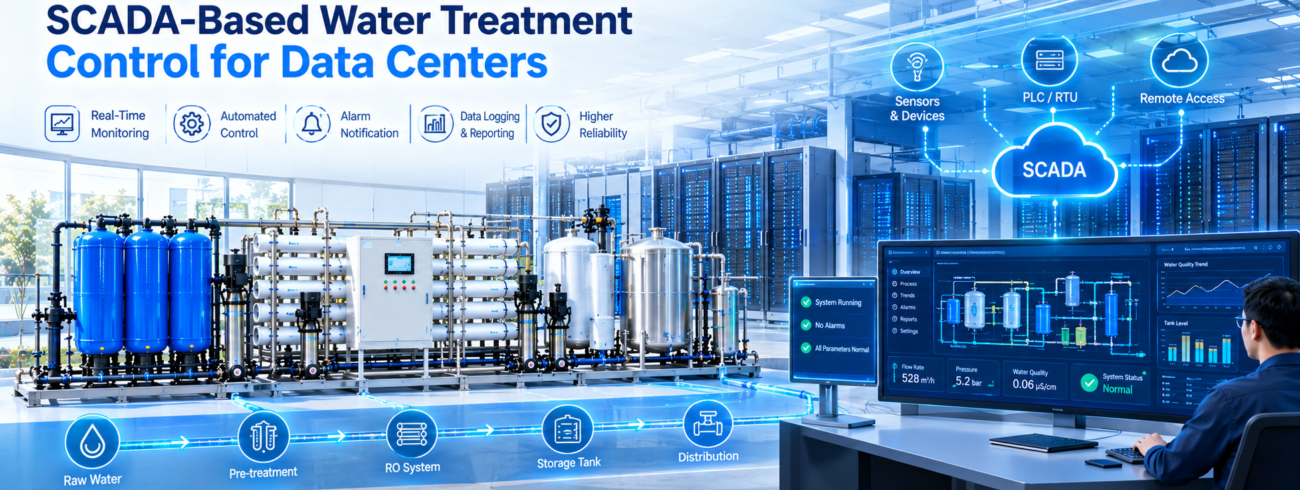
The distinction below is the one most RFQs get wrong: whether a SCADA-based water treatment control for data centers package is standard equipment or a custom engineering scope.
Fast Check Product: https://yourwatergood.com/product/industrial-reverse-osmosis-system
What SCADA Actually Adds Beyond a Standard PLC Skid
A standard industrial RO skid’s PLC does exactly what it needs to at the equipment level: it sequences backwash cycles, protects the membrane array from over-pressure or dry-run conditions, and reads out PSI differential and flow in real time on a local HMI panel.
What it does not do, by default, is talk to anything outside itself.
SCADA — supervisory control and data acquisition — is the layer that aggregates data from every mechanical system on a site (chillers, CDUs, cooling towers, water treatment, electrical switchgear) into one operational picture. A facilities director watching a SCADA dashboard isn’t looking at “the RO skid’s PSI trend” in isolation — they’re looking at whether a water treatment excursion correlates with a rising approach temperature on the cooling tower three systems over.
That correlation is the entire value proposition of SCADA integration, and it’s structurally impossible to get from a standalone PLC panel.
Where the Line Sits: PLC-Only vs SCADA-Integrated Water Treatment
This is worth stating plainly, because it’s the single most common point of confusion in data center water treatment RFQs: a standard pre-engineered skid ships with PLC automation and local real-time monitoring. It does not ship with SCADA or BMS integration.
That’s not a limitation — it’s a scoping decision. Most industrial RO applications never need facility-wide SCADA visibility. Mission-critical data center applications frequently do, but the integration work is a distinct, engineered-to-order scope that sits on top of the base skid, not inside it.
Getting this line clear at RFQ stage prevents two expensive outcomes:
- Under-scoping: assuming “real-time monitoring” on a spec sheet means the skid will natively report into a central BMS, then discovering during commissioning that a protocol gateway and additional engineering hours are required
- Over-scoping: paying for full SCADA integration on a project where local PLC monitoring and periodic manual logging would have satisfied the actual operational requirement
Protocol and Network Reality: Getting Water Treatment Data Into a Facility BMS
A water treatment PLC typically communicates over Modbus TCP or Modbus RTU — an industrial standard, but not necessarily the one a facility’s BMS runs on. Building management platforms frequently standardize on BACnet or a Niagara-framework integration layer instead.
Bridging the two isn’t a cable — it’s a protocol gateway, configured to map the PLC’s Modbus registers (conductivity, PSI differential, flow rate, alarm states) into BACnet objects the BMS can actually trend and alarm against. Get the register mapping wrong, and the BMS either shows stale values or silently drops the alarm states that matter most.
Scan rate mismatches compound this. A water treatment PLC might log internally at one-second resolution; a BMS historian trending hundreds of points across a facility often defaults to a much coarser interval. For day-to-day operation that’s invisible — for post-incident forensics on a water quality excursion, it’s the difference between reconstructing exactly when a membrane started fouling and having a data gap across the event.
OT Segmentation: Why a Water Treatment Skid Shouldn’t Just Plug Into the Corporate Network
Here’s the detail that separates a controls engineer who’s actually commissioned mission-critical SCADA integration from a vendor quoting it from a catalog: a water treatment skid’s PLC is an OT endpoint, and it should never have a direct path to the corporate IT network.
Data center OT environments generally follow segmented network architecture — the Purdue model, in practice — where control-level devices (the PLC) sit on an isolated OT VLAN, and only aggregated, read-only data crosses into the SCADA historian or BMS layer. A poorly scoped integration that routes the water treatment PLC straight onto a flat network turns a routine equipment vendor connection into a potential lateral-movement path into the facility’s broader OT environment.
The practical fix is a unidirectional gateway or data diode for the historian feed, or at minimum a firewalled DMZ segment between the water treatment OT network and the facility SCADA layer. This is a network architecture decision, not a PLC configuration setting — and it needs to be specified before integration work starts, not discovered during a security audit after commissioning.
When SCADA Integration Actually Becomes Necessary
Not every water treatment skid needs SCADA integration. The decision usually turns on a small number of operational triggers:
- Multi-system correlation requirements — when facilities teams need to see water quality trends alongside cooling tower and CDU performance data on one screen, not three
- Centralized alarm routing — when a water quality excursion needs to page the same on-call rotation as an electrical or mechanical alarm, rather than sitting on a local HMI no one is watching after hours
- Compliance and audit logging — when a facility’s uptime SLA or internal governance requires a historian record of water quality data alongside every other mechanical system, not a standalone log
- Remote/lights-out operations — when a site runs with minimal on-site staff and depends on centralized monitoring rather than someone walking past the skid’s local panel
If none of those apply, a well-instrumented PLC skid with local alarming is very often the right-sized answer — and the lower-cost, shorter-lead-time one.
Request a Data Center Water Sizing Consultationto determine whether your facility’s operational model actually requires SCADA integration, or whether standard PLC automation with local alarming meets the requirement.
OPEX and Capital Protection: Standard Skid vs. Data Center Grade System
| Parameter | Standard Pre-Engineered Skid | Data Center Grade High-Redundancy System |
|---|---|---|
| Flow control | Fixed setpoint, manual valve trim | PID-modulated, remote setpoint capability |
| Redundancy | Single train, no standby | N+1 / 2N parallel trains |
| Controls integration | Local PLC, HMI panel readout only | PLC standard; BMS/SCADA integration engineered as a custom scope |
| Network architecture | Not addressed at base spec | OT segmentation, protocol gateway, and historian feed engineered per site |
| Typical lead time | 8–12 weeks | 12–20 weeks, longer when SCADA/OT integration is in scope |
| Filtration precision | 5-micron pre-RO cartridge | Down to 1-micron pre-RO stage, continuously monitored |
The OPEX argument for SCADA integration isn’t about the water treatment skid in isolation — it’s about the labor cost of manual log-walking versus centralized alarm response, and the capital protection value of catching a correlated multi-system trend (water quality plus rising approach temperature) before it becomes a thermal event. Where reclaimed or municipal water source variability is already a known site risk, that correlated visibility is worth more, not less, because feed water quality swings show up faster on a SCADA trend than on a manual log sheet.
Scope SCADA integration at RFQ stage, not after commissioning. Retrofitting a protocol gateway and OT network segmentation onto a skid that’s already installed and running costs materially more in both engineering hours and facility downtime than specifying it up front.
Treating SCADA-based water treatment control for data centers as a defined engineering scope — protocol gateway, register mapping, and OT segmentation specified up front — is what keeps commissioning on schedule instead of stalled on a network security review.
FAQ: SCADA-Based Water Treatment Control for Data Centers
Does a standard industrial RO skid come with SCADA integration out of the box? No. Standard skids ship with PLC automation and local real-time PSI/flow monitoring on an HMI panel. SCADA and BMS integration is engineered as a custom scope on top of the base skid.
What’s the actual difference between PLC control and SCADA integration? PLC controls the skid itself — backwash sequencing, membrane protection, local readout. SCADA aggregates data across multiple facility systems for centralized trending, alarm routing, and historian logging.
What communication protocol do water treatment PLCs typically use? Modbus TCP or Modbus RTU is standard on most industrial skids; bridging to a BACnet-based BMS requires a protocol gateway to map register data into BACnet objects.
Why does OT network segmentation matter for a water treatment SCADA integration? A water treatment PLC is an OT endpoint — connecting it directly to a flat corporate network creates a potential lateral-movement path into the facility’s broader operational technology environment.
When does a data center actually need SCADA integration instead of PLC-only monitoring? When facilities teams need multi-system trend correlation, centralized alarm routing, compliance-grade historian logging, or remote/lights-out monitoring — otherwise a well-instrumented PLC skid is often sufficient.
What data points should a water treatment skid send to a central SCADA/BMS? Conductivity or TDS, differential pressure (PSI) across the filtration and RO stages, flow rate, and discrete alarm states for fouling, over-pressure, and membrane protection interlocks.
How much lead time does SCADA integration add to a water treatment skid project? Standard skids typically run 8–12 weeks; adding SCADA/BMS and OT network engineering typically extends that to 12–20 weeks depending on protocol gateway and network segmentation scope.
The gap between a PLC readout and a SCADA-integrated water treatment system isn’t a feature checkbox — it’s a distinct engineering scope covering protocol translation, network segmentation, and historian architecture. Specifying it correctly at RFQ stage is the difference between a clean commissioning and a retrofit.
Get an Infrastructure Engineering Quote — request technical data sheets, a controls integration scope review for your facility’s BMS/SCADA architecture, and B2B wholesale / factory-direct pricing for modular RO skid deployments.