
Best water filter for commercial ice machine — choosing, sizing and maintaining the right system for foodservice

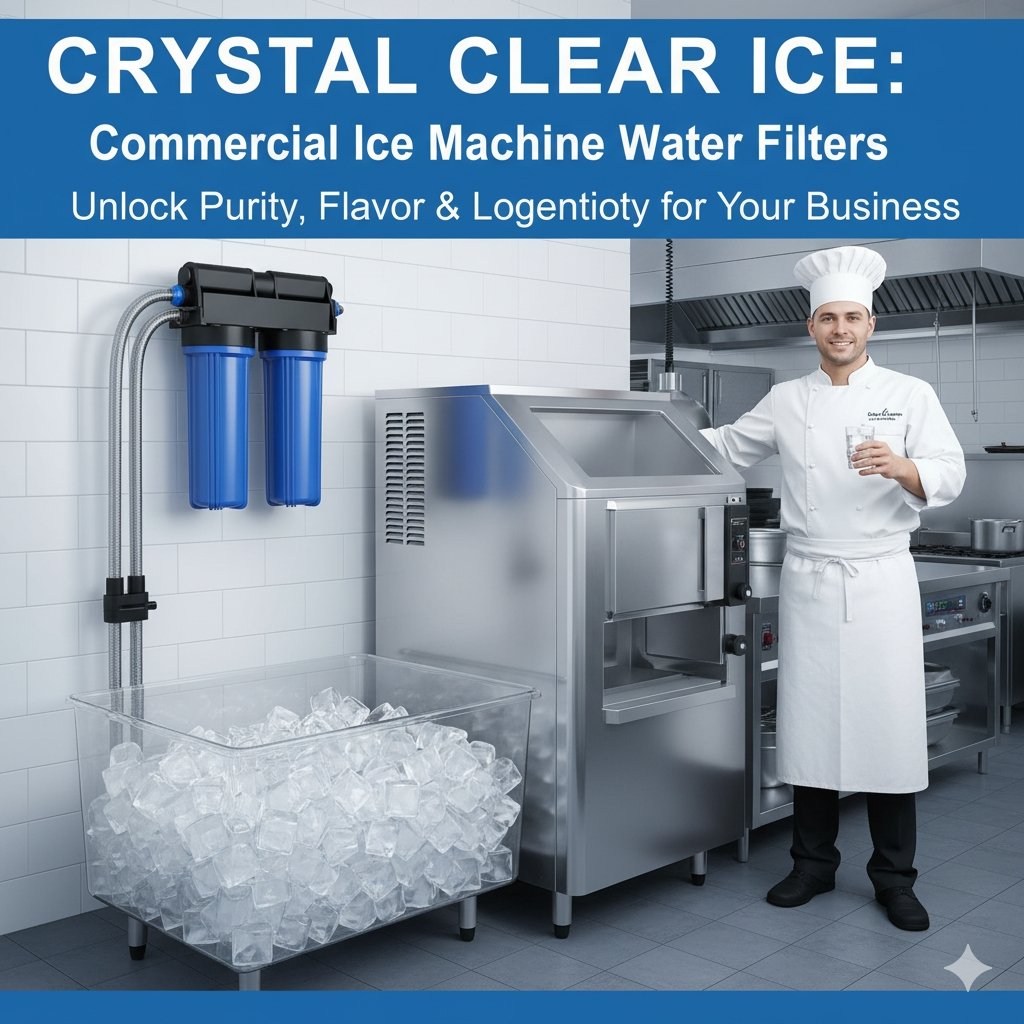
When you search best water filter for commercial ice machine, you’re looking for more than “taste improvement.” Commercial ice machines are precision pieces of equipment: poor source water shortens life, causes scale and biological growth, reduces production, raises maintenance costs, and — worst of all — risks food-safety problems and unhappy customers. This long-form article explains everything operators, purchasing managers and head chefs need to know: which contaminants matter, the filtration technologies that work, how to size for continuous ice production, plumbing and installation considerations, maintenance schedules, troubleshooting, and a checklist to choose the right system for your kitchen or bar. When you’re ready to review commercial-grade systems and accessories, see a vetted POE/whole-house solution for businesses here: https://yourwatergood.com/product/whole-house-water-filtration-system-for-business/.
Read straight through or jump to the sections you need — by the end you’ll know how to pick the best water filter for commercial ice machine and how to keep it working reliably for years.
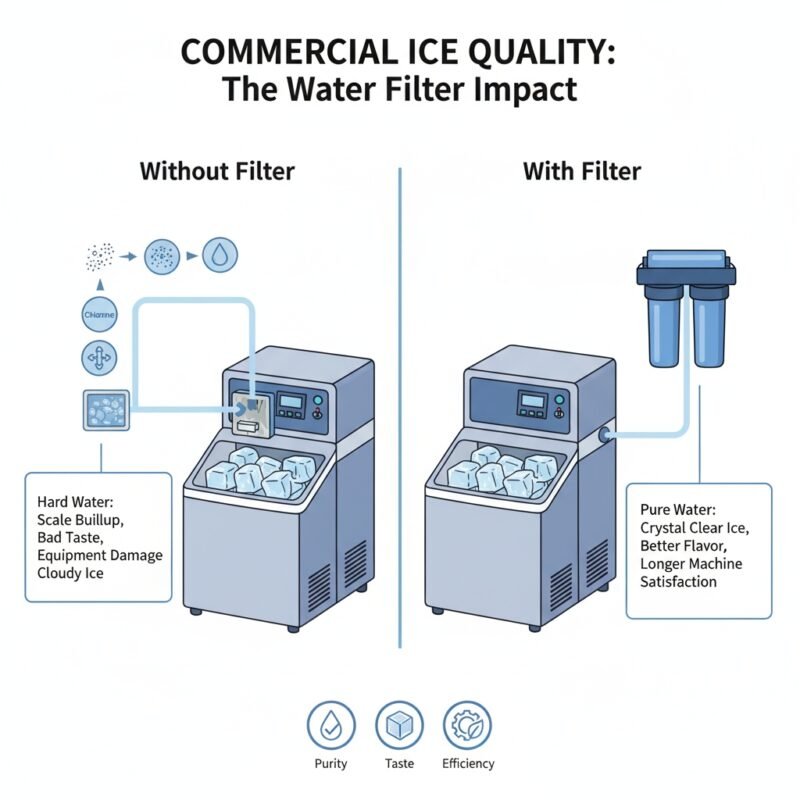
1. Why water quality matters for commercial ice machines
Ice might look like “just frozen water,” but in foodservice it’s a product that touches drinks and food and enters mouths directly. For commercial ice machines, source water affects:
- Scale and mineral buildup: Hardness minerals (calcium and magnesium) precipitate on evaporator plates and in distribution components. Scale reduces heat transfer, slows production, and increases energy use.
- Limescale flake contamination: Descaled particles can get into ice, affecting appearance and mouthfeel.
- Biofilm and microbial growth: Carbon beds or neglected filters can become breeding grounds for bacteria if not sized, installed and maintained properly. Ice machines with poor sanitation histories are health code risks.
- Taste and odor: Chlorine or sulfurous tastes and smells are retained in ice, harming beverage quality.
- Equipment corrosion and premature failure: High dissolved solids (TDS), chlorides or aggressive pH can corrode internal parts.
- Clogging and reduced flow: Sediment, rust and particulate can clog distribution lines and nozzles, reducing output.
A properly specified, installed and maintained filtration system protects equipment, ensures ice clarity and taste, reduces downtime, and lowers total cost of ownership. The question is: which technologies deliver those outcomes reliably and cost-effectively?
2. Key contaminants to control for ice machine performance and safety
Not all water problems are equally important. Focus your attention on the contaminants that damage ice machines or compromise ice quality:
- Hardness (calcium & magnesium): Primary driver of scale. Hardness is expressed in grains per gallon (gpg) or mg/L (ppm). Even moderate hardness will cause scale over time.
- Total Dissolved Solids (TDS): High TDS often means more mineral residue and reduced ice clarity. RO lowers TDS dramatically.
- Iron & manganese: Cause discoloration, staining, small particulate and onboard fouling.
- Chlorine & chloramines: Affect taste and can degrade seal materials; chloramines are harder to remove than free chlorine.
- Sediment / turbidity / rust: Clog nozzles, interfere with sensors and cause abrasive wear.
- Microbial contamination: Coliform and heterotrophic bacteria can colonize surfaces, especially when combined with organic carbon from poorly maintained carbon filters.
- Silica and other scale-forming anions: Silica and carbonate hardness can create hard-to-remove deposits.
- pH extremes and aggressive water: Can accelerate corrosion of components.
Start with a certified water test showing hardness, TDS, iron, chlorine/chloramines, turbidity, pH, and microbial screening (for wells or suspect systems). That drives what you must remove and how hard you need to work to protect your machine.
3. Filtration technologies and how they apply to ice machines
Here are the most commonly used and effective filtration technologies for commercial ice machines, with pros and cons.
3.1 Sediment filtration (pre-filtration)
What it removes: Sand, rust, particulate, and large debris.
Why it matters: Protects downstream media and machine nozzles from clogging and abrasion.
Typical configuration: 5–20 micron spun polypropylene or pleated cartridges upstream of all other treatment. Change frequency depends on turbidity and loading.
Recommendation: Always install at least a 5 µm sediment prefilter; for dirty sources step down to 1–5 µm as needed.
3.2 Activated carbon (GAC) & carbon block
What it removes: Free chlorine, taste and odor compounds, residual organics. Catalytic carbon can reduce chloramines if sized properly.
Why it matters: Removes residual disinfectants that affect flavor and can break down machine internals or membranes; also protects RO membranes when present.
Typical configuration: POE carbon vessel or inline carbon post-prefiltration.
Caveat: Carbon beds can support bacterial growth if left stagnant or undersized; when used, ensure good contact time and regular replacement/regeneration per manufacturer guidance.
3.3 Water softeners (ion exchange)
What they remove: Calcium and magnesium hardness ions.
Why it matters: Prevents scale formation; soft water dramatically reduces descaling frequency and protects heat exchange surfaces.
Typical configuration: POE salt-based softener sized for daily flow and hardness load.
Caveat: Softened water increases sodium content and does not reduce TDS significantly. For some applications, softened water alone isn’t enough to achieve crystal-clear ice.
3.4 Template-assisted crystallization (TAC) / salt-free conditioners
What they do: Alter the behavior of hardness minerals to reduce scale formation (they don’t remove hardness).
Why it matters: Useful where discharge of brine is restricted or where softener salt is undesirable. Performance varies by water chemistry; not a drop-in replacement where very hard water or heavy scaling exists.
Recommendation: Use cautiously and validate performance in your water matrix.
3.5 Reverse osmosis (RO)
What it removes: Dissolved salts (most TDS), many organics, PFAS in many cases (combined with activated carbon), nitrates, heavy metals, and reduces silica and color.
Why it matters: RO produces low-TDS water that yields clearer, purer ice, reduces scale dramatically, and reduces corrosion risk. For premium ice (clear, slow-melting), RO is often the gold standard.
Typical configuration: Under-counter or central RO skid feeding the ice machine (often with a booster pump and storage tank for continuous demand).
Caveat: RO consumes water (reject stream) and requires pretreatment (sediment & carbon) to protect the membrane. RO systems require regular maintenance (membranes, pre-filter cartridges). Also higher upfront cost and footprint.
3.6 Ultrafiltration (UF)
What it removes: Particulates, bacteria, and larger organics; UF does not remove most dissolved salts.
Why it matters: For microbial control, UF can be useful with low turbidity feedwater; often used for well service.
Caveat: UF is not a replacement for demineralization or softening where scale is an issue.
3.7 UV disinfection
What it removes: Inactivates microbes (bacteria, viruses, protozoa) but does not filter particles or reduce chemicals.
Why it matters: Helpful for well water or post-treatment disinfection. Must follow good filtration to keep turbidity low; can’t be used alone for scale control or taste.
Caveat: UV lamps require periodic replacement; quartz sleeves require cleaning.
3.8 Combination systems and skid-based POE solutions
In commercial kitchens, the best approach is often a staged system: sediment → carbon → softener or TAC → RO → post-carbon (or RO with remineralizer where desired). For high-volume operations, use a commercial RO skid with dedicated storage and high-flow capability.
4. Which technology is the “best”? Matching solution to your business case
There is no single universal “best.” The correct system depends on the water test and the ice quality target.
- Primary objective: prevent scale and reduce maintenance cost. Use a properly sized salt-based softener POE. Add sediment and carbon prefilters to protect the softener and improve taste. For many operations this keeps scale manageable and extends machine life.
- Primary objective: highest clarity, best-tasting ice for premium beverages. A POU or POE RO system (with proper pretreatment) produces the purest ice and is preferred by high-end bars and craft beverage outlets. Many choose a small RO dedicated to the ice machine or per-drink tap to avoid whole-building RO costs.
- Primary objective: microbial safety (well water). Sediment → carbon → UV or UF plus routine monitoring and sanitation protects against microbial risks.
- Limited footprint and water-saving required. Consider TAC + carbon for simpler maintenance; validate performance with your water.
- Hybrid approach (most practical): Sediment → carbon → softener for equipment protection, then RO for ice if clarity/taste is mission-critical. This balances cost, water efficiency, and equipment protection.
5. How to size a filtration system for a commercial ice machine
Sizing matters — undersized systems fail fast and reduce return on investment.
Step A — Calculate continuous and peak ice production needs
- Determine your ice machine capacity (lbs of ice produced per 24 hours). Commercial machines may range from 100 to 2,000+ lbs/day.
- Convert to water demand: about 1 gallon of water makes ~8–10 lbs of ice (machine design varies). Use the manufacturer’s conversion. Example: a 500 lb/day machine needs roughly 50–65 gallons/day.
- Assess peak hourly draw — if your machine runs continuously, estimate gallons per hour. For a busy bar with multiple machines or simultaneous use, scale accordingly.
Step B — Match filtration flow & storage
- RO systems: size membranes and pumps for your daily and peak demand. For continuous production, a storage tank or high-recovery RO skid with sufficient permeate flow and pressure is required. An RO system that produces only a fraction of machine demand without storage will starve production.
- Softener & carbon: size service flow (GPM) to match maximum expected water draw (including cleaning, dishwashing, and other appliances that may run concurrently). A typical single ice machine has modest flow requirements, but if the softener protects multiple devices size for combined flow.
Step C — Account for recovery and wastewater (if using RO)
- RO recovery can be as low as 20–50% for small systems without a permeate pump. For each gallon of permeate, multiple gallons may be rejected. Factor this into supply and local water cost calculations or consider systems with permeate pumps to improve recovery.
Step D — Plan for backwash & regeneration flows
- Softener regeneration and backwashing for media tanks require temporary high-flow waste drains. Ensure your drain can handle these pulses and that your plumbing permits such discharge.
Example sizing scenario
- Ice machine: 1,000 lb/day → ~100–125 gallons/day.
- RO: choose membrane array to produce ~125–150 gpd with a storage tank for buffer and a booster pump to maintain pressure. Include 5–10 gpm service flow for cleaning tasks and redundancy.
Work with your ice machine manufacturer and water-treatment vendor to confirm precise flow and storage needs — they know compatibility and warranty considerations.
6. Installation considerations: plumbing, materials, and placement
Proper installation ensures the system protects the ice machine and stays serviceable.
- Location: place filtration near the ice machine inlet, but accessible for cartridge changes and media service. Avoid freezing environments.
- Materials: use food-grade materials for wetted components (food-grade plastics, stainless steel fittings where required). Avoid copper where corrosion or dissolved oxygen can cause issues unless manufacturer allows it.
- Bypass valves & isolation: include a bypass or shutoff valves to isolate the filtration system for service without shutting down the entire ice operation.
- Pressure & backflow protection: install pressure regulators and backflow preventers to protect equipment and comply with codes.
- Drain sizing: softeners and RO systems need appropriate drains for brine and reject water. Confirm code compliance.
- Sample taps & monitoring: install sampling points (before and after treatment) to allow quick water quality checks (TDS, chlorine).
- Electrical & safety: UV and RO pumps require safe wiring and GFCI protection.
- Sanitation access: ensure the ice machine and filtration system are accessible for routine cleaning and sanitation cycles.
Always use licensed plumbers and follow local regulations; many manufacturers’ warranties require professional installation.
7. Maintenance schedule: what to change and how often
A strong maintenance discipline prevents contamination and equipment failure.
Typical schedule (general guidance)
- Daily / weekly: Check upstream water clarity; inspect for leaks.
- Monthly: Visual inspection of housings; check pressure gauges and monitor for ΔP increase.
- Every 3 months: Replace sediment prefilter (or sooner if turbidity requires).
- Every 6 months: Replace carbon prefilters (or per manufacturer gallons rating); inspect softener salt level and cleanliness.
- Annually: Service RO membrane prefilters; sanitize RO storage tanks and ice machine per manufacturer recommendations; replace UV lamp if used (often annually).
- Every 2–5 years: Replace RO membranes depending on feedwater and TDS drift; replace softener resin if performance declines dramatically.
- Ongoing: Monitor TDS and taste/odor; schedule immediate service if ice clarity dulls, production falls, or off-tastes appear.
Document every service: date, part replaced, water tests. Consider a service contract with a water-treatment vendor to ensure scheduled maintenance and fast emergency response.
8. Hygiene & biofilm prevention — critical for ice machines
Ice machines are at risk of biofilm formation, especially where filters are neglected.
- Avoid stagnant water: design piping so treated water flows regularly through the machine. Stagnant water in a carbon bed or storage tank can foster growth.
- Sanitize regularly: both the ice machine and associated storage lines need scheduled cleaning with manufacturer-approved sanitizers. Follow strict protocols for drain and bin cleaning.
- Change carbon & storage sanitation per schedule: carbon that is stale or saturated may release organics that feed bacteria — timely replacement is vital.
- Consider point-of-use UV sterilization: place a small UV reactor inline immediately before the ice machine if microbial risk is a concern (after adequate filtration).
- Use food-safe sanitizers and follow manufacturer guidance to avoid damage to components.
Hygiene is as important as scale control — both determine ice safety and quality.
9. Troubleshooting common ice problems and their likely water treatment causes
- White, cloudy ice or rapid melting: often high TDS, dissolved gases, or tiny particulate. Solution: RO water or improved degassing; check feed TDS and aeration.
- Flecked or dirty ice: sediment or rust — improve sediment prefiltration and check upstream piping.
- Scale on evaporator or rails: hard water — install or service softener or scale control system.
- Off-taste or chlorine smell in ice: carbon exhaustion or insufficient carbon contact time — replace carbon and increase bed size or contact time. Catalytic carbon if chloramines present.
- Low production: clogged distribution, fouled evaporator, or pressure issues. Inspect filters for ΔP; clean machine per manual.
- Biofilm / slime in bin: sanitation lapse, stagnant water, or contaminated water — sanitize bin and evaluate upstream carbon and storage tank maintenance.
Root-cause diagnosis always starts with water testing and inspection of filters and the machine. Don’t chase symptoms with random fixes — test first.
10. Budgeting and total cost of ownership (TCO)
When selecting the best water filter for commercial ice machine, evaluate TCO, not just purchase price.
- Upfront costs: equipment, installation, possible plumbing or electrical upgrades.
- Operating costs: filter cartridges, softener salt, membrane replacement, UV lamps, water cost for RO reject.
- Service costs: scheduled maintenance, emergency calls, downtime.
- Energy costs: poorly performing systems that cause scale increase machine energy consumption.
- Replacement & downtime costs: lost revenue during repairs.
Example: a modest under-counter RO with prefilters and a small storage tank might cost $2,000 installed, with annual consumables of $300–$600. A full POE softener + carbon stack may cost $3,000–$6,000 installed with lower annual consumables but requires brine handling.
Calculate 3- to 5-year TCO and compare the cost of faster failure or more frequent descaling if you under-spec treatment.
11. Decision checklist — choose the best water filter for commercial ice machine
Use this checklist when comparing vendors and systems:
- Water test first: provide the lab report to vendors.
- Define the goal: clarity/taste vs scale prevention vs microbial control.
- Recommended primary tech: softener for scale; RO for clarity; sediment + carbon baseline for all.
- Sizing: verify GPM and daily production matching.
- Pretreatment: sediment (≤5 µm) and carbon before any RO membrane.
- Installation: professional installer, bypass valve, backflow prevention, sampling ports.
- Maintenance plan: scheduled replacements, documented service log, and emergency SLA.
- Hygiene plan: machine sanitation schedule and storage tank sanitizing.
- TCO analysis: 3–5 year comparison including water waste, consumables, and service.
- Certifications & warranties: NSF/ANSI or manufacturer-backed performance claims; warranty terms and conditions.
If you want an example commercial package that fits many small businesses, review a POE/whole-house offering designed specifically for business use here: https://yourwatergood.com/product/whole-house-water-filtration-system-for-business/.
12. Final recommendations and next steps
- Start with a certified water test. Don’t guess.
- For scale-first problems choose a well-sized softener plus sediment and carbon.
- For premium clarity and taste, choose properly pretreated RO with storage and a booster pump.
- For well water or microbial concerns, combine UF/UV with strict sanitation routines and prefiltration.
- Always size systems for peak demand, include a bypass, and ensure easy access for maintenance.
- Document and follow a maintenance schedule; neglected filters are the largest cause of ice-machine problems.
- When in doubt, choose a vendor who provides itemized proposals, local service, and a clear maintenance plan.
Choosing the best water filter for commercial ice machine is an investment in product quality, machine uptime and customer satisfaction. If you’d like, gather your water test results and your machine model/specs and I’ll help translate them into a concrete spec sheet you can send to water-treatment vendors. For a ready-built business solution to evaluate, see https://yourwatergood.com/product/whole-house-water-filtration-system-for-business/ — it’s a practical starting point for many foodservice operators.