
Choosing the Right city water filtration system: a practical, homeowner-friendly blueprint

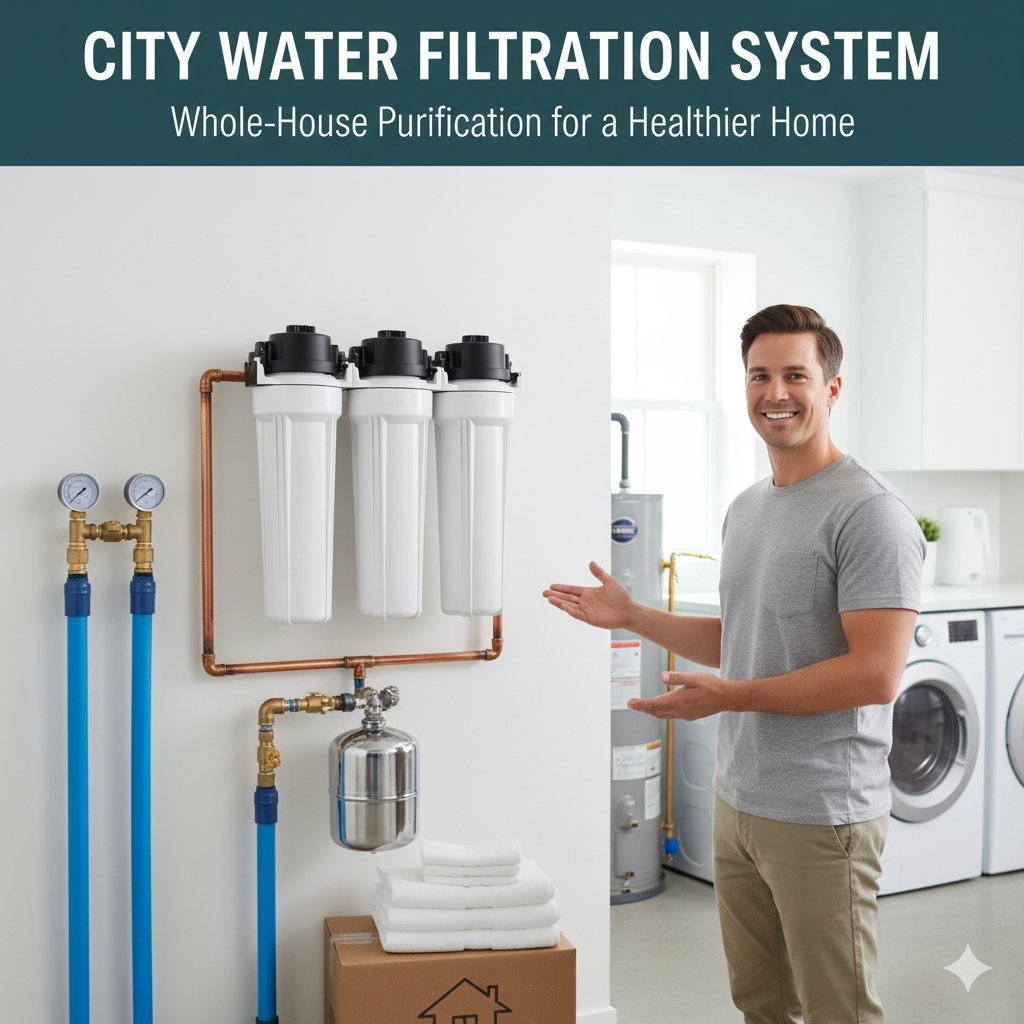
Municipal water utilities do an essential job making water safe at scale, but “safe” doesn’t always equal “perfect” for every household use. Even treated city water can carry chlorine taste, pipe-born sediment, dissolved minerals that cause scale, occasional discolored water after mains work, and in some places trace contaminants that concern homeowners. That’s where a well-chosen city water filtration system comes in — it can protect appliances, improve taste and odor, lower maintenance headaches, and give you confidence that the water reaching your taps meets your priorities.
This article is a start-to-finish, practical guide for homeowners who want to evaluate, choose, install, and maintain an effective city water filtration system. I’ll explain what municipal water commonly contains, how to test and interpret results, which filtration technologies solve which problems, realistic sizing and installation advice, maintenance rules that keep systems working, budgeting and cost trade-offs, and a vendor checklist to get apples-to-apples quotes. Where useful I include short decision rules so you can act immediately.
If you want to compare a concrete product when you shop or ask for quotes, use this example whole-house unit as a baseline for specs and consumable pricing: https://yourwatergood.com/product/whole-house-water-filtration-system-for-home/.
Why city water sometimes needs extra treatment
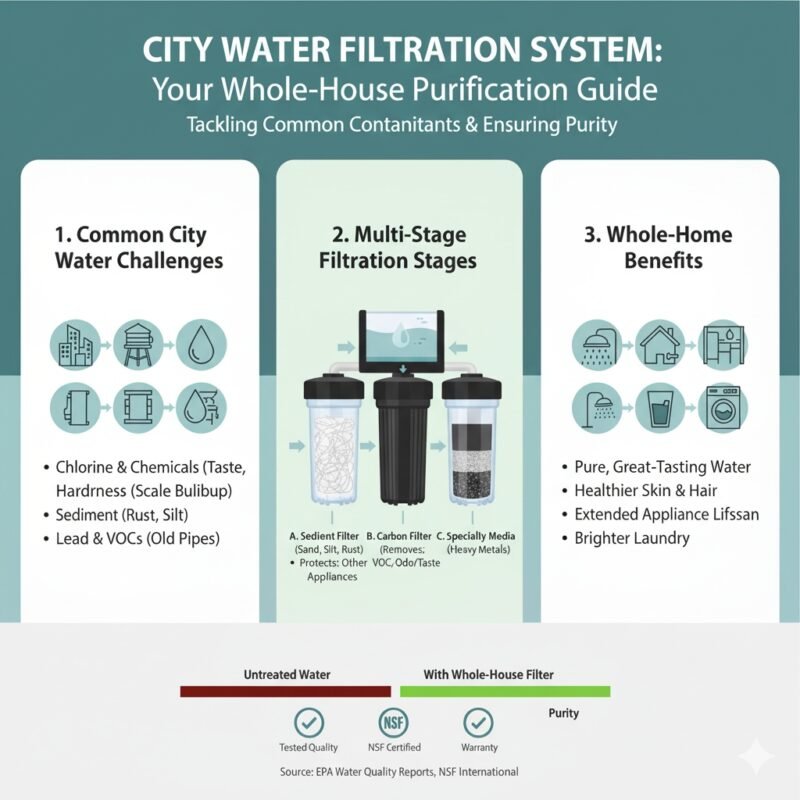
City water is regulated and monitored for public health, but several practical issues still lead homeowners to install a city water filtration system:
- Disinfectant residuals (chlorine or chloramine): utilities add disinfectants to keep the distribution system sanitary. These chemicals preserve safety but can produce taste and odor that many people dislike.
- Pipe and distribution particulate: aging mains and household plumbing can shed rust, scale flakes and sand that clog aerators and stain laundry.
- Hardness and minerals: dissolved calcium and magnesium (hardness) cause scale on heaters and fixtures, reduce soap effectiveness, and increase energy use.
- Trace contaminants: PFAS, lead (from old home plumbing), nitrates or pesticides appear regionally and sometimes at low concentrations that homeowners want reduced further.
- Aesthetic issues or episodic spikes: after maintenance, main breaks, or storms, turbidity or temporary contaminants can produce cloudy or discolored water.
A city water filtration system is not a reflexive “fix everything” device — it’s a targeted tool. The right system depends on what the water actually contains and what your household cares about (taste, scale prevention, crystal-clear ice, removing a specific contaminant, etc.).
Step 1 — Get the data: water tests and your utility report
You can’t choose a solution until you know the problem. Start with two pieces of information:
- Consumer Confidence Report (CCR): your utility publishes an annual CCR showing regulated contaminants, typical levels, and whether any limits were exceeded. The CCR is a starting point but averages can hide local issues.
- Home water test (inlet and tap): get a lab or professional test that includes at minimum: TDS, hardness (as CaCO₃), pH, free chlorine (and total chlorine/chloramine if possible), iron, turbidity (NTU), and lead if your home is older. If you suspect PFAS or other niche contaminants in your area, request targeted tests. A single sample taken at the inlet and at a kitchen tap helps you see what changes between supply and point-of-use.
Interpretation tips:
- If chlorine is the main issue and everything else looks normal, a carbon-based city water filtration system will likely solve taste and odor.
- If hardness is above ~7 gpg (grains per gallon) and you notice scale, plan a softening solution.
- If lead shows up or you have pre-1986 plumbing, focus on certified lead-reduction POU devices or replace plumbing.
- If turbidity spikes at certain times, staged sediment filtration or backwashing media can help.
- If PFAS are present, you’ll need specialized adsorbents or point-of-use RO with verified performance for the specific PFAS species found.
Types of systems: point-of-entry (POE) vs point-of-use (POU)
A key design choice is whether to treat all water entering your home (POE / whole-house) or only water at specific taps (POU).
- Point-of-Entry (POE) / Whole-house systems treat water at the main cold-water inlet so all fixtures and appliances receive treated water. POE is best for sediment control, chlorine removal throughout the house, and scale control (softeners). It protects water heaters, washing machines, dishwashers and showers. If your primary goals include appliance protection and house-wide taste improvement, a POE city water filtration system is often the right choice.
- Point-of-Use (POU) devices sit at the faucet or appliance (under-sink RO, inline fridge filters, countertop cartridges). Use POU when you want exceptional drinking or cooking water quality (low TDS, PFAS removal, or lead reduction) but don’t need the expense of whole-house RO. POU is also common for ice machines, espresso machines and beverage stations.
Common filtration technologies and when to use them
Below are the major technologies you’ll encounter and the specific problems each addresses.
Sediment filters (PP, pleated)
Purpose: remove sand, rust, silt and visible particulates.
Use in: first stage of any city water filtration system (POE or POU) to protect downstream cartridges and equipment. Choose micron rating based on your feed: 50–20 µm for coarse debris, 5–10 µm for rust, 1–5 µm for delicate downstream equipment.
Activated carbon (block or GAC)
Purpose: remove free chlorine, taste & odor, many organics and some VOCs.
Use in: typical city water systems where chlorine taste is primary complaint. Carbon blocks provide consistent flow and particulate reduction; packed carbon vessels offer much higher capacity for whole-house removal or chloramine (if using catalytic carbon).
Catalytic carbon
Purpose: specialized carbon designed to remove chloramine (harder to adsorb than free chlorine).
Use in: when your utility uses chloramine. Standard carbon is often insufficient for chloramine.
Water softeners (ion exchange) & salt-free conditioners (TAC)
Purpose: remove hardness (Ca, Mg) via ion-exchange softeners. Salt-free alternatives (Template Assisted Crystallization — TAC) reduce scale but perform differently; choose based on local regulations about brine discharge and desired results.
Use in: homes with scale problems (appliances, heaters).
Reverse osmosis (RO)
Purpose: remove dissolved salts (TDS), PFAS, fluoride, nitrates and many dissolved contaminants.
Use in: POU for drinking/ice where low TDS or PFAS/lead removal is needed. Whole-house RO is rarely practical due to cost, waste flow and complexity.
Ultrafiltration (UF) / Microfiltration (MF)
Purpose: physical removal of bacteria and particulates (not dissolved salts).
Use in: when microbial control is needed without RO; must be preceded by sediment filtration.
UV disinfection
Purpose: inactivates bacteria and viruses (no chemical residual).
Use in: well water or if microbiological concerns arise; install after sediment/UF pretreatment.
KDF / catalytic media, specialty adsorbents
Purpose: KDF for chlorine/chloramines and heavy metals; specialty media for lead, arsenic, PFAS—often in cartridge or packed-bed form.
Use in: targeted contaminant reduction where test results show specific needs.
How to design a practical city water filtration system
- Define goals clearly. Example goals: remove chlorine at all taps; protect water heater and coffee machine; provide PFAS-free drinking water. Rank them.
- Choose POE vs POU by goal. For housewide chlorine and sediment control, choose POE. For low-TDS drinking water or PFAS reduction, choose POU RO at the kitchen sink while maintaining POE prefiltration.
- Stage correctly. Good rule: sediment → carbon → specialty media / softener / UV (if used). Always put sediment first to protect adsorbents and membranes.
- Size for flow and capacity. Design the POE city water filtration system to handle peak household flow (add 25–30% margin). For carbon beds, choose bed volume and contact time appropriate for the contaminant (chloramine needs longer contact time than free chlorine).
- Plan for maintenance access and bypass. Install a full bypass valve so you can service the system without shutting water to the house. Choose housings and vessel placements with service clearances.
Sizing: peak flow and media life
Sizing has two parts: flow capability (GPM) and media capacity (gallons or months).
- Calculate peak flow (GPM): tally likely simultaneous uses during peak times (two showers, dishwasher, washing machine, kitchen faucet) to estimate worst-case flow; add a safety margin. Typical family peaks often land in the 8–15 GPM range — design accordingly.
- Choose components rated for that flow with acceptable pressure drop (ΔP). Cartridge housings have rated flow curves; packed vessels are preferred for higher flows with lower ΔP.
- Estimate media life: many cartridges list rated gallons for target contaminants. Convert to calendar life using your household gallons-per-day. Example: carbon rated for 100,000 gallons at given challenge and your home uses 400 gpd → ~250 days life; plan replacement earlier (70–80% of rated) for safety.
Installation considerations and code points
- Location: install POE on the incoming cold-water line after the meter. Avoid hot-water installation for POE unless system is rated for it.
- Bypass & isolation valves: necessary so you can service without interrupting supply.
- Backflow prevention & permits: many jurisdictions require testable backflow prevention, especially if your system includes pumps or chemical treatment. Check local codes.
- Drainage for backwash/regeneration: water softeners and backwashing media need permitted drain connections. Don’t discharge brine or RO reject to storm drains.
- Electrical for UV/pumps: must be installed by a qualified electrician with GFCI protection where required.
- Manufacturer instructions and warranty: follow installation guidelines; some warranties require licensed installers.
Maintenance: the schedule that keeps water excellent
Maintenance is the make-or-break element. A well-maintained system performs reliably; a neglected one fails quietly.
General maintenance rules:
- Sediment cartridges: inspect or replace every 3–12 months depending on turbidity.
- Carbon cartridges: replace every 6–12 months for small cartridges; packed carbon vessels may last 1–3 years before media exchange. For chloramine, expect shorter lifetimes.
- Softener resin: salt replenishment as required (monthly-ish) and periodic servicing; resin replacement is rare (years).
- RO membranes: 2–5 years depending on pretreatment and feedwater; monitor TDS on permeate for performance.
- UV lamp: replace annually; clean quartz sleeve as required.
- Pressure gauges and ΔP monitoring: install inlet/outlet gauges to watch for rising ΔP — it’s an objective early warning of clogging.
Recordkeeping: label housings with install dates, keep a service log, and set calendar reminders. If your warranty requires professional maintenance, keep invoices.
Costs and budgeting
Costs vary widely based on configuration:
- Basic POE (sediment + two-stage carbon cartridges in 20″ housings): equipment $300–$1,000, install $200–$800, annual consumables $100–$300.
- Packed carbon vessel POE: $1,200–$3,500 installed depending on vessel size and media.
- POE + softener: $1,500–$4,500 installed.
- POU RO (under-sink) for drinking water: $300–$1,500 installed depending on features.
- Service contracts: $100–$400/year typical for proactive maintenance.
Think in multi-year TCO terms (equipment + installation + consumables + service) rather than just upfront cost. Bigger, properly sized components often lower 3–5 year TCO.
Performance verification — how to know it’s working
- Before/after sampling: commission the system with pre/post sampling for key parameters (chlorine, turbidity, TDS for RO). Keep the report.
- Simple checks: taste/odor, no visible sediment, consistent pressure.
- Instrumented monitoring: differential pressure switches, TDS monitors (for RO), and chlorine sensors where necessary provide early warnings and allow planned maintenance.
Common pitfalls and how to avoid them
- Undersizing for peak flow → pressure loss and unhappy showers. Design with margin.
- Using standard carbon with chloramine → poor chloramine control; use catalytic carbon or deeper beds.
- Skipping sediment prefiltration → rapid carbon/membrane fouling.
- Ignoring maintenance → exhausted media can become a hygiene or taste problem. Label housings and schedule changes.
- DIY without checking codes → permit or backflow issues; consult local codes and a licensed plumber if unsure.
A practical buyer’s checklist
When you solicit quotes or evaluate products, ask suppliers for:
- Exact component model numbers and datasheets (flow vs ΔP curves).
- Certification copies for any health-related claims (NSF/ANSI 42, 53, 58 as appropriate).
- Expected media life in gallons and months for your test conditions.
- Itemized installation quote (equipment, labor, bypass, gauges, permits).
- Consumable SKUs and 3-year pricing.
- Commissioning plan: pre/post tests and acceptance criteria.
- Warranty and service terms.
- Local references or installers who have worked on similar homes.
Real-world examples: three common homeowner setups
- Taste and particulate improvement (most city homes): POE 20″ coarse sediment → 20″ carbon block. Good for chlorine taste and visible particles. Low maintenance and moderate cost.
- Chloramine and taste (utility uses chloramine): POE sediment → packed catalytic carbon vessel sized for EBCT; POU RO for kitchen if desired. Catalytic carbon handles chloramine better than standard block carbon.
- Scale prevention + chlorine (hard water + taste): POE sediment → carbon → softener (duplex for continuous service if needed). Protects appliances and improves taste across the home.
Conclusion — pick solutions based on tests, priorities and realistic maintenance
A city water filtration system is a pragmatic, cost-effective way to tailor municipal water to your household’s needs — whether your goal is better-tasting water, protecting appliances from sediment and scale, or removing specific trace contaminants. The single most important step is to base your decision on data: get your utility CCR and a targeted water test. From there, choose POE for house-wide protection and POUs for high-quality drinking water or special appliances. Size systems for peak flow, stage them correctly (sediment → carbon → specialty), and commit to routine maintenance — that combination delivers predictable performance and keeps your water tasting and working the way you expect.
If you want a practical next step, collect your CCR and a one-page lab test (inlet & kitchen tap) and I’ll convert them into a concise spec you can send to local vendors: suggested POE/POU configuration, recommended flow rating, expected consumable schedule, and a short vendor scoring matrix so you get apples-to-apples quotes. And if you want a baseline product to compare real-world specs and consumable costs, consider reviewing a representative whole-house unit here: https://yourwatergood.com/product/whole-house-water-filtration-system-for-home/.