Commercial Water Purification Machine Supplier: What Plant Engineers Should Verify Before Sourcing

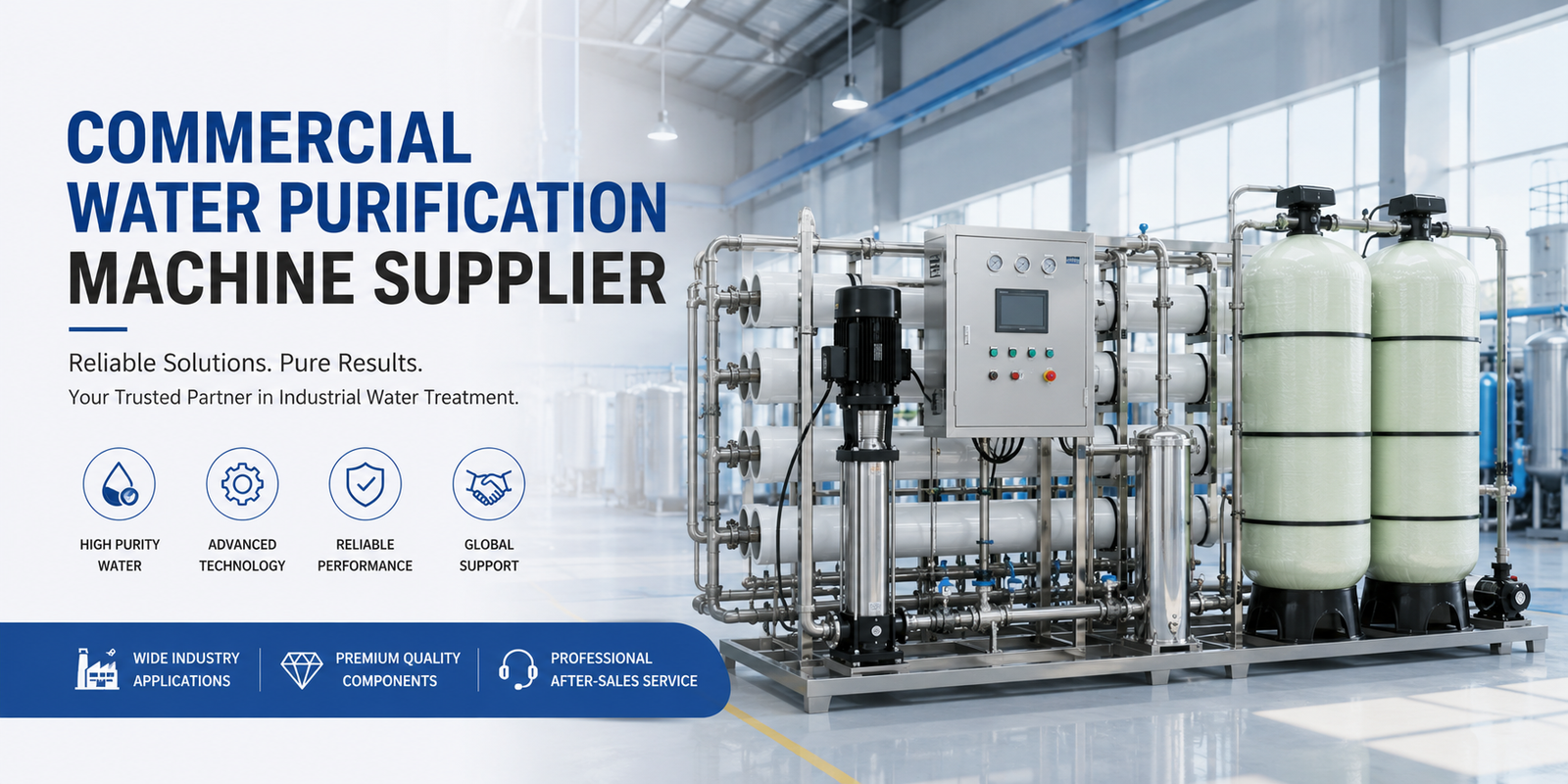
Raw water variability — a TDS spike after a storm, a well running higher in iron and silica than last quarter’s test — is a direct threat to continuous production. A commercial water purification machine supplier either engineers around that variability or your process water quality drifts with the seasons.
Before evaluating a supplier or sizing a system, lock down these:
- Continuous duty cycle capacity — rated for 24/7 operation, not intermittent commercial use
- Pretreatment train depth — how many stages stand between raw feed and the membrane
- Documented salt rejection data — actual TDS-in/TDS-out numbers, not a rounded percentage
- Real-time PSI and flow monitoring — the difference between predictive maintenance and a surprise shutdown
- Concentrate discharge engineering — how the reject stream is piped matters as much as how the permeate is
Fast Check Product: https://yourwatergood.com/product/industrial-reverse-osmosis-system/
Matching Capacity to Continuous Production Load
Industrial RO capacity is typically quoted in tonnes per hour (T/H), which converts roughly to:
- 1 T/H ≈ 4.4 GPM — small laboratory or pilot-scale process water demand
- 10 T/H ≈ 44 GPM — large-scale chemical or food/beverage production line
A supplier offering scalable configurations across that 1–10 T/H range (roughly 4.4–44 GPM) is sizing to a facility’s real production load rather than pushing a single fixed-capacity unit. Undersizing here doesn’t just limit throughput — it forces the membrane array to run at sustained peak flux, which is the fastest path to premature fouling.
Storage integration matters too. Pairing the RO output with purified water or pressure tanks lets the system produce at a steady, sustainable rate while still covering short-duration peak draw — the same buffering logic that protects the membrane also protects your uptime.
Duty cycle is the number most sizing conversations skip. A system rated for intermittent commercial service and one rated for 24/7 continuous operation can carry the same nameplate GPM and still perform very differently over a production year. Continuous-duty sizing accounts for sustained membrane flux, not a burst rating — ask specifically whether the quoted capacity is a continuous or intermittent figure before it goes into a capital budget.
Engineering the Pretreatment Train for Variable Feed Water
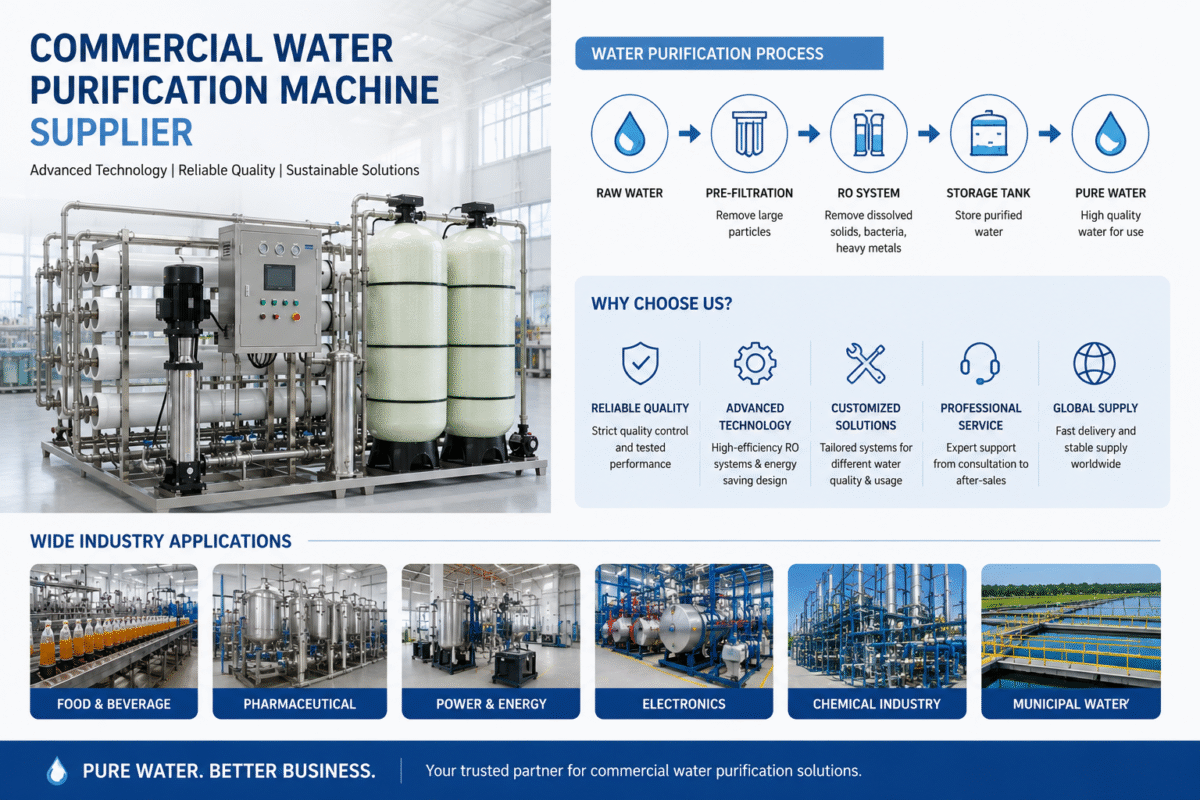
A single-stage system fed directly into an RO membrane is a maintenance plan, not an engineering design. A properly specified industrial system runs feed water through a five-stage sequence before it ever reaches the membrane:
- Multimedia filtration — intercepts sediment, rust, and suspended solids
- Activated carbon filtration — adsorbs residual chlorine and organics before they oxidize the membrane
- Ion-exchange softening (with a dedicated brine/salt tank) — strips calcium and magnesium before they become scale
- Precision security filtration — a final micron-rated barrier ahead of the RO stage
- RO membrane array — the desalination stage itself
Municipal supply vs. well water changes what that pretreatment train has to do. Municipal feed is mainly a chlorine/chloramine and disinfection-byproduct problem. Deep well water is a different design case entirely — high hardness, elevated iron and manganese, and silica levels that drive a different scaling risk than calcium ever does. A system engineered around municipal assumptions will underperform on a well feed, regardless of membrane quality.
Salt Rejection Performance: What the Numbers Actually Mean
“High rejection rate” is marketing language. TDS-in vs. TDS-out is engineering data.
In documented operation, a properly configured system has taken raw feed water from 1,300 mg/L TDS down to under 20 mg/L in a single-stage configuration — better than 98% rejection — and under 10 mg/L in a two-stage configuration, north of 99% rejection.
Ask any supplier for that same before/after pair, tested on water comparable to your feed source. A rejection percentage with no TDS-in figure attached tells you nothing about how the system performs on your actual water.
Not sure what your feed water will do to that number? Request a Custom Water Analysis Review before you spec a system against assumptions.
Pre-Engineered Skids vs. Fully Customized Turnkey Systems
These are two different purchases, not two tiers of the same product.
| Factor | Pre-Engineered Skid | Fully Customized Turnkey System |
|---|---|---|
| Capacity range | Standard configurations within the 1–10 T/H product line | Engineered to a specific production target, including multi-train builds |
| CAPEX | Lower — standardized components and fabrication | Higher — engineered-to-order design and project management |
| Lead time | Shorter — built from stock configurations | Longer — design, fabrication, and factory testing before shipment |
| Automation & monitoring | Standard automatic backwash/flush cycles with PSI and flow gauges | Automation scope defined by project requirements — confirm PLC/SCADA integration with your engineering team |
| Redundancy | Single train, standard configuration | Multi-train / N+1 redundancy available on request for continuous-process facilities |
If your process can tolerate a planned maintenance window, a pre-engineered skid is usually the faster, lower-CAPEX path. If downtime is not an option — pharmaceutical, semiconductor-adjacent, or continuous food production — the conversation shifts to redundancy and automation scope before it ever gets to price.
There’s also a staffing dimension that rarely makes it into the spec sheet. A single-train skid puts the full maintenance burden on whatever service window your facility can schedule. A multi-train turnkey system lets one train go down for membrane cleaning or cartridge swaps while the others carry the load — which changes how your maintenance team plans labor, not just how the equipment is priced.
Field Engineering Details That Protect Uptime
Two details separate a system that runs for a decade from one that scales up in year two.
Cold feed water changes membrane performance. As water temperature drops — a common issue with well feed in winter, or ground water running near 50°F (10°C) — viscosity increases and membrane flux drops. A system that isn’t designed with temperature correction factored in gets pushed to compensate with higher differential pressure, which accelerates fouling instead of solving the flux loss. Ask any supplier how their sizing accounts for your site’s coldest expected feed temperature, not just the annual average.
The concentrate (reject) discharge line has to stay unobstructed. RO systems are engineered around a specific osmotic balance across the membrane; adding a valve or restriction on the concentrate discharge line disrupts that balance and can push the system outside its designed operating window. It’s a detail that shows up in commissioning notes, not in sales literature — and it’s worth confirming directly with whoever is designing your piping.
Where This Fits: Applications and Regulatory Context
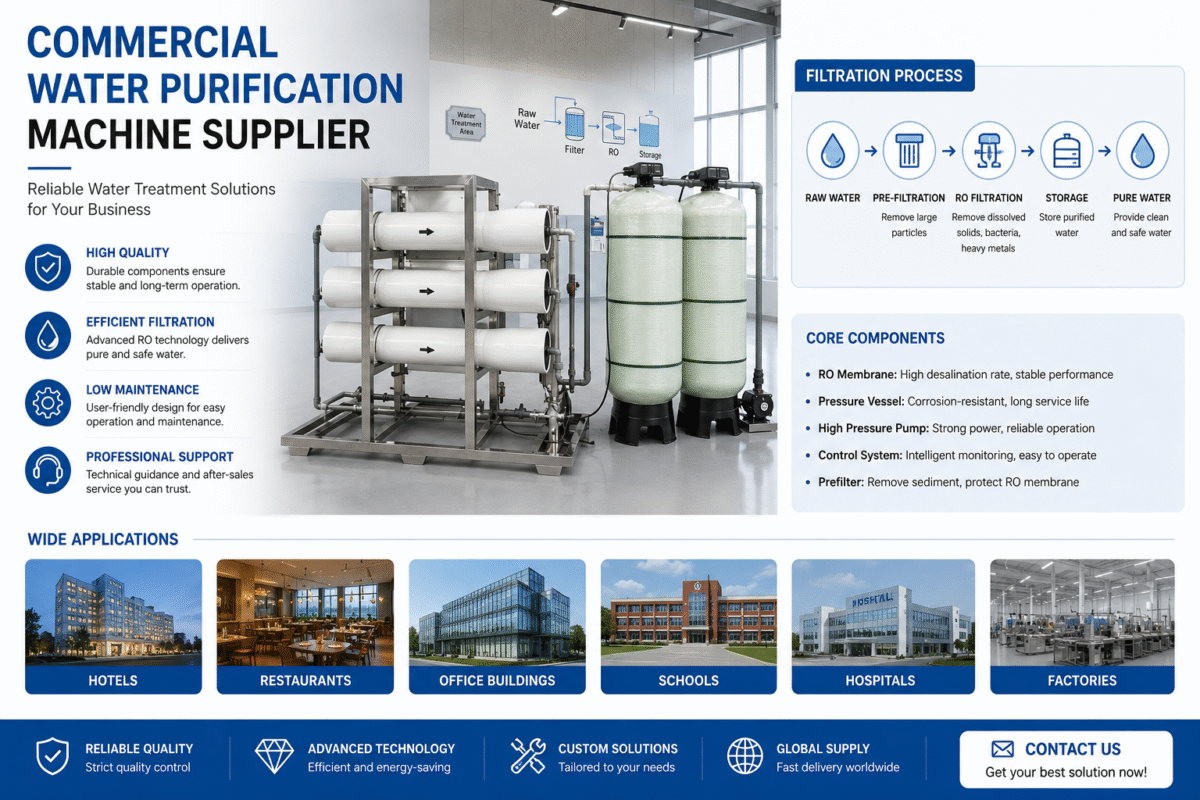
Industrial RO systems in this capacity range are specified across several sectors:
- Food & beverage production — consistent process and ingredient water
- Medical and laboratory use — low-conductivity purified water for testing environments
- Livestock and agriculture — mineral-balanced supply for large-scale operations
- Metal processing — corrosion and mineral-deposit protection for precision machinery
On the regulatory side: the EPA water quality framework sets the baseline municipal supply already has to meet before it reaches your site — it isn’t an equipment certification. If your application is food or pharmaceutical-grade (USP purified water, for example), that’s a validation and testing question for your specific configuration and end use, not something any RO skid is automatically compliant with out of the box. Confirm testing and documentation requirements with your supplier before they become a commissioning-day surprise.
FAQ
What capacity range do industrial RO systems come in? Common configurations scale from roughly 1 T/H to 10 T/H (approximately 4.4–44 GPM), covering everything from laboratory-scale demand to large production-line loads. Larger continuous-process facilities typically move to a custom multi-train design.
What salt rejection rate can I expect from an industrial RO system? Ask for documented TDS-in/TDS-out data rather than a rejection percentage alone. As a reference point, well-engineered systems have taken feed water from 1,300 mg/L TDS to under 20 mg/L in single-stage configurations, and under 10 mg/L in two-stage setups.
Should I choose a pre-engineered skid or a fully customized turnkey system? A pre-engineered skid fits standard capacity needs with a shorter lead time and lower CAPEX. A fully customized turnkey system fits continuous-process facilities that need multi-train redundancy or project-specific automation.
What inlet water pressure does an industrial RO system need? Most industrial RO systems need a stable inlet pressure of at least 0.2 MPa (roughly 29 psi). Sites with insufficient pressure typically need a pre-boost pump integrated ahead of the system.
How does well water pretreatment differ from municipal feed in industrial RO design? Municipal feed mainly needs chlorine/chloramine and disinfection-byproduct treatment. Well water pretreatment has to address hardness, iron and manganese, and silica scaling risk — a fundamentally different design case.
What happens to RO system performance in cold feed water? Colder water increases viscosity and reduces membrane flux. Systems not sized with a temperature correction factor for the site’s coldest expected feed temperature end up compensating with higher differential pressure, which accelerates membrane fouling.
Do industrial RO systems meet FDA/USP purified water standards? The RO process itself can produce water suitable for food and pharmaceutical applications, but meeting FDA/USP purified water standards is a validation and testing question specific to your configuration and end use — confirm documentation requirements with your supplier rather than assuming automatic compliance.
Get Engineering-Grade Numbers Before You Spec the Project
A commercial water purification machine supplier should hand your team data, not a brochure. Before you finalize a project scope, get:
- An industrial engineering quote sized to your actual production load and feed water
- Technical data sheets and P&ID drawings for your review and internal engineering sign-off
- B2B wholesale / factory-direct pricing for capital project budgeting
Send your current water analysis and target capacity — we’ll size the pretreatment train and membrane array to match, not the other way around.