
Conquering Limescale: The Comprehensive Guide to Choosing a Hard Water Filter for Your Home

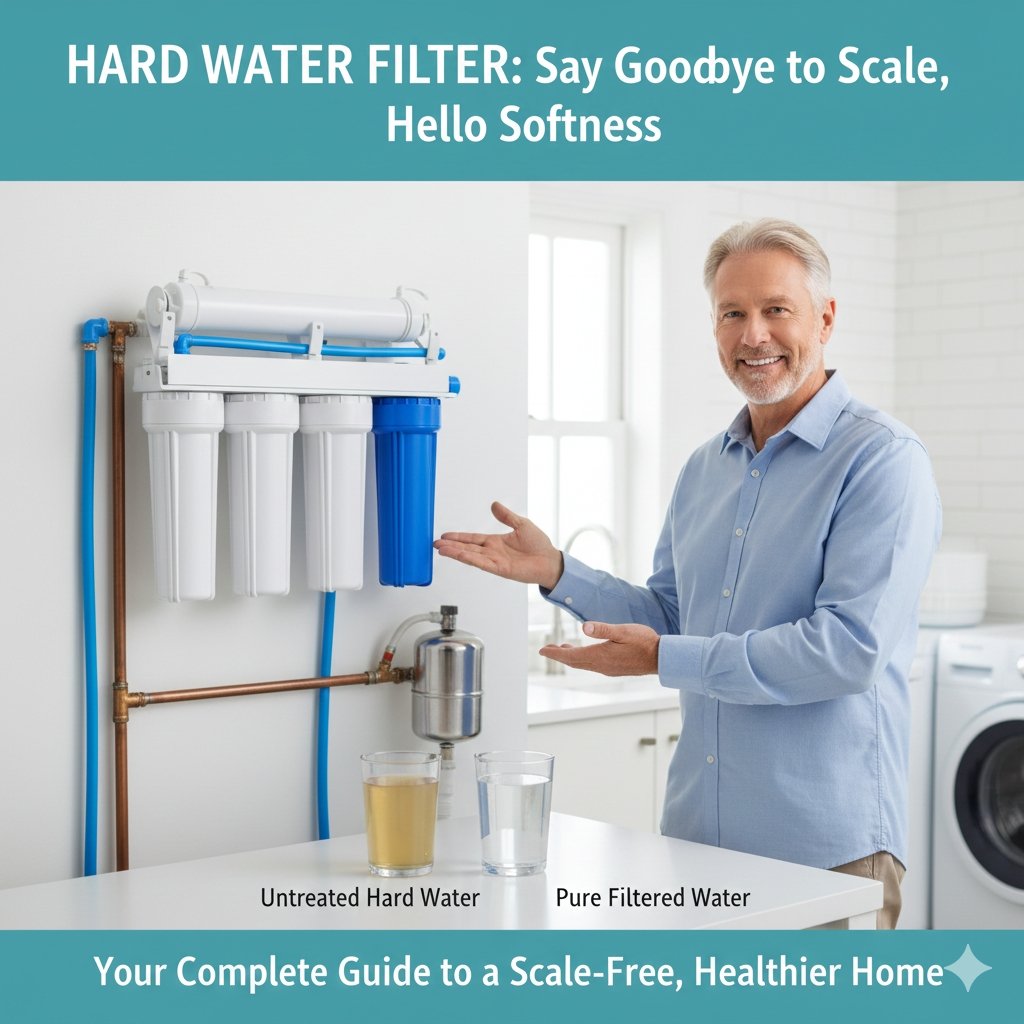
Water is the essential element of our daily lives. We use it to cook, to clean, to bathe, and to hydrate. However, for millions of households, the water flowing from the tap brings with it an invisible burden: hardness. If you have ever battled stubborn white crust on your showerhead, noticed your glassware coming out of the dishwasher cloudy, or felt your skin itch after a shower, you are likely dealing with hard water.
The solution seems simple: get a filter. But typing “water filter” into a search engine yields a dizzying array of options. Specifically, the search for a hard water filter can be confusing because “hardness” is not a contaminant in the traditional sense—it is a mineral characteristic.
In this extensive guide, we will demystify the science of hard water. We will explore why it damages your home and your health, and we will navigate the complex market of solutions—from whole-house softeners to precision Reverse Osmosis systems—to help you find the perfect hard water filter for your needs.https://yourwatergood.com/product/ro-water-purifier/.
Part 1: Understanding the Invisible Enemy
Before we can choose a solution, we must understand the problem. What exactly makes water “hard”?
The Geology of Your Tap Water
Water is a universal solvent. As rainwater falls and percolates through the earth to reach underground aquifers, it dissolves rocks. If the geology of your region is rich in limestone, chalk, or gypsum, the water picks up high concentrations of calcium and magnesium.
These dissolved minerals are what constitute “hardness.” It is measured in Grains Per Gallon (GPG) or Parts Per Million (PPM).
- Soft: 0–3 GPG
- Moderate: 3–7 GPG
- Hard: 7–10 GPG
- Very Hard: Over 10 GPG
Why “Hard” is Hard on You
While calcium and magnesium are essential minerals for the human body, they are disastrous for your home’s plumbing infrastructure.
- Scale Formation: When hard water is heated or evaporates, the minerals precipitate out of the liquid and form a rock-like deposit called limescale. This coats heating elements, clogs pipes, and ruins fixtures.
- Soap Scum: Hard water minerals react with soap to form a sticky curd (calcium stearate). This means you get less lather, your clothes don’t get as clean, and a film is left on your skin and bathtub.
- Skin and Hair Issues: That soap curd clogs pores and coats hair shafts, leading to eczema, dry skin, dandruff, and dull, brittle hair.
This is why the search for an effective hard water filter is not just about clear water; it is about protecting your lifestyle and your assets.
Part 2: The “Filter” vs. “Softener” Confusion
When consumers search for a hard water filter, they are often looking for anything that solves the scale problem. However, in the technical world of water treatment, terminology matters.
The Standard Water Filter
A standard activated carbon filter (like a pitcher or a simple fridge filter) removes chlorine, taste, and odor. It does not remove dissolved minerals. If you pour hard water through a carbon filter, it comes out just as hard. It might taste better because the chlorine is gone, but it will still scale up your kettle.
The Water Softener
A traditional ion-exchange water softener is the classic solution for the whole house. It physically swaps calcium ions for sodium ions. This removes the hardness entirely.
The Reverse Osmosis System (The Ultimate Filter)
This is where the distinction becomes interesting. A Reverse Osmosis (RO) system is arguably the most powerful hard water filter available for drinking water. Unlike simple carbon filters, the RO membrane has pores so microscopic (0.0001 microns) that it physically blocks dissolved minerals like calcium and magnesium.
If your goal is to have drinking water that is absolutely free of hardness—water that makes crystal clear ice and tea without scum—then a dedicated point-of-use system is your best bet. For this level of purity, we highly recommend the RO Water Purifier. This system acts as a true hard water filter for your kitchen, stripping away the minerals that affect taste and appliance longevity, along with lead, fluoride, and other contaminants.
Part 3: Why Your Appliances Need Protection
The financial impact of hard water is often underestimated until something breaks. Installing a hard water filter or treatment system is an investment in your property’s infrastructure.
The Water Heater Crisis
Your water heater is the most expensive victim of hard water.
- Electric Heaters: Scale builds up on the heating element. This acts as an insulator. The element has to get hotter and hotter to heat the water through the rock crust, eventually causing the element to burn out.
- Gas Heaters: Scale builds up at the bottom of the tank, creating a barrier between the flame and the water. This causes the metal tank bottom to overheat and eventually crack/fail.
- Efficiency Loss: Just a quarter-inch of scale can increase your energy bills by 20%.
The Dishwasher and Laundry Machine
Modern high-efficiency appliances have sensitive sensors and spray jets.
- Dishwashers: Scale clogs the spray arms, leading to dirty dishes. The minerals etch glassware, leaving permanent cloudy scratches.
- Washing Machines: Hard water prevents detergent from working effectively. You end up using twice as much soap, and your clothes wear out 15% faster because the fibers become brittle with mineral deposits.
Part 4: Choosing the Right Hard Water Filter for Your Needs
Since “hard water” impacts both your plumbing and your drinking experience, the “best” solution often involves a two-pronged approach.
Strategy A: Whole House Protection (Point of Entry)
To protect your pipes, water heater, and shower, you need a system installed where the water enters the home.
- Salt-Based Softeners: The most effective at removing hardness. However, they add sodium to the water, which some people prefer not to drink, and they require carrying heavy bags of salt.
- Salt-Free Conditioners: These do not remove minerals; they crystallize them so they don’t stick to pipes (Template Assisted Crystallization). They prevent scale but do not give you that “slick” soft water feel, nor do they help with spotting on dishes as effectively as salt units.
Strategy B: Kitchen Purity (Point of Use)
Even if you soften your water, you might not want to drink softened water (due to the sodium content). Or, perhaps you live in an apartment where you cannot install a whole-house unit.
In these cases, a hard water filter installed under your kitchen sink is the ideal solution. This is where Reverse Osmosis (RO) shines.
- Descaling the Drink: An RO system removes the hardness minerals entirely from your drinking water.
- Taste Profile: It provides a neutral, crisp taste perfect for coffee and cooking.
- Safety: Unlike a softener which adds sodium, an RO system removes everything, including the sodium added by a softener. This makes it the perfect companion to a whole-house softener.
For the ultimate kitchen setup, pairing a whole-house sediment pre-filter with a specialized RO Water Purifier ensures that your drinking water is not only soft but also medical-grade pure.
Part 5: The Hidden Role of Sediment in Hard Water
When we talk about a hard water filter, we often forget about the “dirt” that comes with it. Hard water usually originates from groundwater sources (wells or aquifers). These sources are often rich in sediment, sand, and turbidity.
The Importance of Pre-Filtration
If you install a sophisticated softener or RO system directly onto a line carrying gritty hard water, you will destroy the system.
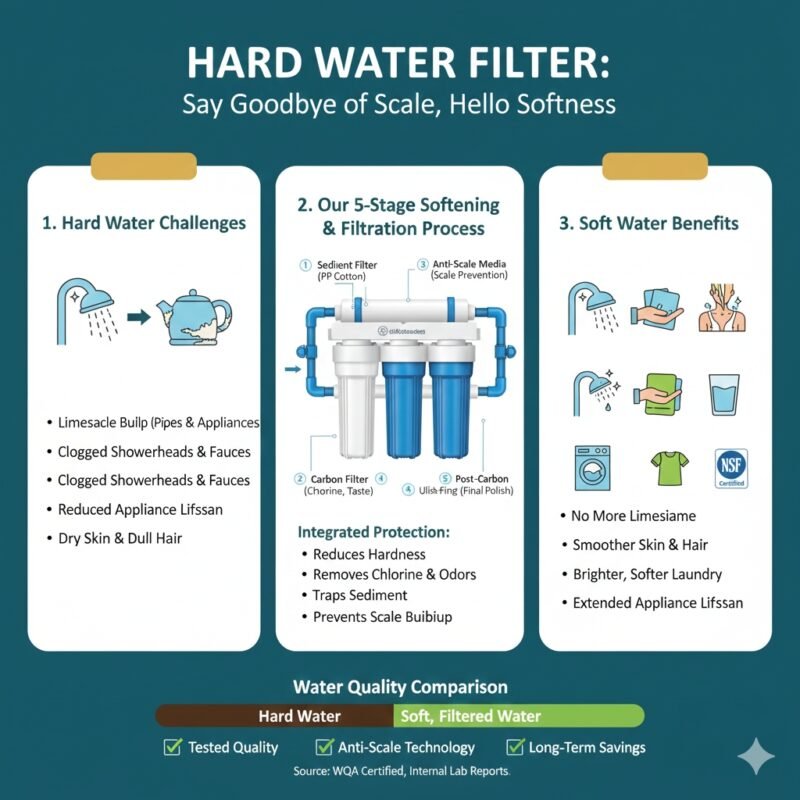
- The Solution: High-quality Polypropylene (PP) Cotton filters.
- The Mechanism: These melt-blown filters trap the physical particles—the rust flakes and sand grains.
- The Benefit: By removing the sediment first, you allow the hard water filter (whether it is an RO membrane or resin beads) to focus solely on the dissolved minerals.
As a specialist in filtration, we cannot stress enough that a premium PP cotton pre-filter is the bodyguard of your entire water treatment system. Without it, the efficiency of your mineral removal drops significantly.
Part 6: Health and Beauty Benefits
While protecting appliances saves money, protecting your body improves your quality of life. The impact of a functional hard water filter system on personal hygiene is profound.
The “Squeaky Clean” Myth
When you wash with hard water, you often feel “squeaky” clean. This is actually a misconception. That “squeak” is the friction caused by soap scum sticking to your skin. It strips your natural oils.
The Soft Water Glow
When you remove hardness:
- Skin: Your natural oils are preserved. Conditions like eczema and psoriasis often improve because the skin is no longer irritated by mineral deposits.
- Hair: Hair becomes softer, shinier, and more manageable. You will find you need less conditioner and fewer expensive salon treatments.
- Soap Usage: You can use up to 50% less shampoo and body wash to get a rich, luxurious lather.
Part 7: Installation and Maintenance
Investing in a hard water filter is not a “set it and forget it” event. To ensure the system continues to protect your home, you must understand the maintenance.
Maintaining an RO Hard Water Filter
If you choose an RO system to tackle hard water in the kitchen:
- Membrane Life: Hard water is tough on RO membranes. While a standard membrane lasts 2-3 years, in very hard water (over 15 GPG), it might need changing every 18 months.
- Flow Restrictors: Hard water can clog the tiny flow restrictor that manages the waste water. Check this annually.
- Pre-Filters: Change your sediment and carbon pre-filters every 6 months faithfully. This protects the membrane from chlorine and dirt, allowing it to fight the calcium effectively.
Maintaining a Whole House Unit
- Resin Bed: If using a softener, the resin beads eventually wear out (usually after 10–15 years).
- Salt Bridges: Sometimes a hard crust forms in the brine tank, preventing the salt from dissolving. You need to break this up with a broom handle occasionally.
Part 8: Myths About Hard Water Filters
There is a lot of pseudoscience in the water industry. Let’s debunk some common myths regarding the search for a hard water filter.
Myth 1: “Magnetic filters remove hardness.” Fact: Magnetic or electronic descalers clamp onto pipes and claim to use magnetic fields to stop scale. Scientific consensus is mixed to poor on these. They do not remove minerals. The water remains hard. They might reduce scale adhesion in some specific conditions, but they are not true filters.
Myth 2: “Boiling water removes hardness.” Fact: Boiling precipitates temporary hardness (calcium bicarbonate) out of the water, which creates the white flakes you see in your kettle. However, it does not remove permanent hardness (calcium sulfate). Plus, it is incredibly energy-inefficient to boil all your water.
Myth 3: “All filters are the same.” Fact: As discussed, a carbon filter does nothing for hardness. You must look for “Ion Exchange” or “Reverse Osmosis” technology if your goal is mineral reduction.
Part 9: Commercial Applications
Hard water isn’t just a homeowner’s headache; it is a business killer.
- Coffee Shops: Hard water destroys espresso machines. Scale builds up in the boiler and clogs the tiny solenoid valves. A commercial hard water filter is mandatory for any café.
- Restaurants: Spotted wine glasses and cloudy ice cubes are the hallmark of untreated hard water.
- Laundromats: Hard water increases detergent costs by up to 40% and reduces the lifespan of the commercial linens.
For small businesses, a robust filtration strategy typically involves a large whole-house sediment filter to catch rust, followed by a softener, and finally, a precision RO unit for the beverage station to ensure the perfect taste profile for coffee and tea.
Part 10: Environmental Considerations
When choosing a hard water filter, it is important to consider the environmental footprint.
The Salt Issue
Traditional softeners discharge salty brine into the sewage system. In some drought-stricken or environmentally sensitive areas, these are banned because they make water recycling difficult.
The High-Efficiency Alternative
If you are environmentally conscious, an RO system for your drinking water is a great choice. Modern RO systems are far more efficient than they used to be. While they do produce some wastewater (brine) as they strip away the calcium, the volume is negligible compared to flushing a toilet. Furthermore, by filtering your own water, you eliminate the massive plastic waste associated with buying bottled water.
Conclusion: Making the Right Choice
Living with hard water is a choice, not a necessity. The damage it causes to your plumbing, your appliances, and your skin is real and quantifiable. By choosing the right hard water filter, you stop this damage in its tracks.
To summarize your path to success:
- Test Your Water: Know your GPG (grains per gallon).
- Protect the House: If your water is over 7 GPG, consider a whole-house treatment solution to save your water heater.
- Perfect the Drink: For the water you actually consume, nothing beats the purity of Reverse Osmosis. It removes the minerals that ruin the taste of your coffee and tea, along with the sodium left behind by softeners.
If you are ready to banish limescale and enjoy the crisp, clean taste of mineral-free water, start with your kitchen. Explore the capabilities of the RO Water Purifier. It is a powerful, compact, and efficient solution that turns the hardest municipal water into a refreshing, premium beverage.
Water quality dictates quality of life. Don’t let dissolved rocks dictate yours.
Frequently Asked Questions (FAQ)
Q: Can a shower filter remove hard water? A: Generally, no. Small shower filters (usually containing KDF or Carbon) are designed to remove chlorine. They are too small to contain enough ion-exchange resin to soften water effectively for more than a few showers. To fix hard water in the shower, you typically need a whole-house system.
Q: Does a hard water filter remove healthy minerals I need? A: An RO system does remove calcium and magnesium. However, humans get the vast majority of their minerals from food, not water. You would have to drink bathtubs full of hard water to equal the calcium in a wedge of cheese. The benefits of removing the “rock” from your water far outweigh the minor loss of dietary intake.
Q: How often do I change the filters for hard water? A: In hard water conditions, pre-filters (sediment) often clog faster due to the associated turbidity. Check them every 3 months. RO membranes usually last 2 years, but in very hard water, you might need to replace them every 12–18 months if you don’t have a softener installed before them.
Q: Will a hard water filter fix my low water pressure? A: If your low pressure is caused by scale buildup inside the pipes (common in old steel pipes), a filter won’t unclog the pipes. However, installing a system now prevents the pipes from getting worse. If the low pressure is caused by a clogged existing filter, changing the cartridge will restore pressure immediately.
Q: What is the white dust on my humidifier? A: That is calcium dust. Ultrasonic humidifiers atomize the minerals in hard water and shoot them into the air. Using water from an RO Water Purifier in your humidifier will eliminate this white dust completely and protect the machine.