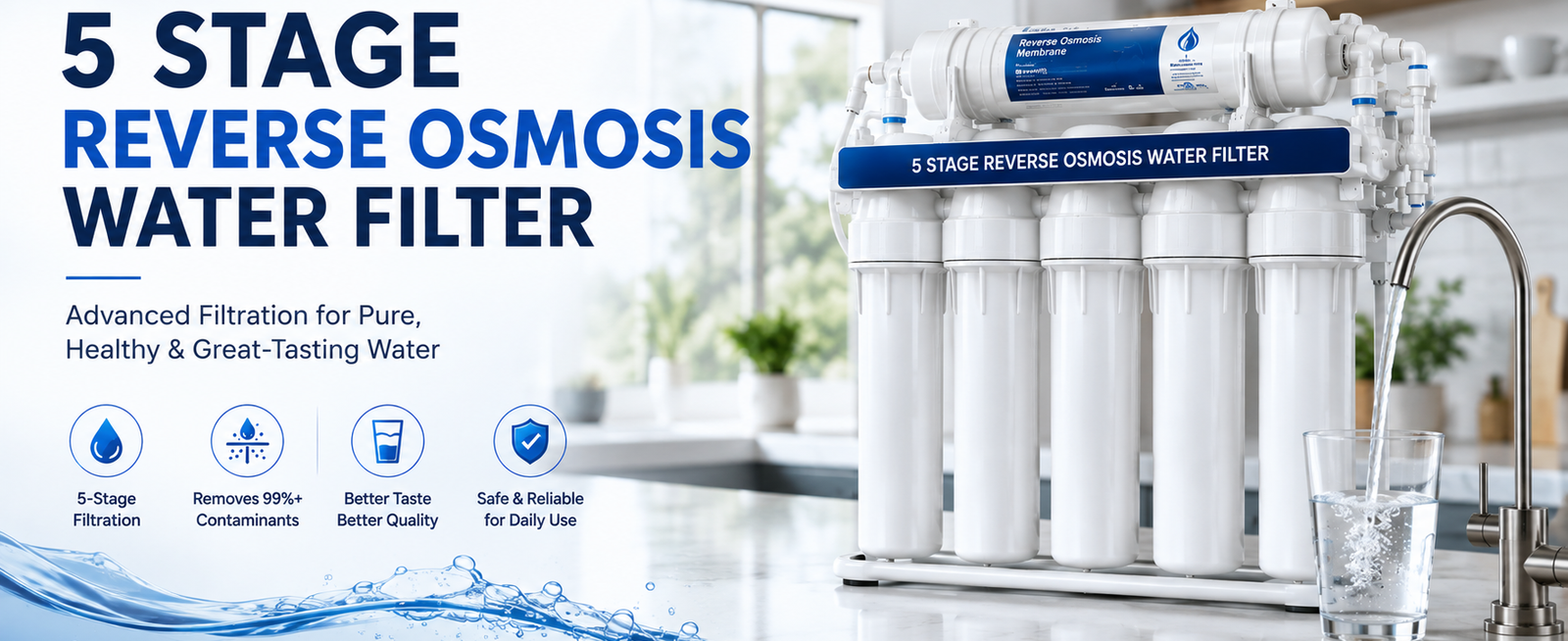
The Definitive Guide to the 5 Stage Reverse Osmosis Water Filter: Unlocking Pure Hydration
Water is the foundation of our existence. It makes up the majority of our bodies, it is essential for cooking, and it is the key ingredient in the beverages we love. However, in the modern world, the water flowing from our taps is rarely just hydrogen and oxygen. It is often a cocktail of dissolved minerals, chemical disinfectants like chlorine, sediment from aging pipes, and increasingly, invisible contaminants like microplastics and “forever chemicals” (PFAS).
For homeowners who prioritize health and for small business owners—such as café managers and restaurateurs—who prioritize product quality, standard filtration is no longer enough. The search for the ultimate purification solution almost always leads to one technology: the 5 stage reverse osmosis water filter.
This system is widely regarded as the “Gold Standard” of residential and light commercial water treatment. But why five stages? How does it work? And is it the right investment for your specific needs? In this comprehensive, deep-dive guide, we will explore every nut and bolt of this technology. We will dismantle the process stage by stage, analyze the economic benefits, and reveal why this specific configuration is the secret to crystal-clear ice, barista-quality coffee, and the safest drinking water for your family.https://yourwatergood.com/product/5-stage-ro-water-filter-for-home-busines/.

Part 1: Deconstructing the Technology
To understand the value of a 5 stage reverse osmosis water filter, we must first understand the philosophy behind its design. It is not a single filter; it is a treatment plant miniaturized to fit under your sink.
The Concept of Progressive Filtration
Filtration is a battle against debris of various sizes. If you tried to filter muddy water directly through a microscopic membrane, the membrane would clog instantly. The 5 stage reverse osmosis water filter uses a strategy called “Progressive Filtration.”
It works like a series of sieves, starting with a coarse net and ending with a molecular barrier.
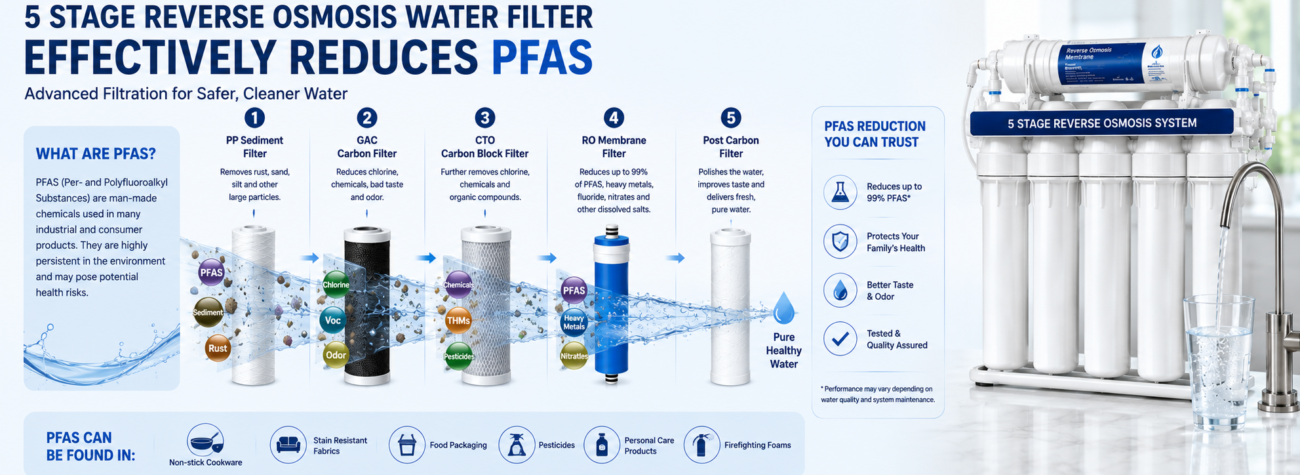
- Stage 1: Stops the rocks and sand.
- Stage 2 & 3: Stops the chemicals and odors.
- Stage 4: Stops the dissolved solids and metals (The RO Membrane).
- Stage 5: Polishes the taste.
This “Team Approach” ensures that each filter protects the next one in the chain, maximizing the lifespan of the system and ensuring that the final product is 99% pure.
Part 2: The Anatomy of a 5 Stage Reverse Osmosis Water Filter
Let’s take a microscopic journey through the system. Understanding these components will help you appreciate the engineering that goes into every glass of water you drink.
Stage 1: The Sediment Pre-Filter (The Shield)
The first cylinder in the lineup is the unsung hero of the entire operation.
- Material: High-quality Polypropylene (PP) Cotton.
- Function: This is a mechanical filter. Its job is to physically trap suspended particles. We are talking about rust flakes from cast-iron city mains, sand grains from well water, silt, dirt, and turbidity.
- Why It Is Critical: The Reverse Osmosis membrane (Stage 4) costs the most money. If sediment hits that membrane, it acts like sandpaper, tearing the delicate film. Or, it acts like mud, plugging the pores. The PP cotton filter sacrifices itself to save the membrane.
- Quality Indicators: A high-quality PP filter has a “graded density.” It is looser on the outside to catch big dirt and tighter on the inside to catch fine dust. This utilizes the full depth of the filter.
! Alt: Diagram of a 5 stage reverse osmosis water filter from a pp cotton household water purifier company.
Stage 2: Granular Activated Carbon (GAC)
Once the water is physically clear, it enters the chemical phase.
- Material: Loose granules of carbon, usually derived from coconut shells or coal.
- Function: Adsorption. Carbon has a massive surface area full of nooks and crannies. Chemical contaminants, particularly Chlorine, are attracted to the carbon and get trapped in these pores.
- Target: Chlorine, bad tastes, odors (like rotten eggs), and Volatile Organic Compounds (VOCs).
- Why It Is Critical: Chlorine is an oxidizer. If chlorinated water touches an RO membrane, it chemically “burns” holes in it, rendering it useless. Stage 2 neutralizes this threat.
Stage 3: Carbon Block (CTO)
You might ask, “Why two carbon stages?”
- Material: Compressed carbon powder formed into a solid block.
- Function: The “CTO” stands for Chlorine, Taste, and Odor. Because it is a solid block, water cannot channel around the carbon; it must squeeze through it. This increases “contact time.”
- Target: It catches any residual chlorine that escaped Stage 2 and acts as a secondary sediment filter for any carbon dust (fines) released by the GAC filter. It ensures the water hitting the membrane is chemically neutral and particle-free.
Stage 4: The Reverse Osmosis Membrane (The Heart)
This is where the magic happens. This is what makes a 5 stage reverse osmosis water filter a “purifier” rather than just a “filter.”
- Technology: The RO membrane is a semi-permeable thin-film composite (TFC).
- The Process: Water is forced against this membrane. The pores are 0.0001 microns wide. To visualize this: if the membrane pore were the size of a coin, a bacterium would be the size of a football field.
- Rejection: Water molecules (H2O) are small enough to pass through. Contaminants like Lead, Arsenic, Fluoride, Nitrates, PFAS, Mercury, and Viruses are too large. They bounce off the membrane and are flushed down the drain line.
- Result: The water that passes through—called the “permeate”—is essentially stripped of all dissolved solids.
Stage 5: The Post-Carbon Filter (The Polisher)
After the membrane, the water flows into a storage tank. When you open your faucet, the water travels from the tank through this final stage.
- Material: High-grade Coconut Shell Carbon.
- Function: Polishing. Water sitting in a rubber-lined tank can sometimes develop a slightly flat or stale taste. This filter “wakes up” the flavor, ensuring the water tastes crisp, sweet, and refreshing immediately before it hits your glass.
Part 3: Why Homeowners Are Switching to 5-Stage Systems
The adoption of the 5 stage reverse osmosis water filter in residential settings has skyrocketed. This isn’t just a trend; it’s a response to growing concerns about what is coming out of the tap.
1. The “Forever Chemical” Crisis (PFAS)
One of the biggest drivers for RO adoption is PFAS (Per- and polyfluoroalkyl substances). These man-made chemicals are found in non-stick cookware and firefighting foam. They do not break down in the environment and have been found in the blood of 97% of Americans. Standard carbon filters (like pitchers) struggle to remove them efficiently. RO membranes, however, are highly effective at physically blocking these complex chemical chains.
2. Lead Contamination
We all know the dangers of lead: developmental issues in children and kidney damage in adults. Even if your city water is lead-free, the service line connecting your house to the street might be lead. An RO system is the most reliable barrier against lead because lead is a heavy metal that cannot pass through the membrane.
3. The Convenience of “Bottle-Free” Living
Hauling cases of bottled water from the grocery store is a chore. Storing them takes up pantry space. Disposing of the plastic is an environmental nightmare. By installing a 5 Stage RO Water Filter for Home & Business, you have an endless supply of “bottled-quality” water at your kitchen sink. You save money, save your back, and save the planet.
Part 4: The Commercial Advantage (Small Business Focus)
At www.yourwatergood.com, we often speak with owners of small cafes, bistros, and tea houses. For these businesses, water is an ingredient. It is the canvas upon which they paint their flavors.
The Science of Coffee Extraction
Coffee is 98% water. The mineral content (TDS) of your water dictates how the coffee extracts.
- Unfiltered Water: Contains chlorine, which clashes with the coffee oils, creating a bitter, acrid taste. High mineral content (hardness) prevents the water from pulling the delicate fruit and floral notes from the bean.
- RO Water: A 5 stage reverse osmosis water filter strips the water to a neutral base. This allows the barista to serve the coffee exactly as the roaster intended. It is the secret to a smooth, non-bitter cup.
The “Clear Ice” Factor
Have you ever noticed that ice at high-end cocktail bars is crystal clear, while ice at home is cloudy?
- Cloudiness: This is caused by trapped air and dissolved minerals. As water freezes, minerals are pushed to the center, creating a white cloud.
- The Solution: By removing the dissolved solids with an RO system, you produce ice that is dense, hard, and crystal clear. It melts slower (preventing drink dilution) and looks premium.
Protecting Commercial Equipment
Espresso machines, steamers, and dishwashers are expensive. The #1 cause of failure is limescale buildup from hard water. The scale clogs sensors, burns out heating elements, and blocks tiny valves. By feeding your equipment with RO water, you essentially eliminate scale. A $300 filtration system can save a $10,000 espresso machine from a premature death.
! Alt: Barista making coffee with a 5 stage reverse osmosis water filter from a pp cotton household water purifier company.
Part 5: Installation and User Experience
A common misconception is that a 5 stage reverse osmosis water filter requires a professional plumber to install. While professionals are always an option, modern systems are designed for DIY installation.
The Setup
- Placement: The unit typically sits under the kitchen sink. The storage tank sits next to it.
- Connections:
- Feed: Connects to your cold water line via a simple adapter.
- Drain: A saddle clamp connects to your sink’s drain pipe to carry away the contaminants.
- Faucet: A dedicated drinking faucet is installed on the sink (requiring a hole, often replacing a soap dispenser).
- Tubing: Modern systems use “Quick-Connect” fittings. You simply push the color-coded plastic tubing into the slot, and it locks. No wrenches or soldering required.
Maintenance: The Key to Longevity
A filter system is only as good as its maintenance. Neglecting it turns a purifier into a bacteria trap.
- Every 6 Months: Change Stages 1, 2, and 3. (Sediment and Pre-Carbons). If you skip this, chlorine will break through and ruin the membrane.
- Every 12 Months: Change Stage 5 (Post-Carbon).
- Every 2-3 Years: Change Stage 4 (RO Membrane). You can test this with a TDS meter; if the number starts creeping up, it’s time to change.
Part 6: Myths vs. Facts
There is a lot of conflicting information online about RO water. Let’s separate fact from fiction.
Myth 1: “RO systems waste huge amounts of water.”
- Fact: In the past, inefficient systems wasted 4 to 8 gallons for every 1 gallon produced. However, modern systems like the 5 Stage RO Water Filter for Home & Business are much more efficient, utilizing automatic shut-off valves and sometimes permeate pumps to improve the ratio significantly. Furthermore, the “waste” water is comparable to a couple of extra toilet flushes a day—a drop in the bucket compared to lawn watering or long showers.
Myth 2: “Drinking RO water is unhealthy because it has no minerals.”
- Fact: It is true that RO removes calcium and magnesium. However, the human body derives the vast majority of its minerals from food (vegetables, dairy, nuts), not water. You would have to drink bathtubs full of tap water to get the calcium found in a single piece of cheese. The primary job of water is hydration and flushing toxins, which RO water does perfectly.
Myth 3: “It removes healthy fluoride.”
- Fact: This is a polarizing topic. RO does remove fluoride. For many people, this is a feature, not a bug, as they prefer to control their fluoride intake via toothpaste rather than ingesting it in their water.
Part 7: Comparing the 5-Stage to Other Options
Is the 5 stage reverse osmosis water filter always the right choice? How does it stack up against competitors?
vs. Pitcher Filters
- Pitchers: Only remove taste, odor, and some heavy metals. They do not remove viruses, fluoride, or nitrates. They have a small capacity and require frequent filter changes.
- 5-Stage RO: Removes 99% of contaminants. High capacity. Lower long-term cost per gallon.
vs. 3-Stage Under-Sink Filters
- 3-Stage: Usually Sediment + Carbon + Carbon. They are good filters, but they are not purifiers. They do not reduce Total Dissolved Solids (TDS). If you have high lead or arsenic, a 3-stage filter is not safe enough.
- 5-Stage RO: The membrane barrier makes the difference. It is the only way to significantly lower TDS.
vs. Distillation
- Distillation: Boils water and collects steam. It is very pure but incredibly slow (takes hours to make a gallon) and uses a lot of electricity.
- 5-Stage RO: Produces water on demand (via the tank) and uses no electricity (unless a booster pump is needed), relying on water pressure.
Part 8: Choosing the Right System for Your Needs
Not all 5-stage systems are created equal. When shopping, you must look at the quality of the components.
1. The Quality of the Pre-Filter
As a specialized pp cotton household water purifier company, we cannot stress this enough: The system is only as strong as its first stage. If the manufacturer uses a cheap, low-density PP cotton filter, it will collapse under pressure or allow sediment to pass through. This will foul the expensive carbon filters and ruin the membrane. Always look for high-density, melt-blown PP cotton filters.
2. The Capacity
Systems are rated in GPD (Gallons Per Day).
- 50 GPD: Standard for small families.
- 75-100 GPD: Better for larger families or small offices.
- 400+ GPD: Tankless commercial options for restaurants.
3. Certification and Support
Does the supplier offer replacement parts? Do they support the US and European markets with standard sizing? One of the risks of buying generic systems is that you cannot find replacement filters next year. At www.yourwatergood.com, we ensure that our systems use standard-sized cartridges, making maintenance easy and future-proof.
Part 9: Environmental Impact
We live in a time where sustainability is paramount. While some critics point to the wastewater of RO systems, the net environmental impact is overwhelmingly positive when compared to the alternative: bottled water.
The Plastic Scourge
- Production: Making plastic bottles requires oil and massive amounts of water (more water than is actually in the bottle).
- Transport: Diesel trucks ship heavy water bottles across the country, creating carbon emissions.
- Disposal: Billions of bottles end up in landfills or oceans every year, breaking down into microplastics.
By switching to a home filtration system, a single household can keep thousands of plastic bottles out of the ecosystem annually. It is a tangible way to lower your carbon footprint while ensuring your family’s health.
Conclusion: The Ultimate Upgrade
The 5 stage reverse osmosis water filter sits at the intersection of health, luxury, and practicality. It transforms questionable municipal tap water into a premium beverage.
For the homeowner, it means safety from lead and PFAS. It means children drinking more water because it tastes better. For the business owner, it means consistent product quality and equipment protection.
It is an investment that pays for itself—both in the money saved on bottled water and in the long-term health of your body and your appliances.
If you are ready to take control of your water supply, do not settle for half-measures. Choose the system that provides the comprehensive protection of five distinct stages of purification.
Visit YourWaterGood today to explore our high-performance solutions. Whether you are outfitting a busy cafe kitchen or a family home, we have the expertise and the quality components to ensure your water is always good.https://yourwatergood.com/product/5-stage-ro-water-filter-for-home-busines/.
Frequently Asked Questions (FAQ)
Q: Can I connect the 5 stage reverse osmosis water filter to my refrigerator? A: Yes! This is a very popular setup. You can install a “T-fitting” on the tube leaving the system. One line goes to the drinking faucet at the sink, and the other runs to your fridge. This gives you crystal clear, filtered ice cubes and chilled RO water from the fridge dispenser.
Q: How do I know when to change the RO membrane? A: The best way is to use a TDS (Total Dissolved Solids) meter. These are cheap handheld devices.
- Test your tap water (e.g., 300 ppm).
- Test your RO water. It should be 90-95% lower (e.g., 15-30 ppm).
- If the RO water starts reading higher (e.g., 100 ppm), the membrane is degrading and needs replacement.
Q: Does the system remove beneficial minerals? A: Yes, it removes most minerals. If you prefer mineral-rich water (alkaline water), you can add a 6th Stage Remineralization Filter. This cartridge contains Calcite or Maifan stones that dissolve small amounts of calcium and magnesium back into the water after it has been purified, raising the pH and adding flavor.
Q: What happens if I go on vacation? A: If you are away for more than a week, it is good practice to turn off the water supply to the RO unit and empty the storage tank. When you return, turn it back on and let the tank fill and empty once before drinking, just to ensure freshness.