
Inline Water Filter for Home Manufacturer — The Complete Guide for Buyers, Brands, and Engineers

Inline water filters are compact, often unsung heroes in modern homes. Hidden beneath a sink, behind a refrigerator, or tucked into a coffee machine, they quietly improve taste, protect appliances, and extend the life of downstream systems. For manufacturers, producing reliable inline filters combines material science, precision molding, quality control, and supply-chain know-how. For brands and buyers, selecting the right manufacturer is essential to deliver a product that performs, meets regulatory expectations, and builds customer trust.
This long-form guide explains what inline filters are, how they’re made, the critical manufacturing and quality-control steps, certifications that matter for selling in major markets (particularly the U.S.), sourcing and OEM/ODM options, cost drivers, sustainability considerations, and practical buyer checklists. If your needs outgrow inline filtration and you’re evaluating whole-home alternatives, take a look at a balanced whole-house option here: https://yourwatergood.com/product/whole-house-water-filtration-system-for-home/.
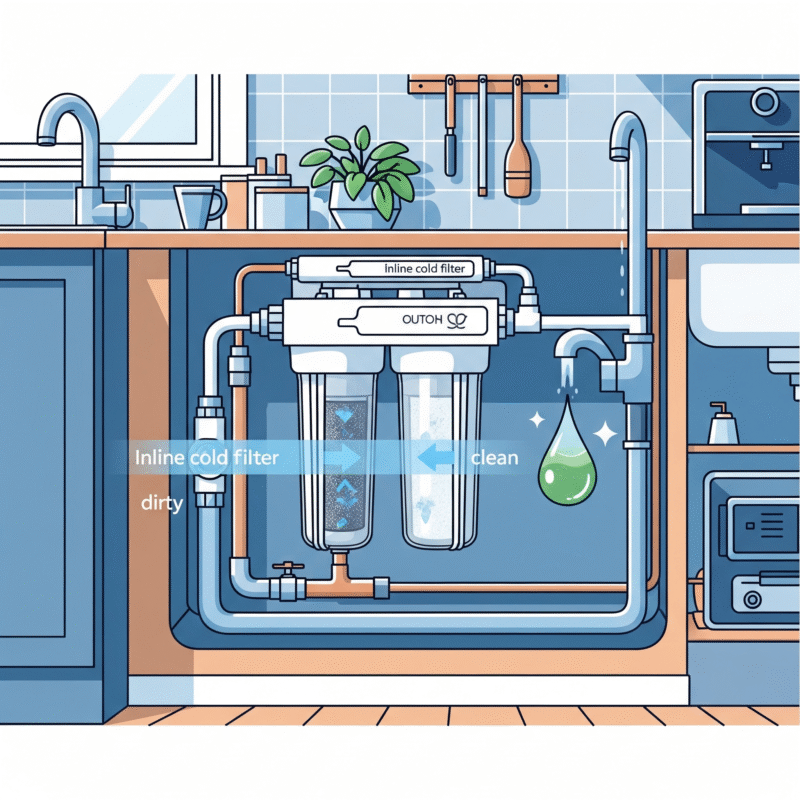
1. What is an inline water filter — quick refresher
An inline (or in-line) water filter is a small cartridge or assembly installed directly into a water line so that water passes through it as part of normal plumbing. Common use cases include:
- refrigerator water and ice lines
- espresso and coffee machines
- dedicated drinking-water faucet feeds
- point-of-use protection for appliances in tight spaces (RVs, tiny homes)
- pre-filtration before sensitive point-of-use systems
Inline filters vary from single-stage sediment cartridges to compact multi-stage designs that combine sediment, activated carbon, and specialty media. Their compact footprint and ease of install make them attractive for both consumers and product designers.
2. Typical inline filter designs and components
Inline filters generally have three basic elements:
- Filter media — sediment (polypropylene melt-blown or spun), activated carbon (block or granular), KDF or specialty resins, ceramic microporous elements, or membranes.
- Housing and endcaps — injection-molded plastic parts that hold media and connect to tubing (quick-connect, barbed, or threaded fittings).
- Connectors and seals — O-rings, push-fit connectors, or threaded adapters to ensure leak-free joins.
Design variations include:
- Disposable cartridge: entire unit replaced.
- Replaceable-core housing: housing remains, inner cartridge is replaced.
- Multi-stage inline module: two or more media layers within a compact length.
- Mini-RO feed modules: small RO membranes with an integrated pump for appliance feeding.
Manufacturers choose materials and configurations to balance flow, pressure loss, contaminant removal, cost, and manufacturability.
3. How inline filters are manufactured — the production flow
A high-quality inline filter starts with controlled production steps:
Raw-material sourcing
- PP resin for sediment cartridges (food-grade melt-blown or spun polypropylene).
- Activated carbon (coconut shell or coal based) — particle size, ash content, and activation method matter.
- Polymers for housings (e.g., PP, ABS, PPO) chosen for durability and FDA suitability.
- O-rings and adhesives — silicone or EPDM for potable water compatibility.
Reputable factories demand Certificates of Analysis (COAs) and traceability for raw materials.
Media fabrication
- Melt-blown process for depth (PP) cartridges: resin extruded into microfibers and collected into a gradient-density structure. Gradient forming increases dirt-holding capacity and minimizes early clogging.
- Carbon block production: powdered activated carbon blended, sometimes with binders, then compressed or extruded into a dense block with consistent porosity.
- Resin filling: for specialty media (KDF, ion-exchange), measured fill and containment are critical for consistent performance.
Molding and mechanical parts
- Injection molding makes housings, endcaps, and connectors. Tooling tolerances determine sealing faces and fit accuracy.
- Mold maintenance and quality control prevent flashing, warpage, and dimensional drift.
Assembly and bonding
- Media is inserted into housings, O-rings seated, and endcaps crimped, glued, or ultrasonically welded depending on design. For carbon blocks, some designs require endcaps with gasket seating and adhesive curing.
Functional testing
- Pressure/leak testing at rated PSI to detect sealing issues.
- Flow and pressure-drop measurement to confirm GPM at various pressures.
- Micron or particle retention spot tests to validate nominal filtration performance.
- Microbial testing for products claiming bacterial control (or when required by certification).
Packaging and labeling
- Clear instructions, replacement intervals, and compliance markings are added. For private-label orders, brand packaging and manuals are printed and applied.
These steps must be documented and controlled to ensure reproducible product quality.
4. Key manufacturing quality metrics and test protocols
Buyers should expect manufacturers to provide meaningful test data. Typical metrics include:
- Micron rating and test method — e.g., removal efficiency ≥ X% at Y µm using ASTM or ISO test protocols.
- Flow vs pressure-drop curve — graph showing GPM at different inlet pressures; essential to size for appliances.
- Endurance/capacity — capacity in gallons until breakthrough or rated pressure drop.
- Material safety data — FDA or equivalent material declarations confirming potable-water suitability.
- Physical integrity tests — pull-off force for connectors, torque tests for threaded fittings.
- NSF/ANSI test reports — when applicable, showing third-party verification of removal claims.
Demanding these data points up front filters out suppliers who can’t reliably meet performance claims.
5. Certifications and regulatory requirements — why they matter
For the U.S. market, and many other developed markets, certification and documented testing are central:
- NSF/ANSI Standard 42 — aesthetic effects (taste, odor, chlorine).
- NSF/ANSI Standard 53 — health effects (lead, cysts, VOCs when claimed).
- NSF/ANSI P231 or other microbial standards — for devices claiming microbial control.
- FDA food-contact compliance — ensures materials are safe for potable water contact.
- RoHS/REACH — for chemical restrictions in some regions.
A product can be sold without NSF certification, but retailers and consumers increasingly expect certified claims. For private-label brands, securing certification for the final product (and not just components) is often necessary for broad distribution and marketing.
6. Manufacturer types: commodity vs premium vs domestic
Commodity manufacturers
- Large factories, typically offshore, that produce high volumes of standard cartridges at very low per-unit costs.
- Pros: low COGS, short per-unit price.
- Cons: variability in QC, longer shipping, lower traceability unless audited.
Premium / accredited manufacturers
- Factories with ISO, documented QC, and the ability to support NSF testing. Many have vertical integration for carbon production or melt-blown lines.
- Pros: traceability, better test data, easier path to certification.
- Cons: higher per-unit price.
Domestic manufacturers
- North American or European producers offering shorter lead times and easier audits.
- Pros: faster response, local support, “Made in” marketing.
- Cons: significantly higher COGS.
Brands choose based on required claims, MOQ constraints, price targets, and customer expectations.
7. OEM / ODM partnerships — working with factories
If you plan to create a private-label inline filter, manufacturers typically offer a ladder of services:
- Off-the-shelf supply: buy existing SKUs with your branding on the box. Fast and low risk.
- Minor customization (ODM): adjust connector types, lengths, or basic branding. Moderate MOQ and lead time.
- Full OEM development: fully custom housings, unique media blends, or performance targets. This requires tooling fees, pilot runs, and longer validation.
Best practice: start with samples and third-party lab testing. Use a small pilot run to validate packaging, fit, and user experience before scaling.
8. Sourcing strategy and minimum order quantities
Factory pricing is inversely related to order quantity. Typical patterns:
- Commodity cartridges: very low FOB price at MOQs in the thousands.
- Custom assemblies: higher per-unit cost and tooling amortization; MOQs depend on supplier but often in the low thousands.
- Low MOQ options: some factories or trading partners will do smaller initial runs at a price premium to help startups test the market.
Total landed cost includes FOB price + freight + duty + inland logistics + inspection fees. For Amazon sellers or distributors, account for FBA prep and labeling too.
9. Cost drivers and pricing expectations
Major cost components:
- Raw materials: carbon grade, PP resin cost, special media.
- Tooling: injection molds for housings; amortized over the production run.
- Testing and certification: lab fees (NSF testing can add materially to project costs).
- Labor & overhead: assembly, QC, packaging.
- Logistics: ocean freight, customs and inland transport.
Typical price ranges (indicative for planning; actual numbers vary with quantity and supplier):
- Simple inline sediment or carbon cartridges (commodity, large MOQ): a few dollars each FOB.
- Higher-quality carbon-block inline units: $5–$15 FOB at mid-volume.
- Custom multi-stage modules or mini-RO feed assemblies: $20–$80+ FOB depending on complexity.
- NSF testing & documentation per SKU: several thousand dollars at lab rates plus time.
Calculate total landed cost and then apply your target margin for MSRP.
10. Production pitfalls that cause customer complaints
Common manufacturing issues that lead to returns and poor reviews:
- Inconsistent media density (melt-blown variations) causing premature clogging or weak performance.
- Poor endcap bonding on carbon blocks resulting in channeling or leakage.
- Incorrect micron rating claims — customers notice when particles pass through.
- Push-fit connector leaks due to tolerance drift in molding.
- Poor instructions — customers confuse flow direction or installation sequence.
Manufacturers should run SPC and lot testing to minimize these failures.
11. Testing, sampling, and pre-shipment inspection
For brands buying from offshore factories, pre-shipment inspection is essential. Recommended tests and checks include:
- Visual inspection for cosmetic defects.
- Dimensional checks for sealing faces and connector geometry.
- Random pressure/leak tests at rated PSI.
- Flow tests to sample GPM at a defined inlet pressure.
- Media verification (e.g., carbon particle sizing or PP fiber checks).
- Packaging and labeling verification — barcodes, multilingual manuals.
Use third-party inspection (SGS, Bureau Veritas) for larger shipments to reduce risk.
12. Sustainability and end-of-life considerations
Inline filters are small but disposable. Manufacturers and brands face growing pressure on sustainability:
- Refillable housings allow reuse of a durable plastic housing with replaceable inner cartridges.
- Reduced packaging and recyclable carton choices cut waste.
- Media recycling programs are rare but differentiate premium brands.
- Material selection — using recyclable plastics and reducing mixed materials simplifies end-of-life processing.
Brands should be transparent about recyclability and consider take-back programs for high-value markets.
13. How to vet a manufacturer — the buyer’s checklist
When evaluating manufacturers, use this checklist:
- Ask for COAs for raw materials (PP resin, carbon).
- Request production photos and line videos (melt-blown lines, molding machines, assembly).
- Obtain sample test reports (flow curves, micron retention, pressure tests).
- Check certifications — ISO 9001, NSF support, or the ability to support testing.
- Review references — other brands or distributors the factory supplies.
- Confirm MOQ and lead times in writing.
- Arrange pre-shipment inspection and ask about corrective action for defects.
- Clarify warranty terms and RMA processes.
Carry out a small pilot order and test in the field to validate claims under real water conditions.
14. Marketing and compliance for consumer products
If you sell to consumers, marketing claims must match testing. Best practices:
- Avoid over-claiming (e.g., “removes pathogens” without microbial test evidence).
- Display replacement intervals in months or gallons using realistic assumptions.
- Publish flow rates and pressure-drop data to reduce returns based on poor performance.
- Keep instructions simple — installation diagrams and clear flow-direction labeling reduce support tickets.
Retailers may ask for test evidence before accepting new SKUs.
15. When to choose inline filters vs whole-house systems
Inline filters are excellent for targeted needs (drinks, appliances), but they’re not a universal solution. Choose inline filters when you want:
- targeted filtration for a single fixture or appliance,
- low upfront cost and simple installation, or
- a compact option in space-constrained environments.
Choose a whole-house system when you need filtered water everywhere (showers, laundry, all faucets) or when water quality problems (hardness, heavy sediment) affect the entire plumbing network. If you want to compare a balanced whole-house option as an alternative or complement to inline solutions, review this product for reference: https://yourwatergood.com/product/whole-house-water-filtration-system-for-home/.
16. After-sales support and warranties — why they matter
Good manufacturers offer clear warranties and an RMA process. For brands, alignment on warranty fulfillment is essential:
- Warranty coverage should be explicit (failures due to defects vs normal wear).
- Spare parts availability for housings and connectors ensures long-term customer satisfaction.
- Technical support (installation guides, videos) reduces returns and service costs.
Negotiate warranty liabilities in OEM contracts and document triage steps for returns.
17. Case study example (hypothetical): Launching a private-label inline filter
Steps and timeline for a small brand:
- Market research & spec (1–2 weeks): decide micron rating, flow target, and price.
- Sample sourcing (2–4 weeks): request 3–5 supplier samples.
- Lab testing (2–6 weeks): third-party confirmatory tests.
- Pilot order & packaging (4–8 weeks): small run to test retail fit and consumer feedback.
- Certification (optional) (8–16 weeks): pursue NSF for claimed reductions.
- Full production & logistics (varies): scale order and route to fulfillment centers.
This staged approach controls risk and helps a brand refine messaging and technical specs before mass market launch.
18. Future trends manufacturers should watch
- Advanced media blends that remove micropollutants with lower pressure drop.
- Smarter cartridges with RFID or QR codes to remind consumers when to replace.
- Sustainable refill models and circular packaging.
- Local/regional manufacturing to shorten lead times and reduce carbon footprint.
Manufacturers who invest in measurable performance and sustainability will find greater trust among discerning buyers.
19. Practical buyer takeaways — summary checklist
- Validate materials: request COAs for PP and carbon.
- Require test data: flow curves, micron retention, pressure testing.
- Insist on sample validation in your water conditions.
- Plan for certification if you make health-related claims.
- Start with a pilot to confirm packaging, instructions, and replacement behavior.
- Monitor supply chain: MOQ, lead times, and freight affect landed cost and cash flow.
- Design for serviceability: replaceable cartridges or clear instructions reduce returns.
20. Conclusion
A reliable inline water filter is the sum of many small decisions: the right resin grade, an accurately produced carbon block, precision molding, and disciplined quality control. For manufacturers, attention to detail in the production line, transparent test data, and the ability to support OEM/ODM customers are the cornerstones of long-term success. For brands and buyers, a structured sourcing process — samples, third-party testing, pilot orders, and clear contractual terms — reduces risk and ensures customers receive consistent, safe, and effective products.
If your needs move beyond a single point of use, evaluate how inline filters fit into a broader water-treatment strategy — sometimes a combined approach (whole-house sediment/carbon + inline or point-of-use RO for drinking) offers the best balance of cost and performance. For a whole-home reference point, check this balanced option: https://yourwatergood.com/product/whole-house-water-filtration-system-for-home/.