
OEM Water Filter Opportunities: How to Design, Manufacture, and Scale a Private-Label Filtration Business

Introduction
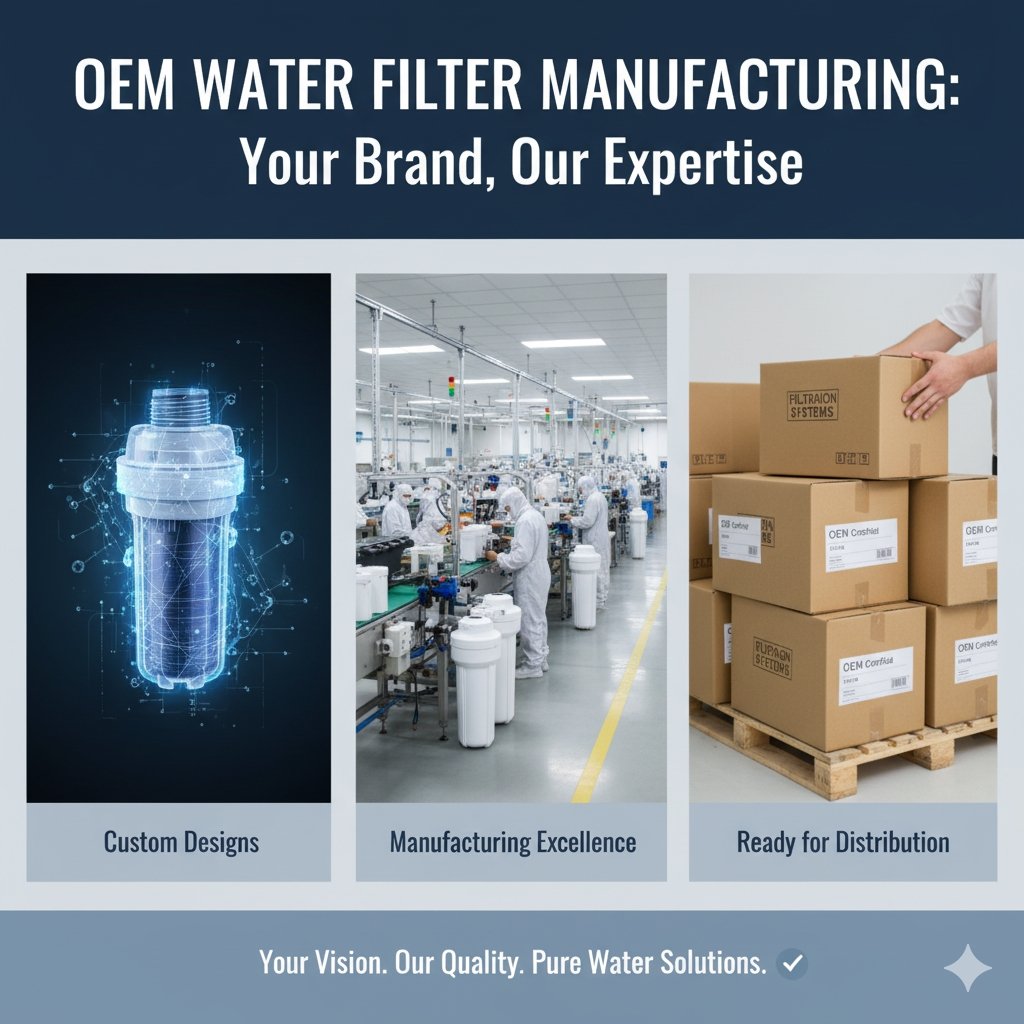
The phrase oem water filter captures a clear business opportunity: producing high-quality filtration products that other brands, retailers, or installers can private-label and sell under their own name. For manufacturers and entrepreneurs, the OEM channel offers attractive margins, repeatable volume, and the chance to build long-term partnerships without the marketing costs of a branded consumer business. But success requires more than assembling housings and filters. It demands rigorous product design, consistent media sourcing, traceable manufacturing, validated test data, compliance with local regulations, clear packaging and documentation, dependable logistics, and after-sales support that protects both the OEM and its customers.
This article explains, step-by-step, how to turn an oem water filter concept into a scalable, reliable product line. Whether you plan to supply under-sink cartridges, inline refrigerator modules, whole-house point-of-entry systems, or reverse-osmosis units, these principles apply. I cover product architecture, media selection, prototyping, certification, quality systems, commercial terms, pricing strategies, packaging, distribution models, and practical checklists that help you avoid common pitfalls. The goal: give you a pragmatic road map so the next OEM conversation you have lands as a long-lasting relationship rather than a one-off shipment.https://yourwatergood.com/.
Why OEM Is a High-Value Channel
OEM partnerships are attractive for several reasons:
- Lower customer acquisition cost for buyers: Retailers and installers can offer a private-label product without investing in R&D or manufacturing. They get a tested product, go-to-market materials, and a predictable supply.
- Recurring aftermarket revenue: Filters, cartridges, membranes, and replacement kits generate steady demand. OEMs that design easy-to-replace consumables create dependable long-term revenue streams.
- Scale and predictability for manufacturers: Supplying many similar SKUs under different labels reduces product complexity while increasing order volumes. You can amortize certification costs and test benches across partners.
- Focus on core strengths: Manufacturers concentrate on engineering and production; partners handle distribution and customer relationships.
But the channel also creates responsibilities. Your buyers expect consistent lots, specifications that match claims, and fast response to RMAs. A single high-profile failure can damage both the OEM partner and your reputation.
Product Architecture: Choosing the Right Platforms
Start by selecting form factors that cover the most market demand with the fewest SKUs. Typical OEM water filter platforms include:
- Inline refrigerator/ice-maker modules: Compact, sealed cartridges that connect to quick-connect fittings. High velocity at low footprint; popular with appliance dealers.
- Under-sink point-of-use (POU) systems: 10″ or 20″ cartridge housings or multi-stage RO systems for drinking water. These are consumer-facing and often sold through retailers and e-commerce.
- Whole-house point-of-entry (POE) filters: Larger housings with pleated sediment or carbon modules; installed by contractors to protect plumbing and appliances.
- Reverse osmosis (RO) units: Multi-stage POU units that include sediment, carbon, membrane, and post-filter stages — higher complexity but higher perceived value.
- Commercial modules: Larger-capacity cartridges and housings for cafés, foodservice, and small offices.
Designing modular, cross-compatible cartridges (e.g., a single carbon module that fits multiple housings) reduces SKUs and simplifies production.
Media Selection and Performance Targets
The heart of any water filter is its media. OEM buyers will assess your product primarily by measurable performance: particle retention, chlorine removal, VOC reduction, TDS reduction (for RO), flow vs pressure drop (ΔP), and dirt-holding capacity. To be a trusted oem water filter supplier, you must define and meet tight media specifications.
Common media and considerations:
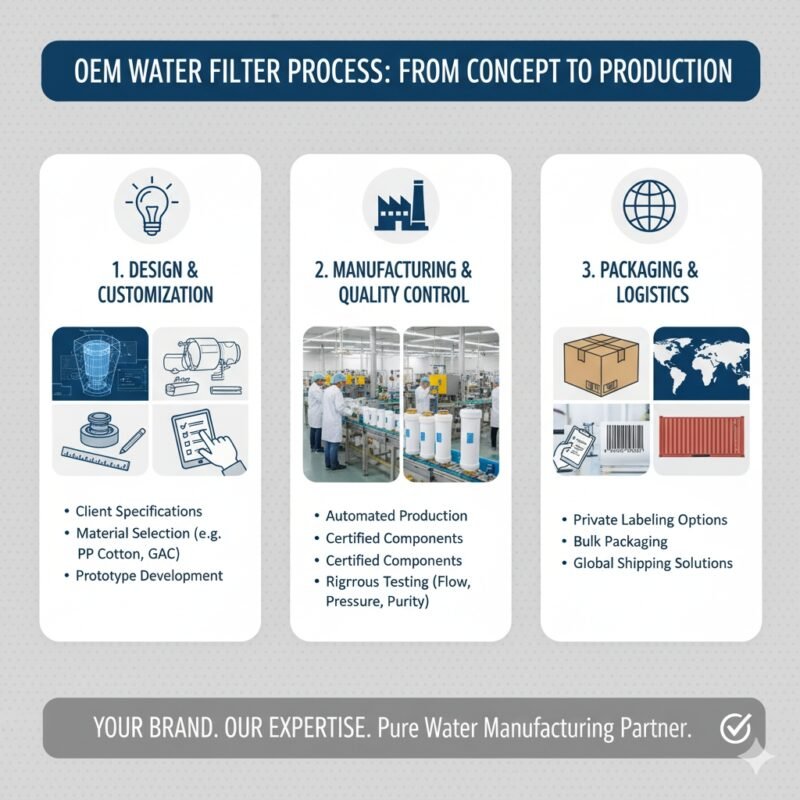
- Melt-blown polypropylene (PP cotton) for sediment: choose melt-flow-resin grade with consistent melt-flow index (MFI) and a graded-density design for long life with manageable ΔP. Provide dirt-holding data and initial-fines measurements.
- Carbon block vs granular activated carbon (GAC): carbon block offers higher adsorption per volume and particle polishing; GAC has lower ΔP and is preferred in pulse-flow cases. Specify iodine number/BET surface area, ash content, and activation method (steam vs chemical).
- Catalytic carbon or specialty media: needed for chloramine reduction and specific VOCs; validate with challenge tests.
- RO membranes: select trusted brands or validated membrane formulations, and document TDS rejection performance, flux (GPD at standard conditions), and chlorine tolerance.
- Ion-exchange resins: for water softening; specify capacity and regeneration chemistry.
When creating OEM specs, include not just nominal micron ratings but the test methods used. For example: “5 µm nominal, ASHRAE-style bead challenge at X flow rate and reported percent capture.” Ambiguity kills trust.
Prototyping and Validation
Before any commercial conversation, build prototypes and validate them under realistic conditions. A convincing OEM pitch includes not only samples but lab data and clear test methods.
Key validation steps:
- Bench testing — ΔP vs flow: Map initial pressure drop across the cartridge at representative flows (e.g., 0.5–2 GPM for POU; 5–15 GPM for POE). OEM buyers need to know user experience at taps and peak flows.
- Dirt-holding capacity: Use a standardized particulate challenge to measure grams retained until a service ΔP endpoint (e.g., 15 psi). This predicts replacement intervals and aftermarket cadence.
- Contaminant reduction testing: For carbon stages, run chlorine/VOC challenge tests and document breakthrough curves under expected influent concentrations. For RO, document TDS rejection at specified pressure and temperature. Third-party lab verification is highly persuasive.
- Initial-fines / extractables: Measure first-flush particulate counts and organics. High initial fines cause early returns; factory conditioning can reduce this.
- Mechanical tests: End-cap pull strength, core collapse pressure, burst tests at >1.5× rated pressure. Hardware failures are expensive in the field.
- Accelerated aging / shelf life: Validate that cartridges stored for months still meet specs; verify packaging sufficiency under hot/cold freight conditions.
Third-party lab reports, ideally from accredited labs, will strengthen OEM negotiations. If you can offer certification-ready testing (NSF/WQA prep), even better.
Manufacturing Discipline and Quality Systems
A reliable oem water filter supplier invests in processes that ensure repeatability. Key elements:
- Incoming materials control: Require Certificates of Analysis (CoA) for resin, carbon, membranes, gaskets, and other wetted parts. Match incoming lots to production lots.
- SPC and inline monitoring: Track melt-blown die temperatures, collector speeds, web basis weight, slitting tolerances, and bond parameters. Use control charts and automated rejection where possible.
- Lot traceability and retained samples: Retain a production sample from every lot for 6–24 months. Print lot codes on cartridges and master cartons so RMAs can be traced quickly.
- Finished-product test matrix: Define which tests are run per lot (ΔP bench, mechanical pull, extractables), and require QA sign-off for lot release. Provide a concise CoC per shipment.
- Calibration and lab maintenance: Keep test equipment calibrated and maintain test logs—buyers will ask to see these during audits.
- Clean production environment: Prevent cross-contamination and minimize fines; conditioning or rinsing steps after conversion reduce early-use turbidity.
OEM buyers will expect robust QMS documentation. If you have ISO 9001, mention it — it shortens trust-building time during audits.
Certifications and Regulatory Considerations
Certification requirements vary by market and by the claims your OEM partner wants to make. Certifications add time and cost, but they unlock channels.
Common certifications:
- NSF/ANSI 42: aesthetic claims (taste/odor, chlorine).
- NSF/ANSI 53: health-effect claims (lead, cysts) — requires model-level testing.
- NSF/ANSI 58: RO systems.
- NSF/ANSI 401: emerging contaminants.
- WQA Gold Seal: trade credibility.
- CE / LVD / EMC: for units with electrical components (pumps, controllers).
- Local potable approvals: some countries require local registrations.
If an OEM buyer asks for specific certifications, collaborate early. Certification can be integrated into the product roadmap — use pilot production to collect data and then submit for model-level testing. Publishing test conditions and lab reports alongside certification makes it easier for resellers to list credible claims.
Packaging, Labeling, and Documentation
OEM customers expect retail-friendly packaging and professional documentation they can drop into their channels.
Packaging and labeling must include:
- Clear product name and SKU (even for private label you’ll often have a manufacturer SKU).
- Lot codes and production dates printed on each cartridge and the master carton.
- CoC or CoA reference (either printed or downloadable via QR code).
- Installation quick-start and first-flush volume clearly stated. Buyers hate customers with cloudy first-use water.
- Parts lists and compatibility charts to help installers understand fitment and spares.
- Regulatory statements as appropriate for the market (e.g., “meets NSF/ANSI 42 where certified”).
Professional packaging reduces retailer returns, increases perceived value, and lowers customer support burdens for your OEM partners.
Supply Chain and Logistics: Meeting MOQs and Lead Times
OEM relationships often require predictable lead times and flexible MOQs. Plan accordingly.
- MOQ strategy: Offer pilot MOQs for new partners (e.g., 250–1,000 units) then scale with volume bands that unlock discounted pricing.
- Forecasting and capacity planning: Request rolling 3–6 month forecasts from partners. Lock periodic production slots and reserve raw-material capacity for larger contracts.
- Regional warehousing: For high-turn replacement cartridges, regional warehousing shortens delivery times for installers and distributors.
- Packaging and cross-docking: Prepare master cartons with retailer-specific labels if required; support direct fulfillment to multiple distribution centers.
- Returns handling: Define RMA routing: do returns come back to factory, regional warehouse, or third-party service centers? Fast RMA turnaround is a key OEM requirement.
Commercial Terms: Pricing, Warranties, and RMAs
Commercial negotiations should balance fair margins with responsibilities.
Pricing considerations:
- Unit pricing tiers by volume: Provide transparent price breaks (e.g., 0–999, 1,000–4,999, 5,000+).
- Consumables economics: Replacement cartridges usually carry higher long-term margins; structure bundle discounts that favor initial adoption and recurring orders.
- Freight and duties: Clarify whether pricing is EXW, FOB, or landed. OEM buyers value predictable landed costs.
- Warranty and reserves: Agree on warranty coverage: manufacturing defects vs customer misuse. For validated defects, OEMs usually expect replacement units and credit; maintain a warranty reserve for early product life.
RMA process:
- Triage SLA: Initial reply within 48–72 hours.
- Sample policy: Require returned field sample and compare with retained production sample.
- RCA with CAPA: Provide a written root-cause analysis and corrective action plan within an agreed timeframe.
- Service credits or replacements: Define thresholds for full recalls, partial credits, or replacements.
Transparent, fast RMAs protect both the OEM partner’s brand and your credibility as a supplier.
Go-to-Market Models for OEM Customers
OEM partners use several channel strategies; tailor your offering to each:
- Installer/contractor programs: Sell bulk starter packs (system + first-year cartridges) and provide technical training, installation videos, and prioritized RMA handling. Provide attractive margins for installers and co-marketing support.
- Retail/e-commerce: Supply retail-ready packs with UPC codes and clear consumer-facing messaging. Include simple change reminders and subscription options for replacements.
- Private-label mass-market: Offer flexible packaging with private-label artwork, and support translation/localization for multi-country distribution.
- Commercial and institutional: Provide performance guarantees, service-level agreements, and on-site maintenance plans.
Marketing support such as spec sheets, images, and explainer videos speeds the OEM partner’s time-to-market and increases the attractiveness of your product.
Technical Support and Training
OEM water filter suppliers that offer robust training and tech support keep aftermarket issues low.
- Installer certification: Short courses, tele-training, and certification badges help partners refer customers and reduce installation errors.
- Troubleshooting guides: Flowcharts for common issues (low flow, leaks, cloudy water) reduce unnecessary RMAs.
- Field test kits: Provide TDS meters, pressure gauges, and simple test protocols to help installers diagnose issues quickly.
- Knowledge base and ticketing: Centralize resources and track support metrics; respond promptly to technical queries to maintain trust.
Sustainability and End-of-Life Strategy
More OEM partners demand sustainable approaches and clear recycling or take-back options.
- Durable housings vs sealed modules: Encourage reusable housings with replaceable media to reduce plastic waste.
- Recycling pilots: Partner with recyclers for cartridge collection and material separation (PP, carbon, gaskets).
- Recycled content: If using recycled plastics, validate extractables to avoid compromising potable standards.
- Efficiency messaging: Highlight water-efficient RO options or high-capacity cartridges that reduce replacement frequency.
Sustainability claims must be substantiated and, ideally, verified by third parties.
Common Pitfalls and How to Avoid Them
Avoid these mistakes that sink OEM relationships:
- Vague specs: Don’t rely on nominal micron labels—provide test methods and raw data.
- No retained-sample policy: Without retained samples, RCA and dispute resolution become expensive and slow.
- Overpromising certifications: Don’t claim health-effect removals without model-level lab data and certification.
- Underestimating packaging damage: Pleated elements deform easily—validate packaging and freight tests.
- Slow RMA response: OEMs demand fast resolutions; poor RMA performance kills repeat business.
A disciplined, transparent approach to data and process avoids most pitfalls.
Practical Checklist for Launching an OEM Water Filter SKU
- Define form factor(s) and target applications (POU, in-line, POE, RO).
- Specify media and performance targets, including test methods.
- Produce prototypes and validate ΔP, dirt-holding, contaminant reduction, and mechanical tests.
- Obtain third-party lab reports for priority claims.
- Implement SPC, lot tracking, and a retained-sample policy.
- Create packaging templates, installation guides, and CoC formats.
- Negotiate MOQs, price tiers, and RMA SLAs with clear financial terms.
- Pilot with an OEM partner on a limited MOQ before scaling.
- Prepare training materials and launch support for the partner.
- Monitor KPIs: RMA rate, OTIF, first-30-day fails, consumable attach rate.
Conclusion
Building a sustainable oem water filter business requires more than cheap components. The most successful manufacturers combine rigorous engineering, validated test data, traceable manufacturing, and fast, transparent commercial processes. OEM partners pick suppliers they can trust to protect their brand — that means consistent lots, clear documentation, reliable RMAs, and on-time delivery. Focus on measurable performance, invest in quality systems, and deliver practical support for installers and resellers. Do that, and your manufacturing capability becomes a strategic asset for brands who want to bring great water filtration products to market without the heavy lifting of building their own factories.
If you can offer pilot MOQs, share production-run test data, and support your buyers with training and packaging assets, you’ll be in the best position to convert one-off orders into long-term partnerships and recurring consumable revenue. For retailers and partners who want to explore product portfolios, you can direct them to a central company site such as https://yourwatergood.com/ for product references and contact details — but your real advantage will be the repeatability and transparency your factory delivers day after day.