
Ro Water Purifier Wholesale — The Complete Wholesale Buyer’s Playbook (pricing, sourcing & quality control)

If you’re searching for ro water purifier wholesale, you want more than a single product page — you want a repeatable process that gives you good margins, predictable quality, and reliable delivery. This long-form guide walks you, step-by-step, through the entire wholesale lifecycle: market context and realistic price bands, minimum order quantities and packaging expectations, how to vet manufacturers and certifications, negotiation points, logistics and incoterms, quality control and sample protocols, branding & OEM options, warranty/after-sales setup, and practical checklists you can use tomorrow. I also point you to common pitfalls and ways to protect your cash and reputation. For product-level comparisons and spec sheets as a next step, check product catalogs like https://yourwatergood.com/.
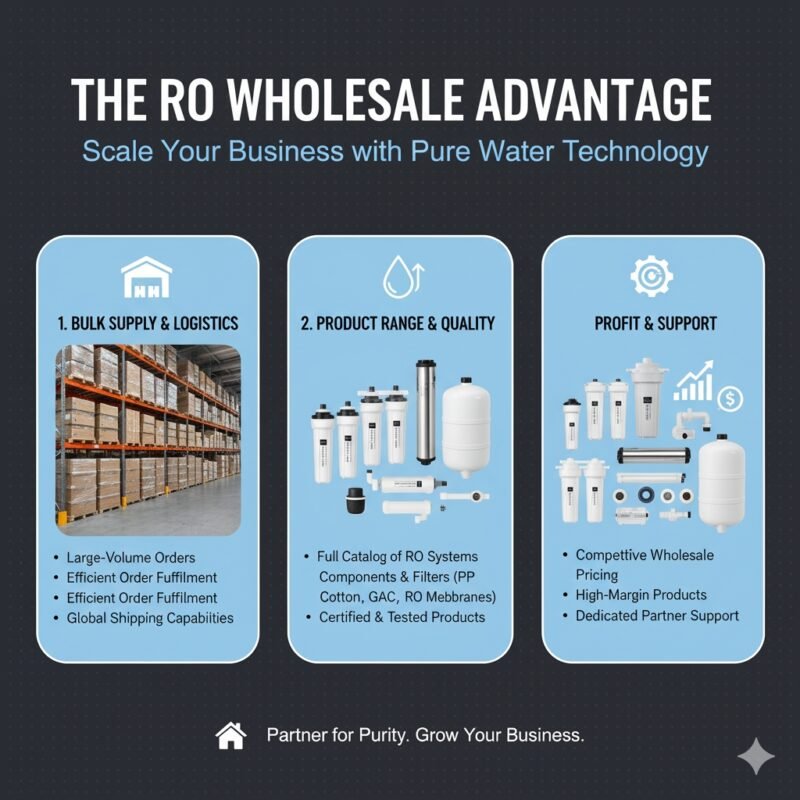
Quick overview — what you’ll learn
- Typical wholesale price ranges and the factors that drive them. Alibaba+1
- Where most suppliers are located and how that affects lead times and MOQ. Accio
- How to verify certifications and independent lab data before placing a bulk order.
- Quality assurance (IQC / AQL) steps and sample testing to protect your order.
- Shipping, incoterms, customs, and cost-saving logistics.
- Practical buying checklist and negotiation scripts you can reuse.
1.Market snapshot & realistic wholesale price bands
Before you commit money, understand the market price structure. Wholesale pricing for RO systems varies dramatically by capacity and configuration:
- Household under-sink RO units (basic 50–100 GPD): very low factory pricing in large orders — some factory offers on major B2B marketplaces start in the low-hundreds per unit in bulk. For example, small household units are commonly listed in the low-hundreds at minimum order quantities on major platforms. Alibaba+1
- Commercial / small-scale RO (500–2,000 GPD): mid-range pricing per system typically runs from a few thousand dollars wholesale depending on options (frame, skid, stainless housings). Reverse Osmosis Superstore+1
- Large industrial / skid RO systems (5,000–20,000+ GPD): prices scale to many thousands or tens of thousands per unit; these systems often require custom quotes and engineering. 博德水质过滤器
These ranges reflect product capability (membrane brand & count, stainless vs polymer housings, pre/post-treatment stages, controls and instrumentation). When you see a $60–$200 retail “tankless” RO on marketplace listings, that’s typically a low-margin factory price before shipping and certification checks; real wholesale buyers must add testing, certifications, spare parts, and warranty provisioning. Alibaba
2.Where to source: geography, clusters, and supplier types
Supplier choices affect cost, lead time, and quality:
- China — the largest manufacturing cluster for RO membranes, housings, pumps and finished units. Provinces in the Pearl River Delta and Yangtze River Delta are well known for OEM factories with fast turnarounds and low unit costs. If speed and low FOB cost matter, China is the natural starting point.
- USA / Europe — suppliers here typically sell higher-margin commercial and specialty RO systems (stainless skids, certified membranes, local support). If you need local inventory, shorter lead times, or particular certifications (e.g., NSF/ANSI, UL) with local service, consider regional distributors.
Supplier types:
- OEM factories — produce at scale and offer the lowest FOB price but require more QA and MOQ management.
- Trading companies / brokers — often handle smaller MOQs and consolidation but add margin.
- Local distributors — useful if you need local stock, immediate replacement parts, or warranty service.
Tip: for first large purchases, prefer factory direct (OEM) but insist on samples and clear QC terms; for ongoing smaller replenishments, a trusted trading partner or local distributor may be more convenient.
3.MOQ, packaging and typical lead times
Understand what a factory expects to accept as a minimum order:
- MOQ ranges: for finished household RO units, MOQ can be as low as a few dozen to several hundred units, depending on the factory and customization level. For commercial skids or industrial units, MOQ is usually 1 (custom build). Many Chinese listings show MOQs of 1 set for large systems but higher MOQs for OEM boxed household units. Alibaba+1
- Packaging expectations: wholesale buyers should require export-grade packaging (double boxed, interior foam, pallets wrapped) and include instructions/labels in required languages. Custom branding/PACK-OUT adds time and cost.
- Lead times: basic stock models: 2–6 weeks; OEM customized runs: 6–12 weeks or more; industrial skids: 8–16+ weeks depending on engineering and approvals.
Negotiation tip: ask for a production schedule with milestones (raw material purchase, first article, bulk run, packing) included in the contract.
4.Real cost components buyers must budget for
When calculating landed wholesale cost, don’t focus only on FOB unit price. Key additions include:
- FOB factory unit price — the base. (varies widely by model and membrane brand). Alibaba
- Sampling and testing fees — request sample units for approval; independent lab testing will add costs.
- Export packaging & labeling — custom packaging and manuals in your language.
- Freight (air vs sea) — sea is cheaper per unit but adds transit time and container fees; air is faster but expensive.
- Import duties & VAT — depends on destination country and HS codes for water purifiers.
- Inland delivery, customs brokerage & port handling — often underestimated.
- Insurance — advisable for high-value shipments.
- Initial spare parts — membranes, pumps, and typical consumables to support first sales.
- Certification costs — if you plan to sell into regulated markets (NSF, CE, etc.), factor certification test fees and time.
Example: a $150 FOB under-sink RO may become $220–$320 landed after freight, duties, and local handling depending on order size and shipping terms. Real numbers vary by route and scale — always run a landed-cost spreadsheet before committing.
5.Certifications, test data & compliance (must-have checklist)
When buying wholesale RO units, the PR and packaging claims are meaningless without proof. Ask suppliers for:
- NSF/ANSI certification(s) for the claimed contaminant reductions (e.g., NSF/ANSI 58 for RO systems). If the model claims lead or fluoride removal, demand model-specific certificates.
- Material safety (NSF/ANSI 61) and WQA or equivalent quality seals where relevant.
- CE / RoHS / local electrical safety approvals for pumps, controllers, and lamps.
- Independent lab reports — third-party testing for TDS rejection, microbial reduction (if claimed), and PFAS removal where applicable.
- Production batch traceability — membrane LOT numbers, pump serials, and date codes.
If the supplier cannot produce certification documents or independent lab reports for the exact model and serial range you will receive, treat the offer skeptically. Counterfeit certificates and recycled PDFs are common; request original PDFs and confirm with the issuing body.
6.Quality assurance: sample and batch testing strategy
Don’t skip this: implement a testing protocol for any significant order.
Step 1 — Pre-production sample (PPS): Request a physically produced sample unit. Validate dimensions, packaging, and basic operation.
Step 2 — Independent lab testing (optional but recommended): For high-volume or regulated markets, send the sample to an accredited lab to verify TDS rejection, flow, and any claimed contaminant removal. This can catch membrane counterfeits or poor assembly.
Step 3 — During production (DUPRO) inspection: Factory invites you or a 3rd-party inspector to check random units during the run; ensure tooling and assembly are consistent.
Step 4 — Pre-shipment inspection (PSI): Inspect a statistically significant sample of finished goods (visual check, leak test, pressure test, accessory presence, serial numbers). Use AQL sampling plans.
Step 5 — Post-arrival acceptance: On arrival, test a random sample against the lab results to confirm no damage in transit and no performance drift.
Use a third-party QA firm (SGS, Bureau Veritas, Intertek) if you can’t inspect personally — the upfront cost is small compared with the potential losses from a bad batch.
7.Negotiation levers that actually move price
When you contact a supplier, focus on levers that change economics:
- Order quantity (scale): biggest driver — per-unit cost drops fast with volume. Ask for pricing tiers (100, 500, 1,000+). Alibaba
- Payment terms: Net 30 or L/C for trusted suppliers; partial upfront deposits reduce supplier risk and can lower price.
- Longer lead times: flexible manufacturing windows can reduce costs.
- Standardized options: removing optional add-ons (display, special fittings) reduces cost.
- Consistent reorder commitments: commit to a 6–12 month rolling purchase schedule in exchange for better pricing.
- Bundled services: suppliers often reduce prices if they also handle packaging, palletization or partial logistics.
Always get price quotes that show unit FOB, packaging, palletization, and any optional extras separated line-by-line.
8.Profit margin math for resellers — simple example
A realistic pricing exercise helps decide if the SKU fits your channel:
- FOB factory price: $120/unit (50 GPD household RO)
- Landed cost after freight & duties: $180/unit
- Local installation/kit & spares per unit: $20
- Total unit cost: $200
Suggested resale pricing (B2C):
- Wholesale to dealers (30% margin): sell at $260–$300/unit.
- Retail (direct to consumer) with marketing & overhead: $349–$499 depending on brand positioning.
Margin tip: sell add-on consumables (replacement filters, membranes, service) as subscription revenue — this is where long-term margins live.
9.Logistics, incoterms and shipping tips
- FOB (Free On Board) — common for ocean shipments; supplier loads container at origin port. Buyer arranges freight and insurance.
- CIF / DDP — suppliers may quote CIF (cost, insurance, freight) or DDP (delivered duty paid) for convenience; these carry premiums but simplify import. For first orders, DDP can reduce surprises.
- Consolidation: if you buy multiple SKUs, consolidate shipments to reduce per-unit freight.
- LCL vs FCL: Less than Container Load (LCL) is cheaper for small orders but adds handling; Full Container Load (FCL) reduces per-unit freight if you can fill a container.
- Customs classification & duties: work with a customs broker early to confirm HS codes and duty rates for water purifiers and RO membranes.
Logistics tip: ask suppliers to palletize with load-secure strapping and include barcode labels for each carton — this speeds receiving and inventory.
10.Branding, OEM & private label strategies
If your business model is brand-led, discuss OEM/private-label with factories:
- Simple private label: use existing factory models, add your badge/sticker, and printed manual. Faster and lower MOQ.
- Co-engineered models: tweak features (faucet design, color, app integration). Requires higher MOQ and longer lead times but differentiates you.
- Exclusive SKUs: negotiate exclusivity per region to protect investments in marketing — factories may grant this for larger commitments.
Ensure trademark and IP rights are clearly included in the contract; get sample approvals for any branded packaging.
11.Warranty, spare parts, and after-sales setup
A robust after-sales system protects brand reputation:
- Warranty period: typically 1–2 years for parts and workmanship on household RO; commercial units often have different schedules. Clarify what is covered (labour, shipping, consumables).
- Spare parts inventory: keep membranes, pumps, valves, and common cartridges in local inventory for quick service. Wholesale buyers frequently under-stock spares — this creates customer dissatisfaction.
- Service network: either train local technicians, partner with existing plumbers, or contract a service provider.
- RMA process: define returns policy, who pays for return shipping, and replacement timelines in the contract.
Profitability often depends more on consumable replacements and service contracts than on initial hardware markup; plan accordingly.
12.Regulatory, labelling and safety requirements by market
Different markets demand different compliance:
- USA: NSF/ANSI standards plus possible state requirements; care with claims (you can’t claim “removes bacteria” without appropriate testing).
- EU / UK: CE and local water treatment directives.
- India / other markets: local certifications or BIS approvals may be required.
- Retail claims & advertising: always back product claims with certificates to avoid liability.
Check labelling laws for language requirements, safety marks, and what must appear on packaging (warranty, country of origin, electrical ratings where relevant).
13.Sustainability and circularity — modern buyers care
Increasingly, buyers and end customers expect responsible choices:
- Membrane & cartridge recycling: enquire whether suppliers or local partners have recycling for spent cartridges/membranes.
- High-efficiency RO models: lower reject ratios save water and can be a selling point. Crystal Quest Water Filters
- Energy efficient pumps and smart controllers: reduce operating costs and carbon footprint.
- Responsible materials: food-grade plastics, BPA-free housings, and non-toxic adhesives.
Sustainability can be used as a premium differentiator in B2C markets and as procurement criteria for B2B tenders.
14.Common pitfalls and how to avoid them
- Buying on price alone: cheap units with no test data are high risk. Always demand model-specific docs.
- Skipping samples & lab tests: never place bulk money without a validated sample and independent test.
- No spare parts plan: inability to support customers after sale kills brands. Keep a spare parts kit.
- Not checking electrical & safety approvals: pumps and controllers without approvals may be blocked by customs or be unsafe.
- Ignoring packaging & damage risk: poor packaging leads to returns and chargebacks; insist on export-grade packing.
Avoid these with a checklist and a simple contract that ties payment to milestones and inspection approvals.
15.Practical, ready-to-use wholesale checklist (use before you buy)
- Define SKU scope (household 50–100 GPD, commercial 500–2,000 GPD, etc.).
- Request 3+ factory quotes with FOB unit price, MOQ tiers, and sample price.
- Order a production sample and run independent lab tests for claimed performance.
- Negotiate terms: price tiers, lead time, payment terms, and warranty.
- Agree QA procedure: DUPRO and PSI with AQL sampling plan.
- Confirm packaging & palletization standards in writing.
- Decide incoterm and shipping method; get landed cost estimates.
- Plan spare parts inventory for the first 6 months of sales.
- Prepare marketing & compliance docs (manuals, labels, certificates).
- Set up after-sales logistics and service contacts.
Use this checklist as a work order to guide procurement and legal teams.
16.Short case study — from inquiry to on-shelf (example timeline)
Buyer: small online retailer wants 500 household RO units private labeled.
Steps & timeline
- Week 0: RFQ to three factories; obtain FOB quotes and MOQ tiers.
- Week 2: Select vendor and order two samples; test in independent lab (TDS rejection, flow, leak test).
- Week 4: Approve sample; deposit 30% for P.O. (lead time 8 weeks).
- Week 8–10: DUPRO inspection and PSI at factory (3rd party inspector).
- Week 11: Container loaded FOB; sea transit 4 weeks.
- Week 16: Arrival, customs clearance, local delivery, small batch test (random 10 units) before distribution.
Total time ~16 weeks from initial inquiry to on-shelf product. This matches common timelines for OEM private label batches.
17.Tools & partners to speed your wholesale program
- B2B marketplaces: Alibaba, Made-in-China, TradeIndia for supplier discovery. Alibaba+1
- 3rd-party QC: SGS, Bureau Veritas, Intertek for inspections.
- Freight forwarders: Use experienced forwarders who know water purifier HS codes.
- Lab partners: Accredited labs for NSF-equivalent testing or local regulatory tests.
- Customs broker: required to speed import clearance and avoid misclassification.
These partners reduce risk and improve predictability.
18.Where to go next — tactical first moves
- Decide your initial SKU and target margin.
- Gather target market certification requirements.
- Request sample quotes from 3 suppliers and order samples to test.
- Build a landed cost sheet including freight, duties, spares and certification.
- If you want a low-risk start, consider buying a small distribution lot from a local wholesaler, test market response, and then scale to OEMs for lower unit costs.
And if you’re comparing product specs and certified models for resale, start your shortlist at sites like https://yourwatergood.com/ where models and technical sheets can be compared side-by-side.
19.Final words — a business case, not a hobby
Sourcing ro water purifier wholesale is a predictable business when you treat it like one: specify exactly what you need, verify with samples and lab tests, lock down QA milestones, and plan spares and service before you sell. The initial unit price is only one variable — landed cost, certification, reliability, and after-sales will determine whether the SKU is profitable and scalable.
If you follow the purchasing checklist in section 15 and insist on documented test data and pre-/post-shipment inspections, you’ll dramatically reduce risk and improve margins. When you’re ready to compare certified SKUs or request quotes, look up product catalogs and manufacturer specifications at https://yourwatergood.com/ and bring your certificate checklists to the supplier conversation.