How Much Does a Water Filtration System Cost? Point-of-Use vs Whole House

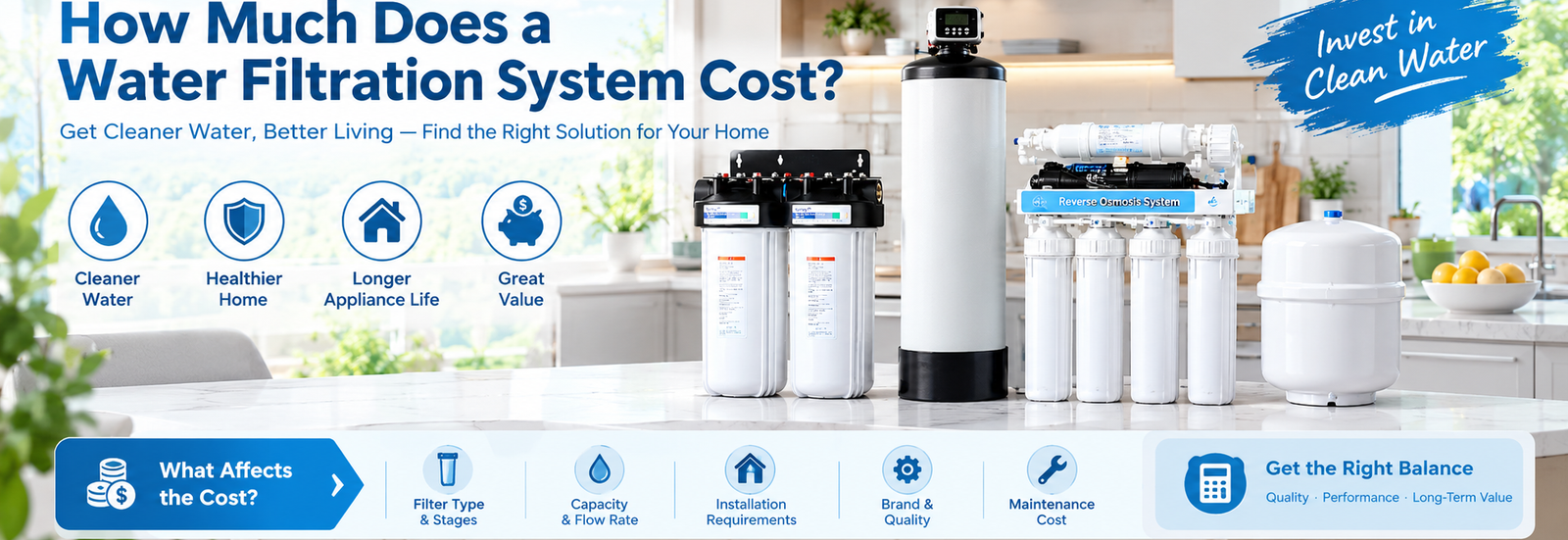
How much does a water filtration system cost? It ranges from a pitcher you buy at a grocery store to a multi-stage whole house system. HomeAdvisor’s cost guide puts whole house water filters at $1,129 to $3,540, averaging about $2,272. Point-of-use filters for one tap cost far less upfront, but they only treat that tap.
What decides your number:
- Coverage: one faucet (point-of-use) or the whole house (point-of-entry)
- Technology: carbon, reverse osmosis, softening, UV, or a combination
- Water source: city water usually needs less treatment than a well
- Installation: DIY, or a plumber at roughly $300 to $500 in labor for a typical job
- Running costs: cartridges, membranes, salt, and lamps every year
Two Kinds of Systems, Two Kinds of Cost
Point-of-use (POU) systems treat water at one outlet: a pitcher, a faucet-mounted filter, a countertop unit, or an under-sink filter or RO system. They are cheaper to buy and often DIY-installed. They do nothing for showers, laundry, or the water heater.
Point-of-entry (POE), or whole house, systems treat all water entering the home. They cost more and usually need a plumber, but they handle sediment, chlorine smell, and scale at every tap and appliance.
Many homes end up with both: a whole house filter for general use and RO at the kitchen sink for drinking water. Our comparison of whole house vs point-of-use water filters explains when each makes sense.
Cost by System Type
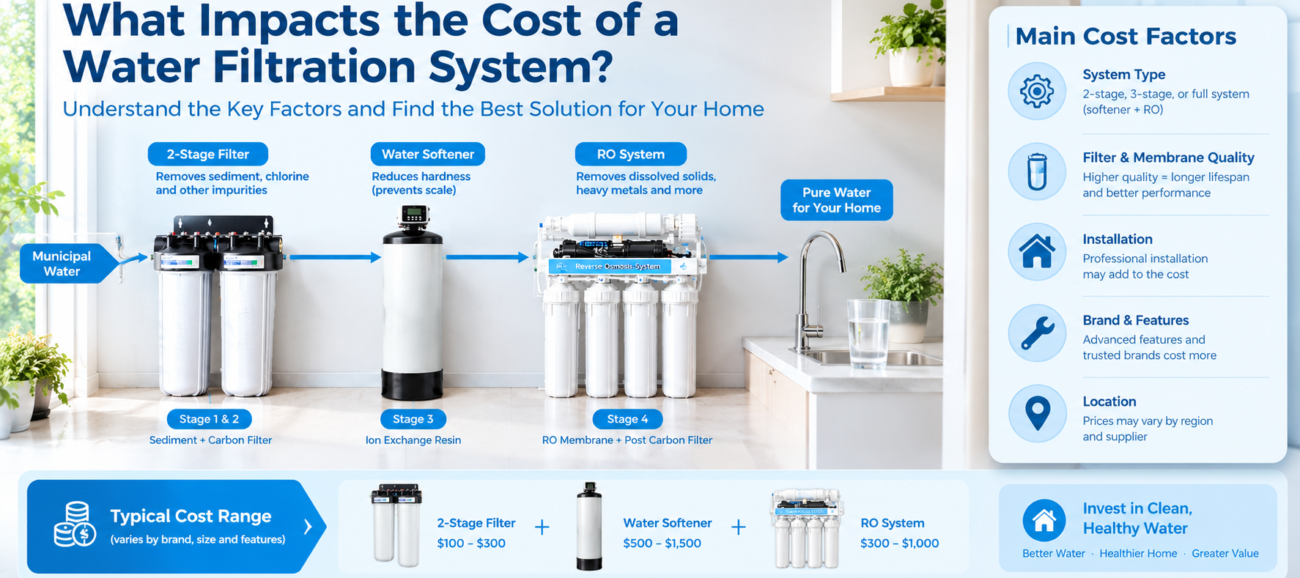
| System | Upfront cost | Typical running costs | What it does |
|---|---|---|---|
| Pitcher or faucet filter | Lowest | Frequent small cartridges | Improves taste at one tap |
| Under-sink carbon filter | Low | Cartridges once or twice a year | Chlorine taste and odor at the kitchen tap |
| Under-sink RO | Low to moderate | Pre-filters, membrane every year or two | Dissolved solids, nitrate, fluoride at one tap |
| Whole house filter | $1,129 to $3,540 (HomeAdvisor) | Sediment and carbon cartridges | Sediment and chlorine at every tap |
| Water softener | $200 to $6,000 (HomeAdvisor) | Salt, occasional service | Removes hardness |
| UV unit | $500 to $1,500 (HomeAdvisor) | Annual lamp, electricity | Microbial control, mainly on wells |
| RO system | $1,000 to $4,800 (HomeAdvisor) | Pre-filters, membranes, water to drain | Dissolved contaminants |
HomeAdvisor’s figures are national ranges and do not always separate system size. Point-of-use figures are shown as tiers because public pricing varies too widely to quote a reliable range.
Installation Costs
- Point-of-use: pitchers and faucet filters need no installation. Under-sink filters and RO are common DIY jobs.
- Whole house: HomeAdvisor lists typical labor at $300 to $500. Galvanized pipe, hard-to-reach mains, softener drains, and UV wiring push that higher.
Our how much to install a whole house water filter article covers the labor side in detail.
Running Costs Over Time
Upfront price is the smaller part of the story for most systems. HomeAdvisor puts ongoing maintenance at $50 to $300 per year and repairs, when needed, at $50 to $800.
What drives running costs:
- Cartridge size and interval. Small cartridges are cheap but changed often. Larger whole house cartridges cost more each but last longer.
- RO pre-filters and membranes. A typical 5-stage RO changes pre-filters every few months and the membrane every one to two years.
- Softener salt throughout the year.
- UV lamps once a year, plus electricity.
- Water testing. HomeAdvisor lists $30 to $500, depending on how many contaminants you test for.
How to Estimate Your Total Cost of Ownership
Comparing systems on sticker price alone leads to bad choices. Do this instead:
- Write down the upfront price and installation for each option.
- List every cartridge, membrane, lamp, or salt purchase per year, with its price.
- Add up those yearly costs over five years.
- Add the upfront total to the five-year running cost.
- Compare options on that total, not on the purchase price.
A cheap system with expensive proprietary cartridges often ends up costing more than a mid-priced system that uses standard sizes.
Which System Do You Actually Need?
| Your situation | Usually enough | Usually not needed |
|---|---|---|
| City water, only drinking taste bothers you | Under-sink carbon filter | Whole house system |
| City water, chlorine smell in showers, grit in aerators | Whole house sediment and carbon | Whole house RO |
| Concern about nitrate, fluoride, or high TDS in drinking water | Under-sink RO | Whole house RO |
| Hard water with scale on fixtures and heaters | Softener, often with a whole house filter ahead of it | UV |
| Private well with bacteria or iron | Treatment designed from a lab test | A single cartridge filter |
For more detail on whole house costs alone, see our whole house water filtration system cost breakdown.
Hidden Costs to Plan For
- Pressure loss from an undersized system, which may push you toward a booster pump later
- Drain and power for softeners, backwashing tanks, RO, and UV
- Proprietary cartridges that only one supplier sells
- Water to drain from RO systems and softener regeneration
- Replacing a cheap housing that cracks under high pressure
Questions to Ask Before You Buy
- Which contaminants does each stage target, and what in my water report justifies it?
- What size are the cartridges, and what does each replacement cost?
- How often will I change each cartridge on my water, not on average water?
- Does the system need a drain or electricity, and is that in the installation price?
- What is the rated flow, and will it keep up when two showers run?
- Is installation included, and does a DIY install affect the warranty?
If the seller cannot answer these, the price you were quoted is not the price you will pay.
Ways to Spend Less Without Cutting Corners
- Test first. Buy only the treatment your water needs.
- Use RO where you drink, not at the main line.
- Choose standard cartridge sizes, so you can compare replacement prices.
- Size the whole house system correctly, so it does not need upgrading.
- Install a bypass and gauges at the start to make maintenance faster and cheaper.
How YourWaterGood’s Systems Fit
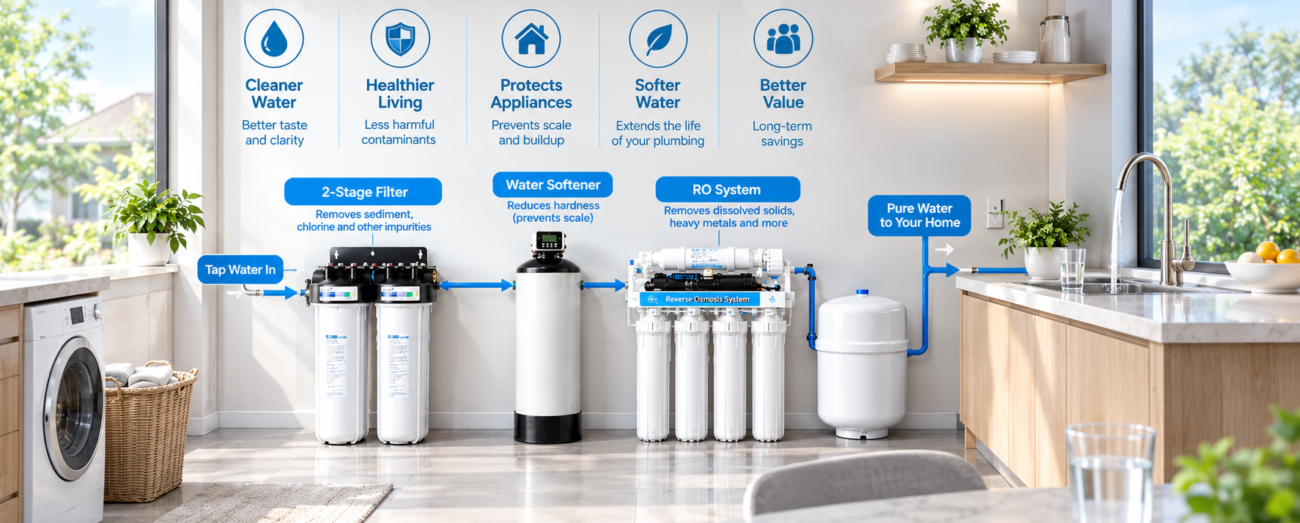
- Our 2-stage whole house water filter is a cartridge system with PP cotton + CTO carbon block for city water taste and odor, or PP cotton + polyphosphate scale inhibitor for slowing scale without salt. Our 3-stage system adds a second carbon stage. Both run with no electricity and no wastewater, so there is no operating cost beyond cartridges. We suggest replacing the PP cotton stage every 3 to 6 months.
- For drinking water, our 5-stage RO water filter for home lists its replacement schedule up front: PP cotton at 3 to 6 months, carbon stages at 6 to 9 months, the membrane at 12 to 24 months, and the post-carbon at 12 months. That makes the yearly cost easy to calculate before you buy.
Prices depend on configuration and quantity, so we quote each order together with the replacement cartridges.
For Installers, Property Managers and Brands
If you supply filtration across many homes, cartridge pricing decides your margin and your customers’ running cost. We supply whole house systems, RO systems, and replacement cartridges in volume, with spec sheets and wholesale pricing on request.
FAQ
How much does a whole house water filtration system cost?
HomeAdvisor’s June 2026 guide puts whole house water filters at $1,129 to $3,540, averaging about $2,272. Simple cartridge systems on city water sit at the lower end.
How much does an under-sink RO system cost?
Under-sink RO costs much less upfront than whole house treatment, but plan for pre-filter changes every few months and a membrane every one to two years. Ask for the full replacement schedule and prices before you buy.
What does it cost to maintain a water filtration system?
HomeAdvisor lists typical maintenance at $50 to $300 per year. Cartridges are the main cost for filters; softeners add salt and UV adds a yearly lamp and power.
Is a whole house filter worth more than a point-of-use filter?
If you only care about drinking water, a point-of-use filter is cheaper and enough. A whole house filter is worth it when you want sediment and chlorine removed at every tap and appliance.
How much does water testing cost?
HomeAdvisor lists $30 to $500, depending on the number of contaminants tested. City customers can start with their utility’s free annual water quality report.
Why do two quotes for a water filter differ so much?
They usually treat different problems or use different cartridge sizes. Compare the stages, flow rating, and five-year cartridge cost side by side.
Get a Quote That Includes Running Costs
Tell us your water source and what you want to fix. We will tell you how much a water filtration system costs for your home, including replacement cartridges, and send the spec sheets. Installers and property managers can request wholesale pricing from YourWaterGood.