
Skid Mounted RO System for Data Center: Factory-Built, Fast to Deploy, Engineered to Fit

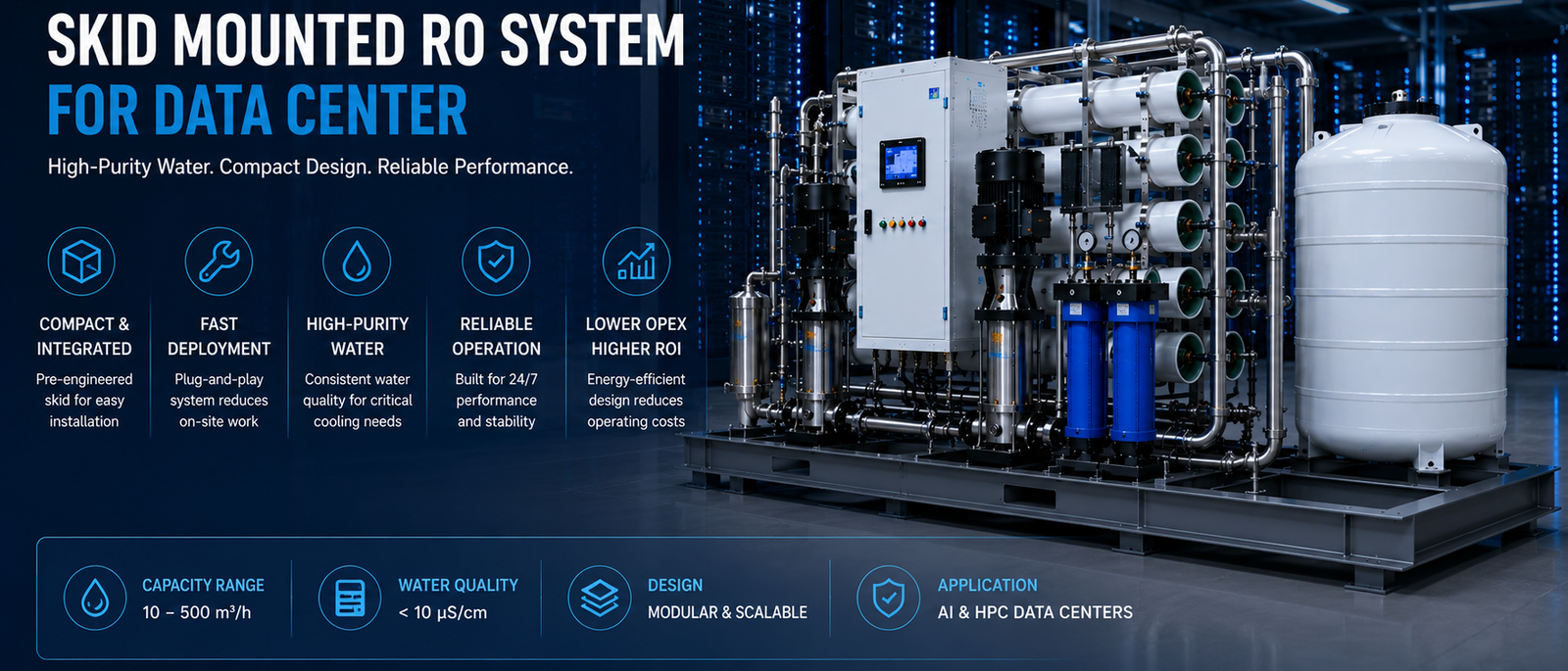
A data center’s water plant sits on the critical path of the build, and a field-assembled (stick-built) system is the slowest, highest-risk way to get there. Pipes cut on site, components mounted one by one, and quality verified only after everything is connected.
A skid-mounted RO system arrives the opposite way: pre-assembled on a single frame, factory-tested, and ready to connect. It is the deployment format a fast data center schedule actually demands.
A skid mounted ro system for data center use is not a different RO technology — it is a different way of delivering it, engineered for speed, predictable quality, and a footprint that fits a crowded data hall.
Before sourcing, lock these skid-specific specifications:
- Factory-assembled and FAT-tested — performance verified off-site before it ships.
- Compact, engineered footprint — including service clearance, not just the frame outline.
- Modular for parallel operation — additional skids for N+1 redundancy or capacity.
- Pre-integrated — pump, piping, instrumentation, controls, and BMS interface on one frame.
- Rigging access verified — door, corridor, floor loading, and crane access checked against the assembled skid.
The sections below break down what the skid format delivers and where it can trip a project up.
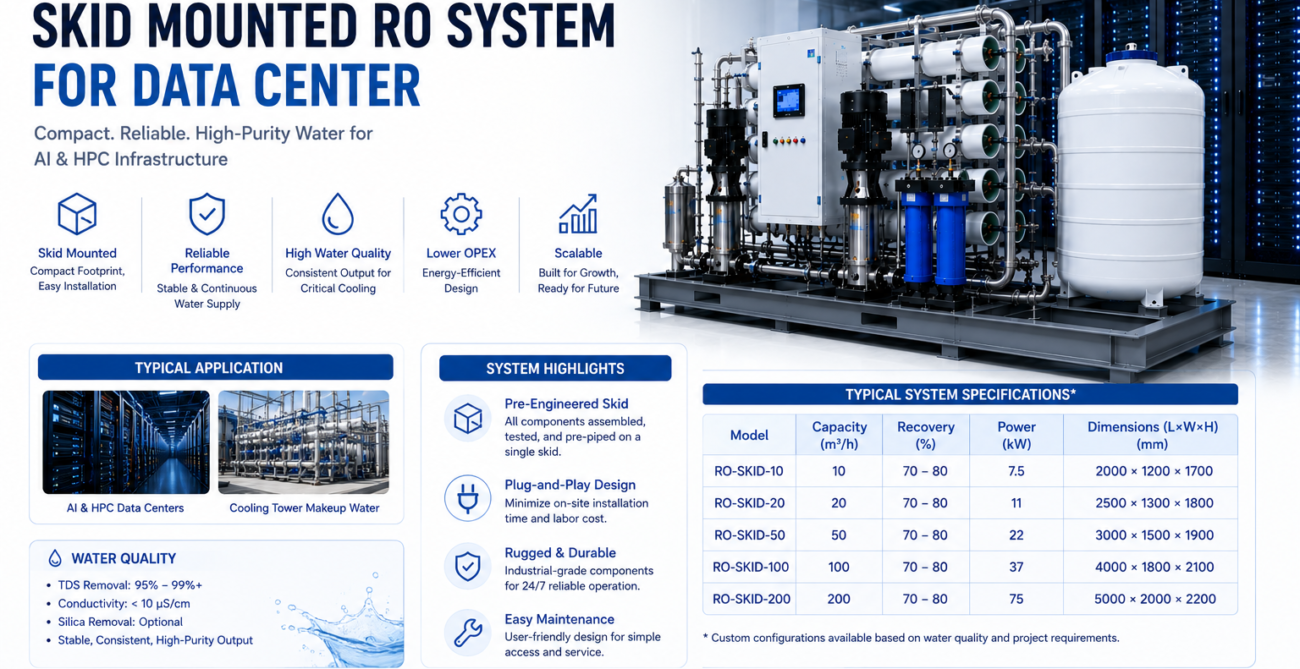
Why Skid-Mounted, Not Field-Built: The Schedule and Quality Case
The strongest argument for a skid mounted ro system for data center deployment is that it removes the water plant from the construction critical path, where a field-built system would sit for weeks.
A skid-mounted approach changes the build in three ways:
- Speed — the system is assembled and tested at the factory in parallel with site construction, then installed by connecting inlet, outlet, power, and BMS, rather than built on site.
- Predictable quality — the skid is performance-tested before shipment, so issues are caught at the factory, not discovered during commissioning in a live facility.
- Single integrated unit — pump, vessels, piping, and controls arrive pre-engineered and pre-wired, eliminating the field coordination a stick-built system requires.
For a facility racing to energize compute, a delayed water plant delays the whole building. The skid format compresses that risk by moving assembly and testing off the critical path — which is why it has become the default for time-driven data center buildouts.
What “Skid-Mounted” Actually Delivers: Factory Assembly, Testing, and Footprint
Beyond speed, the skid format delivers concrete engineering advantages that a field-built system cannot match. Each follows from the system being built and tested as one unit.
What a quality skid-mounted system provides:
- Factory acceptance testing (FAT) — the skid is run and verified at the factory, proving flow, recovery, and rejection before it ships.
- Engineered footprint — components laid out on a frame for minimum floor area, valuable where data-hall space is scarce.
- Pre-integrated instrumentation — flow, pressure, and conductivity (µS/cm) monitoring wired to a single control panel and BMS interface.
- Continuous-duty construction — stainless frame and piping rated for 24/7/365 operation.
- Documented as one package — a single P&ID and one set of spares for the assembled unit.
The footprint advantage carries a caveat: the real footprint includes service clearance — pull space for membrane replacement and access to panels and valves — not just the frame outline. A skid specified to the frame dimensions alone will be hard to maintain once installed. The skid format is efficient, but the layout still has to account for service access.
Modular Skids: Scaling Capacity and Redundancy by Adding Units
The skid format makes the RO system a building block, which is how a data center scales capacity and builds redundancy without redesigning the plant.
Modularity in practice:
- Parallel skids for capacity — additional identical skids increase total GPD as the facility grows, matching water output to load in phases.
- Redundancy by unit — an N+1 configuration runs a spare skid so a membrane change or service event on one does not take the loop down.
- Phased CAPEX — capacity is added when needed rather than oversized on day one, aligning spend with the buildout.
- Standardized spares — identical skids share one spare-parts inventory, simplifying support.
This block-based approach pairs naturally with mission-critical design: the skid is both the capacity unit and the redundancy unit. Adding a skid adds output and resilience at once, which is far simpler than re-engineering a single large field-built train. The result is a system that grows with the facility while holding 99.999% uptime.
Feed Water Still Sets the Design: Municipal vs Reclaimed Skid Trains
The skid format is a delivery method, not a treatment shortcut. The feed water still determines what goes on the skid — and municipal versus reclaimed feed requires different skid trains.
Municipal potable feed:
- A lighter skid train — cartridge pre-filtration, carbon for chlorine/chloramine, and single- or two-pass RO.
- Chloride control in material selection to protect 316L from pitting.
Reclaimed and recycled feed — increasingly mandated for WUE targets in Ashburn, VA and Phoenix, AZ:
- A heavier, multi-skid train — multimedia filtration, softening, and antiscalant dosing ahead of the RO skid.
- Fouling-resistant membranes and lower recovery for high TDS and silica above ~150 ppm.
- More skids in the train, and a larger combined footprint.
A skid configured for municipal feed will foul on reclaimed water regardless of how well it is built. The feed-water analysis sets the skid content, and the skid format simply delivers it pre-assembled — consistent with ASHRAE TC 9.9 and EPA frameworks.
Standard Skids vs Data-Center-Grade Skid Systems
Not every skid-mounted system is built for mission-critical duty. A commercial skid and a data-center-grade skid differ in redundancy, testing, materials, and integration.
| Engineering Parameter | Standard Pre-Engineered Skids | Data Center Grade High-Redundancy Skid Systems |
|---|---|---|
| Factory testing | Minimal | Full FAT before shipment |
| Flow capacity (GPM) | 10–50 GPM | 100–1,000+ GPM, parallel skids |
| Redundancy | Single skid | N+1 / N+2 / 2N parallel skids |
| Purity | Single-pass | Two-pass + EDI to 18.2 MΩ·cm |
| Pump | Fixed-speed | VFD-controlled |
| Materials | 304 stainless | 316L / PVDF |
| Integration | Basic panel | Online analyzers, BMS (Modbus/BACnet/SNMP) |
| Documentation | Limited | Full P&ID, standardized spares |
The testing and redundancy rows separate the two: a single, lightly-tested skid carries the same downtime exposure as any non-redundant system, while a FAT-tested, N+1 skid array protects the loop. The skid format does not by itself make a system data-center-grade — the engineering on the skid does.
To pressure-test a vendor, ask whether each skid is FAT-tested and how redundancy is configured. A skid quoted without testing or redundancy is a commercial unit on a frame.
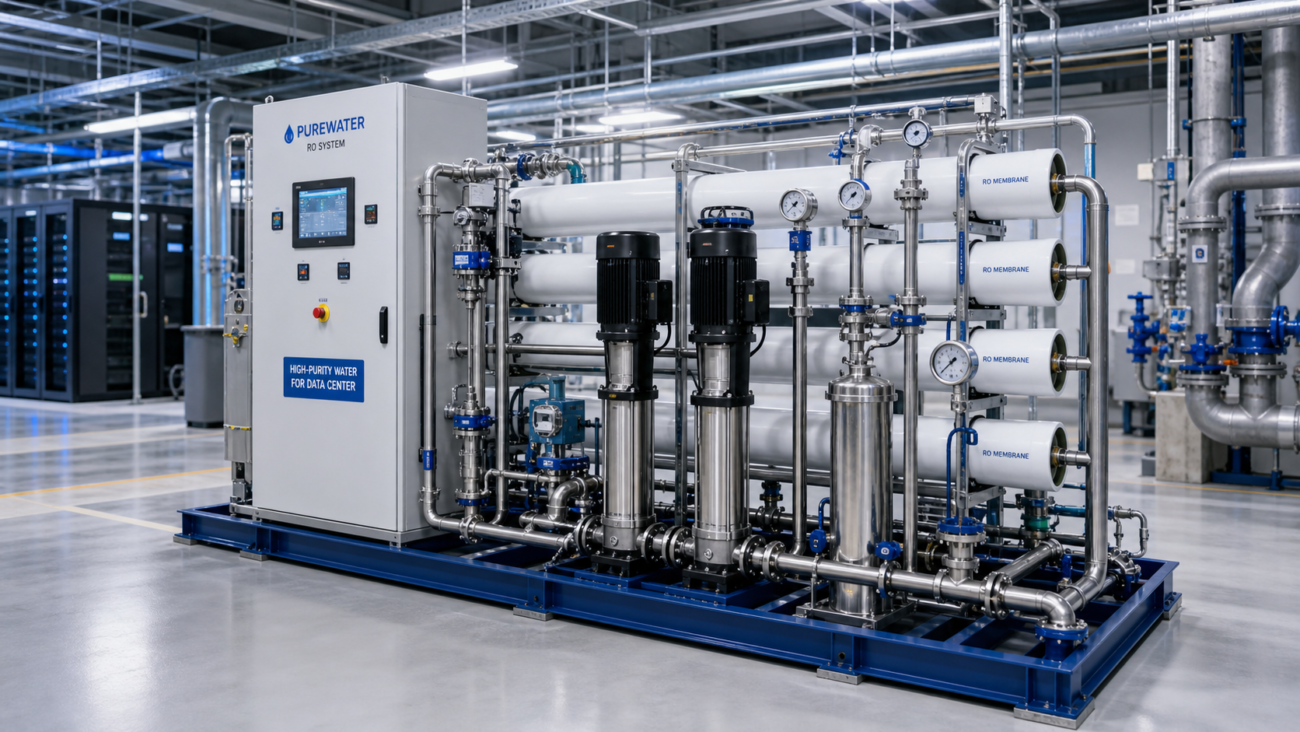
Field Engineering Insight: The Skid That Fits on the Drawing but Not Through the Door
Here is the detail that turns a fast skid deployment into a delayed one: a skid is built and shipped as a single rigging unit — and if the path into the data hall was never checked against its size and weight, it arrives and cannot be brought in.
The skid’s biggest advantage — full factory assembly — is also its constraint. A large RO skid, complete with pressure vessels, high-pressure pump, and stainless frame, is heavy and dimensionally fixed. “It fit on the layout drawing” is not the same as “it fits through the building.”
The rigging path is where projects get caught:
- Door and corridor widths, and the turning clearance around corners.
- Elevator or ramp capacity for upper-floor or raised-floor installations.
- Structural floor loading — a fully assembled, water-filled skid concentrates significant weight.
- Crane or forklift access to set the skid in place.
Miss any of these and the FAT-tested skid sits on the dock while the schedule it was meant to protect slips.
The defense is to verify the route before the skid is built:
- Check the full rigging path and floor loading against the assembled skid’s envelope and weight, early.
- Specify the skid in transportable sections sized to the access route where the path is tight, assembled and re-tested on site.
- Confirm door, corridor, and elevator dimensions and turning clearance in writing.
- Coordinate rigging method (crane, forklift, skating) before delivery.
This is the kind of detail that never appears on a flow-rated quote but decides whether the skid’s speed advantage is realized or lost. It is also where a well-coordinated skid deployment pays back: a system installed fast and correctly starts protecting cold plates and CDUs sooner, lowers install cost, and holds 99.999% uptime from the moment the loop goes live.
Skid Mounted RO System for Data Center FAQs
What is a skid-mounted RO system? An RO system pre-assembled on a single frame at the factory — pump, pressure vessels, piping, instrumentation, and controls integrated and performance-tested before shipment, so it installs by connection rather than field assembly.
Why use a skid-mounted RO system in a data center? For faster installation, factory-tested quality, a compact footprint, and modular expansion. It removes the water plant from the construction critical path, fitting the fast-build schedules data centers run on.
How fast can a skid-mounted system be installed? Far faster than a field-built system. Installation is connecting inlet, outlet, power, and BMS and commissioning, rather than weeks of on-site assembly — though the exact time depends on site readiness and rigging access.
Are skid-mounted RO systems modular? Yes. Multiple identical skids run in parallel to add capacity (GPD) or provide N+1 redundancy, letting the system scale with the facility and share one spare-parts inventory.
Does the skid format change the treatment design? No. The feed water — municipal versus reclaimed — still sets the membranes, pre-treatment, and recovery. The skid is the delivery format, not a change to the treatment requirement.
What about footprint and rigging access? The engineered footprint must include service clearance for membrane replacement and panel access, and the rigging path (door, corridor, elevator, floor loading) must be verified against the assembled skid before it is built.
Can skid-mounted systems be relocated? Yes. Because they are self-contained units, skid-mounted systems can be moved or redeployed, which suits phased buildouts and temporary or bridge capacity.
Deploy a Skid That Fits Your Space and Your Schedule
A skid-mounted RO system for a data center delivers the same treatment as a field-built plant, faster and with verified quality — provided it is engineered for your feed water, your footprint, and your rigging access. The format protects the schedule only when those constraints are designed in.
Whether you need a single skid or a parallel skid array for a larger buildout, YourWaterGood sources the right system through our manufacturing partner and a network of vetted factories — skid mounted ro system for data center configurations cover skid-mounted RO, EDI, softening, and dosing, with quality inspection, logistics, and English-language support handled for you.
- Get an Infrastructure Engineering Quote: send your capacity, footprint, and access constraints for a configured skid proposal.
- Request Technical Data Sheets: skid dimensions, weights, FAT scope, and BMS integration detail for your site planning.
- Get Competitive B2B Pricing: sourced through our supplier network, with QC and shipping managed end to end.