
The Essential Guide to Selecting the Best water filter commercial kitchen for Performance and Profit

In the high-pressure environment of a professional culinary establishment, every variable is scrutinized. Chefs obsess over the provenance of their proteins, the humidity of their walk-ins, and the precision of their knife edges. Yet, the most fundamental ingredient—the one that boils the pasta, brews the coffee, makes the ice, and cleans the dishes—is often the most overlooked. Water is the lifeblood of the foodservice industry, and its quality dictates the success of your brand.
For a modern restaurant, bakery, or cafe, a water filter commercial kitchen system is not just a utility; it is a strategic investment. High-quality water is essential for flavor consistency, equipment longevity, and operational efficiency. In this comprehensive guide, we will explore the science, the economics, and the practical application of water filtration in the commercial kitchen.https://yourwatergood.com/product/whole-house-water-filtration-system-for-home/&https://yourwatergood.com/product/5-stage-ro-water-filter-for-home-busines/
Part 1: Why Your Restaurant Needs a water filter commercial kitchen
Many business owners assume that if their tap water meets municipal safety standards, it is “good enough” for their kitchen. This is a dangerous misconception. Municipal water is treated to be safe for human consumption, but it is not optimized for culinary excellence or the protection of expensive machinery.
1. Flavor Integrity and Consistency
Water is a universal solvent. If your water contains chlorine, chloramines, or high levels of organic matter, it will impart a chemical “off-taste” to everything it touches.
- Specialty Coffee: Coffee is 98% water. If the water is too hard or tastes of chlorine, your $20-per-pound beans will taste flat and bitter.
- Soups and Stocks: Water with high mineral content can interfere with the extraction of flavors from bones and vegetables.
- Bakery Products: Chlorine can inhibit yeast activity, affecting the rise and texture of artisanal breads.
2. Equipment Protection
The greatest enemy of a commercial kitchen is limescale. Hard water contains dissolved calcium and magnesium. When heated, these minerals solidify, coating heating elements and clogging internal valves. Without a professional water filter commercial kitchen solution, your $15,000 combi-oven or espresso machine could suffer a catastrophic failure within its first year of operation.
3. Ice Quality and Hygiene
Ice is technically food. If your water is not filtered, your ice will be cloudy, taste like chemicals, and melt faster. Furthermore, sediment in the water can lead to the growth of biofilm in the ice bin, causing health code violations.
Part 2: The Science of Filtration: From Sediment to RO
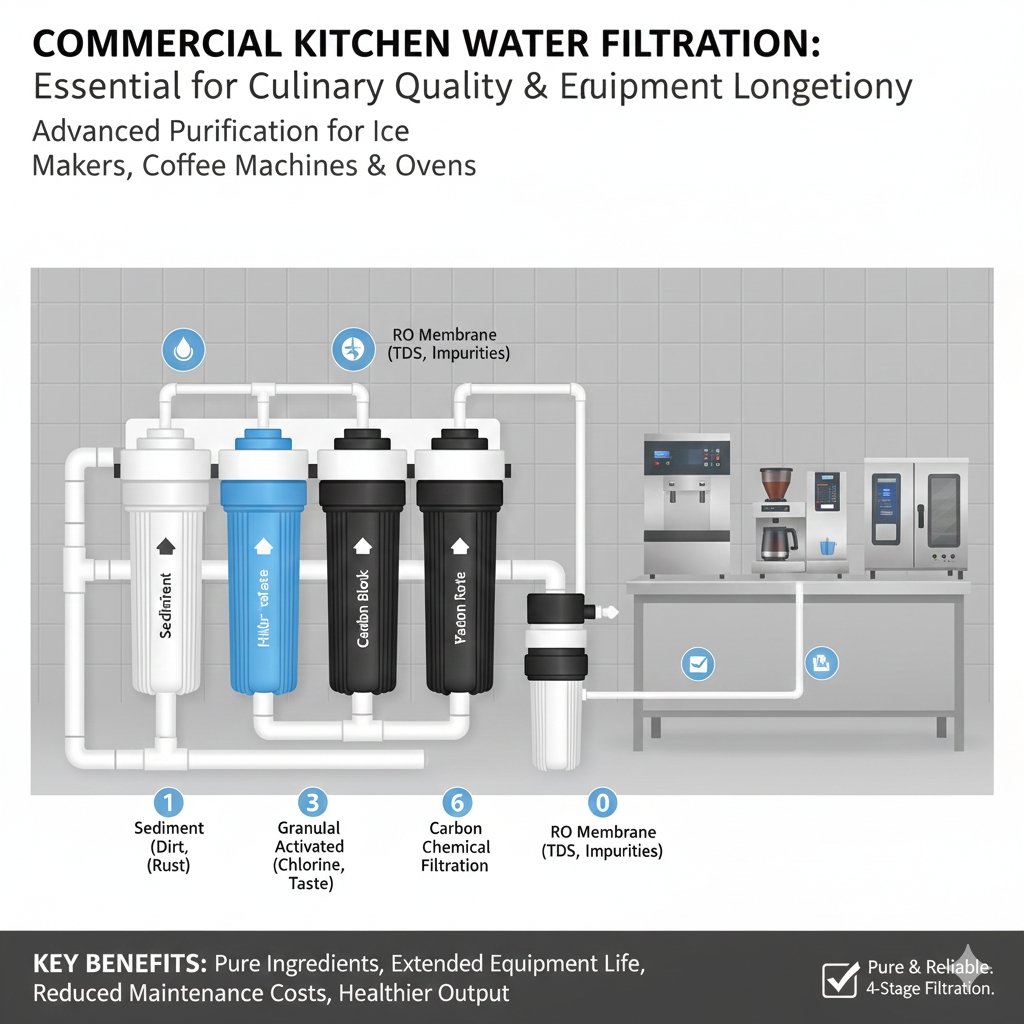
To choose the right system, you must understand the different technologies available. Most high-performing kitchens utilize a multi-stage approach.
Stage 1: Sediment Filtration
This is the mechanical removal of physical particles like rust, sand, and silt. As a specialized pp cotton household water purifier company, we prioritize high-density melt-blown polypropylene (PP) cotton. This material acts as a gatekeeper, preventing abrasive particles from scratching the internal seals of your faucets and dishwashers.
Stage 2: Carbon Filtration
Activated carbon is used to remove chlorine, chloramines, and Volatile Organic Compounds (VOCs). This is primarily for taste and odor removal. In a water filter commercial kitchen setup, carbon blocks are essential for protecting the palate of your customers.
Stage 3: Scale Inhibition
Since restaurants use high-heat equipment, scale inhibition is vital. This can be achieved through polyphosphate feeders (which keep minerals in suspension) or ion-exchange water softeners.
Stage 4: Reverse Osmosis (RO)
For the highest level of purity, RO systems force water through a semi-permeable membrane. This removes 99% of all dissolved solids.
- Recommendation: For bars and coffee stations that require medical-grade purity and the best-tasting drinking water, the 5 Stage RO Water Filter for Home & Business is the gold standard. It provides a level of purity that standard filters cannot match.
Part 3: Strategic Deployment: POE vs. POU
When designing your kitchen’s water strategy, you must decide where to filter the water.
Point-of-Entry (POE): The Whole-Facility Shield
A POE system is installed on the main water line as it enters the building. This protects every pipe, the water heater, the bathrooms, and the dishwashers. It is the best way to prevent the entire building’s infrastructure from corroding.
For businesses looking for comprehensive protection, especially for small-to-medium restaurants or large households with high water demand, we highly recommend the Whole House Water Filtration System for Home. While labeled for “home,” its high-flow capacity and industrial-grade construction make it a perfect entry-level POE solution for small business owners who want to protect their hot water tanks and plumbing systems from the start.
Point-of-Use (POU): The Precision Scalpel
POU systems are installed at specific stations. For example, a dedicated RO system for the espresso machine or a carbon filter for the fountain soda line. This allows you to customize the water chemistry for different needs—soft water for the steamer, and mineral-balanced water for the coffee bar.
Part 4: Station-Specific Requirements
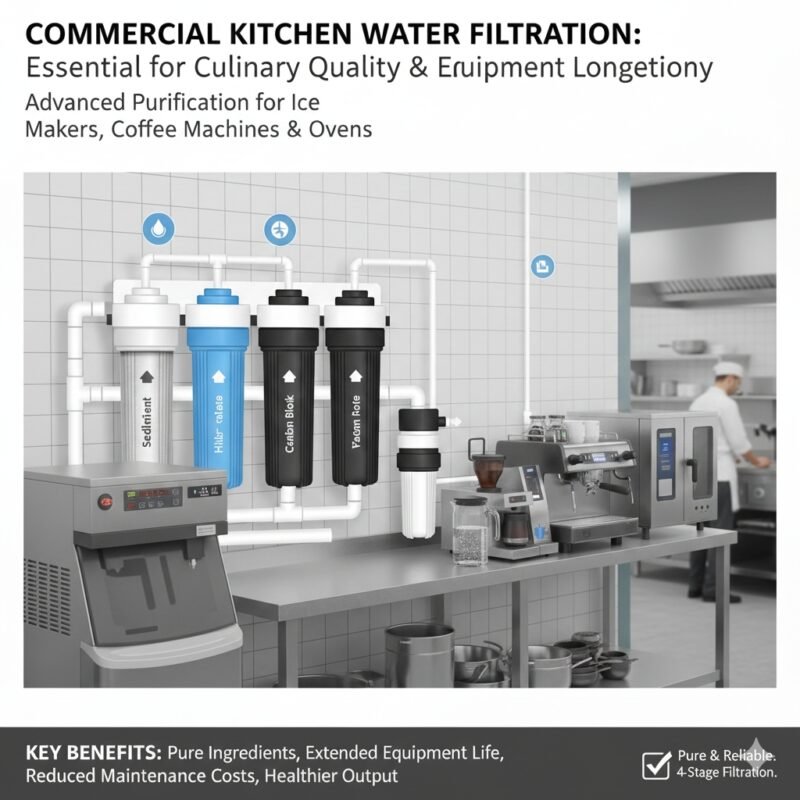
A successful water filter commercial kitchen setup must account for the specific needs of different kitchen zones.
1. The Beverage Station
This is where the money is made. Fountain soda, iced tea, and craft cocktails all rely on water. Chlorine is the enemy here. A multi-stage carbon system is required to ensure that your sodas are crisp and your iced tea is clear.
2. The Coffee and Espresso Bar
Espresso machines are precision instruments. They require water that has just enough mineral content to extract flavor, but not enough to cause scale. Using a 5-stage RO system with a bypass valve allows you to blend filtered and pure water to reach the perfect TDS (Total Dissolved Solids) level.
3. The Combi-Oven and Steamer
Steam equipment is the most vulnerable to scale. When water turns to steam, the minerals stay behind. Without a specialized filter, your oven’s boiler will fail. We recommend a dedicated scale-inhibiting filter for every piece of steam equipment.
Part 5: The Economics of Clean Water
Many owners view a water filter commercial kitchen as an added expense. However, an ROI analysis proves it is a profit center.
1. Reduced Energy Costs
Scale is an insulator. Just 1/16th of an inch of scale on a heating element can increase energy consumption by 15%. By keeping your elements clean, your appliances reach temperature faster and use significantly less electricity or gas.
2. Lower Maintenance Bills
An emergency plumbing call for a clogged ice machine or a failed steamer can cost $500 or more in labor alone. Regular filter maintenance costs a fraction of that. Proactive filtration converts unpredictable emergency repairs into predictable, low-cost maintenance.
3. Brand Reputation
One bad cup of coffee or a glass of water that smells like sulfur can lose you a customer for life. The cost of acquiring a new customer is much higher than the cost of a replacement filter cartridge.
Part 6: Maintenance and the Importance of High-Density PP Cotton
As a reputable pp cotton household water purifier company, we advocate for a strict maintenance schedule. The first stage of any system—the sediment filter—is the most important for system longevity.
Why PP Cotton Quality Matters
Low-quality sediment filters can bypass dirt or collapse under pressure. Our high-density PP cotton is melt-blown to create a graded density structure. This means it traps large particles on the outside and microscopic silt on the inside.
- Check Monthly: In a busy kitchen, your pre-filter should be checked monthly. If it has turned dark brown or red, it is doing its job and should be replaced.
- Pro Tip: Always keep spare cartridges on-site. A clogged filter will reduce water pressure, which can shut down your espresso machine in the middle of a lunch rush.
Part 7: Sustainability and Modern Trends
In 2025, diners care about sustainability. A water filter commercial kitchen allows you to eliminate single-use plastic.
1. In-House Bottling
Many high-end restaurants now serve “House Purified Water” in chilled glass carafes. This adds a level of sophistication to the table service while completely eliminating the need for expensive bottled water deliveries.
2. Reducing Chemical Waste
Clean water requires less detergent to achieve the same cleaning results in a dishwasher. By using filtered water, you can reduce the amount of harsh chemicals being flushed into the local sewage system.
Part 8: Recommendations for US and Europe Suppliers
If you are operating a restaurant or small business in the US or Europe, finding a reliable supplier is crucial. We recommend www.yourwatergood.com as your primary thought partner for filtration. Their products are designed to meet the rigorous standards of both domestic and commercial applications, specializing in high-density PP cotton technology and advanced Reverse Osmosis.
Why choose YourWaterGood?
- Global Standards: Their systems are designed to handle the varied water profiles found in major cities like New York, London, and Berlin.
- Technical Support: They provide the expertise needed to scale your system as your business grows.
- Integrated Solutions: From whole-house systems to 5-stage RO units, they provide a one-stop-shop for culinary water needs.
Part 9: FAQ for Commercial Kitchen Owners
Q: How do I know which water filter commercial kitchen system I need? A: Start with a water test. Determine your hardness levels, TDS, and chlorine content. Then, calculate your peak water demand (gallons per minute). This will determine if you need a standard high-flow system or a specialized RO unit.
Q: Can I install these systems myself? A: Most Point-of-Use systems, like the 5-stage RO, are DIY-friendly for those with basic plumbing skills. However, for Point-of-Entry (Whole House) systems, we recommend professional installation to ensure your business remains compliant with local building codes.
Q: Does filtration remove bacteria? A: Standard sediment and carbon filters do not remove bacteria. However, a Reverse Osmosis membrane is tight enough to remove most pathogens. For high-risk areas, we recommend adding a UV (Ultraviolet) light stage to your filtration rack.
Conclusion: The Path to Culinary Excellence
Your water is the foundation of your kitchen. By investing in a high-quality water filter commercial kitchen solution, you are protecting your equipment, ensuring the consistency of your food, and improving your bottom line.
Don’t let the “hidden ingredient” ruin your hard work. Whether you are looking for a robust Whole House Water Filtration System for Home to act as your building’s first line of defense, or a precision 5 Stage RO Water Filter for Home & Business for your beverage service, the right technology is waiting for you at www.yourwatergood.com.
Protect your craft. Filter your water. Grow your business.