
Commercial Kitchen Water Filter: Protecting Cooking, Steam, and Dish Operations

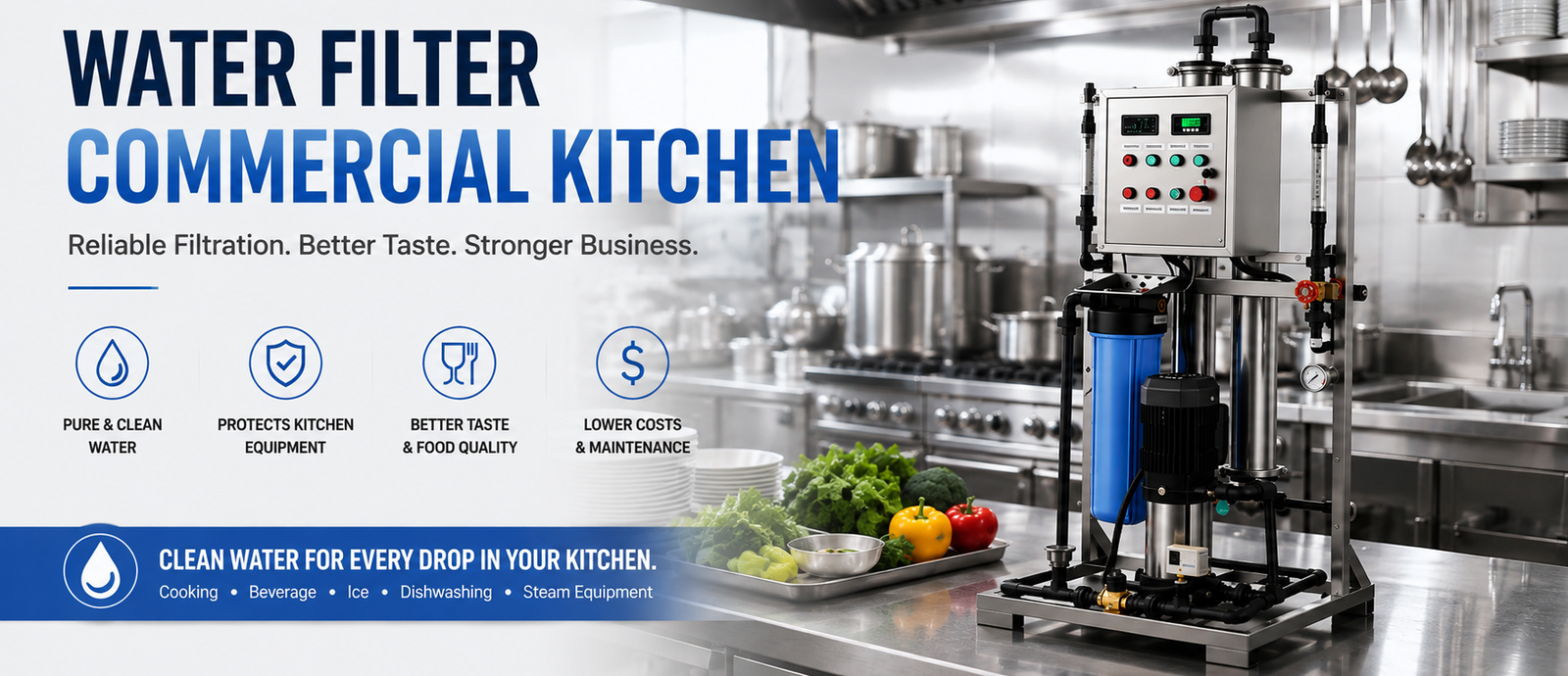
A water filter for commercial kitchen equipment has to do three unrelated jobs at once — protect steam generators from scale, keep dish machines rinsing spot-free, and keep chlorine taste out of every stockpot and sauce — and most systems on the market are only built for one of them. Before you spec anything, here’s what actually needs to hold up during a Friday dinner rush, not just on a spec sheet:
- Peak GPM at the dish pit during rush, not just average daily flow
- A hardness/TDS target low enough to stop scale in combi ovens and steam kettles, without starving them mid-shift
- Feed pressure (PSI) steady enough that steam equipment and dish machines aren’t fighting each other for flow
- Filtration ahead of any point that touches food directly — stockpots, blanching water, ice used in food prep
- Cartridge and membrane change intervals that match how hard the kitchen actually runs, not the catalog default
This is deliberately separate from beverage-side filtration — coffee, tea, and bar ice have their own water chemistry targets. Back-of-house cooking and dishwashing have different failure points, and treating them with the same commercial water filter for restaurant package as your beverage program usually means one side is under-protected.
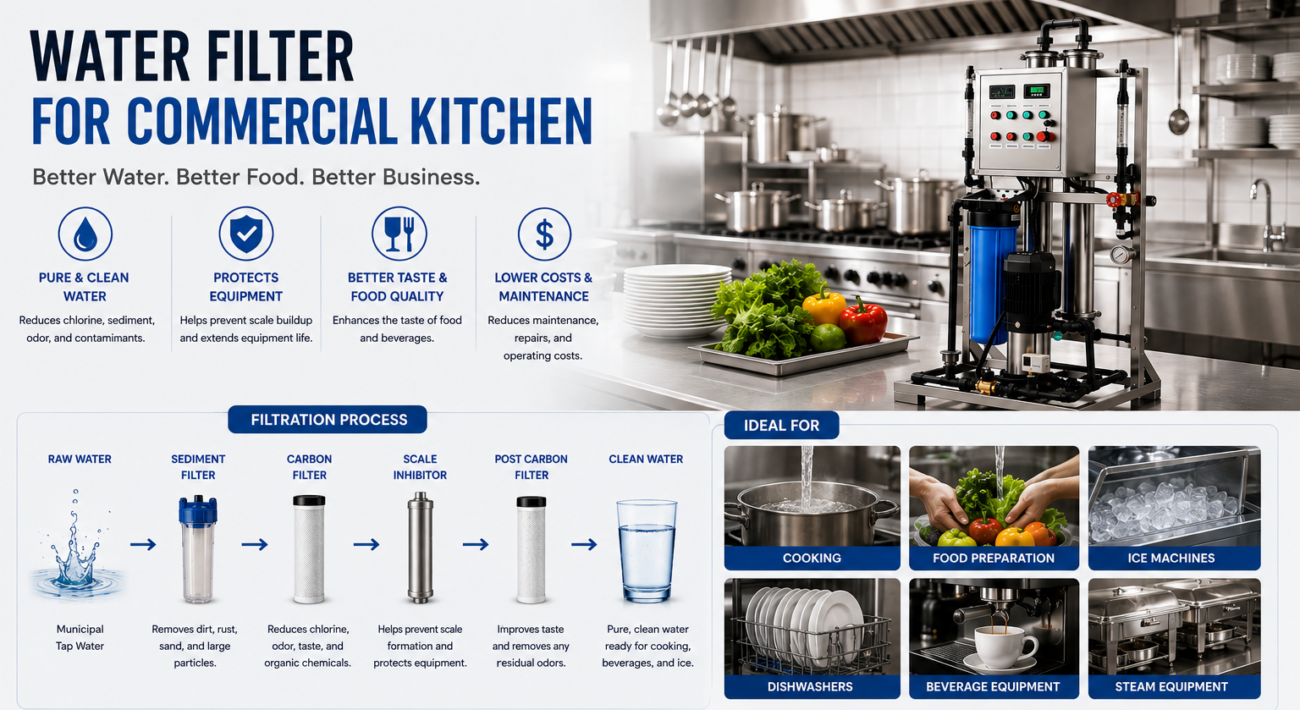
Fast Check Product: https://yourwatergood.com/product/commercial-reverse-osmosis-system/
Cooking Water: Chlorine Taste and DBPs in Stocks, Sauces, and Blanching Water
Chlorine and chloramine don’t cook off as fast as most kitchens assume. In a long-simmered stock or a reduction sauce, residual chlorine taste concentrates rather than disappears, and it’s one of the more common reasons a dish tastes “flat” or “off” without anyone tracing it back to the water line.
Disinfection byproducts (DBPs) carry the same problem — they’re tasteless in small amounts but compound over long cook times, and they show up in blanching water and pasta water just as easily as in a stockpot.
Whether the kitchen is on chlorinated city water or well water carrying iron and hardness, the back-of-house consequences look similar: off flavors, scale, and spotting — just from different sources upstream.
Steam Equipment: Why Combi Ovens and Steam Kettles Scale Faster Than Anything Else in the Kitchen
Combi ovens, steam kettles, and tilt braisers run water through a heating element or steam generator constantly, which means hardness scales them faster than almost any other piece of kitchen equipment — faster than a coffee machine, faster than an ice maker.
Scale on a steam generator element reduces heat transfer efficiency long before it’s visible. The result isn’t a breakdown — it’s slower steam recovery, longer cook times, and eventually an error code or a warranty claim tied directly to water hardness, not a mechanical defect.
Field insight: A boil-out cycle that comes out looking clean doesn’t mean the steam generator is scale-free. Scale builds on the heating element first, not the visible tank walls, and by the time white residue shows up where you can see it, heat transfer efficiency has usually already dropped enough to add minutes to every steam cycle. Kitchens notice this as slower ticket times during service — not as a maintenance alarm — long before anyone connects it back to water hardness.
Central descalers and a properly sized RO system solve this differently — a descaler manages hardness inline, an RO system removes it upstream entirely. For machine-by-machine specs on protecting combi ovens, ice machines, and espresso equipment individually, see how each piece of equipment gets protected.
Dish Machines: Spotting, Filming, and Sanitizing Rinse Performance
Hard water leaves spotting and filming on glassware and flatware that no amount of extra detergent fixes — it’s a water chemistry problem, not a wash-cycle problem, and it’s one of the most visible complaints a front-of-house team gets from guests.
Sanitizing rinse performance depends on water chemistry too. High mineral content and inconsistent pH can reduce how effectively a low-temp sanitizing rinse actually works, which is a food safety issue as much as a cosmetic one.
Chlorine odor carried through on final-rinse water is the other common complaint — guests notice a “pool smell” on stemware before they ever notice it in a glass of water.
Filtration Requirements by Back-of-House Application
| Application | Primary Concern | Water Quality Target | Typical Filtration Stage | Consequence of Skipping It |
|---|---|---|---|---|
| Cooking water (stocks, sauces, blanching) | Chlorine taste, DBPs | Low residual chlorine/DBPs | Carbon or multi-stage filtration | Off flavors traced back to the recipe, not the water |
| Steam equipment (combi ovens, kettles) | Hardness/scale | Low TDS/hardness feed | Softening or RO ahead of the unit | Slower steam recovery, error codes, voided warranty |
| Dish machine rinse | Spotting, filming, sanitizer efficacy | Low hardness, stable pH | Softening or RO-fed rinse line | Visible spotting, reduced sanitizing performance |
| Glassware/flatware final rinse | Visible mineral deposits | Low TDS | Point-of-use filtration or central RO feed | Guest complaints, re-wash labor |
Request a Commercial Kitchen Water Layout Design — we’ll map where filtration goes across cooking, steam, and dish lines instead of treating the kitchen as one generic feed point.
Peak Dinner-Rush Demand: Keeping Dish Pits and Steam Kettles From Starving at 7 PM
A dish machine running full tilt during dinner rush, alongside a combi oven in steam mode and a kettle refilling between batches, adds up to real simultaneous demand — this is where GPM at peak, not average GPD, decides whether equipment starves mid-shift.
On the compact commercial RO platform we build, output is configurable from roughly 250 to 1,000 liters per hour (about 1,500 to 6,300 GPD), sized to the kitchen’s actual peak load rather than a single fixed rating. Feed pressure needs to hold 29–58 PSI (0.2–0.4 MPa) to keep that output consistent when everything is running at once.
Undersizing for peak demand is the most common mistake — a system that handles average daily volume just fine can still fall short during the one hour a night that actually matters.
Request a Free Site Water Report Review — send your peak dinner-rush equipment list and we’ll confirm the flow rate before you commit to a system.
Frequently Asked Questions
Does a commercial kitchen need different water filtration than a coffee or bar program? Yes. Cooking, steam equipment, and dishwashing have different water quality targets than beverage service — chlorine taste and hardness matter for both, but the acceptable TDS range and flow demand are different.
Why do combi ovens scale faster than other kitchen equipment? They run water through a heating element or steam generator constantly, which concentrates hardness deposits faster than equipment that only heats water intermittently.
Can hard water actually affect food safety, not just taste? Yes, indirectly. Hard water and unstable pH can reduce how effectively a dish machine’s sanitizing rinse works, which is a food safety concern beyond cosmetic spotting.
Does chlorine really affect the taste of stocks and sauces? Yes. Residual chlorine and disinfection byproducts concentrate during long simmer times, and it’s a common, often untraced cause of “off” flavors in reductions and stocks.
How much water flow does a busy dish pit and steam line actually need at peak? It depends on the equipment mix, but peak GPM during rush is usually much higher than average daily GPD suggests — sizing for average volume alone is the most common undersizing mistake.
Is a water softener enough to protect combi ovens and steam kettles? Softening addresses hardness, which is the primary scale driver, but an RO system removes a broader range of dissolved solids — the right choice depends on feed water and equipment sensitivity.
Does city water or well water matter for back-of-house filtration? Yes. City water mainly needs chlorine/DBP treatment, while well water more often needs hardness and iron treatment — the consequences in the kitchen (scale, spotting, off flavors) look similar either way.
Protect Cooking, Steam, and Dish Operations Before Service Slows Down
Back-of-house water problems rarely show up as a single failure — they show up as slower steam cycles, spotted glassware, and flavor complaints that get blamed on everything except the water line.
Get a Custom Commercial Quote, a full Technical Parameter Sheet, or B2B wholesale pricing on our commercial-grade multi-stage filtration system, built with configurable output sized to your kitchen’s actual peak cooking, steam, and dishwashing demand.