
Water Filter Wholesale: How to Source Evaluate


If your business plan includes stocking or selling water filters in volume, understanding the wholesale market is the difference between steady profit and wasted inventory. This guide gives you a full, practical playbook for sourcing water filter wholesale: product categories and technical specs to care about, how to vet suppliers and samples, certifications and compliance, pricing and margins, packaging and branding options (OEM/private label), logistics and import considerations, quality control checklists, and go-to-market strategies that keep stock turning and complaints low. Whether you’re a small e-commerce retailer, a bricks-and-mortar plumbing supplier, or scaling a distribution network, this article helps you buy smarter and sell faster.
For a ready-made reference product to test against supplier claims and specs, review a practical whole-house option when comparing performance and consumable costs: https://yourwatergood.com/product/whole-house-water-filtration-system-for-home/.
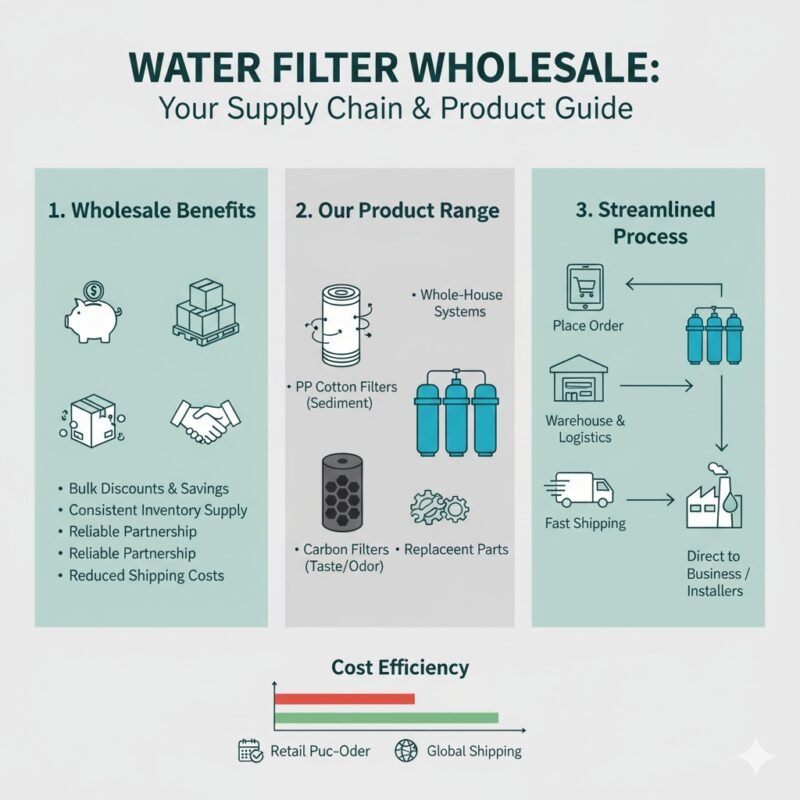
1. Market snapshot: why wholesale water filters remain a strong opportunity
Water filters span many buyer needs: budget-conscious homeowners wanting better tap taste, hospitality operators who need crystal-clear ice and damage-free boilers, and industrial users seeking point-of-entry protection. The reasons wholesale distribution is attractive:
- Recurring revenue from consumables (cartridges, membranes, UV lamps) — filters are not one-off purchases.
- Wide product range — from $10 inline cartridges to $5,000 commercial RO skids, you can select price tiers to match your audience.
- Relatively low SKU complexity for accessories — housings, O-rings, and fittings are stable product groups.
- High trust purchase behavior — buyers often prefer known brands or certified products, which helps margin predictability if you supply trusted SKUs or OEM alternatives.
To succeed you must master technical matching (product to water problem), supplier reliability, and post-sale service (warranty + consumable supply).
2. Product taxonomy: what “water filters” mean in wholesale terms
Wholesale sellers must know product categories and primary use-cases:
- Point-of-Use (POU) cartridges & housings — inline cartridges, under-sink housings, faucet-mounted filters. Low price, high SKUs, good recurring sale potential.
- Point-of-Entry (POE) whole-house systems — 10″ / 20″ housings, multi-stage racks, media vessels, softeners. Higher ticket, lower volume.
- Reverse osmosis (RO) units & membranes — under-sink RO, countertop, commercial skid RO. High margin on membranes and filters.
- Ultrafiltration (UF) / microfiltration modules — used in areas with microbial risk or as RO pretreatment.
- Specialty adsorbents — lead removal cartridges, PFAS-targeted media, arsenic, nitrate-specific resins. Regulatory or health-focused buyers demand these.
- Accessories & consumables — O-rings, wrenches, housing wrenches, tubing, fittings, replacement cartridges, UV lamps. These are steady sellers and often drive long-term customer relationships.
Match your inventory mix to your channel: e-commerce favors POU and consumables; B2B/HVAC channels need POE and service-friendly parts.
3. Technical attributes that matter when evaluating products
When you evaluate water filter wholesale SKUs, stress-test these technical attributes.
- Certifications & test reports
- NSF/ANSI 42 (aesthetic effects), 53 (health effects), 58 (RO) are most common in residential retail markets. Insist on certificate PDFs for the exact SKU.
- For PFAS or other niche contaminants, request third-party lab challenge reports showing species tested and capacity.
- Rated flow & pressure drop (GPM and ΔP)
- For POE and whole-house products, ensure rated GPM at acceptable ΔP for your target homes (e.g., 10–15 GPM for many families).
- For POU, check peak flow rating so the filter does not choke faucets.
- Capacity & expected life
- Demand rated gallons or mg removed for cartridges and convert to calendar life based on expected household use (e.g., 300–400 gpd for a 4-person home).
- Specialty cartridges will list capacity for the specific contaminant (e.g., lead grams removed).
- Micron rating and type (nominal vs absolute)
- Sediment filters: choose between spun PP, pleated, or melt-blown; understanding nominal vs absolute ratings reduces returns.
- Pleated cartridges last longer and can be washed in some contexts—useful for well-water channels.
- Materials & compatibility
- Housing materials, O-ring compounds (EPDM, Viton), and food-grade certification matter for longevity and warranty.
- For UV systems, verify quartz sleeve quality and lamp life specs.
- Installation and serviceability
- Does the design allow quick cartridge swaps? Are housings standard sizes (10″ or 20″) so replacements are available everywhere?
- For commercial clients, look for manifolds or bypass valves to minimize downtime during service.
- Packaging & OEM labeling options
- For private label customers, confirm minimum order quantity (MOQ), label printing options, and compliance for labeling (country-of-origin, materials).
4. How to vet and qualify a wholesale supplier
Start with an initial screening and then verify with proven steps.
Step A — Initial document review
- Request company registration, quality system summary (ISO 9001 if available), product datasheets, and copies of certifications for the exact SKUs.
- Ask for trade references and three recent customer references (preferably in your target market).
Step B — Sample testing
- Never buy blind. Order samples (regular or paid) and run them in real-world conditions. For POE systems, test at simulated flows or real homes. For specialty adsorbents, run a challenge with known concentrations if possible.
- Evaluate: fit and finish, ease of installation, pressure drop, initial taste/odor, and any fugitive contamination (carbon fines).
Step C — Factory audit or third-party inspection
- For larger orders, perform or commission a factory audit. Check QC processes, material traceability, packaging, and storage conditions.
- Use an independent inspection company for pre-shipment checks (random sampling, visual checks, functionality test).
Step D — Contractual protections
- Negotiate payment based on clear milestones: deposit, production samples approval, pre-shipment inspection, and release.
- Include warranties, failure-rate caps, and remedies (replacement, refund) in the contract.
- Define acceptable defect rates (e.g., AQL) and return logistics.
5. MOQ, pricing models and margin planning
Wholesale pricing and MOQ dynamics typically shape profitability.
- MOQ negotiation: Many manufacturers set MOQ by SKU and by customization. Typical MOQs: 500–1,000 pcs for basic cartridges, 50–200 units for branded housings, and 10–50 for larger whole-house units. Negotiate lower MOQs by agreeing to a trial order with an upfront premium or split multiple SKUs in one container.
- Pricing models: FOB (origin) vs CIF/DDP — choose based on your logistics capability. FOB gives you control of shipping; DDP simplifies landed cost but increases seller margins.
- Volume tiers & rebates: Ask for tiered prices at volume thresholds and rebate credits for reaching cumulative buying targets.
- Margin planning: Retail markup commonly ranges from 40% to 200% depending on channel and SKU. Consumables often carry highest lifetime margin. Model 3–5 year customer lifetime value (CLV) including cartridge replacements.
Example: a $20 carbon cartridge bought at $6–$8 wholesale and retailed at $25–$40 yields recurring margin when customers replace them every 6–12 months.
6. OEM & private-label strategies
Private labeling is a high-value route for wholesale sellers who want brand control.
- OEM basics: Manufacturers commonly offer OEM services — your brand + their product. Confirm lead time, minimum order, printing options, and compliance labeling rules.
- Differentiation: Add value through bundled kits, multi-pack discounts, localized installation guides, or after-sales support.
- Quality parity: If you private label, insist on the same or higher QC as for branded accounts — customers expect your label to perform equivalently.
- After-sales logistics: Plan for spare parts stocking, replacement cartridge subscriptions, and warranty service to maintain brand reputation.
For small scale, start with unbranded stock and shift to private label once ROIs and order rhythms stabilize.
7. Packaging, labeling, and regulatory compliance
Proper packaging reduces returns and customs headaches.
- Durable packaging for cartridges: moisture-resistant bags, molded inserts, clear install orientation markings.
- Labeling: Include SKU, model, batch number, install date field, country of origin, and instructions in English (and languages of target markets). For private label, ensure regulatory texts (e.g., “Not a drinking water disinfectant”) are compliant.
- MSDS & hazardous content: If shipping activated carbon pre-loaded with certain chemicals, check MSDS requirements.
- Claims and advertising: Avoid unverified health claims. If a cartridge claims to “remove lead,” back that with certification documents for the exact SKU.
8. Logistics: importing, warehousing & fulfillment
Reduce landed cost and speed delivery with good logistics.
- Shipping mode: Air for urgent, small lots; sea (FCL/LCL) for bulk. Combine SKUs to fill containers to lower per-unit landed cost.
- Incoterms: Use FOB or EXW for established traders; CFR/CIF for first-time suppliers where you want seller-managed freight. For stable relationships, negotiate DDP for predictable landed costs.
- Customs classification & duties: Tariff codes for water filter components vary by part (housings, membranes, fittings). Work with customs brokers to avoid surprises.
- Warehousing strategy: Consider regional fulfillment centers to reduce shipping time—one central depot for consumables; local warehouses for heavy POE units.
- Kitting & subscriptions: Pre-kit popular combos (housing + 2 cartridges + wrench) to boost AOV. Offer subscription programs for replacement cartridges — use inventory forecasting to avoid stockouts.
9. Quality control checklist — what to test on arrival
Create an SOP for incoming QC that your warehouse team uses before releasing stock.
- Visual inspection — packaging integrity, correct labels, unit count.
- Physical dimensions & fit test — cartridge fits into standard housings, O-rings match.
- Functional checks (sample-based) — flow test, leak test at rated pressure, initial flush and taste test for carbon (fines, odor).
- Cert verification — batch-specific certificate matches SKU and serial numbers.
- Random lifecycle checks — run a filter for several hundred gallons to confirm expected ΔP rise and removal performance where feasible.
- Documentation check — installation guides, warranty cards, MSDS included.
Reject or quarantine lots that fail QC and escalate with supplier for root cause and replacement.
10. Pricing, promotions and channel strategies
How you present wholesale offerings to different buyers matters.
- B2B channel (plumbers, hotels, builders): emphasize reliability, service contracts, bulk discounts, and dedicated account management.
- Retail/e-comm: merchandising matters — clear product pages with specs, certifications, and honest replacement cadence. Use starter kits and bundles (e.g., filter + multi-pack replacement) to increase AOV.
- Subscription & consumables: convert buyers into subscribers for predictable revenue. Offer discounts for 3- or 6-month prepayment.
- Seasonal promotions: target spring (allergy season), hurricane season (preppers), and holiday gift cycles with bundles.
- Value-added services: offer installation guides, local installer directories, or promotional co-op funds for larger B2B customers.
Monitor returns and reviews closely; product problems scale quickly in e-commerce.
11. Pricing example and margin math
A practical example for cartridges:
- Purchase price (wholesale): $6.00 per cartridge (MOQ pricing).
- Landed cost after freight, duties, warehouse: $7.50.
- Retail price: $25.00.
- Gross margin (before operational costs): (25 − 7.5) ÷ 25 = 70% gross margin.
- If 20% of customers convert to 3-month subscription at $22/quarter, lifetime revenue increases substantially.
Always calculate CLV including replacement cycles to properly evaluate CAC and marketing spend.
12. Customer support & warranty management
After-sale processes protect your reputation.
- Clear warranty policies (length, exclusions, claim process).
- Spare-parts availability — keep O-ring and wrench SKUs accessible.
- Return & RMA process — quick assessment, photographic evidence, prepaid return labels (for defective units) speeds resolution.
- Technical support — prepare FAQ, troubleshooting guides, and short video demos for common installs and problems.
- Replacement logistics — for urgent failures (e.g., commercial customers), offer expedited courier replacements or on-site repair options via local partners.
Document repair rates and root causes to feed back into supplier quality discussions.
13. Scaling from local reseller to national distributor
Growth considerations for wholesale water filter business:
- Inventory forecasting — use seasonal sales patterns and lead time to size reorders. Safety stock is critical for consumables.
- Multiple supplier strategy — avoid single-source risk; pre-qualify backup suppliers and maintain small safety buffers.
- Automation — invest in order management, subscription billing, and integrated inventory systems to scale operations without ballooning headcount.
- Brand development — private-label assumptions require brand building: consistent packaging, warranties, and marketing collateral.
- Contracts & SLAs — for larger B2B accounts, formal SLAs, and stocking agreements minimize disputes.
14. Green and regulatory trends to watch
- PFAS regulations are tightening globally — specialty media demand is rising. Make sure you can source certified PFAS-reduction cartridges or offer POU RO solutions.
- Microbial safety attention — landlords and hotels increasingly request microbial validation (UV + UF combos) — be ready to supply those systems.
- Sustainability pressure — customers ask for recyclable cartridges and take-back programs. Suppliers that offer cartridge recycling or lower-waste pleated filters win market share.
Align your inventory strategy with regulatory trends to remain compliant and competitive.
15. Practical checklist for your first wholesale procurement
Use this checklist when placing your first larger order.
- Confirm target SKUs and expected sales velocity.
- Request and verify certificates (NSF/ANSI or lab reports) for each SKU.
- Order samples and perform functional tests.
- Negotiate MOQ, pricing tiers, and lead times.
- Agree on payment terms, warranty, and spare parts availability.
- Arrange pre-shipment or pre-acceptance inspection.
- Use a customs broker to estimate landed cost and duties.
- Prepare packaging and labeling compliance for destination market.
- Plan a marketing and launch cadence including subscription options.
16. Real-world supplier red flags and how to avoid them
Be wary of suppliers who:
- Refuse to provide certificate PDFs or provide certificates that don’t match SKU.
- Offer dramatically lower prices without clear material or QC explanations.
- Delay sample shipments or provide only photos instead of physical samples.
- Fail pre-shipment inspections or give vague answers about lead times and spare parts.
If you encounter these, escalate to alternate vendors and only proceed with strict contractual protections.
17. Example: launching a best-seller cartridge kit
A practical go-to-market formula:
- Identify a high-demand cartridge (e.g., 5 µm sediment + carbon block combo).
- Source high-quality cartridges with 3rd-party certifications and order 500–1,000 units sample lot.
- Create a value bundle: housing + 2 cartridges + wrench + quick-install guide.
- Price competitively for a conversion target of 2–3% on paid ads, ensuring subscription offers on replacements.
- Monitor reviews closely first 30–60 days; optimize product page with FAQs and video how-to.
- Scale inventory after achieving stable reorder rate and subscription conversion.
18. Final checklist: measure what matters
Track these KPIs weekly/monthly:
- Gross margin by SKU
- Inventory turnover (months of stock)
- Return rate and causes
- Subscription conversion rate (for consumables)
- Average order value (bundles vs single SKU)
- On-time fulfillment rate
- Customer satisfaction / NPS
These metrics keep suppliers accountable and help you identify product gaps quickly.
Conclusion
Selling water filter wholesale successfully combines technical rigor with solid supply-chain management and smart marketing. Focus on certified SKUs, rigorous sampling and inspection, realistic MOQ negotiation, dependable spare-parts supply, and a business model that converts one-time buyers into recurring customers through consumable subscriptions. With careful vetting, tight quality controls, and a channel-specific inventory mix, you can scale from a local reseller to a profitable national distributor without being surprised by returns, regulatory headaches, or stockouts.
If you want a quick starter plan, pick one proven whole-house SKU to anchor your B2B offering and a high-margin cartridge for consumer channels — compare supplier specs against the product reference here: https://yourwatergood.com/product/whole-house-water-filtration-system-for-home/ — then run a 500-unit pilot with samples and pre-shipment inspection. That small, disciplined pilot will teach you more than theory ever will and help you refine your supplier and pricing strategy before committing to larger container orders.