
Water Filter Wholesale Manufacturer: What Real OEM Engineering Support Looks Like

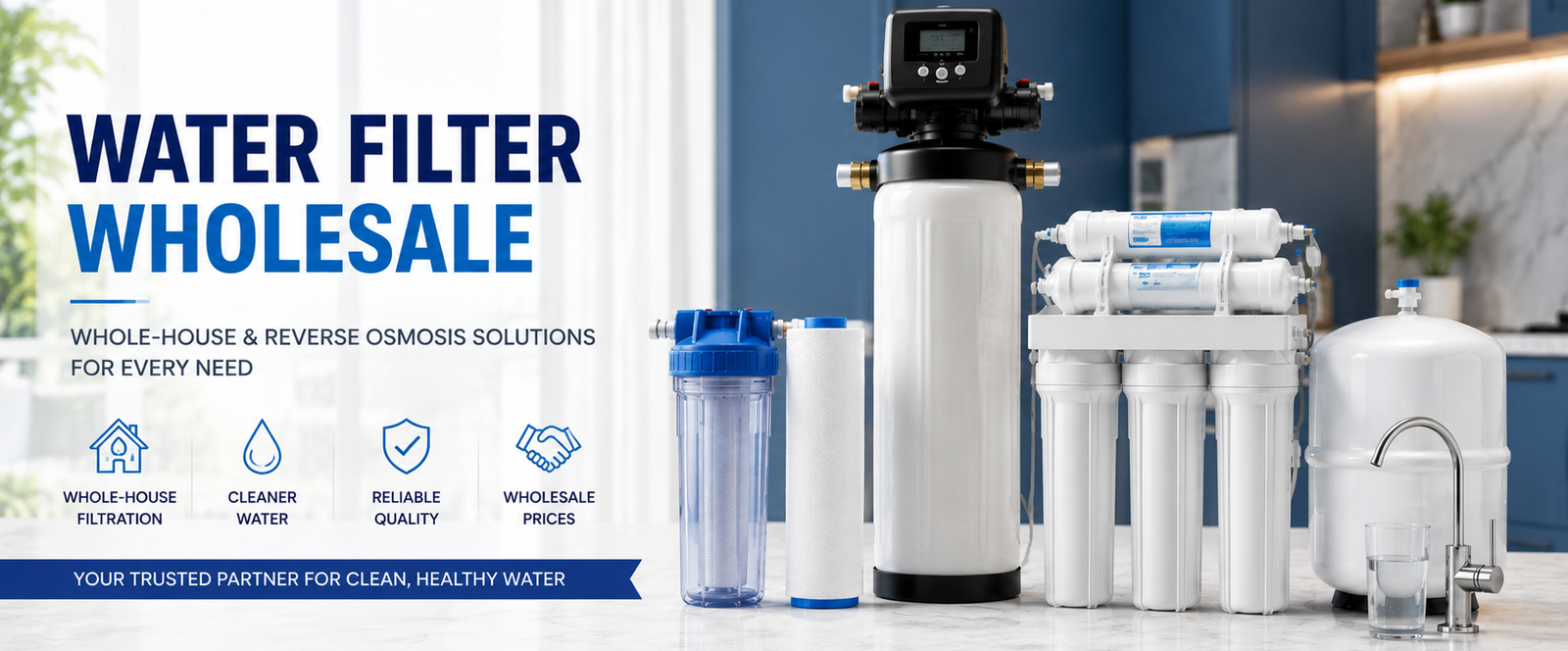
Finding a water filter wholesale manufacturer worth building a private-label line around comes down to one question: does the factory design the system, or just assemble parts someone else designed?
That distinction decides your warranty rate for the next three years.
Before requesting a single quote, check the manufacturer against these hard indicators:
- Documented component traceability — can they name the resin, membrane, and housing supplier for your exact configuration?
- Written engineering drawings — do you receive a technical drawing before tooling starts, or only after?
- Defined lead-time SLA — is the delivery window in writing, tied to a specific production stage?
- Sample validation window — can you test a pre-production sample before the full PO locks?
- Multi-point QC checkpoints — incoming material, in-line assembly, and pre-shipment inspection, documented separately?
A manufacturer who answers all five without hesitation is quoting from their own production floor. One who can’t is reselling someone else’s catalog.
Fast Check Product:https://yourwatergood.com/shop/
Why “Manufacturer” and “Wholesale Supplier” Aren’t the Same Thing
Most B2B directories blur this line, but the difference determines what you can actually customize — and who answers for a bad batch.
A trading company resells finished units from whichever factory quoted lowest that quarter. Specs shift between batches. Tooling isn’t theirs to modify, so a spec request gets relayed, delayed, or quietly declined.
A direct manufacturer owns the molds, controls the assembly line, and adjusts component specification without renegotiating through a third party.
Why this matters for a brand owner:
- Component consistency across repeat POs — housing, membrane, and cartridge spec stay identical batch to batch
- Direct access to engineering for spec changes, with no relay through an intermediary
- Faster resolution when a batch issue surfaces, since the manufacturer controls every production stage
- Full transparency on lead time, since there’s no second factory’s schedule hidden behind the quote
If private labeling or a custom housing color is part of the growth plan, this distinction — not price per unit — should be the first filter applied to any shortlist.
Off-the-Shelf Components vs Full-Scale OEM/ODM Support
Sourcing decisions usually collapse into two paths. Here’s how they actually differ on the factory floor:
| Factor | Off-the-Shelf Component Wholesale | Full-Scale OEM/ODM Support |
|---|---|---|
| MOQ | Often 50–200 units, stock configuration | Typically 500+ units once tooling is involved |
| Lead Time | 2–4 weeks from existing inventory | 6–10 weeks, tied to mold and material lead-in |
| Tooling / Mold Fees | None — shared stock housing | One-time mold investment, amortized across volume |
| Technical Drawing Support | Generic spec sheet only | Custom engineering drawings before production start |
| Branding | Sticker or label only | Injection-molded logo, custom housing color, packaging |
| Spec Flexibility | Fixed — take it as configured | Adjustable stage count, cartridge sequence, port threading |
Neither path is universally better. A buyer validating a new market usually starts off-the-shelf, then migrates to OEM/ODM once demand justifies the mold investment.
Request a Factory Component Blueprint before deciding which path fits your volume — it shows exactly which stage of your target configuration would require tooling versus stock parts.
The Business Case: How Engineering Depth Protects Your Margin and Brand
A cheaper unit price only looks cheaper until the warranty claims start arriving.
Lower warranty claims. Consistent component sourcing across every production run means fewer field failures traced back to a swapped-in substitute part mid-batch.
Operational stability over the system’s service life. A properly engineered stage sequence keeps flow rate and pressure within spec for years, not just through the first inspection.
Water consistency at scale. Buyers reselling under their own brand need every unit — batch one and batch fifty — performing identically. That only happens when the factory controls its own tooling and material sourcing.
Brand equity protection. A single bad batch reaching end customers does more damage to a private-label brand than a slightly higher unit cost ever will. The manufacturer relationship is a brand-risk decision as much as a procurement one.
Where 5-Stage RO and Whole-House Pre-Filtration Fit Your Catalog
Two product families move the most wholesale volume for brand owners entering the US market: under-sink RO purifiers and point-of-entry whole-house pre-filters.
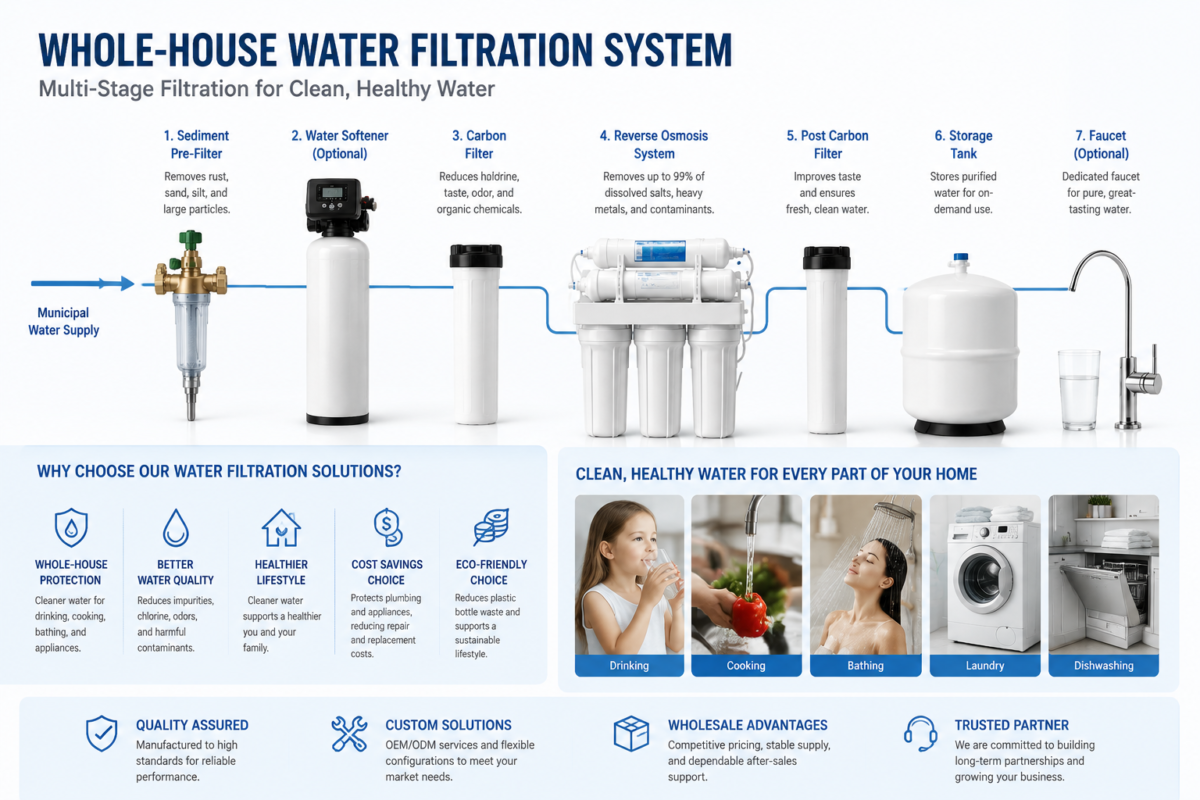
A 5-Stage RO Water Purifier typically stacks:
- A 5-micron PP/FPP sediment stage
- CTO compressed carbon for chlorine and taste
- A secondary 1-micron polishing stage
- The RO membrane itself, rejecting contaminants down to roughly 0.0001 micron
- A T33 coconut-shell post-carbon polish stage before the faucet
High-rejection RO membrane cores commonly used in this category reach up to 99.8% salt rejection — a spec worth requesting in writing rather than accepting as a marketing line.
A 3-Stage Whole House Water Filter — a point-of-entry (POE) pre-filter — solves a different problem: protecting every downstream fixture and appliance, not just the kitchen tap.
Configuration options wholesale buyers typically request:
- Sediment plus chlorine focus, for standard municipal supply
- Ion-exchange resin staging, for hard-water regions with scale-forming municipal or well water
- Ultrafiltration staging, for buyers targeting a “purity” position without RO’s wastewater ratio
Rated operating pressure across this POE category commonly runs 14.5 to 58 PSI, which covers the range most US municipal grids deliver at the curb.
Municipal Tap Water vs Well Water: Why Adaptability Drives SKU Planning
The EPA’s Safe Drinking Water Act framework governs water as it leaves the treatment plant — not what happens to it afterward, in aging distribution pipe or a private well casing.
That gap is exactly why wholesale SKU planning can’t assume one configuration fits every territory.
Municipal tap water sourcing typically needs:
- Higher-capacity carbon staging to handle chlorine and chloramine dosing, which varies significantly by utility
- Confirmed GPD output at the incoming TDS level a target territory actually sees, since output drops as source TDS rises
Well water sourcing typically needs:
- Pre-filtration rated for variable hardness and sediment load, which swings far more than municipal supply
- Membrane specification confirmed against the higher mineral load, since undersizing here shortens membrane service life fast
GPM flow rate matters most for whole-house sizing. A system rated for a single bathroom won’t hold pressure across a household running two fixtures at once. Buyers reselling into single-family versus multi-fixture properties should confirm this before finalizing a SKU.
Field Engineering Details Most Wholesale Buyers Never Ask About
This is where a quote that looks 8% cheaper on paper turns into a warranty problem eighteen months later.
What most buyers miss #1: low-grade activated carbon cartridges are sometimes bonded with adhesives that raise initial pressure drop across the housing. That drop compounds downstream — the RO membrane behind it works outside its rated PSI range earlier than expected, cutting membrane service life well before the warranty term closes.
What most buyers miss #2: injection-molded housings with inconsistent wall thickness — a shortcut some factories take to cut material cost per unit — develop stress-cracking at the threaded port after repeated pressure cycling. It rarely shows up in QC. It shows up in the field, at a customer’s sink, eight to fourteen months in.
Ask a manufacturer directly whether wall-thickness tolerance is a controlled spec on their molding line, or an assumption. The answer tells you which supplier absorbs field failures — and which one leaves the warranty claim with you.
Request a Technical Parameter Sheet before the next PO — confirm wall-thickness tolerance and carbon bonding method in writing, not as a verbal assurance.
Frequently Asked Questions
What MOQ should I expect from a water filter wholesale manufacturer? Off-the-shelf configurations often start around 50–200 units. Once custom tooling or a branded mold is involved, MOQ typically rises to 500+ units to amortize the mold investment.
How long does OEM/ODM tooling take before production starts? Custom mold development commonly adds 6–10 weeks ahead of the first production run, on top of standard manufacturing lead time.
Do wholesale RO systems and whole-house filters share cartridge components? Not usually. RO systems use a dedicated membrane stage plus pre/post carbon cartridges, while whole-house pre-filters typically use PP cotton, carbon block, or resin cartridges sized for point-of-entry flow. Confirm SKU overlap directly with the manufacturer when stocking both lines.
What water pressure range do residential systems need to handle? US municipal supply commonly delivers in the 14.5–58 PSI range at point of entry, which most whole-house pre-filtration and RO pre-treatment stages are engineered around.
Why does incoming TDS affect RO system output? Rated GPD output assumes a baseline incoming TDS. As source TDS rises — common in well water or certain municipal blends — actual daily output drops below the rated figure, which matters when sizing systems for a specific territory.
Can I get a custom housing color or logo without full OEM tooling? Limited branding — sticker or label — is usually possible at off-the-shelf MOQ. Injection-molded branding requires the OEM/ODM tooling tier.
What’s the biggest hidden cost in a wholesale water filter quote? Component-level shortcuts that don’t show up in initial QC. Carbon adhesive bonding method and housing wall-thickness consistency are the two that surface as warranty claims months after shipment, not at inspection.
Get Your Wholesale Program Priced Correctly
A water filter wholesale manufacturer is only worth partnering with if the engineering behind the unit is documented, not assumed.
Before the next purchase order:
- Request a Custom OEM Quote scoped to a target configuration and volume
- Request a full Technical Parameter Sheet — wall-thickness tolerance, carbon bonding method, and membrane rejection spec included
- Request tiered B2B Wholesale Pricing to know exactly where a given volume sits on the cost curve
Explore the full water filter wholesale catalog and start a quote request today.