
Water Filtration System Price — How Much You’ll Really Pay (and How to Buy Smart)

This topic is covered in full in our main guide: How Much Does A Water Filtration System Cost — Complete Pricing Guide & Ownership Calculator.
If you typed water filtration system price into a search bar, you’re hunting for clarity: how much will a system cost today, what drives that price, and how to avoid surprises after installation. This article gives a practical, buyer-focused breakdown you can use to estimate real costs, compare options, build a budget, and negotiate like a pro. I cover typical price ranges by system type, component and installation line-item costs, ongoing operating expenses, how to calculate total cost of ownership (TCO), value-for-money tradeoffs, financing and procurement tips, and real-world examples so you can map a recommended solution to your needs. Links to reputable product catalogs and replacement parts are included so you can compare models and order consumables: YourWaterGood and our product range.
Read straight through or skip to the sections you need — by the end you’ll understand what determines water filtration system price and how to get the best return for your money.
Quick headline answers
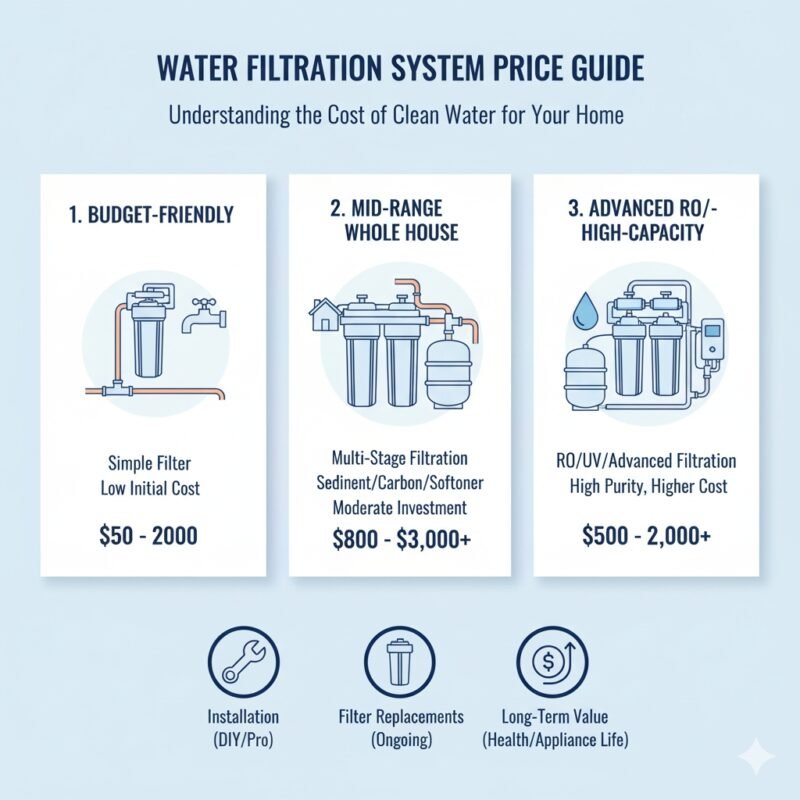
- Small point-of-use filters (pitcher/countertop/cartridge): $20–$300 upfront.
- Under-sink RO systems (POU): $150–$1,500 depending on features (membrane brand, tank, pump, remineralizer, certifications).
- Whole-house systems (POE basic sediment + carbon): $800–$3,000 installed for typical homes.
- Whole-house complexes (softening + iron removal + carbon): $2,000–$8,000+ installed.
- Commercial or industrial units and whole-house RO: $10,000 to $100,000+ depending on capacity and specs.
These are ballpark bands; read on to learn what alters them and how to produce an accurate estimate for your home or business.
What “water filtration system price” actually includes (and what it doesn’t)
When vendors quote a number, they may mean different things. Clarify which of the following the quote includes:
- Equipment price — the system hardware only (the factory or catalog price).
- Installation — labor, plumbing changes, electrical work, permits.
- Shipping & handling — crate, freight to your address, and local delivery.
- Commissioning & testing — flushing, microbial/chemistry verification after install.
- Consumables & warranties — initial filters, membranes, or a first-year service plan.
- Taxes & permits — local sales tax and any permit fees.
A bare equipment price can be misleading. Always ask for an itemized quote or line-item estimate so you can compare “apples to apples.”
The price drivers — 10 factors that move the needle
- Technology class: Carbon-only is cheap; RO, UV, softeners, and special-media (PFAS adsorbents, greensand) are progressively more expensive.
- Capacity & flow rating: Higher flow and larger daily volumes require bigger vessels, more membranes, or parallel trains — that raises cost.
- Membrane & media brand: Branded membranes (Dow Filmtec, Toray) and high-grade coconut-shell carbon cost more than generic alternatives but usually perform better and last longer.
- Certifications: NSF/ANSI, UL/ETL, and other testing add to manufacturing cost and are passed through to buyers. Certified systems cost more upfront but can be essential for regulatory or trust reasons.
- Automation & controls: Smart controllers, conductivity/TDS monitoring, remote alerts, and automatic backwash valves increase capital cost but reduce operating headaches.
- Pre- and post-treatment complexity: Pretreatment (softening, anti-scalant dosing, iron removal) to protect membranes adds equipment and service cost.
- Installation complexity: Retrofit into tight basements, long plumbing runs, or homes with older pipes raise labor and parts cost.
- Waste management / discharge requirements: RO reject plumbing, softener brine disposal, or permits for discharge can add expense.
- Warranty & support: Longer warranties, on-site service, and local spare-part stocking increase the vendor’s cost and therefore price.
- Volume & procurement channel: Retail markup vs direct wholesale, and order volume — buying many units lowers per-unit cost.
Knowing which of these matter for your situation helps you focus your budget where it matters.
Price ranges by system type — realistic numbers and what to expect
Point-of-use (POU) options
- Pitcher / countertop filters: $20–$100. Low maintenance, useful for temporary or rental use. Replacement cartridges cost $5–$30 each.
- Faucet-mounted filters / inline cartridges: $20–$200 for the system; cartridges $10–$60. Ideal for quick installation and modest taste/odor problems.
- Under-sink single/multi-cartridge systems (non-RO): $80–$600 upfront; annual filter cost $20–$150. Good for chlorine and particulate removal.
- Under-sink reverse osmosis (RO): $150–$1,500 depending on membrane brand, number of stages, tank quality, pumps, UV, and remineralizer. Expect annual consumables $50–$250.
Point-of-entry (whole-house) options
- Basic sediment + carbon POE system (residential): equipment $600–$2,000; installation $200–$1,500 depending on labor and plumbing. Annual consumables $20–$200 depending on cartridge or media life.
- Softener + carbon combos: equipment $1,200–$4,000; salt/maintenance $50–$300/year.
- Iron removal or oxidation systems with backwash: $1,500–$6,000+ depending on media and pumps.
- Whole-house RO: expensive and rare in homes — $15,000–$50,000+ installed; requires significant pretreatment and has substantial wastewater. More common for specialty properties.
Commercial / industrial systems
- Small commercial RO skids (restaurant, small factory): $3,000–$25,000+ depending on GPD and instrumentation.
- Large industrial & municipal plants: custom-engineered projects costing tens of thousands to millions.
These ranges reflect typical mid-market suppliers and installation by qualified technicians. Premium brands and certified units will sit at the higher end of each band.
Component-level cost breakdown — what’s inside the price
Understanding component costs helps you negotiate and spot upcharges.
- Prefilters (sediment & carbon cartridges): $5–$60 per cartridge.
- RO membrane: $40–$300 depending on brand & capacity.
- Storage tank (POU RO): $10–$100.
- Permeate / booster pump: $40–$400 for POU; larger pumps for POE can be thousands.
- Carbon vessels (POE): $200–$1,200 depending on bed volume and vessel material.
- Softener resin & valve: $500–$2,500 depending on resin and valve quality.
- UV reactor & lamp: $150–$1,500 depending on flow and quality; annual lamp replacement ~$50–$200.
- Control valve, PLC, sensors: $100–$2,000+.
- Fittings, piping, and mounting hardware: $50–$500 depending on complexity.
- Labor: $50–$150/hour for plumbers/technicians (rates vary by location).
When a salesperson bundles these as “one price,” ask for the parts list. It gives you leverage to swap components or validate quality.
Installation and hidden costs to budget for
Installation often adds 20%–100% to equipment price depending on complexity. Key elements:
- Plumbing modifications: T-joints, shutoffs, and new pipes.
- Drilling or faucet modification for dedicated filtered faucet holes.
- Electrical work for pumps, UV, or control panels (permit may be required).
- Permits & inspections (local fees vary).
- Disposal or routing of RO reject and softener brine (may require connection to sanitary sewer or licensed waste handling).
- Site prep & structural support (for large tanks or wall-mounted vessels).
- Commissioning tests such as TDS/lead checks, done post-install.
Always ask for a written installation scope and a fixed-price breakdown. If permits or unforeseen work appear later, ask the installer to provide change orders in writing.
Operating costs: filters, consumables, energy, and labor
A low equipment price can hide high operating costs. Typical annual operating items:
- Filter replacements: $20–$300/year depending on system and usage.
- Membrane replacement: every 2–5 years; $40–$300 each.
- Salt for softeners: $50–$300/year depending on household usage.
- UV lamp replacements: $50–$200/year.
- Electricity for pumps/UV: modest for small POU systems (tens of dollars/year), more for larger pumps.
- Service contract or technician visits: $100–$600/year if you prefer professional maintenance or if the system is critical.
- Water waste (RO): cost of wasted water — depends on your local water rate and RO efficiency. For traditional RO wasting 3–4 gallons per gallon produced, the water cost adds up in high-use settings.
Include these in your TCO calculation — a cheap system with costly consumables or high water waste may be more expensive over 5 years than a pricier, high-efficiency system.
How to calculate total cost of ownership (TCO)
TCO = Equipment price + Installation + (Annual operating costs × Years) + Disposal/upgrade costs − Salvage value (if any).
Example — 5-year TCO for a mid-range under-sink RO:
- Equipment: $450
- Installation: $150
- Annual filters & consumables: $100/year × 5 = $500
- Membrane replacement year 4: $120
- Electricity & water waste: $30/year ×5 = $150
5-year TCO = $450 + $150 + $500 + $120 + $150 = $1,370 → average annual cost ≈ $274.
Use this approach to compare two options: a $350 basic RO vs a $900 high-efficiency RO with permeate pump and better membrane. The high-efficiency unit’s lower waste and longer membrane life may produce lower 5-year TCO despite higher upfront cost.
Value tradeoffs — cheap vs expensive: where to spend
- Spend on membrane quality and pretreatment if your feed water has high TDS or sediment. Replacing membranes early is expensive.
- Invest in certified systems if you must meet health claims (lead removal, PFAS). Certification costs show up in price but matter for liability and marketing.
- Buy high-efficiency RO or permeate pumps if water waste is a priority — better for regions with high water costs or environmental concerns.
- Choose robust housings and valves for whole-house systems — they last, reduce leak risk, and simplify maintenance.
- Avoid over-spec’ing electronics and features you’ll never use (e.g., smartphone app controls may be nice but unnecessary unless you need remote monitoring).
A sensible rule: pay for reliability and components that are expensive or difficult to replace later (membranes, pumps, tanks).
Financing, warranties, and buying channels
- Financing: Many retailers and installers offer financing or pay-over-time plans. Compare interest rates to your opportunity cost; sometimes paying cash is cheaper.
- Warranties: 1–5 year equipment warranties common; longer warranties often require professional installation and adherence to a service schedule. Read exclusions — consumables are usually not covered.
- Buying channels: direct from manufacturers, authorized dealers, big-box retailers, or online marketplaces. Authorized dealers often include local support and commissioning; online bargains may lack local service.
- Subscription models: many suppliers offer subscription plans for replacement filters that reduce the pain of maintenance and protect system performance.
When evaluating contracts, insist on documented scope of work, warranty terms that include labor if possible, and a clear spare-parts list with prices.
Negotiation tactics to lower effective water filtration system price
- Ask for an itemized quote — compare parts line-by-line across vendors.
- Bundle consumables (first-year filters included) to lower first-year TCO.
- Request a discount for cash payment or for combining purchase + installation.
- Negotiate service credits if certain performance metrics (e.g., TDS reduction) are not met at commissioning.
- Trade exclusivity or volume commitments for better unit pricing if you manage multiple properties.
- Ask for remnant spares (extra O-rings, a spare prefilter) included in the deal.
- Get at least 3 quotes and use them competitively.
Vendors expect negotiation — structured, informed negotiating gets you the best price without sacrificing quality.
Where to start shopping (quick practical guidance)
- Compare model specs, filter life, and certifications.
- Check spare parts and filter availability — a system is only useful if replacements are easy to obtain.
- Evaluate local installers and their references — a reliable installer reduces lifecycle headaches.
- Use reputable catalogs and parts shops to validate pricing and spares: YourWaterGood and our product range are good starting points to check models, specs, and replacement cartridges.
Real-world mini case studies
Case 1 — City apartment (taste & odor)
Need: Remove chlorine and improve drinking water taste.
Solution: Under-sink carbon block inline filter.
Price: Equipment $60 + DIY install $0 = $60. Replacement cartridge annually $30.
Outcome: Low cost, quick improvement, minimal maintenance.
Case 2 — Suburban home with hard water and chlorine
Need: Prevent scale across appliances and remove chlorine.
Solution: Dual system — whole-house softener ($1,800 installed) + POE carbon ($800 installed).
Price: $2,600 equipment + installation; salt $100/year; filter changes $50/year.
Outcome: Reduced scale, longer appliance life, improved water taste.
Case 3 — Small café with espresso machines
Need: Protect machines from scale and ensure consistent water for coffee.
Solution: Commercial undercounter softener + carbon + POU RO for specialty coffee bar.
Price: $6,000–$12,000 total depending on capacity and automation.
Outcome: Lower machine maintenance, consistent beverage quality — ROI from lower repair bills and consistent product.
Use these examples to align your required features with realistic budgeting.
Final checklist: how to decide and buy with confidence
- Test your water (at inlet and drinking tap).
- Define performance goals (what contaminants or problems you must solve).
- Request itemized quotes from 3 qualified suppliers.
- Compare TCO over 3–5 years, not just upfront price.
- Verify spare parts & filter availability before you buy.
- Check certifications for health claims you need.
- Negotiate installation scope, warranty, and consumables in the contract.
- Plan for maintenance — schedule and budget it like an operating cost.
- Buy from reputable dealers who offer commissioning and local support.
- Use resources like YourWaterGood and our product range to compare models and stock consumables.
Conclusion
Understanding water filtration system price is less about memorizing numbers and more about understanding the choices behind each number. A low purchase price can become expensive if the system has poor consumable economics, high waste, or requires frequent service. Conversely, a higher upfront investment in quality membranes, efficient designs, or certified systems often reduces TCO and frustration.
Start with a water test, define what you need to remove, compare itemized quotes, calculate 3–5 year TCO, and pick the system that solves your priority problems within your budget. You can begin comparison shopping at YourWaterGood or order spare parts at our product range.