
The Ultimate Guide to Finding the Best Water Purifier for Hard Water: Protecting Your Home and Health

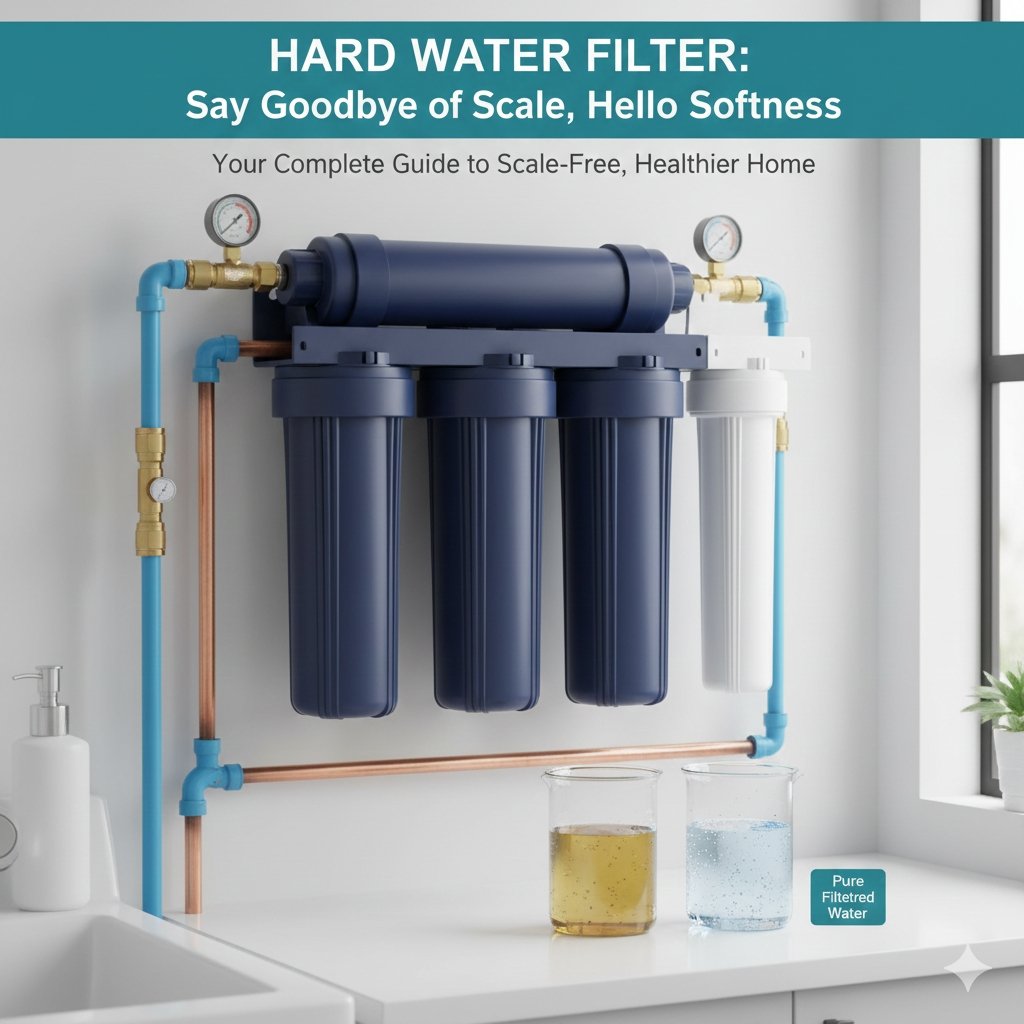
Water is the essential element of our daily lives. We use it to brew our morning coffee, to cook our meals, to bathe, and to hydrate. However, for millions of households and business owners, the water flowing from the tap brings with it an invisible burden: hardness.
If you have ever battled stubborn white crust on your showerhead, noticed your glassware coming out of the dishwasher cloudy, or felt your skin itch after a shower, you are likely dealing with hard water. While not immediately toxic, hard water is a relentless destroyer of appliances, a thief of flavor, and a nuisance for personal hygiene.
The solution seems simple: get a filter. But typing “water filter” into a search engine yields a dizzying array of options. Specifically, the search for a water purifier for hard water can be confusing because “hardness” is not a contaminant in the traditional sense—it is a mineral characteristic.
In this extensive guide, we will demystify the science of hard water. We will explore why it damages your home and your business, and we will navigate the complex market of solutions—from whole-house softeners to precision 5-stage Reverse Osmosis systems—to help you find the perfect solution for your needs.https://yourwatergood.com/product/5-stage-ro-water-filter-for-home-busines/.
Part 1: Understanding the Invisible Enemy
Before we can choose a solution, we must understand the problem. What exactly makes water “hard”?
The Geology of Your Tap Water
Water is a universal solvent. As rainwater falls and percolates through the earth to reach underground aquifers, it dissolves rocks. If the geology of your region is rich in limestone, chalk, or gypsum, the water picks up high concentrations of calcium and magnesium.
These dissolved minerals are what constitute “hardness.” It is often measured in Grains Per Gallon (GPG) or Parts Per Million (PPM).
- Soft: 0–3 GPG
- Moderate: 3–7 GPG
- Hard: 7–10 GPG
- Very Hard: Over 10 GPG
Why “Hard” is Hard on You
While calcium and magnesium are essential minerals for the human body, they are disastrous for your home’s plumbing infrastructure and your business’s bottom line.
- Scale Formation: When hard water is heated or evaporates, the minerals precipitate out of the liquid and form a rock-like deposit called limescale. This coats heating elements, clogs pipes, and ruins fixtures.
- Soap Scum: Hard water minerals react with soap to form a sticky curd (calcium stearate). This means you get less lather, your clothes don’t get as clean, and a film is left on your skin and bathtub.
- The Flavor Thief: For coffee shops and restaurants, hard water prevents the proper extraction of coffee oils, leading to a flat or sour taste.
This is why the search for an effective water purifier for hard water is not just about clear water; it is about protecting your lifestyle and your assets.
Part 2: The “Purifier” vs. “Softener” Confusion
When consumers search for a water purifier for hard water, they are often looking for anything that solves the scale problem. However, in the technical world of water treatment, terminology matters.
The Water Softener
A traditional ion-exchange water softener is the classic solution for the whole house. It physically swaps calcium ions for sodium ions. This removes the hardness entirely, protecting your pipes and water heater. However, it does not purify the water. It doesn’t remove chlorine, lead, bacteria, or “forever chemicals” (PFAS). In fact, it adds sodium, which might change the taste of your drinking water.
The Reverse Osmosis System (The True Purifier)
This is where the distinction becomes interesting. A Reverse Osmosis (RO) system is arguably the most powerful purifier available for drinking water. Unlike simple carbon filters, the RO membrane has pores so microscopic (0.0001 microns) that it physically blocks dissolved minerals like calcium and magnesium.
If your goal is to have drinking water that is absolutely free of hardness—water that makes crystal clear ice and tea without scum—then a dedicated 5-stage RO system is your best bet.
For this level of purity, we highly recommend the 5 Stage RO Water Filter for Home & Business. This system acts as a true purifier, stripping away the minerals that affect taste and appliance longevity, along with lead, fluoride, and other contaminants that a standard softener misses.
Part 3: Why a 5-Stage System is the Best Defense
You might find 3-stage filters or simple pitchers on the market, but when dealing with hard water, the 5-stage architecture provides a critical advantage: protection through redundancy.
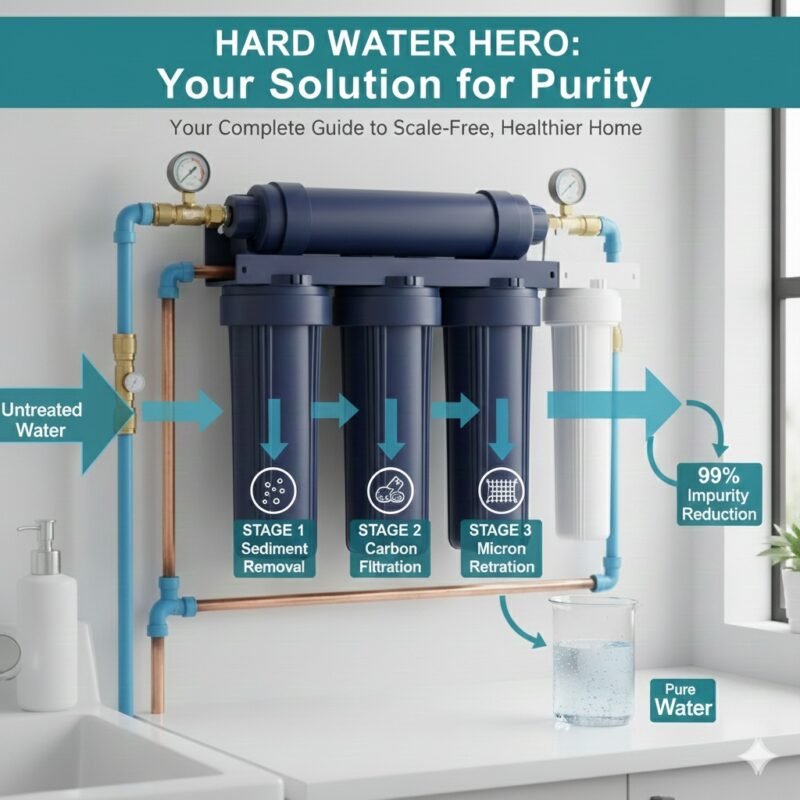
Hard water is tough on filters. If you send raw, gritty hard water directly into a delicate purification membrane, you will destroy it. A 5-stage system uses a “Progressive Filtration” strategy to handle this.
Stage 1: The Sediment Pre-Filter (The Bodyguard)
- The Mission: Remove physical particles. This includes rust flakes from old city pipes, sand, and precipitate caused by hardness.
- Why It Matters: This stage sacrifices itself to save the expensive components. High-quality Polypropylene (PP) cotton is essential here. It acts as a shield, preventing the grit associated with hard water from clogging the system.
Stage 2 & 3: Double Carbon Defense (The Chemical Scrub)
- The Mission: These stages use Granular Activated Carbon (GAC) and Carbon Block (CTO) to remove chlorine, chloramines, and odors.
- Why It Matters: Chlorine destroys RO membranes. By using two carbon stages, the system ensures that the water reaching the membrane is chemically neutral. This is vital in hard water areas where municipalities often use heavy chlorination to combat bacteria in warmer groundwater.
Stage 4: The RO Membrane (The Hardness Eliminator)
- The Mission: This is the heart of the water purifier for hard water. It separates the water molecules from the dissolved solids.
- The Result: Hardness minerals (Calcium and Magnesium) are too large to pass through the membrane. They are rejected and flushed down the drain. The water that passes through is virtually mineral-free, ensuring no scale will ever form in your coffee maker or kettle.
Stage 5: The Polishing Filter
- The Mission: Ensures the water stored in the tank tastes crisp and fresh immediately before drinking.
Part 4: The Business Case: Cafes and Restaurants
Hard water isn’t just a homeowner’s headache; it is a business killer. If you own a small commercial space, investing in a high-quality water purifier for hard water is a strategic move.
The Coffee Shop Crisis
Coffee is 98% water.
- Scale Buildup: Limescale is the #1 cause of espresso machine failure. It coats the boiler, insulates the heating element (increasing energy costs), and clogs the tiny solenoid valves. A single repair bill can cost $500+.
- Flavor Profile: Hard water prevents the delicate fruit and floral notes of coffee from extracting. Your expensive beans will taste flat. Conversely, softened water (with salt) can make coffee taste soapy.
- The Solution: An RO system provides a neutral base. It removes the hardness and the chlorine, allowing the barista to present the coffee exactly as the roaster intended.
The Crystal Clear Ice Factor
Have you ever noticed that ice at home is cloudy, but ice at high-end bars is clear?
- Cloudiness: This is caused by dissolved minerals and trapped air.
- The Fix: By removing the dissolved solids with a 5 Stage RO Water Filter for Home & Business, you produce ice that is dense, hard, and crystal clear. It melts slower, preserving the integrity of cocktails and soft drinks.
Part 5: Maintenance in Hard Water Zones
Owning a water purifier for hard water requires a slightly different maintenance mindset than owning one in a soft water area. The minerals are abrasive, and they accumulate faster.
1. Frequent Pre-Filter Changes
In areas with soft water, you might change your Stage 1 Sediment filter every 6 months. In hard water areas, you might see it turn brown or clog in 3 to 4 months.
- Pro Tip: If your water production slows down, do not blame the membrane yet. Check the Stage 1 filter. It has likely done its job and caught a load of sediment.
2. Membrane Monitoring
The RO membrane is doing the heavy lifting of rejecting calcium. Over time, this calcium can “scale” the membrane surface.
- Flushing: Some advanced systems have a manual or auto-flush feature. This opens the drain line fully for a few seconds to blast high-speed water across the membrane, scouring away the built-up minerals.
- Replacement: While a membrane might last 3-5 years in soft water, expect a lifespan of 2-3 years in very hard water (over 15 GPG).
3. The Softener Combo
For the ultimate setup, many experts recommend installing a whole-house water softener before the RO system.
- Why? The softener removes the calcium (which is hard on the membrane). The RO system then removes the sodium (added by the softener).
- Result: The RO membrane lasts twice as long because it is processing soft water, and you get sodium-free drinking water. It is the perfect marriage of technologies.
Part 6: Myths About Purification and Hardness
There is a lot of pseudoscience in the water industry. Let’s debunk some common myths regarding the search for a water purifier for hard water.
Myth 1: “Magnetic filters remove hardness.”
- Fact: Magnetic or electronic descalers clamp onto pipes and claim to use magnetic fields to stop scale. Scientific consensus is mixed. They do not remove minerals. The water remains hard. They might reduce scale adhesion in specific conditions, but they are not purifiers.
Myth 2: “Boiling water removes hardness.”
- Fact: Boiling precipitates “temporary hardness” (calcium bicarbonate) out of the water, which creates the white flakes you see in your kettle. However, it does not remove “permanent hardness” (calcium sulfate). Plus, it concentrates other contaminants like lead and nitrates as the water evaporates.
Myth 3: “RO water is unhealthy because it has no minerals.”
- Fact: It is true that RO removes calcium and magnesium. However, humans get the vast majority of their minerals from food, not water. You would have to drink bathtubs full of tap water to get the calcium found in a single wedge of cheese. The benefits of removing lead, arsenic, and chlorine far outweigh the minor loss of dissolved minerals.
Part 7: The Environmental Impact
When choosing a water purifier for hard water, it is important to consider the environmental footprint.
The Plastic Scourge
Many people with hard water resort to buying bottled water because their tap water tastes metallic or chalky.
- The Cost: A family of four can spend over $800 a year on bottled water.
- The Waste: This generates thousands of plastic bottles that end up in landfills or oceans.
- The Solution: A home filtration system eliminates this waste stream entirely. You have “bottled quality” water at your tap for pennies per gallon.
Efficiency Improvements
Modern RO systems are far more efficient than they used to be. While they do produce some wastewater (brine) as they strip away the calcium, the volume is negligible compared to flushing a toilet or running a washing machine. Furthermore, by preventing scale buildup in your coffee maker and kettle, those appliances operate more efficiently and last longer, reducing electronic waste.
Part 8: Installation Guide for the DIYer
One of the barriers to owning a water purifier for hard water is the fear of installation. Fortunately, the 5 Stage RO Water Filter for Home & Business is designed for easy implementation.
Step 1: The Feed
The system connects to your cold water supply under the sink using a simple adapter tee.
Step 2: The Drain
A saddle clamp attaches to your sink’s drain pipe. This is where the rejected hard water minerals and contaminants are flushed away.
Step 3: The Faucet
A dedicated drinking faucet is installed on the sink. This ensures that you don’t waste purified water on washing dishes; you save it for drinking and cooking.
Step 4: The Tank
The pressurized storage tank fits neatly under the sink. It holds a reserve of purified water so you have instant flow when you’re thirsty.
Conclusion: Making the Right Choice
Living with hard water is a choice, not a necessity. The damage it causes to your appliances and the poor taste it imparts to your beverages are solvable problems.
By choosing the right water purifier for hard water, you stop this damage in its tracks.
- For the Whole House: Consider a softener if your pipes are clogging.
- For Your Health & Taste: Install a 5-stage RO system in the kitchen.
The combination of sediment protection, carbon adsorption, and membrane purification offers the only comprehensive defense against the twin threats of hardness and contamination.
If you are ready to banish limescale from your kettle and enjoy the crisp, clean taste of mineral-free water, start with your kitchen. Explore the capabilities of the 5 Stage RO Water Filter for Home & Business. It is a powerful, compact, and efficient solution that turns the hardest municipal water into a refreshing, premium beverage.
Water quality dictates quality of life. Don’t let dissolved rocks dictate yours.
Frequently Asked Questions (FAQ)
Q: Will this purifier fix my low water pressure caused by hard water? A: If your low pressure is caused by scale buildup inside your home’s pipes (common in old steel pipes), a filter won’t unclog the pipes. However, the RO system has its own pressurized tank, so the water dispensing from the dedicated faucet will be fast and consistent, independent of your house’s pipe issues.
Q: Can I connect this to my refrigerator? A: Yes! You can run a 1/4″ tube from the RO system to your fridge. This gives you crystal clear, hard-water-free ice cubes and chilled water. It is a fantastic upgrade.
Q: How do I know if the system is working on my hard water? A: Get a TDS (Total Dissolved Solids) meter. Test your tap water (e.g., 400 PPM). Then test the RO water. It should be around 20-40 PPM. The massive drop proves the minerals have been removed.
Q: Does it remove Fluoride? A: Yes. Unlike standard pitcher filters, the RO membrane effectively removes fluoride along with the hardness minerals.
Q: Is it expensive to maintain? A: Compared to the cost of replacing scaled-up coffee machines or buying bottled water, it is very cheap. Annual filter changes typically cost less than $100.