
The Science of Pure Water: Why the 5 Stage RO Filter Is the Industry Standard for Safety and Taste

Water is the most fundamental resource on our planet. It dictates the health of our bodies, the flavor of our food, and the longevity of the appliances in our homes and businesses. Yet, as our industrial world evolves, so does the complexity of the contaminants found in our water supply. From the aging lead pipes of historic cities to the emerging threat of microplastics and agricultural runoff in rural areas, the modern tap is facing unprecedented challenges.
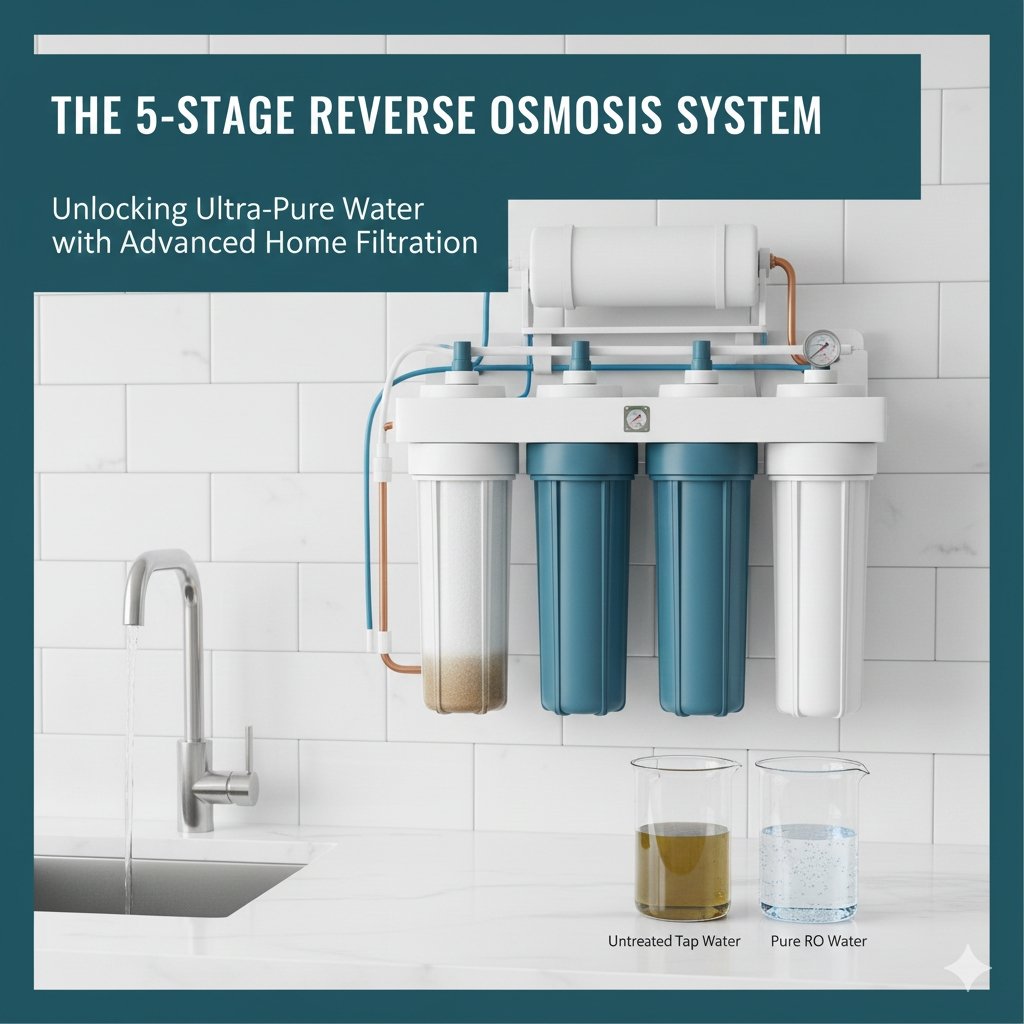
In response to these challenges, water treatment technology has advanced significantly. While simple carbon pitchers were once considered sufficient, the current gold standard for comprehensive purification is the 5 stage ro filter.
This specific configuration—utilizing the power of Reverse Osmosis (RO) backed by a sophisticated pre- and post-filtration team—offers a level of purity that few other residential or light commercial systems can match. But is it right for you? Whether you are a homeowner seeking to banish “forever chemicals” from your family’s diet, or a café owner striving to pull the perfect espresso shot, understanding the mechanics of this system is the first step toward water independence.https://yourwatergood.com/product/5-stage-ro-water-filter-for-home-busines/.
In this deep dive, we will explore the anatomy, the economics, and the performance of the 5-stage system, revealing why it has become the benchmark for clean water around the globe.
Part 1: Why “Five Stages” is the Magic Number
To the uninitiated, a 5 stage ro filter might sound excessive. Why filter water five times? Is it marketing hype, or is it engineering necessity?
The answer lies in the concept of Progressive Filtration Efficiency. If you attempt to filter raw tap water through a microscopic membrane immediately, two things happen:
- Chemical Degradation: Chlorine in the water will chemically burn the membrane.
- Physical Fouling: Sediment and dirt will clog the membrane instantly.
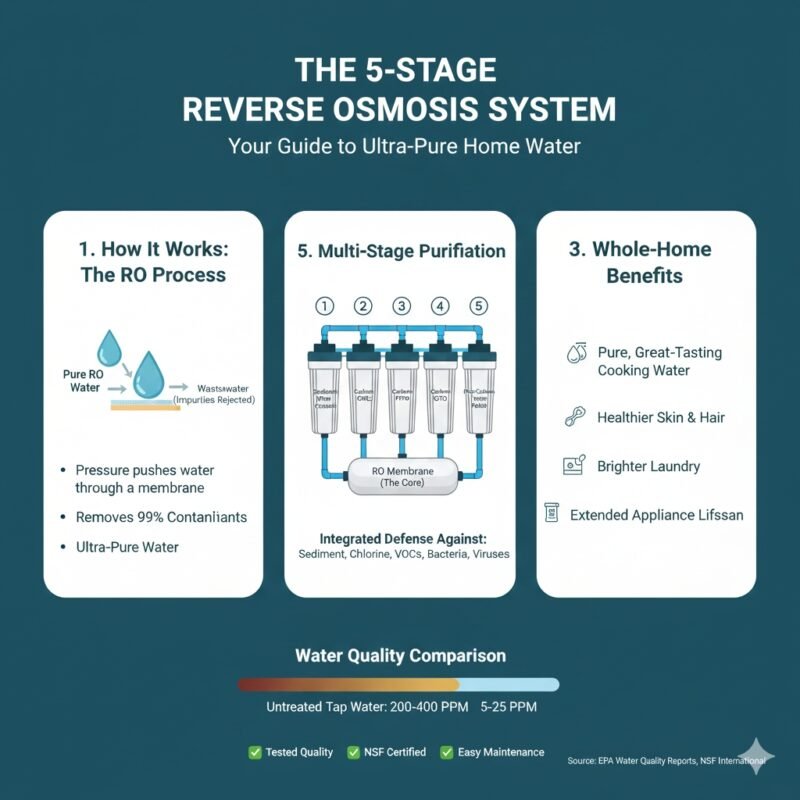
The 5-stage design is a strategic defense system. It is built on the philosophy that different contaminants require different removal methods. By arranging these methods in a specific sequence, the system protects its most expensive components while ensuring that the final product is stripped of up to 99% of impurities. It is a balance of Mechanical Filtration (Stage 1), Chemical Adsorption (Stages 2 & 3), Hyper-Filtration (Stage 4), and Aesthetic Polishing (Stage 5).
Part 2: The Anatomy of a 5 Stage RO Filter
Let’s take a journey with the water molecule as it travels through this system. Understanding the job of each cylinder is crucial for maintenance and for appreciating the quality of the water in your glass.
Stage 1: The Sediment Pre-Filter (The First Line of Defense)
The process begins with the raw water entering the first housing.
- The Component: High-Density Polypropylene (PP) Cotton.
- The Mission: This stage is the “bouncer” at the door. It physically traps suspended solids—particles you can see and some you can’t. We are talking about rust flakes from old pipes, sand grains, silt, dirt, and algae.
- The Engineering: A high-quality PP filter uses “graded density.” The outer layers are looser to catch the big debris, while the inner layers are tight to catch fine dust.
- Why It Matters: Without this stage, the carbon filters would get coated in mud, rendering them useless. As a dedicated pp cotton household water purifier company, we emphasize that this simple white cartridge is the foundation of the entire system’s longevity.
Stage 2: Granular Activated Carbon (GAC)
Once the water is physically clear, it enters the chemical treatment phase.
- The Component: Loose granules of activated carbon (often coconut shell).
- The Mission: Adsorption. Carbon is a magnet for chemicals. This stage specifically targets Chlorine, Chloramines, hydrogen sulfide (rotten egg smell), and Volatile Organic Compounds (VOCs).
- The Engineering: The loose granules allow for high flow rates while maximizing the surface area available to trap chemical molecules.
Stage 3: Carbon Block (CTO)
This is the “redundancy” stage that separates a high-end 5 stage ro filter from cheaper alternatives.
- The Component: Compressed Carbon Block.
- The Mission: “CTO” stands for Chlorine, Taste, and Odor. Unlike the loose granules in Stage 2, this is a solid block. Water must squeeze through tight pathways.
- The Engineering: This stage acts as a gatekeeper. It catches any “fines” (carbon dust) from Stage 2 and ensures that zero chlorine reaches the next stage. Chlorine is the kryptonite of the RO membrane; even a small amount can destroy it. Stage 3 ensures that never happens.
Stage 4: The Reverse Osmosis Membrane (The Engine)
This is the heart of the system. Up until now, we have only filtered the water. Now, we purify it.
- The Component: Thin Film Composite (TFC) Semi-Permeable Membrane.
- The Mission: Separation on a molecular level.
- The Engineering: Water is forced under pressure against a sheet of material with pores sized at 0.0001 microns. To put that in perspective, a bacteria is about 1 micron. A virus is about 0.02 microns. The RO membrane is tight enough to reject heavy metals (Lead, Mercury), Salts (Fluoride, Arsenic), Bacteria, Viruses, and cysts.
- The Result: The contaminants bounce off the membrane and are flushed down the drain (brine), while pure water molecules (permeate) pass through to the storage tank.
Stage 5: The Post-Carbon Polisher (The Finishing Touch)
After purification, the water sits in a pressurized storage tank, ready for use.
- The Component: Inline Activated Carbon Filter.
- The Mission: Taste refinement.
- The Engineering: Water stored in a rubber-lined tank can sometimes pick up a bland or “flat” taste. As the water leaves the tank to go to your faucet, it passes through this final filter. It scrubs the water one last time, ensuring it tastes crisp, sweet, and aerated.
Part 3: The Health Implications
Why are so many families switching to a 5 stage ro filter? The primary driver is health. Municipal water treatment is designed to prevent mass outbreaks of disease (like cholera), but it is not designed to remove modern industrial contaminants.
The PFAS Problem
Per- and polyfluoroalkyl substances (PFAS) are known as “forever chemicals.” They are used in non-stick pans and waterproofing and have leeched into groundwater globally. They are linked to cancer and immune disruption. Standard carbon filters cannot effectively remove them. RO membranes, however, are one of the few EPA-recognized methods for significant PFAS reduction.
The Lead Concern
Lead pipes are still prevalent in many cities. Lead is a neurotoxin with no safe level of exposure, especially for children. Because lead is a heavy metal in dissolved form, simple mesh filters cannot catch it. The 5 stage ro filter is a physical barrier that lead cannot cross, providing safety regardless of the condition of your city’s infrastructure.
Sodium and Nitrates
For individuals with high blood pressure or heart conditions, the sodium in tap water (or softened water) can be an issue. Nitrates from fertilizer runoff are dangerous for infants. RO technology effectively removes both, providing “neutral” water ideal for baby formula and strict diets.
Part 4: The Commercial Edge (Cafes and Restaurants)
While we often discuss this technology in the context of the home kitchen, the 5 stage ro filter is the secret weapon of the independent coffee shop and the boutique restaurant.
The Coffee Connection
If you run a café, your product is 98% water.
- Hardness: High mineral content prevents coffee from extracting properly, leading to sour or flat flavors.
- Chlorine: Chlorine reacts with the oils in the coffee bean, creating a bitter, chemical aftertaste.
- The Solution: An RO system provides a clean slate. It removes the interference, allowing the barista to present the coffee exactly as the roaster intended.
The Equipment Lifesaver
Commercial espresso machines, combi-ovens, and ice machines are expensive assets.
- Scale: Limescale buildup from hard water is the #1 cause of commercial equipment failure. It clogs sensors, blocks valves, and insulates heating elements causing them to burn out.
- The Fix: By removing the dissolved solids (calcium/magnesium) before they enter the machine, a 5 stage ro filter acts as an insurance policy. It can save a business thousands of dollars in repair costs and downtime annually.
If you are a business owner looking for a system that balances commercial durability with the compact footprint needed for a crowded kitchen, we highly recommend the 5 Stage RO Water Filter for Home & Business. This unit is engineered to deliver high-purity water that protects your equipment and elevates your customer’s tasting experience.
! Alt: Barista making espresso using purified water from a pp cotton household water purifier company system.
Part 5: The Economics of Ownership
Is a 5 stage ro filter expensive? When you look at the sticker price compared to a $20 pitcher, it seems so. But when you look at the “Cost Per Gallon” over 5 years, it is the cheapest way to drink water.
The Bottled Water Comparison
Let’s assume a family of four consumes 3 gallons of drinking/cooking water daily.
- Bottled Water: At $1.00/gallon, that is $3.00/day or $1,095/year.
- RO System:
- Initial Cost: ~$250.
- Annual Filters: ~$60.
- Water Bill Increase: ~$5.
- First Year Total: $315.
- Subsequent Years: $65.
The Savings: By Year 2, the RO system is saving you over $1,000 annually. The Return on Investment (ROI) is incredibly fast.
The Hidden Savings
- Plumbing: By using RO water in your kettle, coffee maker, and iron, these appliances never scale up. You stop replacing them every few years.
- Groceries: You stop buying cases of water. No more hauling heavy plastic from the store.
Part 6: Installation and Usability
Modern 5 stage ro filter systems are designed with the DIY homeowner in mind. You do not need to be a professional plumber to install one.
The Setup
- Feed: The system taps into your cold water line under the sink using a simple adapter.
- Drain: A saddle clamp attaches to your wastewater pipe to carry away the rejected contaminants.
- Faucet: A stylish dedicated faucet is installed on the sink (requiring a hole).
- Storage: The pressurized tank sits under the sink, holding 2-4 gallons of pure water so you have instant flow when you open the tap.
Maintenance Schedule
Maintaining the system is vital for safety.
- Every 6 Months: Change the Pre-Filters (Stage 1, 2, 3). This protects the membrane.
- Every 12 Months: Change the Post-Carbon (Stage 5).
- Every 2-3 Years: Change the RO Membrane (Stage 4).
Most systems use standard-sized cartridges, making them easy to service.
Part 7: Environmental Impact
In a world drowning in plastic, the 5 stage ro filter is a green choice.
- Plastic Reduction: By filtering your water at home, you eliminate the need for single-use plastic bottles. One set of filters can replace thousands of bottles.
- Carbon Footprint: You eliminate the carbon emissions associated with manufacturing plastic bottles and trucking heavy water across the country.
While RO systems do produce some wastewater (brine) during the cleaning process, modern systems are increasingly efficient. The environmental cost of this small amount of water is negligible compared to the environmental cost of plastic waste.
Part 8: Myths vs. Reality
Myth: “RO water is dead water because it has no minerals.”
- Reality: Water is for hydration; food is for nutrition. You get more minerals from a single banana than you do from a bathtub of tap water. However, if you prefer the taste of mineral water, you can easily add a 6th stage “Remineralization Filter” to add healthy calcium back in.
Myth: “The system wastes too much water.”
- Reality: While early systems had a 5:1 waste ratio, modern systems with permeate pumps and auto-shutoff valves have improved this drastically, often achieving 1:1 or 2:1 ratios.
Myth: “It’s too complicated to maintain.”
- Reality: If you can change a lightbulb, you can change a filter. Modern “Quick-Connect” fittings make it a tool-free process that takes 15 minutes once a year.
Conclusion: The Standard of Purity
The 5 stage ro filter has earned its place as the industry standard not through marketing, but through performance. It is a comprehensive solution that addresses every aspect of water quality: physical clarity, chemical safety, molecular purity, and taste.
For the homeowner, it offers the security of knowing your family is safe from lead and PFAS. For the business owner, it offers the consistency needed to build a reputation for quality.
If you are ready to upgrade your life from “tap water” to “pure water,” the 5-stage system is your answer.
Visit YourWaterGood today. Explore our high-efficiency, commercial-grade systems designed to bring the ultimate hydration experience to your home or business.https://yourwatergood.com/product/5-stage-ro-water-filter-for-home-busines/.
Frequently Asked Questions (FAQ)
Q: Can I connect the 5 stage ro filter to my refrigerator ice maker? A: Yes! This is a very common setup. You can split the line coming from the RO system: one tube goes to the faucet, and the other goes to your fridge. This gives you crystal clear RO ice cubes and chilled water from your fridge dispenser.
Q: How do I know if my membrane is bad? A: You should buy a TDS (Total Dissolved Solids) meter. They are inexpensive. Measure your tap water, then measure your RO water. The RO water should be 90-95% lower. If the RO water TDS starts creeping up, the membrane is failing.
Q: Does the system work on well water? A: Yes, but with caveats. If your well water has iron, high hardness, or bacteria, you may need additional pre-treatment (like a softener or UV light) before the RO system to prevent the membrane from clogging too quickly.
Q: Is the tank necessary? A: For most residential systems, yes. The RO process is slow (drop by drop). The tank accumulates the water so that when you turn on the tap, you get a strong, fast flow. There are “tankless” systems available, but they are more expensive and require electricity.
Q: Why does my water taste milky? A: This usually happens right after changing filters. It is just millions of tiny air bubbles trapped in the system. If you let the glass sit for a minute, the bubbles will rise and the water will clear. It is harmless and will stop after a few days.