
Point of Entry vs. Point of Use Water Filter Systems: Where a 5-Stage RO Fits

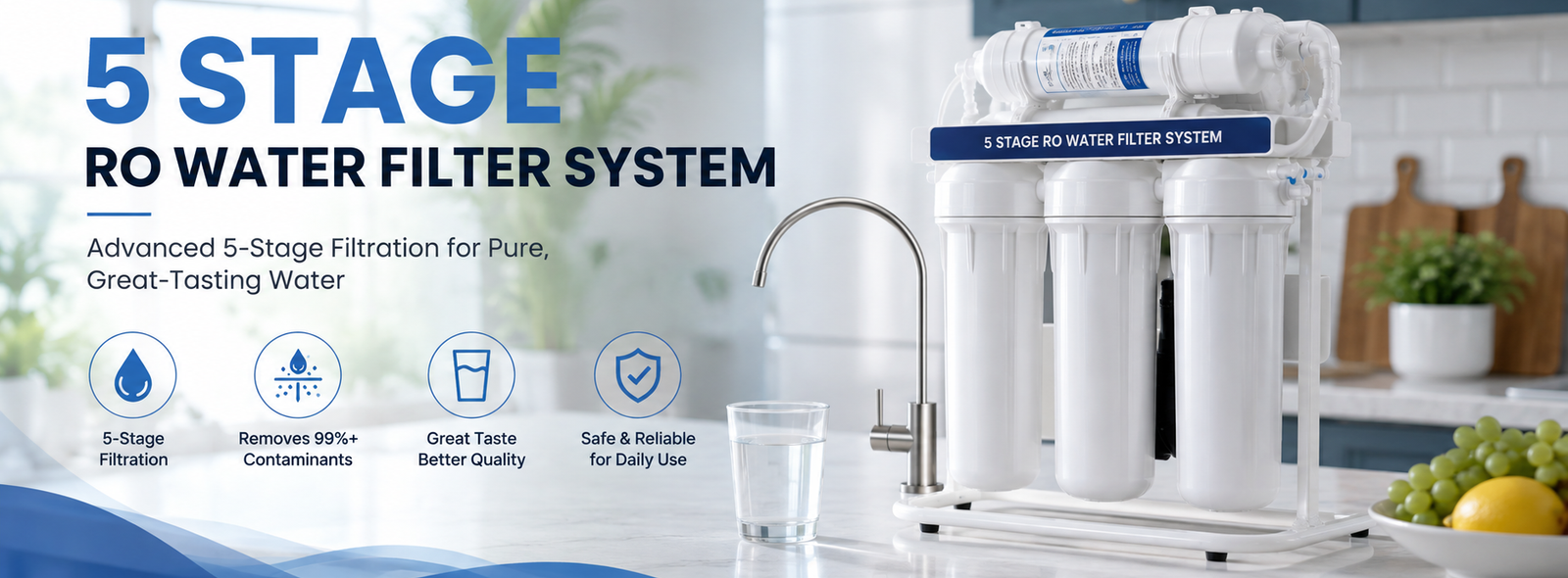
Point of entry (POE) treats water where it enters the building — one system, every faucet. Point of use (POU) treats water at a single tap, typically the kitchen sink. A 5-stage RO system is a POU technology by design. It isn’t built to handle whole-house volume, and understanding why changes how you should actually be shopping.
The distinction matters more than most product pages admit:
- Location in the plumbing line — POE sits at the main line before any fixture; POU sits under one sink.
- Flow rate requirements — POE has to cover whole-house peak demand; POU only has to supply one tap.
- What each is built to remove — POE typically handles sediment, hardness, and chlorine at volume; POU (like 5-stage RO) is built for drinking-water-grade purification.
- Wastewater behavior — RO-based POU systems produce some wastewater per gallon treated; most POE systems don’t.
- Cost structure — POE means higher upfront install cost and lower cost per gallon over total household use; POU means lower upfront cost but higher cost per gallon of the (much smaller) volume it actually treats.
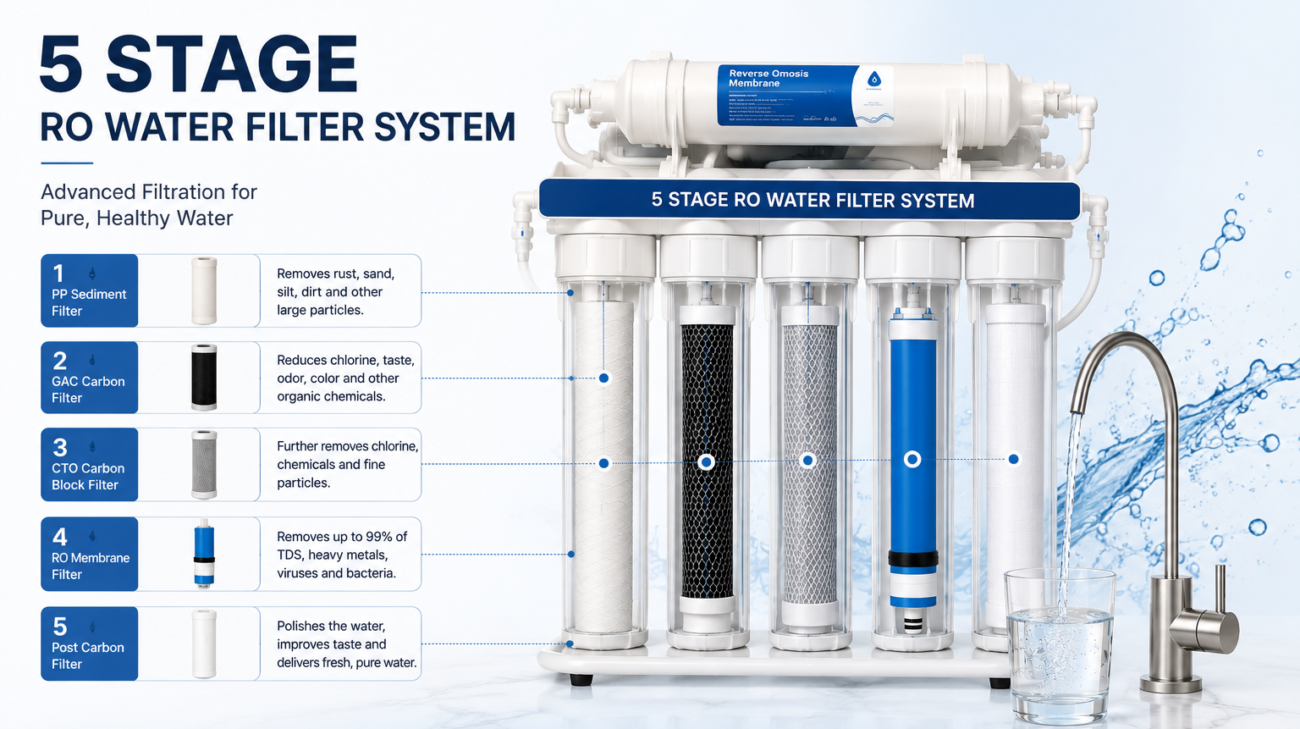
Fast Check Product: https://yourwatergood.com/product/5-stage-ro-water-filter-for-home-busines/
Where Each System Sits in the Plumbing Line
A POE system installs at the main water line, usually right after the meter or pressure tank, before the line splits off to any individual fixture. Everything downstream — showers, laundry, dishwasher, every faucet — gets treated water.
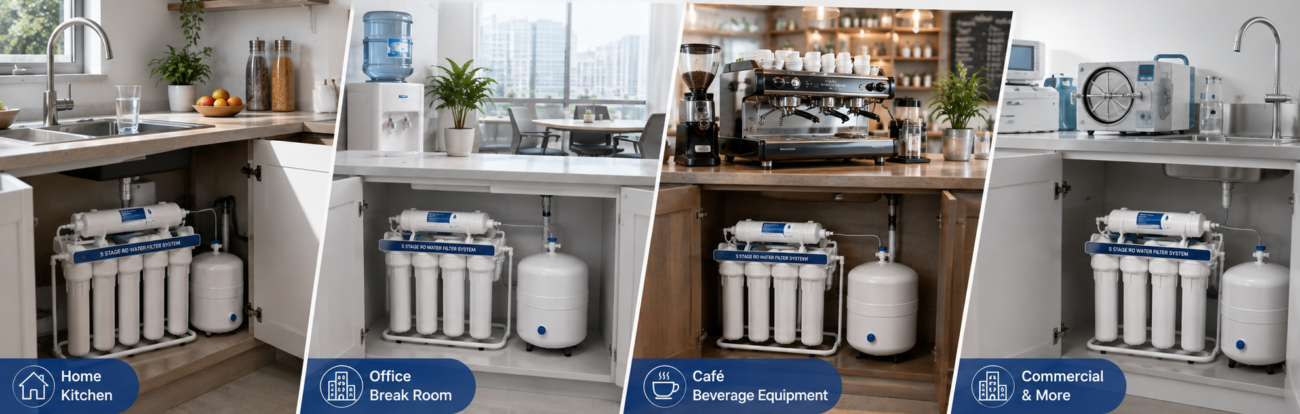
A POU system, including a 5-stage RO unit, installs after that split, dedicated to one fixture. It never sees the household’s total water volume — only whatever comes through that one line.
This isn’t a minor installation detail. It’s the reason the two categories are engineered around completely different flow assumptions.
Why a 5-Stage RO System Is Built for Point of Use, Not Point of Entry
RO filtration works by forcing water through a semi-permeable membrane fine enough to block dissolved solids down to roughly 0.0001 micron. That level of filtration is inherently slow — it’s a trade-off for how thorough it is.
That’s why residential RO systems are rated in GPD (gallons per day), typically in the 400–800 GPD range for a household unit, rather than GPM. A whole-house POE system, by contrast, has to be sized in GPM (gallons per minute) to cover simultaneous demand — a shower running while the dishwasher and a faucet are both on.
Trying to push whole-house GPM-level flow through an RO membrane isn’t a matter of buying a bigger unit. The membrane itself becomes the bottleneck, and pressure requirements climb fast. That’s a supply-side engineering limit, not a marketing decision.
Flow Rate Is the Real Reason You Can’t Run Whole-House Water Through RO
Most homes need somewhere in the range of 8–12 GPM of peak capacity to keep water pressure consistent when several fixtures run at once. A 5-stage RO system was never designed to sustain that — it’s designed to deliver clean water reliably to one tap, on demand, at drinking-water quality.
This is also why incoming PSI matters more for POU performance than most buyers expect. RO membranes need adequate feed pressure to perform correctly — commonly in the 40–60 PSI range depending on the unit. If a POE system upstream (a softener or sediment filter) has already knocked pressure down significantly, the RO unit downstream may underperform even though nothing about it is broken.
POE vs. POU: Side-by-Side
| Factor | Point of Entry (POE) | Point of Use — 5-Stage RO (POU) |
|---|---|---|
| Where it treats | Main line, before any fixture | One tap — typically the kitchen sink |
| Flow rating | GPM, sized for whole-house peak demand | GPD, sized for one tap’s drinking/cooking use |
| What it targets | Sediment, hardness, chlorine, iron/manganese | Dissolved solids, heavy metals, drinking-water-grade purity |
| Upfront cost | Higher — whole-house plumbing tie-in | Lower — single under-sink install |
| Cost per gallon | Lower, spread across total household use | Higher, but only applied to a small fraction of total use |
| Footprint | Utility closet, basement, or main line | Under one sink |
| Wastewater | Typically none | Yes — a ratio of wastewater to filtered output |
Neither category is “better” in the abstract. They’re solving different problems, and pricing them against each other head-to-head — which a lot of comparison content does — misses the point.
When You Actually Need Both
The two aren’t mutually exclusive, and in practice, a lot of well-designed setups run both:
- A POE system (sediment, softening, or carbon at the main line) handles bulk water quality for the whole house — showers, laundry, appliances.
- A POU 5-stage RO system sits downstream at the kitchen sink, delivering the highest tier of purification specifically for drinking and cooking water.
This combination also solves the pressure issue above: sizing the POE pre-treatment correctly so the POU RO unit still gets adequate feed pressure is a detail installers check for and buyers usually don’t — until performance drops and they assume the RO unit is defective.
If whole-house coverage is actually what you’re trying to solve, that’s a separate setup worth reading about on its own. If you’re weighing the cost side of a POU RO system specifically — payback period, cost per gallon versus bottled water — that’s covered in detail on our cost and ROI page rather than duplicated here.
FAQ
What’s the difference between point of entry and point of use water filtration? POE treats water for the entire building at the main line; POU treats water at a single fixture. They’re sized and engineered differently as a result.
Can I use a 5-stage RO system for my whole house? Not practically. RO systems are rated in GPD and built for single-tap output — they can’t sustain the GPM flow a whole house needs at peak demand.
Do I need both a POE and a POU system? Only if you want whole-house treatment (hardness, chlorine, sediment) and drinking-water-grade purification at the kitchen sink. Many households run both for different reasons.
Why is RO capacity measured in GPD instead of GPM? Because the membrane filtration process is inherently slower than bulk flow. GPD reflects realistic daily output for a single point of use, not instantaneous flow.
Does a POE system replace the need for RO filtration? No. POE systems generally don’t remove dissolved solids to the same degree — they handle sediment, hardness, and chlorine at scale, not fine purification.
Will low incoming water pressure affect my RO system’s performance? Yes. RO membranes need adequate feed pressure — commonly 40–60 PSI — to perform as rated. Upstream POE equipment can reduce that pressure if it’s not sized correctly.
Which system removes more contaminants, POE or POU? Per gallon of water it treats, a 5-stage RO (POU) system removes a broader range of dissolved contaminants. A POE system treats more total volume, but generally to a less exhaustive standard.
Which One Fits Your Setup
If you’ve confirmed a 5-stage RO system is the right POU choice for your kitchen, our current model — including the optional UV add-on is worth a look.