
Domestic RO Water Purifier Manufacturer: Engineering Support for Residential Import Programs

A qualified domestic RO water purifier manufacturer for the U.S. residential channel hands over verifiable component data before you sign a purchase order — not after the container lands. Before any deposit changes hands, confirm four things in writing:
- Named component sourcing for the RO membrane, carbon block, and housing — not just a finished-unit spec sheet
- A fixed lead time from sample approval to container-load shipment
- Clear mold/tooling ownership terms for any custom housing, faucet, or private-label branding
Buyers who skip this step tend to find out the hard way — after 500 units are already on the water.
Fast Check Product: https://yourwatergood.com/product/ro-water-purifier/
Vetting a Domestic RO Water Purifier Manufacturer: The Non-Negotiables
Most “manufacturer” listings importers find online are trading companies reselling a factory’s catalog under their own name. That layer adds cost and removes your ability to request engineering changes.
A real production source will tell you, unprompted:
- Which RO membrane brand and rejection rate the unit ships with
- The carbon type used in the pre- and post-filtration stages (granular vs. compressed block)
- Whether housing tooling is shared across customers or dedicated to your account
- Batch-to-batch consistency controls — how they confirm unit #1 and unit #500 perform identically
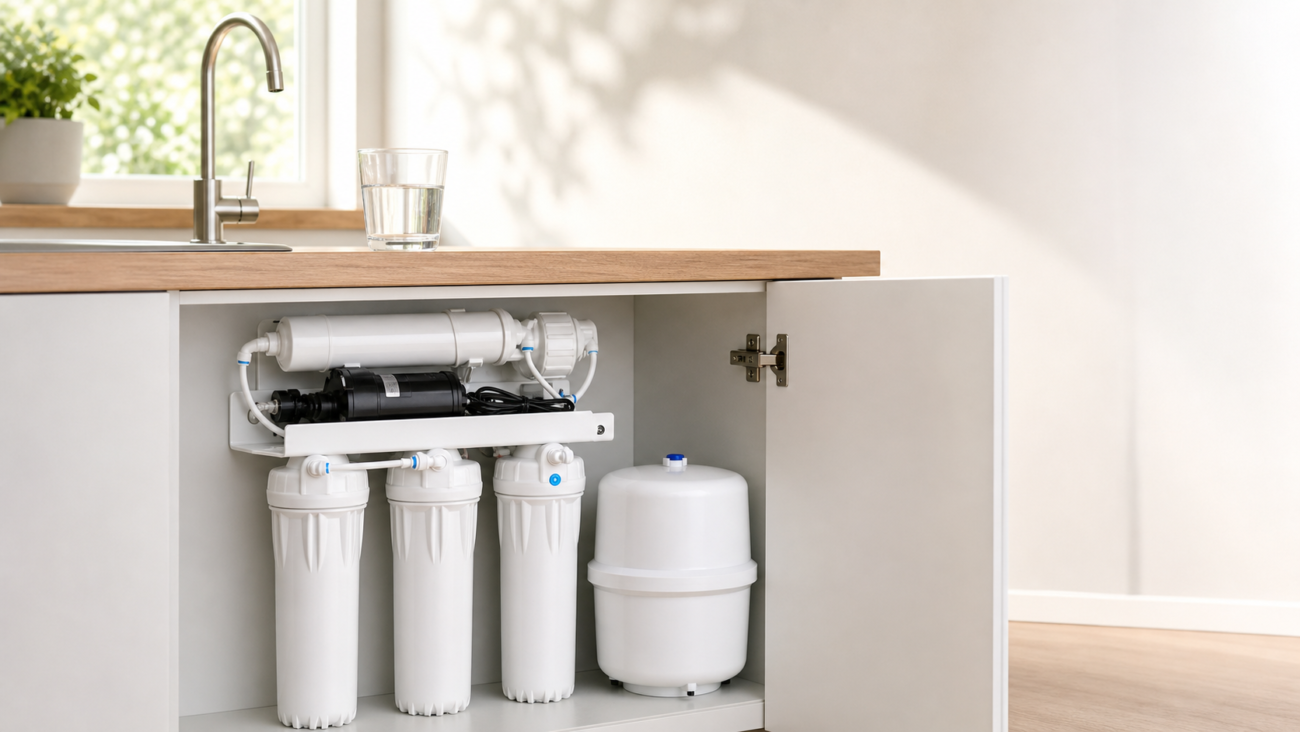
On a standard 5-stage RO water filtration system, that means transparency across the full stack: a 5-micron PP/FPP sediment stage, a CTO compressed-carbon stage for chlorine and taste, a secondary 1-micron polishing stage, the RO membrane itself, and a coconut-shell post-carbon stage for final taste correction. Every one of those five filter cartridge components affects the finished water differently — and a supplier who can’t speak to each stage individually is quoting you a black box.
The same scrutiny applies to the under-sink RO purifier format specifically, since it’s the configuration most private-label programs move first. Compact housings leave less room for error: a slightly undersized pre-filter cartridge fouls faster in a small enclosure than it would in a larger point-of-entry skid, so the replacement-interval numbers on the spec sheet need to reflect the actual housing volume — not a generic industry average pulled from a bigger system.
Off-the-Shelf Wholesale vs. Full OEM/ODM Engineering Support
Not every order needs custom tooling. But knowing which tier you’re actually buying into — before you commit to a MOQ — prevents budget surprises three weeks into production.
| Factor | Off-the-Shelf Wholesale | Full-Scale OEM/ODM Support |
|---|---|---|
| MOQ | 50–100 units, fixed spec | 300–500 units, negotiable for custom builds |
| Lead Time | 2–3 weeks from stock | 5–7 weeks, including tooling and sample rounds |
| Mold/Tooling Fee | None — shared housing | One-time fee, amortized once volume threshold is hit |
| Technical Drawing Support | Generic spec sheet only | Full dimensional drawings and cartridge cross-reference sheets |
| Branding | Sticker/label only | Injection-molded logo, custom faucet finish, private packaging |
Request a Factory Component Blueprint before you lock in a MOQ tier — it’s the only way to see the actual membrane, carbon, and housing drawings behind each row in that table, instead of taking a sales sheet’s word for it.
Engineering for U.S. Feed Water: Municipal Supply, Well Water, and GPD/GPM Sizing
A domestic RO water purifier manufacturer selling into the U.S. residential market has to design around two very different feed-water profiles, not one.
Municipal tap water falls under the EPA’s Safe Drinking Water Act framework for biological safety, but chlorine and chloramine — added specifically to meet that standard — are also the leading cause of premature membrane and O-ring degradation. Adequate carbon pre-treatment isn’t optional; it’s what keeps the RO membrane inside its rated life.
Well water behaves differently: hardness, dissolved iron, and swinging pH show up far more often than in city supply. A system built only for municipal conditions will scale or foul within weeks on groundwater unless the pre-filtration stage is upgraded to match.
On sizing:
- Most residential import orders land in the 400–800 GPD range for tankless under-sink builds — the actual number should be driven by household size and fixture count, not picked off a catalog page.
- GPD describes theoretical 24-hour output; GPM describes what the faucet actually delivers on demand. Spec to GPM if the household has multiple fixtures drawing at once.
- Feed pressure typically runs 40–85 PSI at a U.S. residential tap. Below that range, the system needs a booster pump built in, not sold as an accessory afterthought.
- TDS rejection rate should be quoted against a stated feed concentration in ppm — a rejection percentage without a reference ppm is a marketing number, not a spec.
The Overlooked Component Detail That Drives Warranty Claims
Here’s the one line item that never shows up on a quote sheet: the binder used to compress a carbon-block cartridge.
Low-grade binders swell slightly once wetted. That narrows the internal flow channel and pulls entry-side PSI down before water ever reaches the membrane. The RO element then runs against a starved pressure differential for its entire service life — and a membrane rated for two years can degrade in under one.
A second version of the same problem shows up in the O-rings sealing the housing. Cheap compounds micro-leak the moment the unit cycles between a cold well-water feed and a warm utility closet — a failure mode that doesn’t show up in a dry factory test, only in the field, eighteen months in.
Get the Warranty-Risk Component Checklist — a one-page rundown of the binder, O-ring, and housing specs that separate a low single-digit return rate from a double-digit one.
How Engineering Support Protects Your Margins and Brand Equity
None of this is abstract for a brand owner. It shows up on four specific line items:
- Lower warranty claims — components sourced for consistency instead of unit cost mean fewer failures inside the warranty window
- Operational stability — a membrane and pre-filtration stack matched to the actual feed water holds its rated output instead of degrading early
- Water consistency — unit #1 and unit #500 in a production run need to deliver the same TDS rejection, not a “close enough” spread
- Brand equity protection — a field failure lands as a one-star review against your label, not the factory’s — engineering support upstream is what keeps that review from happening
Private-Label Production Timeline: From Sample Approval to Container Shipment
A realistic OEM timeline for a 5-stage or under-sink RO order runs through five checkpoints:
- Spec confirmation — GPD/GPM target, feed water profile, branding requirements locked in writing
- Tooling — if custom housing, faucet finish, or packaging is requested (skip this step for off-the-shelf builds)
- Pre-production sample — approved against the confirmed spec sheet before mass production starts
- QC sign-off — pressure testing, TDS rejection verification, and cosmetic inspection on a statistical sample of the run
- Pre-shipment inspection and container loading — third-party or buyer-witnessed, before the container seals
Ask for the full documentation package — component test references, dimensional drawings, and the QC sign-off report — to be handed over alongside the shipment, not emailed separately weeks later once the container is already at sea. That handover point is also where most of the vetting criteria from earlier in this article get confirmed in practice, rather than taken on faith from a sales conversation.
FAQ
1. What MOQ should I expect from a domestic RO water purifier manufacturer for a private-label order? Off-the-shelf builds typically start at 50–100 units. Full custom tooling — a proprietary faucet or housing color — usually requires 300–500 units to justify the mold cost.
2. How long does tooling take if I want a custom faucet or housing? Plan for 5–7 weeks from spec confirmation to shipment, including at least one sample round. Off-the-shelf orders ship in 2–3 weeks.
3. Can the same 5-stage RO platform work for both municipal and well-water customers? Yes, with pre-filtration adjustments. Municipal builds prioritize carbon capacity for chlorine; well-water builds need upgraded sediment and, in high-iron regions, oxidative pre-treatment ahead of the membrane.
4. What’s the difference between GPD and GPM on a supplier spec sheet? GPD is a theoretical 24-hour output figure. GPM is the real-world flow rate at the faucet. Size to GPM if your target household has multiple fixtures drawing water simultaneously.
5. What happens if a batch fails incoming QC after it lands in a U.S. warehouse? This should be defined in your purchase agreement before production starts — specifically who covers freight on a rework versus a full reship, and the inspection window you have to file a claim.
6. Can I get a technical parameter sheet before placing a deposit? Yes — and you should treat any supplier unwilling to share one pre-deposit as a sourcing risk, regardless of the price quoted.
Stop sourcing against a sales sheet and start sourcing against engineering data. Request your Custom OEM Quote, a full Technical Parameter Sheet, and tiered B2B Wholesale Pricing for your next production run from a direct domestic RO water purifier manufacturer — before your next PO locks you into a spec you haven’t actually verified.