
Water Filtration System Suppliers: Evaluating Real Engineering Support vs. a Parts Catalog

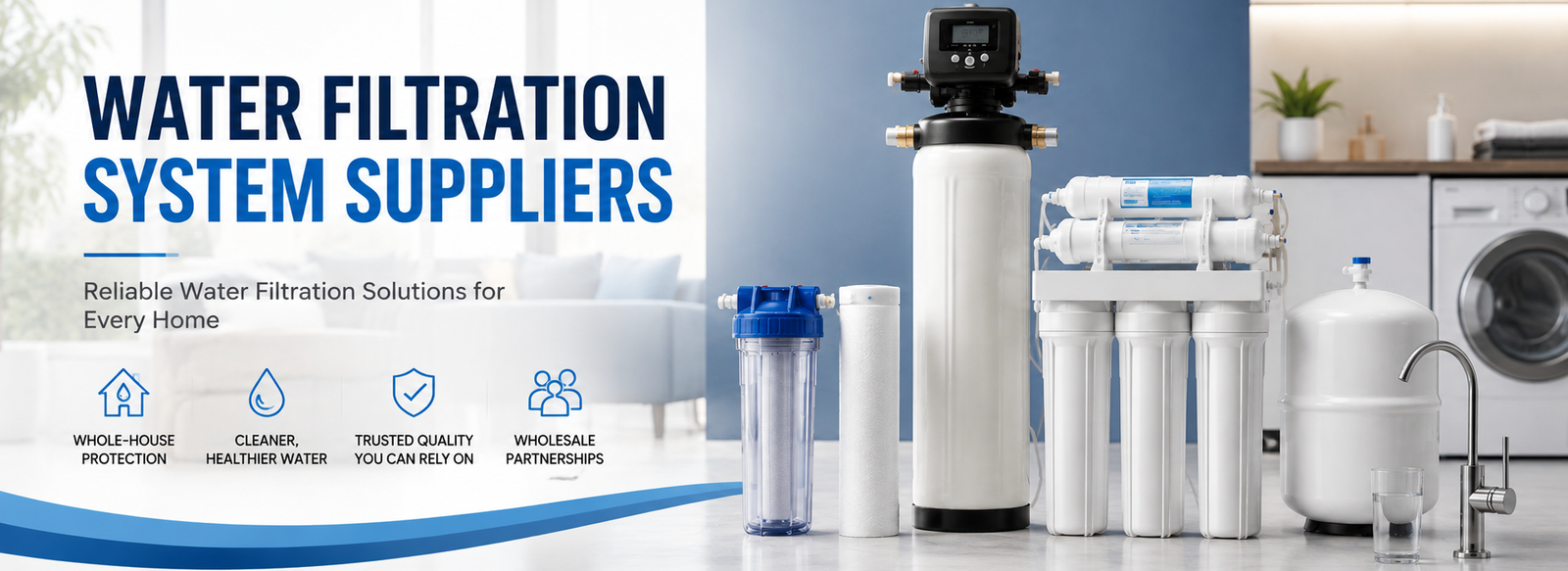
Finding water filtration system suppliers who can actually back a private-label program is a different exercise than buying finished units off a shelf.
The suppliers worth building a program around control the variables that turn into warranty claims six to nine months after installation — not the ones with the glossiest product photos.
Before a purchase order goes out, ask for:
- Component lot traceability for membranes, carbon media, and O-rings — not just a country-of-origin sticker
- Pressure and flow test data at the PSI range your market actually runs, not a lab-ideal number
- A named engineering contact for post-shipment defect analysis, not a shared sales inbox
- Tooling and mold documentation for any custom housing, manifold, or bracket
- Defect-rate history from the last two production runs, not a single sample report
Fast Check Product: https://yourwatergood.com/shop/
Why “Supplier” Doesn’t Always Mean Manufacturer
A lot of the sourcing pain B2B buyers run into comes from a label problem: “supplier” gets used for both traders who relabel finished stock and factories that actually engineer the system.
Those two are not interchangeable, and mixing them up shows up later as:
- Inconsistent water quality between batches — because a trader can’t control which factory filled the last order
- Warranty costs that land on your brand, not the factory that cut corners
- No path to a custom configuration when a distributor is contractually locked to one spec
A manufacturer that owns its tooling can hold TDS reduction, flow rate, and PSI tolerance consistent across a 10,000-unit run. A trader reselling whichever factory quoted lowest that month usually can’t promise that in writing.
That consistency is what actually protects brand equity — not the box art.
The Engineering Evidence Worth Requesting Before You Commit
Skip the sales deck. These are the documents that tell you whether a supplier can support a program past the first container:
- Pressure-drop curves for each filtration stage at your target flow rate (GPM)
- Membrane rejection data at two TDS levels — one representative of municipal tap water, one representative of hard well water
- A bill of materials naming the actual resin, membrane, and housing suppliers, not just “premium materials”
- Sample validation turnaround time — how many days from your spec to a testable prototype
- A tooling amortization schedule if you’re funding a custom mold, so you know what happens to that cost if volume drops
If a supplier can’t produce most of this within a week, that’s the signal — not anything on the spec sheet.
Off-the-Shelf Components vs. Full OEM/ODM Support
| Factor | Off-the-Shelf Component Wholesale | Full-Scale OEM/ODM Engineering Support |
|---|---|---|
| MOQ | 500–1,000 units per SKU, fixed spec | Often negotiable from 100–300 units on a first custom run |
| Lead Time | 15–25 days from existing stock | 35–55 days, covering tooling and first-article inspection |
| Tooling / Mold Cost | None — housing and manifold are fixed | One-time NRE fee, typically amortized after a volume threshold |
| Technical Drawings | Generic spec sheet only | Full CAD drawings, flow-path and pressure-drop data |
| Branding | Neutral housing, no labeling | Custom housing color, laser-etched logo, private-label cartridge wraps |
| Post-Sale Support | General sales inbox | Assigned engineer for defect root-cause analysis |
Request a Component Traceability Report before you commit to a production run — ask for the lot data and test logs behind the exact configuration you’re quoting, not a generic sample from a different batch.
Two Failure Modes That Show Up as Warranty Claims, Not Spec Problems
Two defects account for a disproportionate share of the warranty tickets we see traced back to component sourcing, and neither one shows up on a first-article inspection.
Adhesive breakdown in cheap carbon cartridges. Some granular activated carbon cartridges are bonded with adhesives that weren’t validated against chlorinated tap water. Over 60–90 days of normal use, that adhesive degrades enough to raise inlet-side PSI drop — and that added restriction shortens the working life of any RO membrane sitting downstream. The customer sees it as “my system feels weaker.” The root cause is a $0.30 component.
O-ring micro-leaks under thermal cycling. A soft nitrile O-ring can pass a bench pressure test with no issue, then develop a hairline leak the first time it cycles between hot dishwasher exhaust and cold winter well water repeatedly. This is the kind of defect that surfaces as a wave of warranty claims eight to ten months after a shipment goes out — long after the sample that passed QC is gone.
Request Technical Drawings for a Custom Configuration before tooling starts — get the CAD file and the pressure-drop curve for your target PSI range so this gets caught on paper, not in the field.
Matching Filtration Capacity to Municipal and Well Water Conditions
Filtration capacity has to be sized to the water source, not a generic spec sheet. The three metrics worth requesting from any supplier:
- GPD (gallons per day) — the production capacity rating for a household RO system, sized to household demand
- PSI — the operating pressure window a system is engineered for; most US municipal grids run 14.5–58 PSI, and that range needs to hold at both ends for consistent flow
- TDS (ppm) — influent hardness varies enormously between municipal tap water and well water, and a system’s rejection rate should be validated at both levels, not just one
This is where a configurable product line matters more than a single fixed spec. Our 3-stage whole house pre-filter ships in three engineered configurations rather than one: a sediment-and-chlorine build for municipal water, an ion-exchange configuration built specifically for hard well water regions like Texas or the Midwest to protect espresso machines and ice makers, and a 0.01-micron washable UF configuration for buyers prioritizing pathogen reduction while retaining minerals.
A supplier that only offers one fixed stack forces every buyer into the same water chemistry assumptions — which is how mismatched systems end up as returns.
What a Configurable OEM Product Line Actually Looks Like
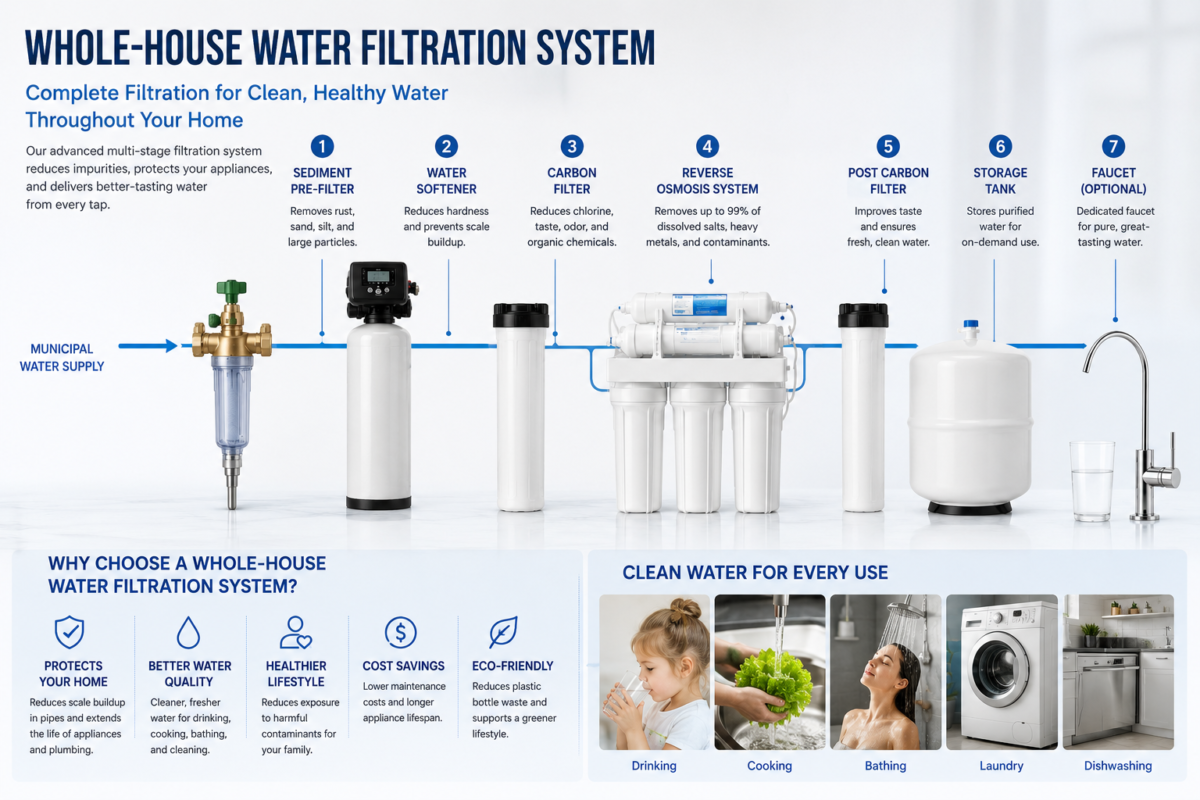
Buyers evaluating suppliers should ask to see the actual stage-by-stage engineering, not a marketing summary. Here’s what that looks like on our under-sink 5-stage RO configuration:
- Stage 1: 5-micron PP/FPP cotton filter — traps sand, turbidity, and rust. Replacement interval: 3–6 months.
- Stage 2: CTO compressed carbon — adsorbs residual chlorine and heavy metals, protects downstream stages. Replacement interval: 6–9 months.
- Stage 3: 1-micron PPF/PP cotton — secondary particulate and colloid removal. Replacement interval: 6–9 months.
- Stage 4: RO membrane rated to roughly 0.0001 micron — the stage responsible for bacteria, viruses, and heavy metal ion rejection. Replacement interval: 12–24 months.
- Stage 5: T33 post-carbon (coconut-shell activated carbon, iodine number ~1,100) — final taste and odor polishing. Replacement interval: 12 months.
Each replacement interval should be documented per stage, not averaged into one “change your filter every year” line — that level of detail is what a technical parameter sheet should look like when a supplier actually engineered the system, rather than assembled it from a parts catalog.
Frequently Asked Questions
What’s the difference between a water filtration system supplier and a manufacturer? A manufacturer owns tooling and controls the bill of materials, so specs stay consistent run to run. A supplier or trader resells finished stock from whichever factory quoted lowest, which makes batch-to-batch consistency harder to guarantee.
What MOQ is typical for a custom OEM water filtration configuration? First custom runs commonly start in the 100–300 unit range when a supplier already has base tooling, versus 500–1,000 units for a fully custom housing built from scratch.
How long does tooling take for a custom-branded housing? Budget 35–55 days from spec sign-off to first-article inspection, factoring in mold cutting and a validation cycle before mass production starts.
What GPD capacity should I request for a household RO system? Size it to actual household demand and peak draw, not just tank volume — ask the supplier for the tested GPD rating at your target inlet PSI, since output drops as inlet pressure drops.
Can the same filtration configuration handle both municipal and well water? Not without adjustment. Municipal water typically needs stronger chlorine and VOC reduction; well water usually needs hardness and sediment handling. A configurable stack, not a fixed one, is what makes this workable.
How often should filter stages be replaced in a private-label program? It varies by stage — sediment pre-filters typically need 3–6 month changes, while RO membranes can run 12–24 months. Publishing per-stage intervals (not one blended number) reduces support tickets significantly.
What causes most warranty claims in water filtration OEM programs? In our experience, component-level defects — adhesive breakdown in carbon cartridges and O-ring micro-leaks under thermal cycling — cause more claims than membrane failure itself, and neither shows up on a standard sample inspection.
Get Your Custom OEM Quote
Most water filtration system suppliers will hand you a price list. Fewer will hand you the engineering data that keeps that price list accurate after year one.
If your next step is comparing real configurations instead of marketing copy, ask for three things in the same request:
- A custom OEM quote scoped to your target MOQ and housing branding
- Technical parameter sheets — PSI range, micron ratings, and replacement intervals for every stage
- B2B wholesale pricing broken out by volume tier, not a single blended number
Contact our engineering team with your target water source — municipal or well — and typical local hardness, and we’ll size a configuration around it.