
What Is A Good Water Filter For Home — Practical Options, Tests & Buying Checklist

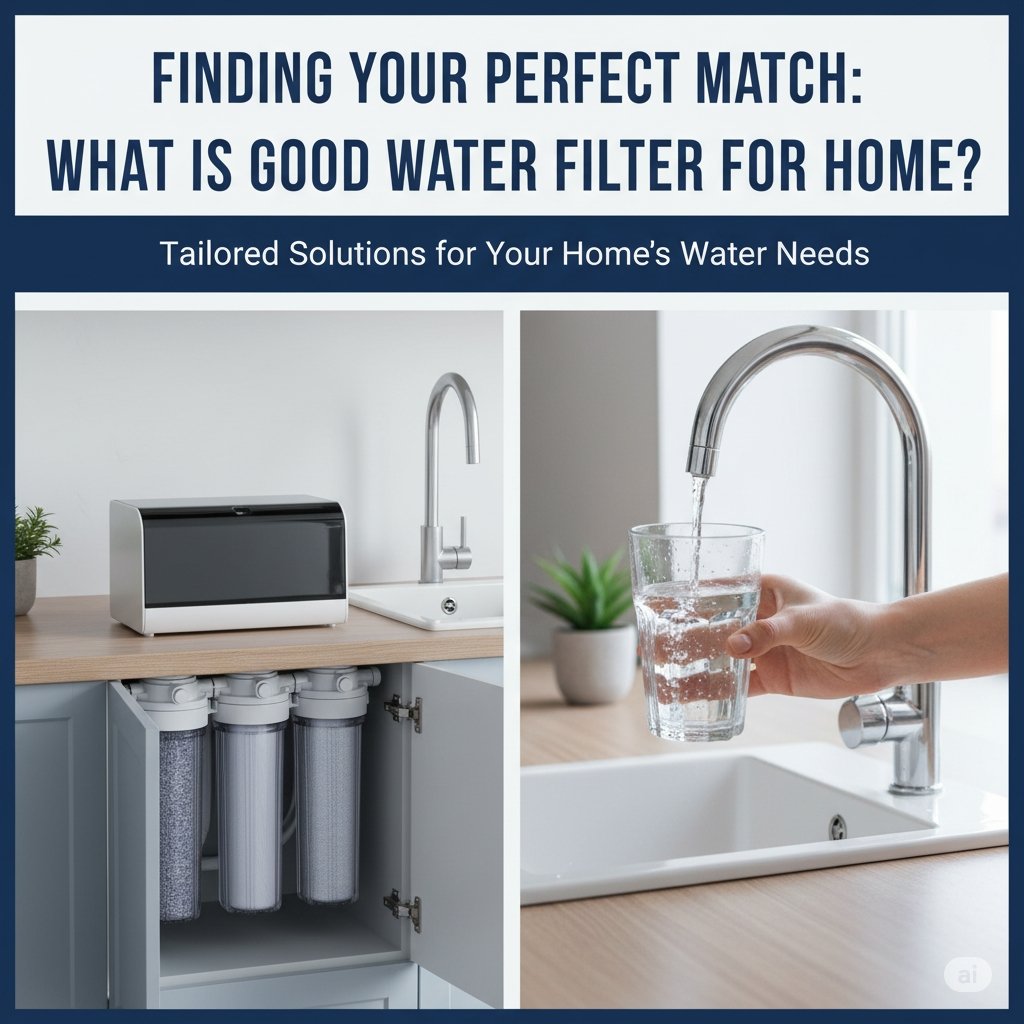
This topic is covered in full in our main guide: What Is the Best Water Filter System For Home — Top Picks, Tests & Buying Strategy.
If you’re asking what is a good water filter for home, you’re doing the right thing: water quality isn’t one-size-fits-all. The single most important rule is test first — pick a filter that removes the contaminants you actually have, not the ones you fear. This guide gives a clear, practical path from testing to buying, explains which technologies work for which contaminants, compares point-of-use and whole-house approaches, shows how to read certifications, and includes a simple buying checklist so you can choose a system that’s effective, affordable, and maintainable. For product comparisons and model specs, you can check options at YourWaterGood.
Quick summary — one line
A good water filter for home is the one that’s certified to remove the specific contaminants in your water report, fits your household flow and installation constraints, has transparent replacement costs, and is backed by reliable testing and warranty support.
1. Start with the test — the decisive first step
Before buying any filter, get a water test. Without it, you’re guessing.
- Municipal customers: download your Consumer Confidence Report (CCR) from the water supplier. It lists regulated contaminants and concentrations.
- Private wells: use a certified laboratory for a full panel (bacteria, nitrates, lead, arsenic, hardness, TDS, pH, iron, VOCs).
- Home test kits: good for quick checks (hardness strips, chlorine, basic lead screens) but not a substitute for lab tests when health-related contaminants are possible.
Record the numbers (e.g., lead ppb, nitrate mg/L, TDS mg/L). Those will map directly to technology choices — this is the data that turns a vague search for “what is a good water filter for home” into a specific recommendation.
2. Match contaminants to technologies — a practical cheat sheet
Once you have your report, use this mapping to narrow choices:
- Sediment (sand, silt, rust): PP polypropylene (sediment) filters, whole-house sediment housings.
- Chlorine, taste/odor, many VOCs: Activated carbon (GAC, carbon block).
- Lead, arsenic, fluoride, nitrates, high TDS: Reverse osmosis (RO) or specialized ion-exchange/adsorptive media.
- Bacteria, viruses: UV disinfection (requires clear water) and/or ultrafiltration (UF) — RO may reduce microbes but is not a guaranteed disinfection method on its own.
- Cysts (Giardia, Cryptosporidium): Micro/ultrafiltration or properly rated sediment filters.
- Hardness (calcium, magnesium): Water softener (ion exchange) or salt-free scale control (tradeoffs apply).
- PFAS (“forever chemicals”): PFAS-specific GAC or RO + GAC combo; check vendor lab data.
This mapping is the core decision tool. A good filter for one home may be useless in another if the contaminants differ.
3. Point-of-Use (POU) vs Point-of-Entry (POE): where to treat
Decide where you want filtered water:
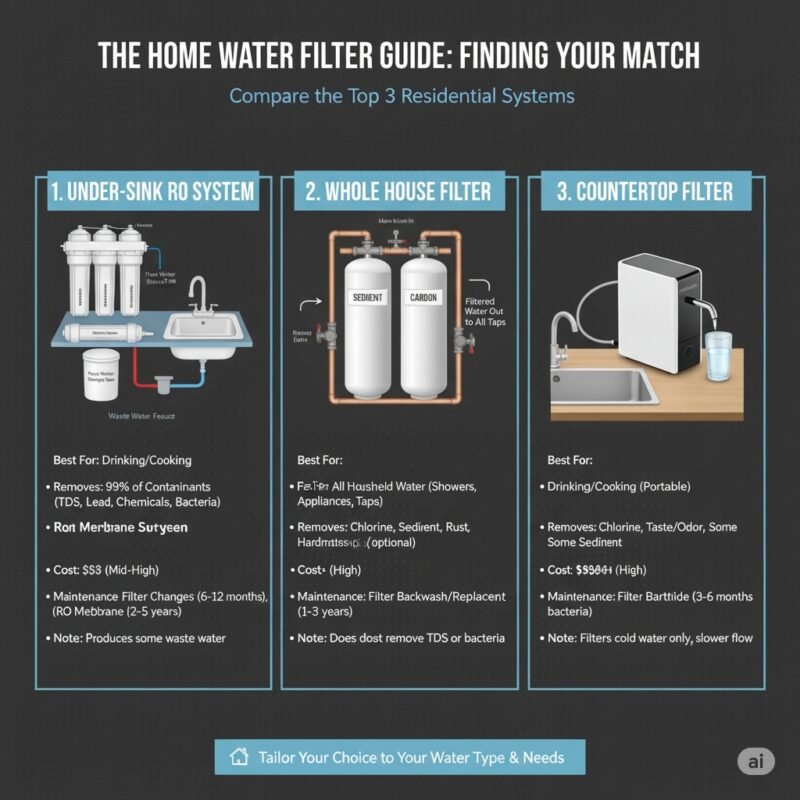
- POU (under-sink, countertop, faucet-mount): Treats a single tap (usually kitchen) for drinking and cooking. Under-sink RO or carbon POU systems are common.
- POE / Whole-House: Treats all incoming water — protects showers, appliances, and plumbing. Good for sediment removal, chlorine reduction, or softening.
Most homeowners benefit from a hybrid approach: whole-house sediment/carbon/softener for plumbing and appliances, plus a POU RO or high-grade carbon for drinking water.
4. Filter technologies explained — strengths, limits, and best uses
Activated carbon (GAC / Carbon block)
- Removes: chlorine, taste/odor, many VOCs, some pesticides.
- Best for: city water with disinfection byproducts or chlorine taste.
- Pros: low cost, no electricity, available in POU and POE formats.
- Cons: not reliable for dissolved salts, most heavy metals, or microbes unless specifically certified.
Reverse Osmosis (RO)
- Removes: dissolved salts (TDS), heavy metals (lead, arsenic), fluoride, nitrates, many organics, and often PFAS when paired with carbon.
- Best for: drinking water in homes with high TDS or harmful dissolved contaminants.
- Pros: broad-spectrum POU removal.
- Cons: wastes some water (efficiency varies), removes minerals (remineralization optional), higher maintenance.
Ultrafiltration / Microfiltration (UF / MF)
- Removes: particles, cysts, some bacteria (depending on pore size).
- Best for: turbidity and protozoan risk; good pre-treatment for UV or RO.
- Cons: not for dissolved chemicals.
UV Disinfection
- Removes: inactivates bacteria, viruses, protozoa (needs clear water).
- Best for: well water with microbial risk or as a final safeguard.
- Cons: no chemical removal; requires electricity and clear feed water.
Ion Exchange / Water Softeners
- Removes: hardness ions (calcium, magnesium) by exchanging them with sodium or potassium.
- Best for: scale prevention in appliances and pipes.
- Cons: adds sodium (unless potassium used), doesn’t remove heavy metals, may be regulated.
Specialized Adsorptive Media (PFAS, arsenic)
- Removes: targeted contaminants when matched to the contaminant chemistry.
- Best for: PFAS or arsenic when vendors supply lab validation.
- Cons: requires proof; performance may vary with water chemistry.
5. Certifications & proof — what a “good” filter must show
Marketing claims mean little without independent verification. Insist on third-party certification and documented performance:
- NSF/ANSI 42: Aesthetic effects (chlorine, taste/odor).
- NSF/ANSI 53: Health effects (lead, VOCs, cysts).
- NSF/ANSI 58: Reverse osmosis systems.
- NSF/ANSI 61: Material safety for plumbing components.
- NSF/ANSI 401: Emerging contaminants.
- WQA Gold Seal: Manufacturer testing and audits.
If you need PFAS, arsenic, or other niche removals, request independent lab reports showing removal for the exact media and (if possible) at concentrations similar to your water test. A good filter is a certified filter for your contaminants.
6. Practical buying checklist — pick the right system fast
- Test your water. Use CCR or a lab test for wells.
- Identify top 2–3 contaminants you must remove (health risks first).
- Decide treatment point: POU for drinking, POE for plumbing/appliances, or both.
- Match technology using the cheat sheet above.
- Shortlist certified systems (NSF/WQA) that list removal for your contaminants.
- Compare 5-year TCO (equipment + installation + consumables + service).
- Check installation needs and space (RO tanks take room).
- Plan maintenance — can you replace filters or will you need a service plan?
- Buy from reputable vendors and keep model certificates and lab reports.
- Retest after installation to verify actual performance.
Following this checklist is the fastest way to ensure the answer to “what is a good water filter for home” is tailored and correct.
7. Costs — initial and ongoing (realistic ranges)
Costs vary by type and home size. Typical residential ranges:
- Pitcher / faucet filters: $20–$150 upfront; low annual costs. Good for taste.
- Under-sink carbon POU: $100–$600 upfront; $30–$150/year consumables.
- Under-sink RO: $300–$1,200 upfront; $50–$300/year consumables; add a booster pump if low pressure.
- Whole-house sediment + carbon: $800–$3,000 installed; media changes every few years.
- Water softeners (POE): $800–$3,000 installed; salt $50–$200/year.
- POE multi-media + UV + softener combos: $2,500–$8,000+ installed.
Calculate total cost of ownership (TCO) over 5 years. A cheap upfront unit with expensive proprietary cartridges can cost more than a better-built model with cheaper consumables.
8. Installation & maintenance realities
A good filter is also one you can maintain reliably.
- DIY vs professional: Many POU systems are DIY-friendly; POE/whole-house installs often require a licensed plumber and may need permits.
- Maintenance schedule: prefilters often 3–12 months, carbon 6–12 months, RO membrane 2–5 years, UV lamp annually.
- Service reminders: set calendar alerts. Failing to replace prefilters shortens membrane life or causes microbial growth in storage tanks.
- Spare parts availability: check part numbers and buy from trustworthy suppliers.
A system that sits unused because it’s hard to service is not a good filter for a home.
9. Environmental tradeoffs — water waste and cartridge disposal
Think beyond performance:
- RO wastewater: older RO units waste more water (ratios like 4:1). Modern high-efficiency RO and permeate pumps approach 1:1–2:1. Consider reusing reject water for toilets or irrigation where safe and permitted.
- Cartridge waste: filters and membranes are plastic; ask vendors about recycling programs.
- Softener brine: salt discharge may be regulated locally — check rules.
A good filter balances human health benefits with responsible resource use.
10. Common real-world scenarios and recommended “good” filters
Below are practical scenarios and the types of filters that typically answer “what is a good water filter for home” in each case.
Scenario A — City water, chlorine taste only
Good filter: Whole-house carbon vessel for showers + under-sink carbon block for drinking.
Why: Carbon removes chlorine taste everywhere; POU gives extra polish for drinking.
Scenario B — Older home with lead plumbing
Good filter: Under-sink RO certified for lead or a carbon block certified to NSF/ANSI 53 for lead at the kitchen tap.
Why: POU protects ingestion exposure where it matters most.
Scenario C — Private well with microbial risk
Good filter: Sediment prefilter → UV disinfection → carbon polish (POE + POU combo).
Why: UV inactivates microbes; prefilters protect UV and GP.
Scenario D — High TDS and dissolved contaminants
Good filter: Under-sink RO with prefilters and remineralizer for drinking; whole-house sediment prefilter to protect appliances.
Why: RO reduces TDS and dissolved toxins for drinking water.
Scenario E — PFAS detection
Good filter: RO combined with PFAS-rated carbon or PFAS-specific media — verify independent lab data.
Why: PFAS removal requires targeted media; RO often helps.
These recommendations assume the system is certified and properly maintained.
11. How to read performance claims and reviews
- Prefer certified removal data over vendor marketing.
- Check test conditions (feed concentration, flow, temperature), and ask whether the certificate applies to the exact model and revision.
- Read consumer reviews for recurring reliability issues (leaks, poor support, part scarcity).
- Beware “up to X%” claims without context — they may be cherry-picked.
A good filter is a product whose published performance you can verify.
12. FAQs — short, practical answers
Q: Do I need RO if my water tastes fine?
A: Not necessarily. If lab tests show no harmful dissolved contaminants, a carbon filter may be sufficient. Use RO when lead, arsenic, nitrates, high TDS, or PFAS appear.
Q: How often should I test water?
A: Municipal users: review CCR annually. Well owners: test at least yearly for bacteria and nitrates and after events like flooding. Re-test 2–4 weeks after installing a filter.
Q: Can one filter remove everything?
A: No single technology removes all contaminants reliably. Effective systems combine stages: sediment → carbon → RO/UV as required.
Q: Are countertop pitchers useful?
A: Useful for taste and minor chlorine reduction, but limited capacity and not recommended for serious contamination.
13. Troubleshooting common problems
- Low flow at POU faucet: check clogged prefilter or, for RO, tank pressure.
- Bad taste after installation: flush new filters as instructed; replace exhausted post-filter.
- High TDS in RO product water: membrane failure or overdue replacement — test feed and product TDS.
- Frequent cartridge replacements: heavy sediment or poor prefiltration — add a coarser prefilter stage.
Keep maintenance logs and part numbers — they speed support.
14. What makes a filter brand “good”?
Look for these traits:
- Transparent certifications and lab data.
- Available, reasonably priced replacement parts.
- Clear maintenance documentation and easy cartridge access.
- Reputation for customer service and warranty fulfillment.
- Options for upgrades (reminder pumps, remineralizers, UV).
A brand that checks these boxes is likely to produce “good” filters in real homes.
15. Final checklist — before you buy
- Do you have a water test?
- Is the filter certified for your priority contaminants?
- Have you calculated 5-year TCO including consumables?
- Can you install or afford professional installation?
- Do you have space for the system and spares?
- Is replacement media available from multiple suppliers?
- Will you retest after installation?
If you can check all boxes, you’re ready to buy a system that truly answers what is a good water filter for home for your situation.
Conclusion — a final, practical answer
So, what is a good water filter for home? The best answer is: the one matched to your water test, certified for the contaminants you care about, sized to your household needs, and simple enough for you to maintain (or backed by a reliable service plan). For many municipal users, a high-quality carbon block under-sink system plus a whole-house carbon or sediment POE is “good.” For houses with dissolved contaminants, an under-sink RO (with remineralizer if preferred) plus whole-house prefiltration is often the right combination. Always verify certification, plan for maintenance, and re-test after installation. Browse systems at YourWaterGood.
Which would you prefer next?