
Water Filter OEM — A practical manufacturer’s guide to design, sourcing & scaling

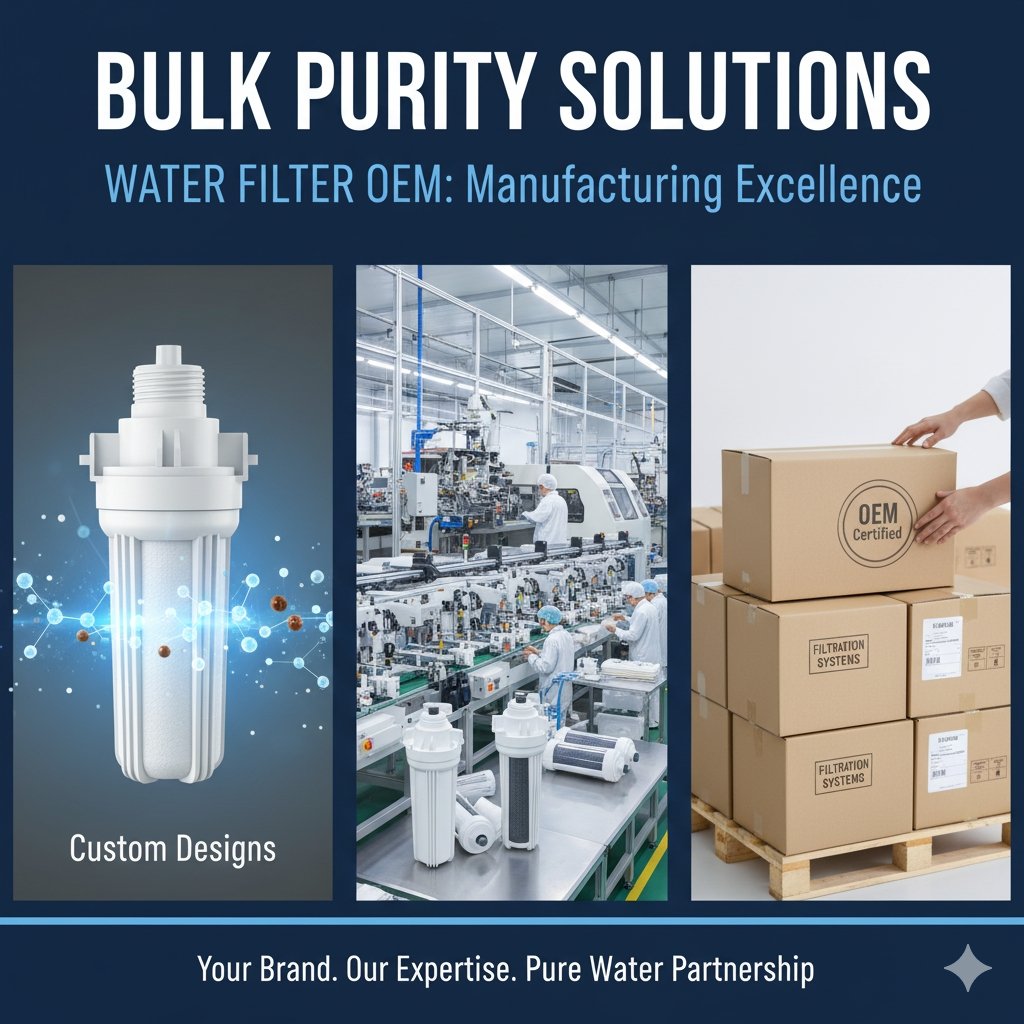
This topic is covered in full in our main guide: OEM Water Filter Opportunities: How to Design, Manufacture, and Scale a Private-Label Filtration Business.
If you’re searching for water filter oem, this guide gives you the operational playbook you actually need — no fluff, just the decisions, trade-offs, and checklists used by procurement managers, product developers, and brand founders who scale reliable products. Whether you want to white-label under-sink RO units, source inline filters for refrigerators, or commission whole-house systems, this article walks you step-by-step through product definition, supplier selection, quality assurance, certifications, pricing, logistics, and after-sales. I also include negotiation levers, common pitfalls, and a final buyer’s checklist so you can move from inquiry to first container with confidence.YourWaterGood.
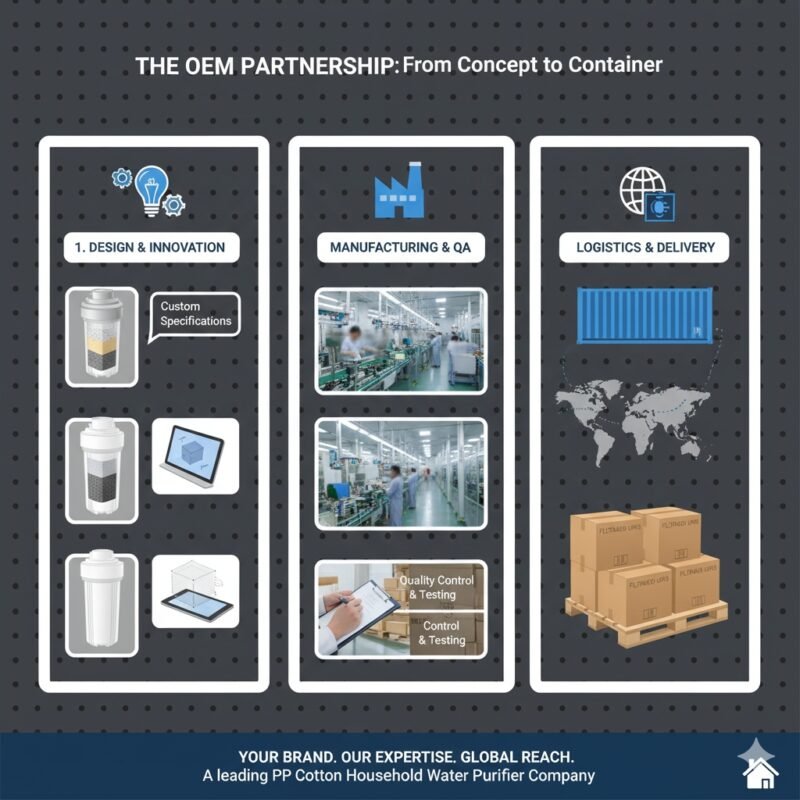
Why OEM matters in water filtration
OEM partnerships let brands focus on market, sales, and customer experience while leveraging factory expertise in injection molding, membrane integration, and electro-mechanical assembly. For buyers, OEM sourcing promises lower unit costs, faster scaling and the ability to customize features (faucets, digital displays, pump options) — but only if you control specification, verification, and after-sales support.
Getting an OEM right means more than a good price per unit. It means:
- Clear technical specs and acceptance tests.
- Verifiable supply of critical components (membranes, pumps, certified carbon media).
- Agreement on MOQ, lead times, and spare-parts provisioning.
- A robust quality control (IQC/AQL/DUPRO/PSI) plan.
This guide explains how to do all of the above without guessing.
Product segmentation: defining what you actually want to build
Start by defining the product family. “Water filter” is broad — break it into narrowly defined SKUs:
- POU under-sink RO — 3–5 stage systems with sediment, carbon prefilter, RO membrane, post-filter, optional remineralizer, storage tank.
- Countertop / faucet filters — compact carbon or UF units, low complexity.
- Inline filters — fridge, coffee machine or appliance in-line cartridges (often disposable housings).
- Whole-house POE systems — sediment + carbon vessels, softeners, iron removal, and UV combos.
- Commercial/industrial RO skids — higher capacity, stainless steel, instrumentation.
For each SKU specify: target retail price, target margin, target minimum order quantity (MOQ), and the primary use case. The SKU definition frames membrane selection, housing materials, pump sizing, and certification targets.
OEM vs ODM vs private label — choose your model
- OEM (Original Equipment Manufacturer): You supply the design or detailed spec; factory manufactures to your drawings. Best if you require specific materials, proprietary design, or control over claims/certification.
- ODM (Original Design Manufacturer): The factory offers an existing design you can brand. Quicker to market and lower development cost, but less control over design and bill of materials.
- Private label / rebrand: You buy a finished model, add packaging and branding. Lowest effort, but may mean competing on price, not product differentiation.
If you want to sell premium performance backed by testing (PFAS removal, NSF/ANSI claims), OEM or close ODM with customization is the right path.
Spec sheet essentials — the non-negotiables to give any supplier
A complete spec sheet prevents mismatches. Include measurable, testable parameters:
- Functional specs
- Inlet/outlet connection size and type (1/4″ QC, 3/8″, 1/2″, 3/4″ etc.).
- Rated flow (L/min or GPM) and peak flow.
- Operating pressure and maximum pressure rating (psi/bar).
- Operating temperature range.
- Expected service life (gallons and months for each filter stage).
- Performance targets
- TDS rejection % at specified feed TDS, pressure and temperature (for RO).
- Specific contaminant reduction targets (lead, fluoride, PFAS, VOCs) in ppb/ppmw and test method.
- Microbial reduction targets or statement if UV/UF is included.
- Materials & durability
- Housing polymer (food-grade PP, ABS, PEEK, or stainless steel for housings).
- Membrane brand and model (Dow Filmtec, Toray, Hydranautics etc.) or performance spec if you permit alternate brands.
- Pump specification (head, max flow, power draw).
- Seals & O-rings (EPDM, Viton, silicone) compatible with household water chemistry.
- Certifications to pursue
- NSF/ANSI 42, 53, 58, 401 as applicable.
- WQA Gold Seal, CE, RoHS, UL/ETL for electrical components.
- Any market-specific approvals (BIS in India, local potable water approvals).
- Packaging & documentation
- Individual retail packaging dimensions, palletization, warranty card, multilingual manual.
Deliver this spec to suppliers and insist on direct responses to each line item.
Component sourcing: what matters (and why)
Critical components determine performance and warranty.
- RO membranes: Membrane quality dictates TDS rejection, recovery, and lifespan. If you want consistent performance, specify brand or equivalently tight performance metrics (e.g., 98% TDS rejection at 1500 ppm feed, 25°C, 60 psi). Using generic membranes lowers cost but increases test variability.
- Activated carbon: Source carbon block or coconut shell GAC with certified adsorption values for target compounds. For PFAS, request media with independent PFAS test data.
- Sediment media: Polypropylene (spun/melt-blown) with absolute vs nominal micron ratings stated.
- Pumps & electricals: Choose pumps with reputable manufacturers and spec vibration/noise limits. Verify CE/UL marks for electrical items.
- Liners, tanks & housings: Tanks must have bladder specs (food-grade butyl for potable use) and housings must be food-grade and UV-stable if exposed.
- Faucets & fittings: Metal (SS or brass) faucets give premium feel and longer life; plastic can be cheaper but risks discoloration and brittleness.
Locking in component names and manufacturer sources prevents later substitution surprises. Require factories to disclose sub-suppliers for critical items and to get approval before any change.
Quality assurance sequence: samples to shipment
A repeatable QA process is essential to avoid a bad container.
- Design Validation Sample (DVS) / Engineering Prototype
- Receive working prototype. Test fit, finish, and function locally. Validate dimensions, connectors, and basic operations.
- Pre-Production Sample (PPS)
- A productionized unit built on the intended line. Run the acceptance test battery: pressure test, leak test, flow and TDS checks, pump current draw, storage tank integrity.
- Independent lab verification (if required)
- For certified claims (lead, PFAS, fluoride), send samples to an accredited lab with documented chain of custody. Save test reports in your product file.
- During Production (DUPRO) inspections
- Third-party inspector checks mid-run for assembly process adherence, fit gaps, torque values, and component lot numbers. Catch process drift early.
- Pre-Shipment Inspection (PSI)
- Final 20–30 unit sample pressure tested and functionally tested. Use AQL sampling to accept/reject.
- Post-arrival acceptance tests
- Randomly test inbound cartons against the PSI results to catch transit damage or container-level substitution.
Contractually tie payments and release of final balances to PSI and independent lab acceptance for critical claims.
Certification strategy: what to certify and in what order
Certifications cost time and money but are the primary trust signal to retailers and end customers.
- Start with material & electrical safety (CE, RoHS, UL) — these are prerequisites in many retail channels.
- NSF/ANSI 42 (chlorine, aesthetic claims) is often requested for carbon-based consumer filters.
- NSF/ANSI 53 (health claims like lead reduction) and 58 (RO systems) require model-specific testing and paperwork; plan 3–6 months for labs and approval.
- NSF/ANSI 401 (emerging contaminants) or PFAS testing are increasingly requested; labs may run targeted PFAS suites.
- WQA Gold Seal is a brandable certification that reassures consumers and trade partners.
Sequence certifications to match launch plan: get safety approvals first to move inventory, then schedule performance certifications (NSF) before large retail rollouts or online claims.
MOQ, tooling, and price modeling
Understand scale economics and tooling costs.
- MOQ: For simple plastic housings and cartridges, many factories accept MOQs of a few hundred to a few thousand units. For custom injection molds, MOQ may be 1,000+ because of tooling amortization. Commercial RO skids can be supplied one at a time but will have higher unit costs.
- Tooling: Custom plastic injection tools cost $3k–$50k+ depending on cavities and complexity. Metal tooling for stainless housings is higher. Amortize tooling across expected production.
- Pricing model: Ask for a tiered price table (100/500/1,000/5,000 units). Expect substantial per-unit drops above the break-points. Include landed cost scenarios in your model (FOB, CIF, DDP) and calculate total landed per-unit at different order sizes.
- Spare parts kits: Negotiate a small stock of membranes, pumps, and seals as part of the initial shipment or as consign stock on terms.
Tip: start with a modest pilot order (e.g., 200–500 units) with rigid inspection, then scale once process capability is proven.
Packaging, labeling & retail readiness
Packaging affects shelf impact, cost, and damage rates.
- Retail packaging: Include UPC/GTIN, clear shelf copy, multilingual manuals, and prominent certification marks. Durable inner cushioning reduces returns.
- Bulk packaging & palletization: Agree pallet configuration, carton counts, weight limits, and strapping. Insist on stretch-wrapped pallets with corner boards for sea freight.
- Documentation: Each carton should contain a parts list, serial numbers (when applicable), and QA certificate. Include certificates of conformity for components (membranes, electrical parts).
- Sustainability: Consider recyclable cardboard and minimal plastic. Many buyers now expect a sustainability claim on packaging.
If selling online, factor in dimensional weight for shipping—the box size and protective fill matter for fulfillment economics.
Logistics: incoterms, shipping mode & lead times
Decide how you’ll move product and who bears risk.
- FOB origin is common: factory handles loading into vessel, buyer controls freight and insurance. If you lack logistics expertise, negotiate CIF (cost, insurance, freight) or DDP (delivered duty paid) for simpler landed costing, albeit at a premium.
- Sea freight vs air: sea is cost-efficient for volume; air for urgent restock. Plan reorder points and safety stock to avoid urgent air shipments.
- LCL vs FCL: less than container load (LCL) is ok for small pilots but increases handling risk; full container load (FCL) reduces per-unit freight and damage risk.
- Lead time: prototypes to stock typically 8–16 weeks, depending on factory backlog, tooling, and certification windows. Build this into your product launch timeline.
Always secure a clear packing list and Bill of Lading, and engage an experienced customs broker for the destination country.
After-sales: spares, warranties, and service networks
Product longevity and brand reputation depend on how you support customers.
- Spares provisioning: Maintain 3–6 months of critical spares (membranes, pumps, valves, O-rings). Make spares available to customers via local warehouses or drop-ship programs.
- Warranty policy: Typical warranties are 1–2 years on parts and labor, with consumables excluded. Define return merchandise authorization (RMA) procedures, replacement timelines, and whether warranty covers shipping costs.
- Service network: Either train local plumbers/partners or maintain an internal technician network. For complex installs (POE systems), a certified installer network reduces installation errors and warranty fraud.
- Consumable subscription: Consider subscription models for filters and membranes—this creates recurring revenue and reduces customer churn.
Include spare parts in your financial model; many successful brands derive a large portion of lifetime value from consumables.
Legal & regulatory checklist (market examples)
- United States: FTC and EPA rules govern advertising claims for water safety. Avoid unverified health claims. NSF and WQA testing enables stronger claims. State laws may restrict certain waste discharges (e.g., brine from softeners).
- European Union / UK: CE marking, RoHS, and national drinking water regulations may apply. Language and documentation requirements are strict.
- India and other markets: Local approvals may be required; check BIS or equivalent. Label languages and consumer protection laws must be followed.
Work with counsel who understands consumer products and local water regulation in your primary markets.
Pricing strategy & margin math for brands
A simple margin model helps you decide whether to OEM.
- Total landed unit cost (TLUC) = FOB unit + freight + duties + local delivery + inspection amortization + initial spare parts allocation.
- Wholesale price = TLUC × (1 + target wholesale margin). Typical reseller margins for consumer appliances: 30–50%.
- Retail price = Wholesale × (1 + retailer margin). Online DTC brands often take 2–3× TLUC to cover marketing and fulfillment.
- Consumable margin: Replacement filters and membranes should be priced to deliver higher margins (40–70%)—this is recurring profit.
Example: TLUC $120 → direct retail price target $299 gives margin to fund marketing and service.
Sustainability & circularity considerations
Increasingly, buyers demand environmental responsibility.
- Design for serviceability: make cartridges replaceable, not entire housings.
- Recycling programs: offer cartridge take-back or partner with recyclers.
- High-efficiency membranes: choose membranes with better permeate/waste ratios to minimize water waste.
- Energy-efficient pumps and smart controls: reduce operational carbon.
Sustainability can be a differentiator in both B2C and B2B channels and may unlock procurement tenders.
Negotiation levers & contract terms
When negotiating with an OEM, use these levers:
- Volume tiers: lock price tiers to rolling 6–12 month forecasts.
- Tooling amortization: split tooling cost or reduce it for multi-year purchase commitments.
- Payment terms: negotiate deposits (30% upfront typical), balance on PSI or letter of credit terms.
- Warranty obligations: cap warranty liabilities and require supplier to maintain a local spare parts pool.
- Change control: require written approval for component substitutions and set penalties for late deliveries.
- IP protection: ensure design IP clauses and non-compete for private label exclusivity in specific geographies.
Draft a clear purchase agreement covering these items and tie payment milestones to inspection outcomes.
Common pitfalls and how to avoid them
- Choosing only on FOB price: ignores quality drift, testing, and spare parts availability.
- Accepting vague performance claims: insist on lab reports and model-specific certificates.
- No spare parts plan: results in long, expensive downtimes and unhappy customers.
- Skipping PSI / independent testing: saves money upfront but risks entire containers of defective product.
- Underestimating certifications’ lead time: NSF and other labs can take months; plan accordingly.
Mitigate risk through small pilot orders, rigorous inspection, and by allocating budget for third-party testing.
Practical case study (end-to-end, condensed)
A mid-sized DTC brand wanted a private-label under-sink RO. Steps taken:
- Defined SKU: 5-stage RO, 50 GPD membrane, coconut carbon block, brushed stainless faucet. Target retail $349.
- Issued RFQ to 6 factories; shortlisted 2 based on sample quality and certification capability.
- Commissioned PPS units; sent for NSF/ANSI 58 pre-test and in-house hydraulic testing.
- Performed DUPRO and PSI with third-party inspector.
- Shipped 1×20′ pilot container (500 units) CIF to their fulfillment center.
- Launched DTC with subscription consumables; first 90 days: <2% RMA rate, strong margin on consumables.
Lesson: rigorous sampling + staged scaling reduced risk and enabled an on-time launch.
10-point buyer’s checklist (ready to use)
- Have you defined exact SKU specs (flow, connections, materials, performance)?
- Do you require brand-preferred components (membrane, pump) or accept equivalent performance?
- Have you requested model-specific certification documents?
- Did you order and independently test a pre-production sample?
- Is tooling cost and MOQ acceptable and documented?
- Have you agreed on inspection milestones (DUPRO, PSI) and AQL levels?
- Are spare parts and first-year stock planned and priced?
- Is packaging, labeling and retail copy finalized and compliant?
- Are logistics terms (Incoterm, lead time, freight) confirmed?
- Do you have a warranty, RMA and service plan with responsibilities spelled out?
If you can check every box, you’re ready to issue a purchase order.
Where to research components & specs
For model and component comparisons, technical datasheets are essential — for example, review the technical sheets at YourWaterGood and confirm certificates before committing to volume.
Final thoughts
Sourcing water filter oem is an exercise in controlled risk: the right specification, an insistence on verifiable testing, staged inspection, and a spare-parts strategy turn a supplier relationship into a scalable competitive advantage. Whether you’re launching one SKU or building a family of filters across POU and POE, treat the process like engineering + procurement + service design — that’s how successful brands deliver reliable systems and recurring revenue from consumables.
If your next step is ready—compile your SKU spec and RFQ, lock a small pilot MOQ, and require a PPS with independent lab tests. Do that, and the path from first sample to reliable supply will be straightforward, predictable, and profitable.