
PP Cotton Filter for Ice Machine: Why It Matters, How to Choose, and How to Get Peak Performance

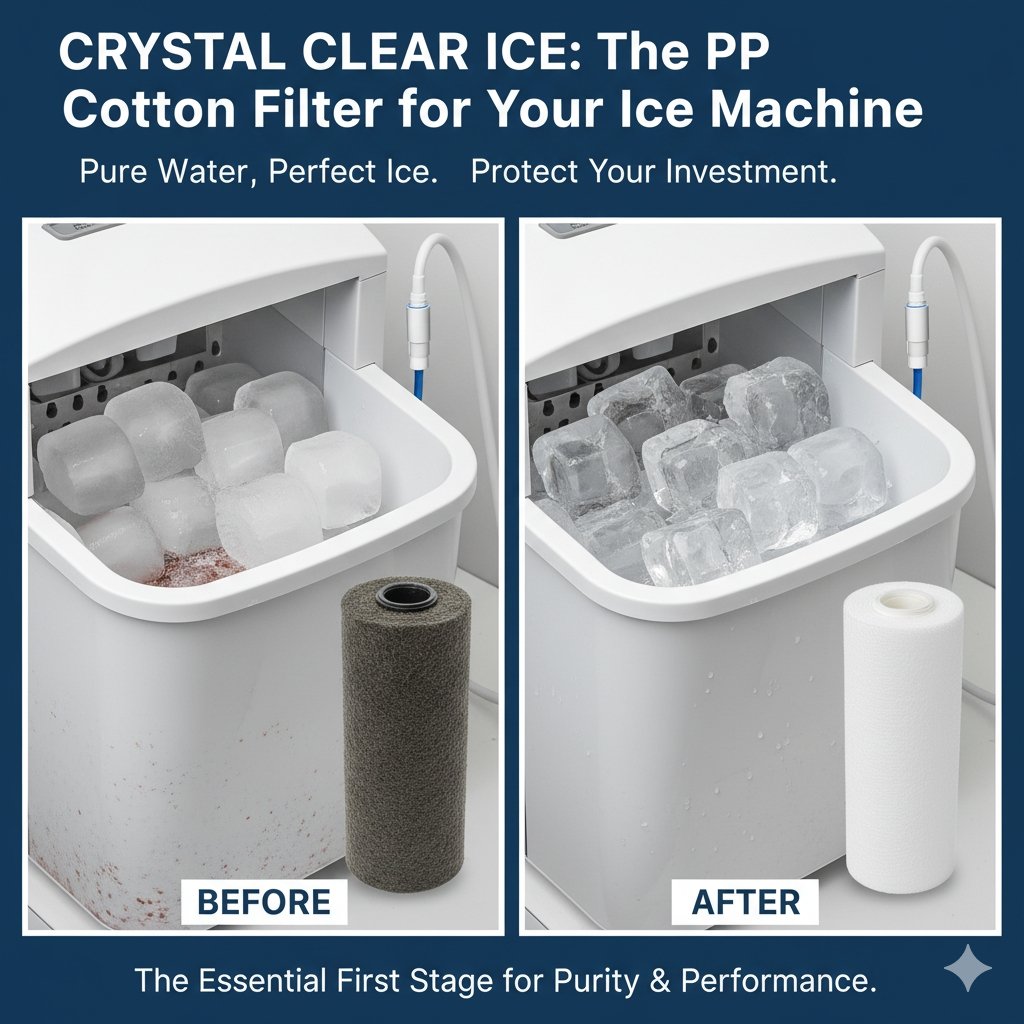
If you run a cafe, restaurant, bar, hotel, or any operation that depends on clean, clear ice, the phrase pp cotton filter for ice machine should be familiar — and it should be part of your equipment checklist. Sediment and particulate matter are invisible enemies of ice makers: they clog water lines, shorten the life of valves and pumps, cause cloudy or off-tasting ice, and increase downtime and service costs. A properly selected and maintained PP cotton (melt-blown polypropylene) sediment filter protects downstream media and mechanical parts, improves ice clarity, and makes maintenance predictable.
This article explains what a pp cotton filter for ice machine does, how melt-blown media is designed, selection criteria (micron rating, flow, ΔP), installation and maintenance best practices, testing and acceptance criteria, supply and stocking strategies, and how to build a cost model and maintenance plan that keeps your ice machine running clean for years. Along the way I’ll point you to product and shopping resources so you can evaluate cartridges and housings: https://yourwatergood.com/ and https://yourwatergood.com/shop/.
Why sediment filtration is critical for ice machines
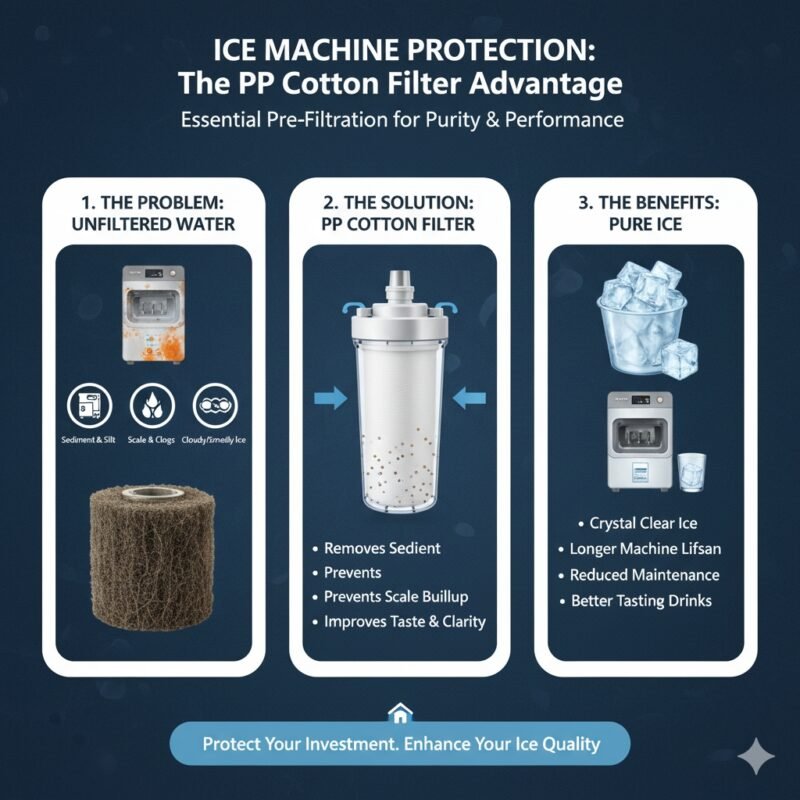
Ice machines are highly sensitive pieces of equipment. Unlike a tap or kettle that tolerates some particulate matter, ice machines actively form crystals on evaporator plates or in molds — and particulate or chlorine can interfere with that process. Untreated feed water causes a chain of issues:
- Clogged solenoid valves and nozzles: Sediment and debris abrade valve seats and restrict flow.
- Fouled pumps and flow switches: Small particulates accelerate wear and lead to premature replacement.
- Cloudy or discolored ice: Visible particles or turbidity in the source water appear in the finished ice, harming presentation and customer trust.
- Reduced heat-transfer efficiency: Scaling and fouling on evaporator plates reduce ice production and increase energy use.
- Higher service frequency: More cleaning cycles, sanitization, and component replacement drive labor and parts costs.
A pp cotton filter for ice machine provides the first line of defense—removing suspended solids and protecting downstream carbon blocks, RO membranes, UV systems, or chemical feed that may be part of your water treatment train.
What is PP cotton (melt-blown polypropylene) and why it’s used
“PP cotton” is the colloquial name for melt-blown polypropylene depth media — a nonwoven, thermally bonded web of microfibers engineered to trap particles throughout the media’s thickness (depth filtration). It’s the go-to material for sediment cartridges because:
- Depth capture captures a broad particle size spectrum without surface blinding.
- Graded density can be engineered (coarse outside to fine inside) to maximize dirt-holding while managing pressure drop.
- Chemical stability — polypropylene is inert in potable water and resists biodegradation.
- Low cost and scalable for economy in high-volume operations.
- Food-safety compatibility: materials can be specified with potable-water CoAs.
Compared to pleated cartridge media, melt-blown PP excels at trapping fine grit and silt at moderate flow rates, making it ideal as the first stage in an ice-machine supply train.
Key performance specs to look for
When specifying a pp cotton filter for ice machine, don’t rely on vague micron labels alone. Insist on measurable performance attributes that match your machine’s flow and water conditions:
- Micron rating — nominal vs absolute
- Nominal ratings (e.g., “5 µm nominal”) indicate typical performance but allow some particles through.
- Absolute ratings (e.g., “5 µm absolute per ASTM F2888 or similar”) specify the particle size that the cartridge will remove at a high efficiency (often >98%). For ice, a conservative approach is to require nominal ratings for pre-filtering and absolute ratings only if sediment is the primary issue and clarity is mission-critical.
- ΔP (pressure drop) vs flow curve
- Initial pressure drop at expected flow (e.g., GPM the ice machine demands) matters. Excessive ΔP reduces inlet pressure and can trigger low-pressure faults. Ask suppliers for a ΔP vs flow curve measured at 20°C with clean water.
- Dirt-holding capacity
- Expressed in grams retained until a defined ΔP endpoint or service threshold. This helps set replacement intervals and stocking levels.
- Material and food-safety declarations
- Request Certificates of Analysis (CoA) for polypropylene resin and any adhesives; ensure materials meet potable-water contact standards.
- End-use mechanical specs
- Core collapse pressure (to avoid collapse under vacuum or pressure), end-cap pull strength, and burst pressure for the housing you plan to use.
- Initial-fines / first-flush data
- Melt-blown media can release fines on first use. Suppliers that factory-condition or pre-flush cartridges and can provide particle counts for first-flush are preferable.
Matching filter capacity to ice machine demand
Ice machines vary widely in water demand. Small under-counter units may use a few gallons per hour, while large modular machines or flaker machines can need tens or hundreds of gallons daily. When choosing a pp cotton filter for ice machine, match cartridge capacity and flow rating to the machine’s needs:
- Flow rating — Choose a cartridge and housing rated above the machine’s peak water draw to avoid excessive ΔP. Manufacturers often list recommended maximum GPM per cartridge (e.g., 3–5 GPM for a standard 10″ cartridge in typical housings).
- Service interval objectives — Decide how often you want to change cartridges. For busy commercial kitchens, weekly or monthly schedules may be necessary; for lower use, quarterly intervals may suffice. Use dirt-holding capacity and local water turbidity to estimate intervals:
- Service interval days = (dirt-holding grams × efficiency factor) ÷ (daily grams of particulate load).
- Since particulate load is hard to predict, run a short pilot or start with conservative replacement intervals and adjust.
Example: If a cartridge holds 50 g of particulates to reach the service ΔP, and your operation accumulates an estimated 2 g/day of particulate into the water (after incoming municipal filtration), the cartridge would last ~25 days (50/2). Overbuild safety and monitor ΔP.
Housing selection and mechanical integration
A pp cotton filter for ice machine is only as good as its housing and installation. Key considerations:
- Housing size: Common sizes include 10″ and 20″ single cartridges; for high-flow applications consider parallel housings or larger 2.5″-x-20″ pleated solutions.
- Material compatibility: Housings should be NSF-rated when used on potable water. For foodservice, stainless or food-grade plastic housings are common.
- Bypass and shutoff valves: Install an accessible bypass so you can service filters without shutting down production.
- Gauge ports: Consider a ΔP gauge or gauge ports upstream and downstream to track real-time pressure drops and trigger service.
- Mounting and access: Position housings for quick cartridge changes and regular inspections. Poor access increases service time and risks improper reassembly.
Installation best practices
Install filters to minimize operational disruption and maximize performance:
- Pre-installation water test
- Test incoming water for turbidity, typical particulate levels, chlorine, iron, and TDS. This helps size filters and informs whether downstream carbon or RO may be necessary.
- Install a sediment pre-filter upstream if water has high particulate
- A coarse pre-filter protects the PP cartridge and extends life. Think in stages: coarse → PP cotton depth filter → carbon → RO if used.
- Follow manufacturer torque and sealing guidance
- Over-torquing housings or using incompatible lubricants on O-rings creates leaks and contamination. Use food-safe lubricants and proper torque.
- Flush on startup
- Even conditioned cartridges benefit from an initial flush to remove loose fines. Record flush volumes and consider embedding the step into your commissioning checklist.
- Monitor inlet pressure and flow after installation
- Verify ΔP is within acceptable range and note baseline values to identify future trends.
Maintenance schedules and service protocols
A disciplined maintenance plan keeps the ice clear and the machine reliable.
- Routine cartridge replacement: Begin with a conservative schedule — for example, replace cartridges monthly in busy locations, then adjust based on measured ΔP trends and ice clarity. Use SPC to refine intervals.
- Recordkeeping: Log lot numbers, installation dates, ΔP readings, and any service observations. This creates traceability if a batch of cartridges underperforms.
- Sanitization and cleaning cycles: Follow the ice machine manufacturer’s cleaning schedule; a clean ice machine with filtered water requires fewer deep cleans.
- Spare parts kit: Keep spare housings, O-rings, and a small ΔP gauge on hand for quick swap-outs.
- Emergency bypass: Have a plan for temporary bypass with a sterile or boiled-water source if immediate cartridge replacement isn’t possible — but avoid prolonged bypassing as it exposes the machine to particulates.
Testing and acceptance criteria for new cartridges
When qualifying a new supplier for pp cotton filter for ice machine cartridges, accept only production-run samples and require documented testing:
- ΔP verification — Run a bench test at the machine’s representative flow and measure initial pressure drop.
- Initial-fines test — Measure turbidity or particulate counts during the first recommended flush volume. Set acceptance thresholds (e.g., turbidity < X NTU after flush).
- Dirt-holding and life test — Challenge the cartridge with a controlled particulate feed to the service ΔP endpoint and record grams retained.
- Material verification — CoAs for resin lot, any adhesives, and food-safety documentation.
- Mechanical testing — Pull tests for end caps, core collapse pressure.
- Field pilot — Install cartridges in 3–5 machines across representative sites for 30–90 days and collect ΔP, ice clarity, and user feedback.
Only after production-run validation should you place a larger order. Vendors who resist production-sample testing or can’t provide CoAs are higher risk.
When to add carbon or RO after a PP cotton filter
PP cotton removes particulates but not chlorine, chloramine, dissolved solids, or some dissolved organics that affect taste and ice clarity. Consider additional stages:
- Activated carbon for chlorine taste/odor and to protect RO membranes. If your water contains chlorine, carbon downstream of sediment is standard: coarse prefilter → PP cotton → carbon block.
- RO membranes if your application requires exceptionally clear ice or reduced TDS (some craft beverage makers prefer low-TDS or controlled mineral profiles). Note RO increases complexity and requires pretreatment to protect membranes (sediment and carbon upstream).
- UV or ozonation as optional sanitization steps for biological control, but only after proper prefiltration to avoid fouling.
Supply strategy: stocking, lead times, and lot control
For commercial operations, inventory planning matters:
- Stock enough cartridges to cover the replacement interval plus safety stock. If you replace cartridges every 30 days at 10 locations, keep at least a 60-day safety stock (replace lead time + buffer).
- Track lot numbers and CoAs. If a particular lot shows elevated initial fines or defects, traceable lot numbers let you quarantine affected inventory quickly.
- Contract with a reliable supplier who can commit to MOQs and predictable lead times, or establish dual-source redundancy if uptime is critical.
- Consider subscription replenishment from suppliers for high-turn locations—this reduces stockouts and administrative overhead.
Cost modeling and ROI
Quantify the business case for a pp cotton filter for ice machine:
- Costs: cartridge unit cost + housing amortization + labor for changeout + disposal costs.
- Savings: reduced downtime, fewer service calls, longer life for pumps/valves, lower frequency of deep cleans, improved ice quality (which is a revenue driver in hospitality), and lower customer complaints.
- Example: If a sediment cartridge costs $6 and labor per change is $12 (technician time), and the cartridge prevents a $400 valve replacement every six months, the cartridge program easily pays back. Create a simple annualized TCO and ROI spreadsheet factoring in parts, labor, frequency, and avoided failures.
Troubleshooting common problems
- Sudden ΔP increase: Check for fouled cartridge; confirm flow rate, and inspect pre-filter if installed. Replace cartridge and inspect for unexpected particulate sources (construction, municipal works).
- Cloudy ice after a cartridge change: Verify first-flush volume was performed and check for a defective cartridge lot that releases fines. Compare lot numbers and run initial-fines measurement if available.
- Leaks at housing: Inspect O-rings for damage, clean sealing surfaces, and verify correct housing torque. Use food-grade lubricant if specified.
- Short cartridge life: Increase dirt-holding spec, consider multi-stage prefiltration (coarse → PP cotton), or identify upstream contamination events.
Regulatory and food-safety considerations
For hospitality and foodservice, ensure compliance and peace of mind:
- Use potable-water-rated materials and request CoAs for resin and housing certifications.
- Follow local health department rules for ice production and storage. Regularly sanitize the machine and ice storage bin per code.
- Document maintenance — authorities appreciate logs showing cartridges changed and machines sanitized on schedule.
Selecting a supplier: questions to ask
When evaluating vendors for a pp cotton filter for ice machine program, ask:
- Do you provide production-run samples and lot CoAs?
- Can you provide ΔP vs flow curves, dirt-holding capacity, and initial-fines data?
- What is your retained-sample policy and shelf-life for cartridges?
- Do you supply housings and accessories, or only cartridges?
- What are your lead times and MOQ tiers?
- Can you support subscription replenishment or scheduled deliveries?
- Do you have customer references in foodservice or hospitality?
- What warranty or RMA terms do you offer for defective cartridges?
Where to buy and product exploration
To compare options and shop for cartridges, housings, and related consumables, start with reputable product pages and online shops that publish technical specs and CoAs. Two useful starting points for product and shopping exploration are https://yourwatergood.com/ and https://yourwatergood.com/shop/. Evaluate product datasheets carefully, ask for test data, and request production samples before committing to large volumes.
Final checklist: deploying a pp cotton filter for ice machine program
- Test incoming water (turbidity, iron, chlorine, TDS).
- Select PP cotton cartridges with documented ΔP vs flow, dirt-holding capacity, and first-flush data.
- Choose housings with gauge ports, bypass, and easy access for cartridge changes.
- Install prefiltration where needed (coarse sediment) and plan for carbon or RO if required.
- Implement an initial pilot at representative locations for 30–90 days and collect ΔP and ice quality metrics.
- Set maintenance intervals based on measured performance and build a replenishment schedule.
- Track lot numbers, CoAs, and retained-sample policy for traceability.
- Train staff on flush volumes, changeout procedures, and sanitization protocols.
- Monitor KPIs: days between replacements, ΔP trends, ice clarity complaints, and service calls.
Conclusion
A thoughtfully specified and managed pp cotton filter for ice machine program pays for itself through lower maintenance costs, fewer service interruptions, clearer ice, and happier customers. The key is to pick the right melt-blown media and cartridge configuration for your machine’s flow and local water quality, validate production-run samples, and build a predictable maintenance cadence. Pair sediment filtration with carbon or RO when taste or dissolved solids matter. With the right supplier and a disciplined service plan, a simple PP cotton cartridge becomes the unsung hero behind every great glass of ice-cold water, cocktail, or soft drink.
For product comparisons and shopping options, begin by reviewing technical specs and availability at https://yourwatergood.com/ and https://yourwatergood.com/shop/. Practice due diligence — production-run tests and pilot installations are the safest path to selecting the right cartridge for your operations.