
Home Soft Water Solutions: Practical Paths to Softer Water, Lower Bills, and Happier Appliances

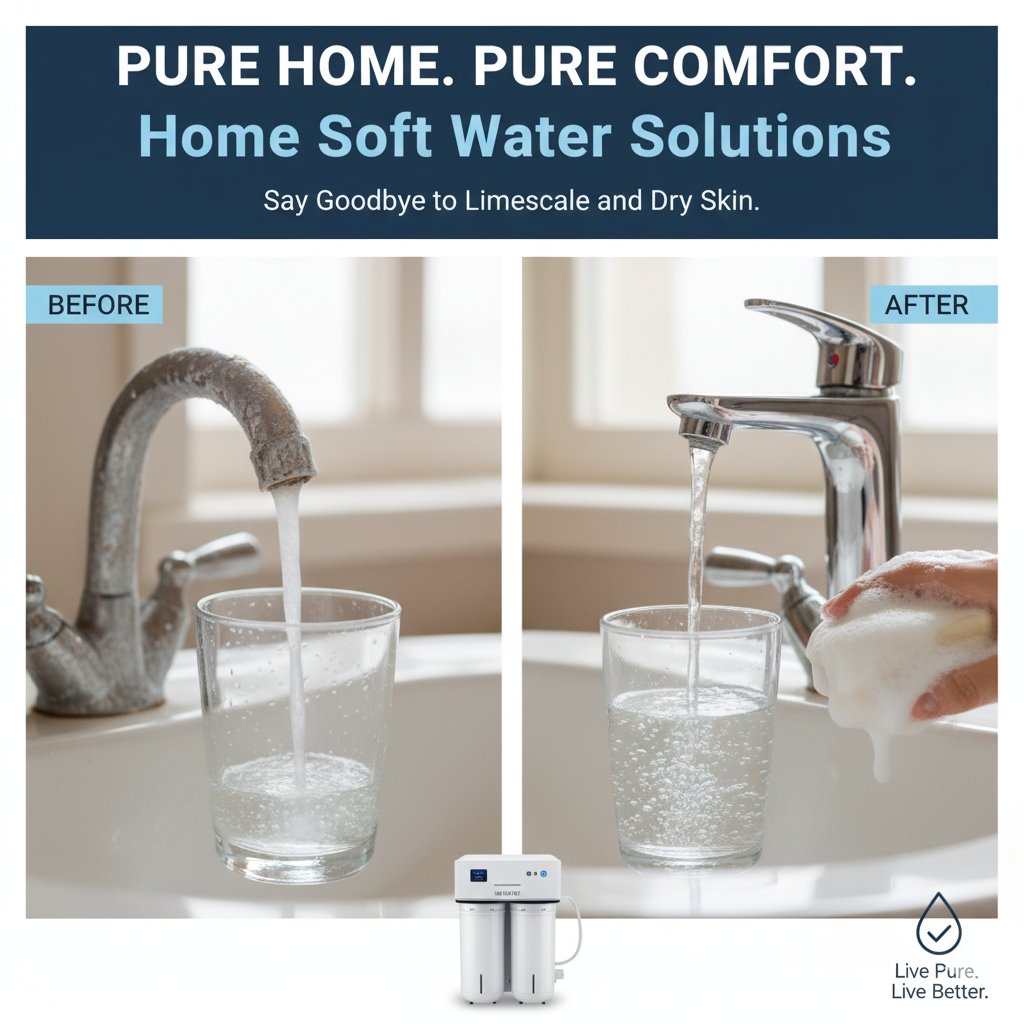
This topic is covered in full in our main guide: Soft Water Filter for Home — The Complete Guide (Types, Costs, Installation, Maintenance, and Buying Advice).
Hard water is a quiet nuisance: it builds scale in pipes and heaters, leaves spots on glassware, dulls fabrics, and makes soap feel less effective. If you’ve started searching for home soft water solutions, you already know the problem — now you need clear, practical options that match your household, budget, and local rules. This article walks through the full decision chain: how to test your water, which technologies really work (and when to avoid them), how to size and install systems, maintenance realities, environmental trade-offs, and how to combine whole-house treatments with point-of-use polishing. It also points you to places where you can explore products and shop for components: YourWaterGood and our product range.
Why soft water matters (and what you’re actually solving)
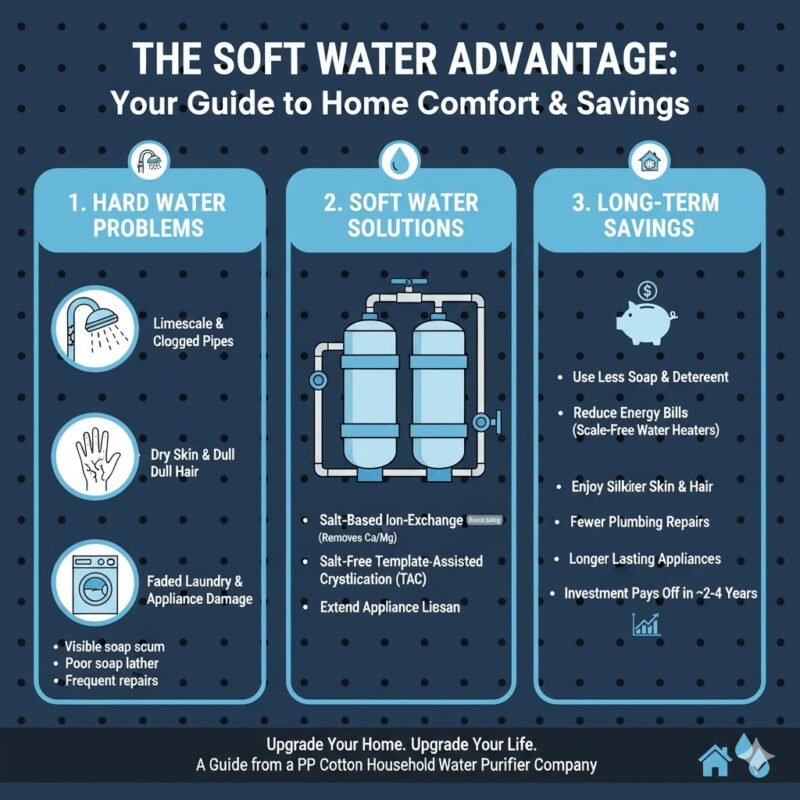
When people talk about “soft water,” they mean water with low levels of dissolved calcium and magnesium — the ions that cause scaling. Scale deposits cut heating efficiency, shorten appliance lifetimes, and increase maintenance costs. Soft water benefits include:
- Far less scale in kettles, water heaters, and boilers.
- Cleaner glassware and dishes with fewer spots.
- Fabrics that feel softer and clean more effectively.
- Better soap performance and less residue on skin and hair.
- Lower long-term operating costs for appliances and plumbing.
Not every household needs the same level of intervention. Some homeowners want absolute zero hardness for every faucet; others are satisfied with modest scale control that protects major appliances. The right home soft water solutions strategy starts with testing and defining priorities.
Step 1 — Test your water (don’t guess)
Before you buy equipment, measure:
- Hardness (reported as grains per gallon — gpg — or mg/L as CaCO₃).
- Iron and manganese (common in wells and damaging to softening media).
- TDS (total dissolved solids) to understand overall mineral load.
- pH and chlorine/chloramine if your municipality disinfects.
Municipal customers can often find baseline numbers in the local water utility’s Consumer Confidence Report (CCR). Well owners should send a sample to a certified lab for a full panel. DIY kits give a quick read but aren’t a substitute for lab verification when you plan a permanent system.
Why this matters: a system sized for a household with 4 gpg hardness will be inadequate at 12 gpg, and iron or sulfur requires pre-treatment to protect resin or membranes.
Technology overview: what “home soft water solutions” actually look like
There are several distinct approaches you’ll encounter. Each has strengths, limits, and ideal use cases.
1. Salt-based ion-exchange softeners (classic soft water)
How they work: resin beads exchange sodium (or potassium) ions for calcium and magnesium, removing hardness ions from the water. Resin regenerates with a brine solution on a programmed cycle.
Pros:
- Reduces hardness to near-zero — the most dependable whole-home protection.
- Proven technology with predictable benefits for appliances and plumbing.
- Well-supported by the service industry.
Cons:
- Adds sodium (or potassium) to the water; consider dietary concerns.
- Requires salt refills and a drain for brine discharge.
- Uses a small volume of water for regeneration (metered systems minimize waste).
- Some localities restrict brine discharge.
Best for: households with moderate to very hard water (e.g., >7 gpg) who want comprehensive scale prevention.
2. Salt-free conditioners (TAC and catalytic media)
How they work: technologies like Template Assisted Crystallization (TAC) alter how calcium carbonate crystallizes so scale-forming minerals remain suspended as microcrystals that don’t adhere to surfaces.
Pros:
- No salt, no brine discharge, low maintenance.
- Retains beneficial minerals; no sodium added.
- Attractive where brine is restricted or homeowners prefer low upkeep.
Cons:
- Do not remove hardness ions — they mitigate scale rather than chemically soften water.
- Performance varies with chemistry, flow rates, and temperature; less effective in extremely hard or iron-rich water.
Best for: moderate hardness and situations where environmental regulations or lifestyle choices preclude salt-based systems.
3. Point-of-use reverse osmosis (RO) — for drinking water
How it works: a semi-permeable membrane removes dissolved solids (including some hardness ions) at a single faucet (usually kitchen). RO is not practical for whole-house use due to flow and waste.
Pros:
- Produces high-purity drinking water and can remove sodium added by softeners at the tap.
- Excellent complement to whole-home softening for taste and health-sensitive uses.
Cons:
- Not economical for whole-house flow; requires pre-filters and periodic maintenance.
- Waste-to-product water ratio varies by system and conditions.
Best for: kitchen drinking water where you want exceptionally low TDS or to remove sodium from softened water.
4. Magnetic/electronic descalers and other “physical” methods
How they work: apply electromagnetic fields to flowing water to change crystallization behavior.
Reality check:
- Evidence is mixed and variable by water chemistry.
- Some homeowners report improvements; scientific tests show inconsistent results.
- Treat as experimental — pilot before relying on them for heavy scaling prevention.
Best for: low-commitment trials in mild-hardness situations.
5. Antiscalants and chelants (specialty cases)
How they work: chemicals sequester or change scale-forming tendencies and are typically used in industrial or specialized residential situations where dosing control is feasible.
Best for: complicated chemistry cases or pre-treatment before reverse osmosis in small commercial or advanced residential setups.
Whole-house vs point-of-use: a practical strategy
Most effective plans combine both:
- Use a POE (point of entry) solution — a whole-house ion-exchange softener or salt-free conditioner — to protect plumbing, water heaters, and appliances.
- Use a POU (point of use) RO or carbon system at the kitchen sink for drinking and cooking water. This gives you the best of both worlds: soft water across the home and pristine drinking water without the sodium taste issue.
If you want to explore consumer-level POUs and product options, check manufacturer resources and shopping pages such as YourWaterGood and our product range for examples and accessory options.
Sizing a softener: the math you need
Sizing determines performance and running cost. The calculation is straightforward:
- Estimate household daily water use (gallons/day). A rough rule: 60–80 gallons per person per day.
- Multiply by measured hardness (gpg) to get daily grains removed.
- Choose a resin capacity (expressed in grains — e.g., 24,000 or 32,000 grains) to set a desirable regeneration interval (commonly 7–14 days).
Example:
- Household: 4 people × 60 gpd = 240 gpd.
- Hardness: 10 gpg.
- Daily grains = 240 × 10 = 2,400 grains/day.
- A 32,000-grain softener regenerates every ~13 days (32,000 / 2,400 ≈ 13.3 days).
A slightly oversized system reduces regeneration frequency and can extend resin life, but increases upfront cost. Demand-initiated (metered) controllers are preferred over timer-based ones because they regenerate only as needed, saving salt and water.
Installation essentials and practical considerations
Where to install:
- After the main shutoff and meter but before the hot-water heater if you want soft hot water too.
- Provide clear access for maintenance and salt addition (for salt-based systems).
- Include a bypass valve to allow water flow during service.
- Confirm local plumbing codes for drain connections and brine disposal.
Pre-treatment:
- If your well has iron, hydrogen sulfide, or high turbidity, pre-treatment is essential; these contaminants foul resin, carbon, and membranes.
- Sediment pre-filters protect equipment and extend service life.
Electrical and drain:
- Many modern controllers are low-power and require a standard outlet; confirm prior to installation.
- Drain location and water for regeneration must conform to local codes.
Professional installation:
- Hire a licensed plumber or certified installer for whole-house systems. A poor install can negate all benefits and create leak risks or improper regeneration behavior.
Maintenance: what to expect year-to-year
Salt-based systems:
- Regular salt replenishment — frequency depends on hardness and usage. Modern systems often use much less salt than older models.
- Occasional brine tank cleaning if sludge forms.
- Resin replacement is infrequent (years) but may be needed if fouled by iron or chlorine.
Salt-free systems:
- Minimal routine maintenance; media replacement intervals vary by make and flow.
- Monitor for visible scale and check manufacturer replacement schedules.
RO systems:
- Replace pre- and post-filters on schedule; membranes every 2–5 years depending on use and feed water.
- Monitor TDS at the faucet to detect membrane decline.
Proactive service:
- Keep installation and service records.
- Test water periodically after installation to ensure performance aligns with expectations.
Environmental and regulation considerations
Salt and brine:
- Brine discharge is concerning for municipal systems and sensitive ecosystems. Some municipalities restrict or ban residential brine discharge. If your area restricts brine, salt-free conditioners or point-of-use RO may be better choices.
Water use:
- Regeneration uses water. Metered systems reduce this; factor it into your total cost and environmental considerations.
Alternatives:
- Potassium chloride can replace sodium chloride to avoid sodium addition but is more expensive and still produces brine.
- Consider hybrid approaches or high-efficiency softeners with lower salt and water use.
Check local rules before committing to a salt-based solution.
Cost picture and return on investment
Upfront costs vary widely:
- Salt-based whole-house systems: typically $800–$3,000 installed, depending on capacity and brand.
- Salt-free conditioners: generally $600–$2,500 installed.
- Point-of-use RO systems: $200–$1,000 depending on stages and features.
Ongoing costs:
- Salt typically $5–$20/month depending on household demand and hardness.
- Filter and membrane replacements for RO: tens to a few hundred dollars per year.
- Occasional service or parts replacement for valves and heads.
Savings and ROI:
- Reduced energy costs from more efficient water heaters (less scale), fewer appliance repairs, and longer appliance life can offset system costs over time. Calculate conservatively and consider non-monetary benefits: convenience and fewer service calls.
Choosing between salt-based and salt-free: practical decision rules
- If your hardness is high (e.g., >7–10 gpg) and you want near-zero hardness, choose a salt-based softener — unless your local area bans brine discharge or you have strict dietary sodium concerns.
- If you have moderate hardness, want low maintenance, or can’t discharge brine, test a salt-free conditioner (TAC) in a pilot install — results vary by water chemistry.
- For drinking water concerns or to avoid sodium at the tap, always pair the POE solution with a POU RO on the kitchen sink.
- If iron or sulfur are present, prioritize pre-treatment before any softening or conditioning to protect media life.
Real-world examples and use-cases
- Urban family with municipal water, moderate hardness (6 gpg): Salt-free TAC conditioner to avoid brine, plus under-sink RO for drinking water.
- Suburban home with hard well water (12 gpg) and iron: Iron removal pre-treatment → salt-based softener sized for family usage → under-sink RO for kitchen.
- Apartment manager: Centralized softener for building inlet with efficient regeneration timers, or salt-free systems where brine disposal is prohibited.
- Coffee shop: POE softening to protect espresso equipment plus a dedicated RO or carbon/RO blend for beverage quality.
Shopping and resources
When researching products, look for transparent technical specifications: resin capacity, regeneration volume and salt use per cycle, efficiency claims, ΔP/flow charts, and warranty/service network.
For product exploration and parts, start with reputable manufacturers and vendor pages. Two places to explore product lines, accessories, and shopping options are YourWaterGood and our product range. Use product spec sheets and compare measured performance rather than marketing claims alone.
FAQs — quick answers to common questions
Q: Will a salt-based softener make my water unhealthy?
A: Softening replaces hardness ions with sodium (or potassium). The sodium increase is small in most cases but consult your doctor if you are on a low-sodium diet. Use potassium chloride as an alternative or install a POU RO for drinking water.
Q: Do salt-free conditioners truly work?
A: In many homes with moderate hardness, they reduce scale formation effectively. In very hard water or with complicating chemistry (iron), they can be less effective. Pilot testing is recommended.
Q: How often do softeners need service?
A: Salt top-ups vary; expect to add salt monthly or every few months depending on usage. Annual checkups are a good practice.
Q: Can I install these myself?
A: Some point-of-use systems are DIY-friendly; whole-house systems typically require a licensed plumber for correct placement, drain installation, and compliance with local codes.
Final recommendations — choosing the best home soft water solutions for your needs
- Start with a proper water test. Don’t guess. Get hardness, iron, TDS, pH, and chlorine data.
- Define your priorities. Do you want complete softness, low maintenance, or environmental friendliness? Different goals point to different solutions.
- Size appropriately. Use household gallons per day × hardness to choose resin capacity and set regeneration intervals.
- Protect your investment. Pre-filter for sediment and iron when needed and pair POE solutions with POU RO for drinking water.
- Consider local rules. Verify brine/discharge regulations and environmental requirements before you buy a salt-based system.
- Plan maintenance. Understand salt or media replacement cadence and budget for it.
- Pilot if unsure. If you’re considering a salt-free conditioner, try a pilot installation to confirm effectiveness with your specific water chemistry.
- Buy from reputable dealers and installers. Compare specs, ask for tested performance, and confirm service and warranty support.
If you want to see product options and compare components or shop for complementary parts (cartridges, housings, RO units), start with manufacturer pages and shopping pages such as YourWaterGood and our product range.