
Water Filters for Ice Maker Commercial — Practical Guide to Selection, Installation, and Maintenance

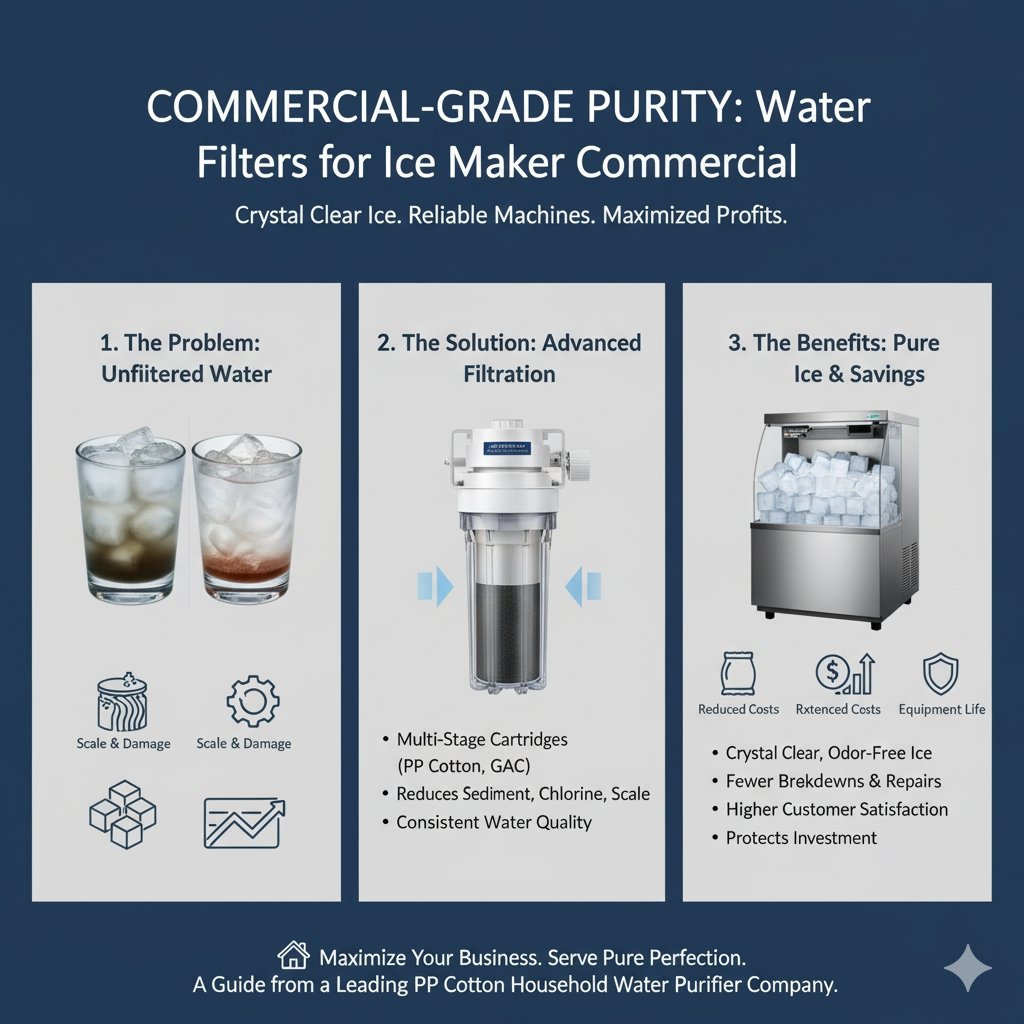
This topic is covered in full in our main guide: Ice-Clear Business: Choosing the Right Water Filter For Commercial Ice Maker.
If you manage a hotel, restaurant, bar, hospital, or any facility that depends on reliable, clear ice, the phrase water filters for ice maker commercial is central to your operations. Commercial ice makers are unforgiving: particulate, chlorine, dissolved solids, scale, and biological contaminants can reduce production, cloud ice, damage valves and pumps, increase cleaning frequency, and ultimately harm guest experience and equipment uptime. This long-form guide walks you through everything you need to specify, buy, install, and maintain an effective filter train for commercial ice-making — from basic sediment protection to high-performance multi-stage systems that deliver crystal-clear ice consistently. Along the way you’ll find practical selection criteria, sizing rules, test protocols, maintenance schedules, cost/ROI analysis, and a ready-to-use checklist for operations teams. For product sourcing and accessory options, see manufacturer and shop resources at YourWaterGood and our product range.

Why high-quality water filtration matters for commercial ice makers
Commercial ice machines are not kitchen sinks — they are precision equipment. Ice clarity, production rate, and equipment life hinge on feed-water quality. Problems caused by poor feed water include:
- Clogged solenoid valves and restricted nozzles — particulates abrade valve seats and block narrow orifices.
- Fouled pumps and flow switches — sediment and scale increase wear and false trips.
- Cloudy, spotted, or off-tasting ice — visible particulates or dissolved-organic compounds degrade presentation and perceived quality.
- Scale on evaporator plates and in heat exchangers — reduces production efficiency and increases energy costs.
- Increased cleaning frequency and shortened service intervals — raising labor and parts costs.
- Microbial harboring in biofilm — if organic load is high, biofilms can form inside lines and housings, posing hygiene risks.
A properly designed filtration and pretreatment train mitigates these issues, lowers operating expenses, and protects the capital investment of the ice machine.
Key water parameters to measure before designing a system
Start with a water test. Your filtration strategy depends on specific feed-water characteristics. At minimum test for:
- Turbidity or suspended solids (NTU) — indicates particulate load and influences sediment filter choice.
- Total dissolved solids (TDS) (ppm) — high TDS can affect taste and ice clarity and may necessitate RO for premium ice.
- Hardness (mg/L as CaCO₃ or gpg) — drives scale formation and determines whether scale-control or softening is needed.
- Chlorine & chloramine — affect taste and can damage downstream RO membranes or resin.
- Iron & manganese — foul filters, resin, and can discolor ice.
- pH and alkalinity — influence scaling propensity and sanitizer performance.
- Microbial tests (HPC, coliforms) — for risk assessment in sensitive environments (healthcare, dental).
- Specific contaminants of concern (e.g., hydrogen sulfide, VOCs) depending on local source.
Testing should be done by a qualified lab for accuracy. Municipal customers can use the water supplier’s Consumer Confidence Report (CCR) as a starting point, but local variations, seasonal changes, and upstream work can change parameters.
Core filter types and where they belong in the train
Commercial installations typically use multi-stage water treatment chains. Below are core filter types, their primary functions, and how they integrate for ice makers:
- Coarse pre-filter (sediment / screen)
- Purpose: Catch large debris (sand, rust flakes) and protect downstream cartridges and valves.
- Typical location: First stage immediately after the inlet shutoff.
- Notes: Use washable/separable screens for heavy particulate loads; replace if damaged.
- Depth sediment filter (melt-blown PP / “PP cotton”)
- Purpose: Remove fine suspended solids (silt, rust, sand) to protect valves, pumps, and downstream media.
- Specs to watch: micron rating (often 1–10 µm for ice machines), dirt-holding capacity, ΔP vs flow.
- Notes: Use individual sealed cartridges and schedule regular replacement to avoid ΔP-induced low-pressure faults.
- Activated carbon (GAC or carbon block)
- Purpose: Reduce chlorine, chloramine (if catalytic carbon), taste, odor, and adsorb some organics that cloud ice.
- Placement: After sediment to avoid premature fouling.
- Notes: For chloramine, require catalytic carbon designed for chloramine; standard GAC has limited chloramine capacity.
- Scale control / water softening
- Purpose: Prevent limescale on evaporator surfaces and heat exchangers. Options include salt-based ion-exchange softeners, salt-free template-assisted crystallization (TAC) media, or dosing antiscalants.
- Notes: For high hardness areas, softening or scale control is essential. Salt-based softeners add sodium to the water; consider RO at the drinking tap if sodium is a concern.
- Reverse osmosis (RO)
- Purpose: Remove dissolved solids (TDS) to produce very clear, pure ice — especially important for high-end cocktail bars, specialty foodservice, and applications where taste and clarity are premium.
- Placement: After carbon prefiltration; requires sediment and carbon prefilters to protect membranes.
- Notes: RO has wastewater and maintenance requirements (membrane and cartridge changes); use only when necessary for quality/marketing reasons.
- UV disinfection
- Purpose: Control microbial load in feed water or in storage lines where biofilm risk exists.
- Placement: Typically after filtration and before the ice machine inlet or after RO when producing product water for storage.
- Notes: UV is ineffective if turbidity is high; ensure upstream filtration first.
- Polishing filters and post-carbon / remineralization
- Purpose: Final taste polishing, or remineralization for RO-treated ice if desired for flavor profile.
- Notes: Rare in standard commercial ice use but relevant for high-end venues.
Design principles for a robust commercial filter train
Follow these guiding principles when designing a system:
- Protect the most sensitive components first. Place sediment filters before carbon and RO to prevent fouling and extend service life.
- Size for peak demand. Ice machines cycle; filters must support peak GPM without excessive ΔP. Review the ice maker’s water consumption per hour (or per production cycle) and design for that flow.
- Use staged filtration. Multiple stages (coarse → depth → carbon → RO) improve longevity and performance compared to single-stage solutions.
- Maintain accessible service points. Housings, shutoffs, bypass valves, and gauge ports should be easily reached for quick servicing.
- Provide bypass and redundancy where downtime is costly. For 24/7 operations, include bypass valves or parallel housings to swap cartridges without shutting down production.
- Monitor ΔP. Install pressure gauges upstream and downstream of staged filters to track loading and trigger scheduled changes before performance drops.
- Follow materials compatibility. Use NSF/food-grade housings and potable-water-rated materials in contact with the feed water.
- Document installation and maintenance. Keep logs of cartridge changes, lot numbers, and water tests for traceability and RMA support.
Sizing filters: flow, micron rating, and ΔP considerations
Correct sizing balances filtration efficiency with minimal pressure loss.
- Flow capacity (GPM): Determine the ice machine’s max water draw (manufacturer’s spec). Standard small undercounter machines may draw 1–2 GPM while large modular ice makers can require 10+ GPM. Select cartridges and housings (single, parallel, or larger diameter) that support the peak flow with a small safety margin.
- Micron rating: For valve protection and clarity, 1–5 µm nominal in sediment stage is common. Extremely fine absolute micron ratings can reduce particulates further but increase ΔP and reduce cartridge life. Use carbon blocks with 0.5–5 µm for polishing.
- ΔP (pressure drop): Initial ΔP at the design flow should be low — typically <5–10 psi depending on the machine’s inlet pressure tolerance. Check manufacturer guidelines for minimum inlet pressure. Track ΔP rise over time to schedule replacements proactively.
- Parallel vs single housings: For high flows, run cartridges in parallel to distribute flow and extend service life; ensure even flow distribution to avoid channeling.
Material & certification checklist
Always insist on potable-water safety and fit for foodservice:
- Material CoAs: polypropylene resin, carbon source, gaskets (EPDM, silicone), adhesives.
- NSF/ANSI standards: NSF 42 (aesthetic chlorine/taste) for carbon filters; NSF 61 for material safety where relevant. For RO systems, NSF/ANSI 58 is relevant.
- Foodservice compliance: Many jurisdictions require equipment and treatment media in foodservice to meet local health codes; confirm before installation.
- Retained-sample and lot traceability: Suppliers should keep production samples per lot and provide Certificates of Analysis (CoA) for shipped lots. This is crucial for troubleshooting and RMAs.
Installation layout and plumbing best practices
A clean, professional installation reduces future headaches.
- Shutoff and bypass: Provide an inlet shutoff and a service bypass that allows cartridge swaps without shutting the ice maker down or disrupting production.
- Accessible housings: Mount housings at a reachable height with clearance for cartridge removal. Use wall brackets or dedicated frames for stability.
- Drain provision for RO & softener systems: Ensure drain lines meet code for discharge and have proper air gaps where required.
- Pressure regulation: If incoming pressure is too high, use a regulator; if too low, consider a booster pump (ensure pump materials are compatible).
- Sanitary connections: Use food-grade fittings, avoid leaded solder, and keep tubing runs as short as practical to reduce stagnation and biofilm risk.
- Labeling: Tag shutoffs, filter change dates, lot numbers, and the next scheduled change date on the housing for operational clarity.
Maintenance schedules and SOPs
An SOP (standard operating procedure) keeps filters working and documents compliance.
- Daily/weekly checks: Visual inspection for leaks, pressure gauge readings, and basic ice clarity check.
- ΔP monitoring: Record inlet and outlet pressures weekly; when ΔP reaches the manufacturer’s recommended service point (e.g., 10–15 psi increase), schedule cartridge change.
- Cartridge change cadence: Initial conservative replacement intervals (e.g., monthly for busy sites) can be optimized over time based on observed ΔP and water quality. Maintain spare cartridges on-site equal to at least one replacement cycle.
- Carbon replacement: Carbon adsorption capacity depends on chlorine/chloramine load and organics; replace per supplier guidance or when breakthrough is detected (taste/odor returns).
- RO maintenance: Replace pre-filters every 3–6 months, membranes typically every 2–4 years depending on feed TDS, and monitor permeate TDS regularly.
- Sanitization: Clean and sanitize the ice machine per manufacturer schedule; more frequent cleaning may be required if feed-water organics are high.
- Recordkeeping: Log date, technician, lot numbers, pre/post-ΔP, and water tests. These logs help identify trends and provide defense in warranty claims.
Microbial control: when and how to add UV or other measures
Microbial contamination in ice is rare with good maintenance, but in healthcare, dental, or other high-sensitivity settings, extra controls may be warranted.
- UV disinfection: Effective for inactivating bacteria and viruses in the water line post-filtration. Ensure UV is sized for flow and that upstream filtration keeps turbidity low (UV effectiveness declines with turbidity).
- Ongoing sanitation: Avoid stagnation — short runs and frequent water usage reduce microbial growth. Where periods of low use occur, flush lines before production begins.
- Monitoring: In high-risk environments, include periodic microbial testing (HPC, coliform) in SOPs.
Cost and ROI analysis
A proper filtration system reduces hidden costs such as downtime, service calls, reduced ice production, and poor guest experience.
- Direct costs: cartridges, housings, RO membranes, carbon, UV lamps, technician labor, and water for RO waste/regeneration.
- Avoided costs: valve and pump replacements, reduced energy consumption from descaled equipment, less frequent deep cleaning and sanitation, and fewer customer complaints or lost business.
- ROI example (simplified): If a valve replacement costs $400 and a cartridge program prevents two valve replacements per year across several machines, the cartridge spend pays for itself quickly. Quantify real-world downtime costs (lost drinks served, labor to clean, emergency service calls) to make the case.
Supplier selection and procurement tips
Choose suppliers who supply data, traceability, and support:
- Ask for production-run test data: ΔP vs flow, dirt-holding capacity, and initial-fines performance.
- Demand lot-level CoAs and retained-sample policies.
- Check lead times and MOQ flexibility: ensure the supplier can deliver spares quickly.
- Service and warranty support: select vendors who provide technical assistance and fast RMA response.
- Local service partners: prefer suppliers with regional distribution to minimize freight times and costs.
Common pitfalls and how to avoid them
- Undersized filters: Choose cartridges/housings that meet peak flow, not average flow.
- Skipping sediment prefiltration: This shortens carbon and RO life dramatically.
- Ignoring ΔP: Don’t wait for visible problems — ΔP rise is an early indicator.
- No bypass/redundancy: Not planning for cartridge swaps leads to unplanned downtime.
- Neglecting sanitation: Filtration reduces physical and chemical problems but does not replace proper machine cleaning.
Turnkey example filter train for a medium-capacity ice maker
A practical commercial setup for a 200–400 lb/day modular machine in a municipal supply with moderate hardness and chlorine:
- Inlet shutoff and coarse screen strainer.
- 10” sediment cartridge (5 µm nominal melt-blown PP) in single housing with ΔP gauge.
- 10” carbon block (1–5 µm) for chlorine removal and taste.
- Scale-control TAC module (if hardness ~6–10 gpg and salt-free preferred) or ion-exchange softener if hardness higher and brine permitted.
- Optional RO (if premium clarity is required) with prefilters and dedicated storage tank.
- UV lamp post-filtration if microbial risk is a concern.
- Bypass valves and spare cartridges on-site; service log posted next to housings.
This modular approach lets you scale up to parallel housings or larger cartridges as demand grows.
Operational checklist before commissioning
- Validate water test results and confirm design alignment.
- Confirm inlet pressure and flow meet ice maker manufacturer minimums.
- Install gauges upstream and downstream of major stages.
- Run initial flush per cartridge supplier instructions and verify turbidity/clarity.
- Document baseline ΔP and label housings with production lot and next change date.
- Train staff on cartridge change procedure, bypass use, and sanitation schedule.
- Stock spares and verify supplier reorder process.
Conclusion
For any commercial operation that relies on ice, investing in properly designed water filters for ice maker commercial is not optional — it is preventive maintenance that safeguards production, quality, and brand reputation. The right filtration train protects mechanical parts, delivers clear ice, reduces cleaning and downtime, and lowers total operating cost. Start with a detailed water test, design a staged filtration approach (sediment → carbon → scale control ± RO → UV as needed), size for peak flow, monitor ΔP, and maintain rigorous service logs. Work with suppliers who provide traceable data and production-run test reports, and plan redundancy or bypass for critical operations. For product exploration and shopping for housings, cartridges, RO systems, and accessories, see supplier resources and product listings such as YourWaterGood and our product range.