
In-Line Water Filters For Home — Practical selection, installation, and long-term care

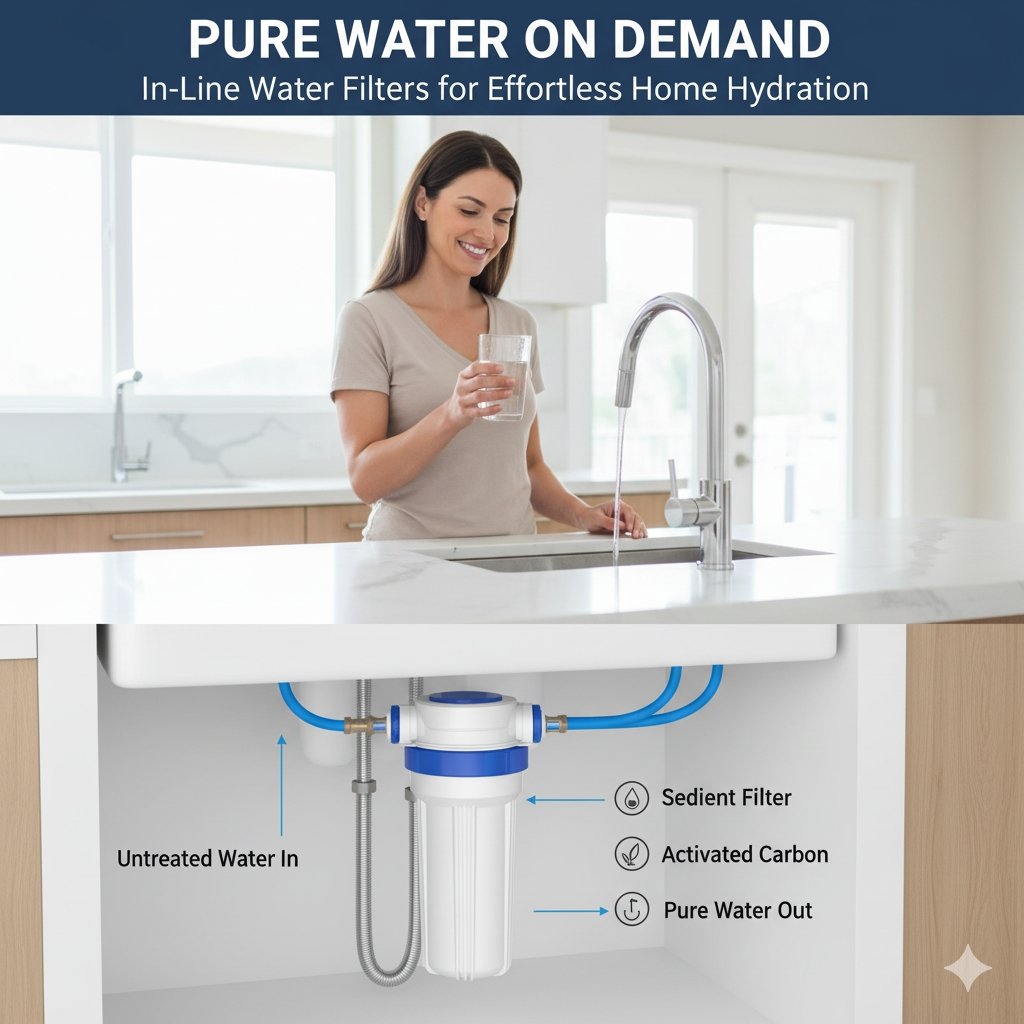
This topic is covered in full in our main guide: Inline Water Filter for Home: The Complete Guide (Benefits, Types, Installation, Costs & Maintenance).
If you searched in-line water filters for home, you’re probably looking for a compact, affordable way to improve drinking and cooking water without a bulky under-sink housing or a full reverse-osmosis system. This guide explains what in-line filters are, how they work, which problems they solve (and which they don’t), how to choose the right cartridge and connection style, step-by-step installation and flushing instructions, realistic cost expectations, maintenance schedules, troubleshooting, and eco-friendly disposal options. To check product specs and order compatible cartridges and accessories, visit YourWaterGood and our product range for parts and replacement supplies.
Read the sections you need or go straight through — by the end you’ll be able to pick the right in-line water filter for your home and keep it working well for years.
What is an in-line water filter for home?
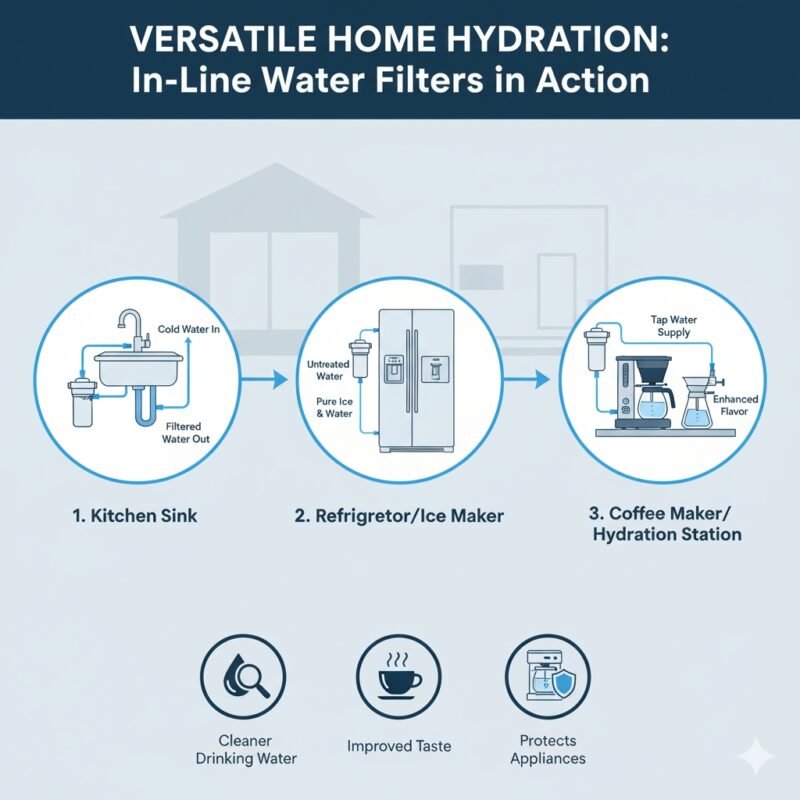
An in-line water filter for home is a compact filtration module installed directly into a water line (usually the cold line) that treats water at the point of use. Unlike bulky under-sink housings or whole-house systems, in-line filters are small cylinders or capsule cartridges that connect with 1/4″, 3/8″, or compression fittings, or with push-fit quick connectors. They’re ideal for:
- Dedicated filtered faucets,
- Refrigerators and ice makers,
- Coffee and espresso machines,
- Instant hot water dispensers,
- Limited-space under-sink installs.
Typical media include polypropylene sediment, carbon block, catalytic carbon (for chloramines), specialty adsorbents (lead, fluoride, PFAS), or ultrafiltration membranes. Because they’re compact and inexpensive, in-line filters are a popular choice for renters, small kitchens, or anyone wanting targeted point-of-use improvement.
What in-line filters remove — and what they don’t
Before buying, match the filter’s capabilities to your water test.
What many in-line filters handle well
- Chlorine taste & odor (carbon block or GAC).
- Sediment, rust, and particulates (PP spun or pleated sediment cartridges).
- Some VOCs and disinfection byproducts (with good carbon).
- Certain heavy metals and targeted contaminants if the cartridge uses ion-exchange or specific adsorbents (e.g., lead-rated cartridges).
- Low-level PFAS or organics if specified and tested by the manufacturer.
What in-line filters usually do not do
- Remove high levels of dissolved solids (TDS) — that’s RO territory.
- Provide reliable microbial disinfection (bacteria, viruses) unless combined with ultrafiltration or UV.
- Treat the whole house — in-line filters treat a single line or faucet only.
- Handle very high sediment loads for long (they’ll clog faster in turbidity conditions).
If your primary problem is scale or very high TDS, an under-sink RO or whole-house softener/RO approach is usually better. Use in-line filters where convenience, taste, or specific contaminant polishing at one tap is the goal.
Advantages of in-line filters for home use
- Space efficiency: tiny footprint, easy to tuck into cabinetry.
- Low initial cost: units and cartridges are inexpensive versus under-sink systems.
- DIY friendly: push-fit connectors and compact mounts make installs quick.
- Flexible placement: can feed an icemaker, espresso machine, or dedicated faucet without major plumbing changes.
- Easy maintenance: cartridge swaps are fast and often tool-free.
- Targeted protection: treat only the water you drink and cook with — lower overall waste and maintenance than whole-house RO.
Limitations & practical trade-offs
- Shorter service life vs larger housings: fewer media grams means earlier replacement in high-use or turbid water.
- Limited multi-stage capability: while multi-cartridge inline stacks exist, space and flow constraints limit complexity.
- Flow & pressure considerations: some inline cartridges add noticeable pressure drop at high flow rates. Check rated flow.
- Fewer certified health claims available: many inline cartridges are optimized for taste and sediment; health reduction claims (e.g., NSF 53 for lead) are available but require certification and may cost more.
Understanding these trade-offs helps you buy the right product and avoid disappointment.
How to choose the right in-line water filter for your home
Follow this decision flow:
- Get a water test or inspect the problem. Know the issue: chlorine taste, rust, lead risk, or nothing obvious? If your water is municipal and you’re only after taste, a carbon inline is likely enough. If lead or PFAS is a concern, choose cartridges rated and certified for those contaminants.
- Decide the treatment point. Are you treating the refrigerator, the espresso machine, or a dedicated faucet? Match the connection size (1/4″, 3/8″, quick-connect) and the flow needs.
- Select media and micron rating.
- Sediment protection → 1–10 μm polypropylene (spun or pleated).
- Chlorine/taste → carbon block (look for solid carbon block for better particle capture).
- Chloramine → catalytic carbon.
- Lead/PFAS → certified specialty cartridges.
- Microbial concerns → ultrafiltration membrane or an inline UV unit (requires power).
- Check flow & pressure specs. Choose a cartridge rated for your faucet’s flow (e.g., 0.5–2.0 GPM for many faucets). Confirm the pressure drop at your expected flow.
- Connection & mounting. Ensure compatibility with existing tubing size and that the mounting bracket fits the cabinet space.
- Certification & test data. For health claims, prioritize NSF/ANSI certified cartridges and check independent lab test reports when available.
- Replacement cost & availability. Look up replacement cartridge prices and how easy they are to order (subscription options reduce the chance you’ll run out).
- Environmental considerations. If sustainability matters, consider longer-life pleated cartridges or brands with recycling programs.
Typical in-line filter types and common uses
- Basic carbon inline (1/4″ push-fit): best for fridge water, coffee machines, and dedicated faucets. Low cost, good taste improvement.
- Sediment + carbon combo capsule: combines prefiltration and taste control in one compact module—good where sediment exists.
- Lead-rated inline cartridges: targeted for homes with lead service lines or older plumbing—look for NSF 53 certification.
- Catalytic carbon inline: use when your utility uses chloramines; standard carbon underperforms on chloramines.
- Inline ultrafiltration (UF): for microbial or very fine particulate issues—UF membranes remove bacteria and cysts but require clean feed water and occasional sanitization.
- Inline remineralization cartridges: if you use RO elsewhere and want to add minerals back for taste under the counter, these inline modules work well.
Installation: step-by-step (typical push-fit inline cartridge to faucet or fridge)
Tools & materials you might need
- Tubing cutter (or sharp utility knife),
- Adjustable wrench,
- Mounting screws and bracket (usually included),
- Teflon tape (if using threaded fittings),
- A bucket and towel.
Steps
- Shut off the water at the dedicated valve or main and open the downstream faucet to depressurize.
- Choose a mount point with clearance for cartridge removal. Mark screw holes and attach the bracket to the cabinet wall.
- Cut the tubing square with a cutter—clean, square ends seat better in push-fit connectors.
- Insert tubing into the push-fit until it seats fully (you’ll feel a stop). For compression fittings, use Teflon on threads and tighten snugly.
- Double-check flow direction. Most cartridges have arrow markers—install so feed enters the inlet.
- Slowly restore water and check all fittings for leaks. If a leak appears at a push-fit, depressurize and reinsert tubing fully.
- Flush the cartridge per manufacturer instructions (often 1–3 liters for carbon; a bit more for specialty media). This removes carbon fines and preservatives.
- Label the cartridge with the install date and expected replacement due date.
Installation time is often 15–30 minutes for a single inline cartridge.
Flushing, priming & first-use tips
New cartridges commonly contain microscopic fines and trapped air. Proper flushing is essential:
- Carbon cartridges: run water for several minutes or dispense the first few liters to drain carbon fines.
- Sediment cartridges: flush until water runs clear.
- Lead/PFAS cartridges: follow manufacturer flush volumes precisely — these cartridges may come preserved and require specific initial flows.
- UF membranes: may require a longer initial flush and occasional sanitization per instructions.
Never skip the flush — first sips from an unflushed filter can taste off or carry particulates.
Maintenance schedule & replacement intervals
Replacement intervals vary by water quality and cartridge capacity; here are common guidelines for normal household use:
- Sediment inline: 3–6 months (sooner in turbid water).
- Carbon inline (taste/odor): 6–12 months.
- Lead/PFAS specialty cartridges: follow manufacturer gallon rating, often 6–12 months.
- UF modules: 12–24 months depending on use and feed water.
Best practices:
- Keep a log under the sink and set calendar reminders 2 weeks before due date.
- Buy replacement cartridges in multi-packs to save money and ensure spares are on hand.
- Consider subscribing for auto-ship replacement cartridges to avoid lapses.
Cost expectations (realistic numbers)
- Entry-level carbon inline cartridges: $10–$30 each.
- Sediment inline cartridges: $10–$25 each.
- Specialty cartridges (lead, fluoride, PFAS): $30–$120 depending on certification and capacity.
- UF inline modules: $50–$200.
- Installation (if hired): $50–$150 depending on local labor rates.
Total annual cost for a household that replaces a carbon inline yearly and a sediment inline twice yearly might be $30–$80 — very affordable compared to under-sink RO systems.
Troubleshooting common problems
Leak at push-fit connection
- Likely cause: tubing not fully inserted or end cut uneven. Fix: depressurize, cut square, reinsert.
Low flow after install
- Cause: cartridge clogged or wrong micron rating; verify orientation and flow specs. Replace if necessary.
Carbon taste persists
- Cause: insufficient flushing or exhausted cartridge. Flush thoroughly; if taste persists, replace with OEM cartridge.
No improvement in contaminant
- Cause: wrong cartridge for the problem. Confirm water test and cartridge capability—get a certified cartridge if health contaminants are a concern.
Air sputtering
- Cause: trapped air after install. Run faucet until steady flow.
When in doubt, check model numbers and contact the supplier with photos—many vendors provide quick troubleshooting help.
Environmental & disposal considerations
Inline cartridges create plastic and spent media waste. Reduce impact by:
- Choosing longer-life pleated cartridges where appropriate.
- Buying cartridges from vendors with recycling or take-back programs.
- Draining and drying spent cartridges where local regulations permit disposal.
- Reusing initial flush water for nonpotable uses like plant watering where safe.
Some suppliers offer return/recycle labels or incentives—ask when you buy replacement cartridges (check availability at our product range).
When to combine inline filters with other systems
A hybrid approach often yields the best balance:
- Inline carbon for taste + under-sink RO for drinking water: carbon improves taste and protects the RO membrane; RO provides low-TDS drinking water.
- Inline sediment upstream of coffee machine + built-in descaling program: protects equipment and preserves performance.
- Inline specialty cartridge at the faucet + whole-house softener for scale: targeted contaminants at drinking taps with POE protection for appliances.
Design the system around the highest-value use cases: drinking, coffee, ice, and expensive appliances.
Buying tips & where to shop
- Match fittings & dimensions — don’t assume all 1/4″ push-fits are identical; check the tubing OD.
- Prefer certified cartridges when health claims are important (NSF/ANSI 53 for lead, 42 for taste/odor).
- Read data sheets for flow vs pressure drop curves — ensure your faucet flow won’t be restricted.
- Buy OEM or reputable aftermarket parts; cheap cartridges often underperform.
- Stock spares—one extra cartridge on hand avoids a missed replacement.
For compatible parts and convenient replacement ordering, check product catalogs and replacement packs at YourWaterGood and our product range.
Final recommendations
If you want a low-cost, low-space way to improve drinking and appliance water, in-line water filters for home are an excellent option. Start with a simple water test, choose a cartridge matched to the problem, confirm fittings and flow ratings, install with care, flush thoroughly, and keep a disciplined replacement schedule. For drinking water safety on sensitive contaminants, prefer certified cartridges and consider combining an inline filter with a POU RO or other polishing system.
With minimal cost and a short installation time, an inline filter can dramatically improve daily water quality in your kitchen and for any appliance that depends on great water — and you’ll find parts and replacements quickly at YourWaterGood and our product range.