
Efficiency Meets Purity: Why a Double Stage Water Filter is the Smart Choice for Modern Living

This topic is covered in full in our main guide: Clear Two-Step: Choosing the Right 2 Stage Water Filter for Your Home.
In the complex world of water filtration, consumers are often bombarded with the idea that “more is always better.” We see 7-stage systems, 10-stage systems, and complex reverse osmosis units with multiple tanks. While these systems have their place, they are not always the right tool for the job. Sometimes, engineering elegance lies in simplicity.
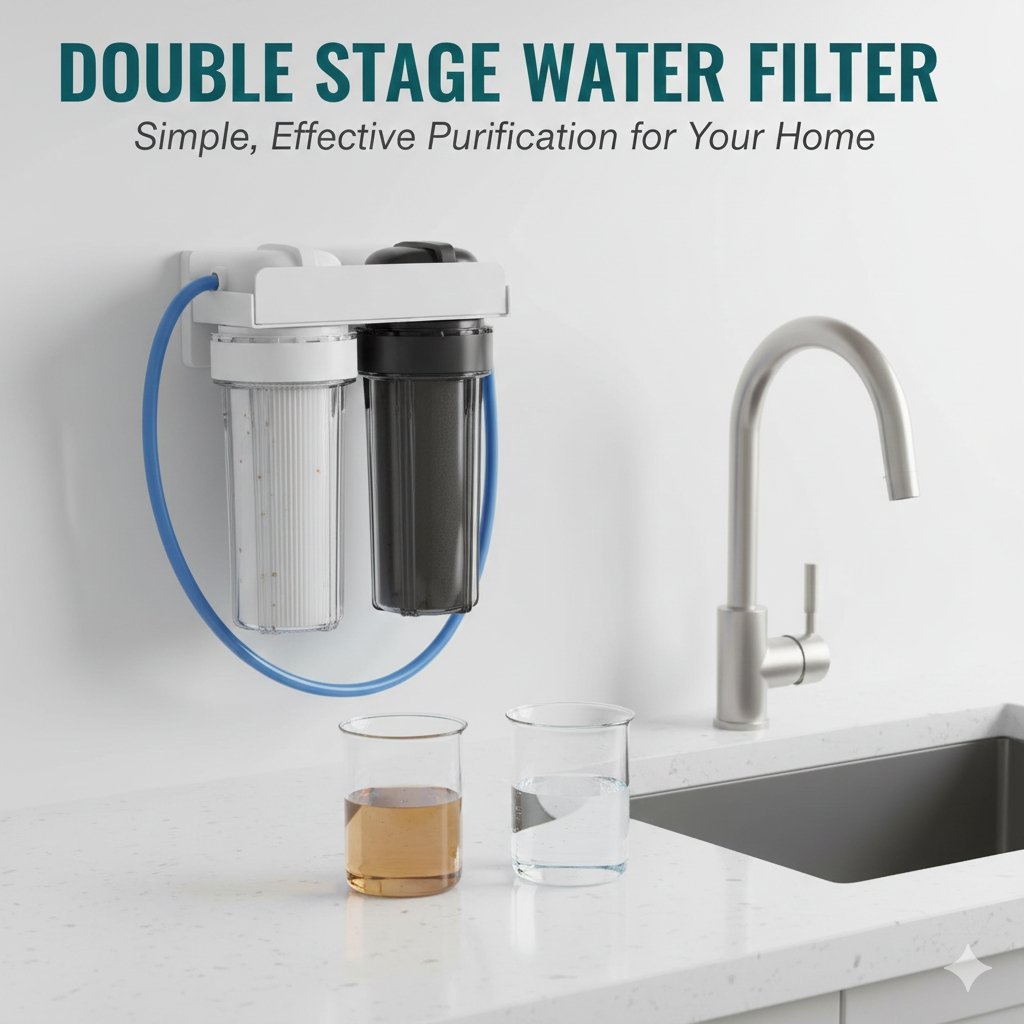
Enter the double stage water filter. This configuration is quickly becoming a favorite for both discerning homeowners and savvy small business owners. It strikes a perfect balance between robust filtration capability, space efficiency, and cost-effectiveness.
Whether you are looking to improve the taste of your morning coffee, protect your appliances from sediment, or ensure your family isn’t bathing in chlorine, understanding the mechanics and benefits of a double stage water filter is the first step toward water independence. In this extensive guide, we will unpack the science, the applications, and the distinct advantages of this powerful filtration arrangement.2-stage whole house water filter for homes.
Deconstructing the Double Stage Water Filter
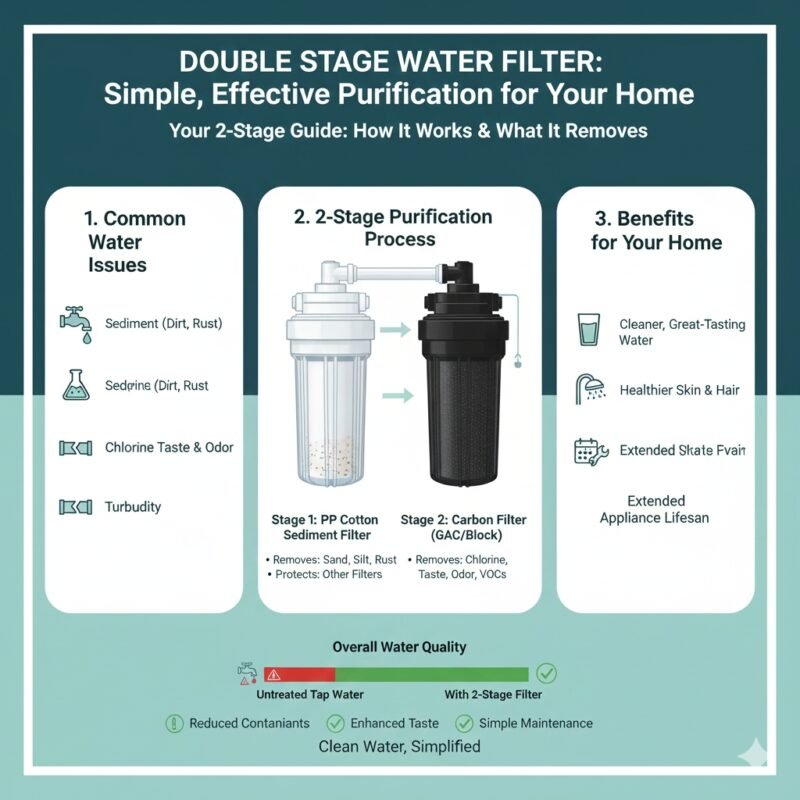
To appreciate this system, we must understand what it is. As the name implies, a double stage water filter processes water through two distinct phases of purification. Unlike a single-stage filter (like a simple pitcher) which tries to do everything at once—often inefficiently—a double stage system splits the workload.
This “Divide and Conquer” strategy allows each filter cartridge to specialize in a specific type of contaminant removal, drastically increasing the overall efficiency and lifespan of the system.
Stage 1: The Mechanical Barrier (PP Cotton)
The first cylinder in a double stage water filter is almost always a Sediment Filter, typically made from Polypropylene (PP) Cotton.
- The Mission: Remove physical particles. This includes rust flakes from old city pipes, sand from well water, silt, dirt, and turbidity.
- The Science: PP Cotton is a depth filter. It doesn’t just catch dirt on the surface; it traps particles throughout the thickness of the cotton. This protects the second stage from clogging.
- Why It Matters: If you skip this stage, the more expensive chemical filter in Stage 2 gets coated in mud immediately, rendering it useless.
Stage 2: The Chemical Sponge (Activated Carbon)
Once the water is physically clear, it moves to the second cylinder. This is usually a Carbon Block or Granular Activated Carbon (GAC) filter.
- The Mission: Remove chemicals, taste, and odor. This targets chlorine, chloramines, volatile organic compounds (VOCs), pesticides, and herbicides.
- The Science: Activated carbon works through adsorption. It attracts chemical molecules and traps them in its microscopic pores.
- The Result: Water that smells fresh, tastes crisp, and is free from harsh chemical disinfectants.
The Strategic Advantages of a Two-Stage System
Why would you choose a double stage water filter over a massive Reverse Osmosis (RO) system or a simple faucet mount? The answer lies in the specific benefits it offers.
1. Retention of Healthy Minerals
This is a critical point for many health-conscious individuals. Reverse Osmosis removes most dissolved minerals, including calcium and magnesium. A double stage water filter removes the bad stuff (dirt, chlorine, chemicals) but leaves the dissolved minerals intact. This results in water that is pH-balanced and often described as “sweeter” or more natural-tasting.
2. High Flow Rate
RO systems are slow; they need a storage tank to hold water. A double stage water filter is a “flow-through” system. It filters water instantly as it passes through the cartridges. This makes it ideal for applications where you need a lot of water quickly, such as a kitchen prep sink, a pot filler, or a busy commercial environment.
3. Zero Wastewater
Sustainability is a growing concern. RO systems produce “brine” or wastewater as part of the filtration process. A double stage water filter produces zero waste. Every drop of water that enters the system comes out as filtered water. This is better for your water bill and better for the planet.
4. Space Economy
For apartment dwellers or cafes with limited under-counter space, a huge tank is not an option. A double stage unit is compact, easily mounted on a wall or the side of a cabinet, keeping your storage space usable.
Residential Applications: The Whole House Approach
While many people install these systems under the sink, the double stage water filter design is arguably most powerful when used as a “Point of Entry” (POE) system for the entire home.
Imagine every tap in your house delivering filtered water.
- The Shower: No more breathing in chlorine vapors.
- The Laundry: Clothes last longer because sediment isn’t grinding into the fabric.
- The Appliances: Dishwashers and water heaters are protected from rust and dirt buildup.
In a whole-house setup, these units are scaled up. We use “Big Blue” housings (large 20-inch filters) to handle the flow rate of a whole household. The configuration remains the same: a large PP Cotton filter followed by a large Carbon Block.
If you are considering upgrading your home’s water infrastructure to protect your plumbing and your health, you should explore the high-capacity options available. Specifically, the Whole House Water Filtration System for Home is a prime example of how this technology can be applied to treat every drop of water entering your property, ensuring consistency and safety from the bathroom to the kitchen.
Commercial Applications: The Secret Weapon of Cafes
For our small business clients—specifically coffee shops, bistros, and small restaurants—the double stage water filter is an industry standard for a reason.
The Coffee Connection
Coffee is 98% water. The mineral content of that water dictates the extraction of the coffee bean.
- If you use RO (0 ppm minerals): The coffee tastes flat and sour because there are no minerals to bond with the flavor compounds.
- If you use Tap Water (Chlorine): The coffee tastes chemically and bitter.
The double stage water filter is the “Goldilocks” solution. By removing the sediment and the chlorine but keeping the magnesium and calcium, you create the perfect water chemistry for brewing espresso and drip coffee.
Equipment Protection
Commercial espresso machines have tiny solenoid valves. Even a small amount of grit or rust from the city pipes can jam these valves, leading to expensive repair calls and downtime. The Stage 1 PP Cotton filter in a double stage system acts as the gatekeeper, ensuring only pristine, particle-free water enters your expensive machinery.
Detailed Breakdown of Contaminants Removed
When you install a high-quality double stage water filter, what exactly are you removing from your life?
1. Sediment and Turbidity
- Source: Rust from iron pipes, soil runoff, construction debris.
- Impact: Clouds water, clogs aerators, ruins valves.
- Removal: Effectively handled by the Stage 1 PP filter (usually rated at 5 microns).
2. Chlorine and Chloramines
- Source: Municipal disinfection.
- Impact: Bad taste, bad smell, and disinfection byproducts (THMs).
- Removal: Handled by the Stage 2 Carbon Block. Note: If your city uses Chloramines (ammonia + chlorine), ensure your Stage 2 filter uses Catalytic Carbon for best results.
3. Volatile Organic Compounds (VOCs)
- Source: Industrial runoff, pesticides, herbicides.
- Impact: Long-term health risks.
- Removal: Activated carbon is highly effective at adsorbing these organic chemicals.
4. Cysts and Parasites (Specific Filters Only)
- If your Stage 2 Carbon Block is rated at 0.5 microns or smaller, it can also mechanically physically block Giardia and Cryptosporidium cysts, which are resistant to chlorine.
Installation Guide: Setting Up Your Double Stage System
One of the benefits of the double stage water filter is its relative ease of installation. Unlike RO systems which require drain lines and drilling into waste pipes, a double stage system is “inline.”
Tools Needed
- Drill and bits.
- Adjustable wrench.
- Tube cutter (for plastic tubing) or pipe cutter (for copper).
- Teflon tape.
Step-by-Step Overview
- Select the Location: Under the sink or on the main water line (for whole house). Ensure you have enough clearance to unscrew the housings to change the filters later.
- Mount the Bracket: Secure the filter head to the wall or cabinet side.
- Shut Off Water: Turn off the cold water supply.
- Connect the Input: Attach the incoming water line to the “IN” port of the Stage 1 (PP Cotton) side.
- Connect the Output: Attach the line going to your faucet to the “OUT” port of the Stage 2 (Carbon) side.
- Flush the System: Before using the water, run it for 5–10 minutes. This flushes out any loose carbon dust (fines) from the new filter so you don’t drink gray water.
Maintenance: The Key to Longevity
A double stage water filter is only as good as its cartridges. Neglecting maintenance is the most common reason for system failure.
The Replacement Schedule
- Stage 1 (PP Cotton): Change every 3 to 6 months.
- Visual Indicator: If the housing is clear, change it when the white cotton turns dark brown or rust-colored.
- Performance Indicator: If water pressure drops significantly, the filter is clogged.
- Stage 2 (Carbon Block): Change every 6 to 12 months.
- Performance Indicator: If the taste of chlorine returns, the carbon is exhausted.
Why You Must Change Stage 1 on Time
If you leave the PP cotton filter too long, the water pressure will eventually force the sediment through the cotton. This dirt will then coat the Stage 2 carbon filter. Once carbon is coated in dirt, it cannot absorb chemicals. You essentially ruin the expensive filter by neglecting the cheap one.
At YourWaterGood, we emphasize the importance of using high-quality replacement cartridges. Our PP cotton filters are manufactured to strict density standards to ensure maximum dirt-holding capacity without premature pressure drops.
Troubleshooting Common Issues
Even the best systems can have hiccups. Here is how to handle them.
Issue: Low Water Pressure
- Cause: Clogged Stage 1 filter.
- Fix: Replace the PP cotton cartridge.
Issue: Water Looks Milky
- Cause: Trapped air bubbles. This is common after installing new filters.
- Fix: It is harmless. Let the water sit in a glass for a minute; the bubbles will clear. It will stop happening after a few days of use.
Issue: Water Tastes Like Tap Water
- Cause: Stage 2 Carbon filter is saturated.
- Fix: Replace the Carbon Block immediately.
Issue: Leaking at the Housing
- Cause: The O-ring (rubber seal) is dry or pinched.
- Fix: Unscrew the housing, check the O-ring for damage, lubricate it with food-grade silicone grease, and retighten. Do not over-tighten!
The Environmental Perspective
In today’s climate, every purchase has an environmental footprint. The double stage water filter is an eco-friendly champion for two reasons.
- Plastic Reduction: By filtering your own water, a single household can eliminate the need for over 2,000 single-use plastic bottles per year.
- Energy Efficiency: Unlike RO systems which often require electric booster pumps, double stage systems typically run on existing water pressure.
- Water Conservation: As mentioned, they produce zero wastewater. In drought-prone areas, this is a significant ethical advantage over standard RO systems.
Customizing Your Double Stage System
One of the hidden benefits of this open-frame design is modularity. While the standard setup is PP Cotton + Carbon, you can customize the cartridges based on your specific water problems.
- For Lead: Swap Stage 2 for a specialized Lead Reduction Carbon Block.
- For Iron: Swap Stage 1 for an Iron Reduction cartridge (if you are on well water).
- For Bacteria: Swap Stage 2 for a Ceramic filter or Ultrafiltration (UF) membrane.
This flexibility allows the double stage water filter to evolve with your needs.
Conclusion: The Smart Investment
The double stage water filter is a testament to the idea that effective solutions do not need to be over-engineered. By respecting the physics of filtration—removing the solids first, then the chemicals—it provides a robust, reliable, and high-flow source of clean water.
For the homeowner, it means safer showers and better-tasting food. For the coffee shop owner, it means protecting your espresso machine and serving a superior product. It is an investment that pays dividends in health, taste, and equipment longevity.
Don’t let the complexity of the market confuse you. If your goal is clean, chemical-free water that retains its natural minerals, the double stage solution is likely your best bet.
Visit YourWaterGood to explore our range of filtration solutions. Whether you need a compact system for your cafe or a powerful whole-house setup, we have the expertise and the quality components to ensure your water is always good.
Frequently Asked Questions (FAQ)
Q: Can a double stage water filter remove fluoride? A: Generally, no. Standard carbon filters do not remove fluoride effectively. If fluoride removal is a priority for you, you will need a Reverse Osmosis system or a specific Activated Alumina filter cartridge.
Q: How do I know what size system to get? A: For a single faucet (drinking water), a standard 10-inch “Slim” system is sufficient. For a Whole House application or a busy commercial kitchen, you need 20-inch “Big Blue” housings to handle the flow rate without dropping pressure.
Q: Is it hard to change the filters? A: Not at all. It typically involves using a plastic wrench (included with the system) to unscrew the housing, swapping the cartridge, and screwing it back on. It takes less than 10 minutes.
Q: Will this system work on well water? A: It depends on what is in your well. If you have sediment and some smell, yes. But if you have coliform bacteria or extremely high iron, you need specialized pre-treatment (like UV or Chlorination) before the double stage filter.
Q: Why do you prioritize PP cotton? A: PP cotton is the unsung hero of filtration. At YourWaterGood, we know that without this inexpensive first layer of protection, the entire system fails. It is the shield that allows the rest of the technology to work.