
The Essential Guide to the Double Water Filter System: Dual Protection for Home

This topic is covered in full in our main guide: Clear Two-Step: Choosing the Right 2 Stage Water Filter for Your Home.
Water is the foundation of a healthy home and a successful food service business. Yet, as we turn on our taps, we are often greeted with water that smells like swimming pool chlorine, looks slightly cloudy, or leaves stubborn rust stains on our porcelain fixtures. In the quest for cleaner water, consumers are often caught between two extremes: the cheap, ineffective water pitcher and the complex, expensive industrial reverse osmosis system.
Fortunately, there is a powerful middle ground that balances efficiency, flow rate, and purity: the double water filter system.
This configuration, often referred to as a dual-stage filter, has become the go-to solution for millions of households and small businesses like cafes and bistros. It provides a logical, two-step approach to water treatment that tackles the most common contaminants found in municipal water supplies. In this extensive guide, we will explore the mechanics, the benefits, and the installation of these systems, and help you decide if a double water filter system is the right investment for your property.2-stage whole house water filter for homes.
What is a Double Water Filter System?
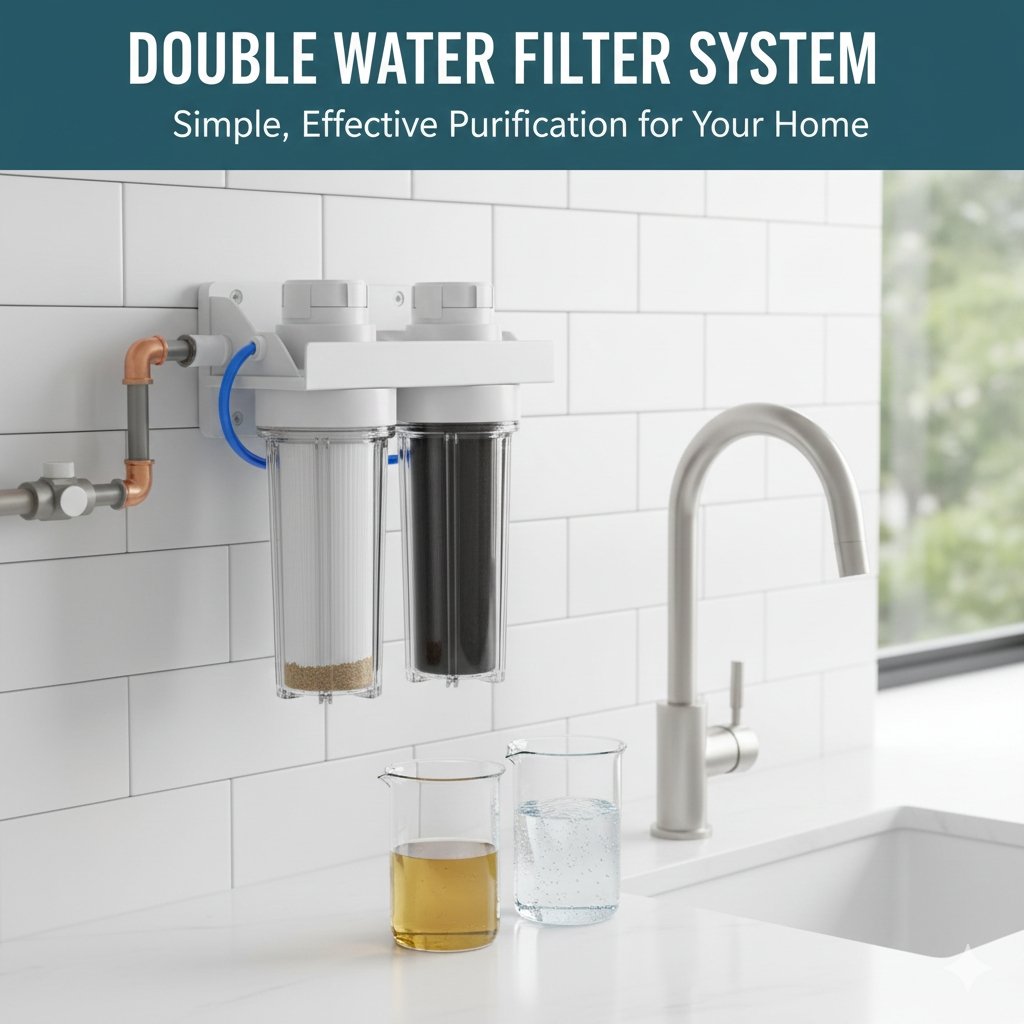
At its core, a double water filter system is a water treatment unit that utilizes two separate filtration housings connected in a series. Water flows from your main supply line into the first housing, passes through the first filter, flows immediately into the second housing, passes through the second filter, and then exits to your faucet or appliances.
This design is based on the engineering principle of “progressive filtration.” Rather than asking one filter to do all the heavy lifting—which often leads to rapid clogging and poor performance—the work is split between two specialists.
The “One-Two Punch” Configuration
While cartridges can be customized, the industry-standard setup for a double water filter system designed for city water is specific:
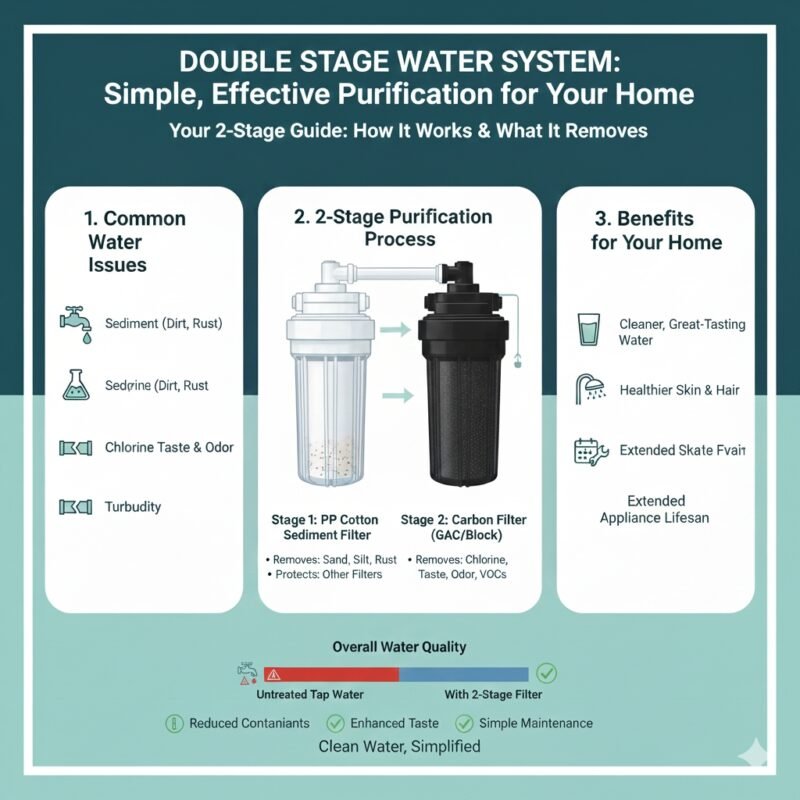
- Stage 1: Mechanical Filtration (Sediment) This is almost always a Polypropylene (PP) Cotton filter. Its job is to remove physical particles: sand, rust, dirt, silt, and algae.
- Stage 2: Chemical Filtration (Carbon) This is usually an Activated Carbon Block. Its job is to remove dissolved chemicals: chlorine, chloramines, pesticides, herbicides, and bad odors.
By placing the PP cotton filter first, we protect the expensive carbon filter from getting plugged with dirt. This simple arrangement maximizes the lifespan of the cartridges and ensures consistent water pressure.
Why Two Stages Are Better Than One
You might ask, “Why not just use a really good single filter?” The answer lies in surface area and chemical kinetics.
The Problem with Single-Stage Filters
In a single-stage system (like a faucet mount), the water has very little “contact time” with the filter media. Furthermore, if that single filter is carbon-based, it will quickly get coated in the sediment found in old city pipes. Once a carbon filter is coated in mud, it can no longer absorb chlorine. It becomes useless very quickly.
The Efficiency of the Double Water Filter System
By separating the jobs, a double water filter system allows the carbon filter to focus entirely on chemical adsorption. Because the water entering the second stage is already crystal clear (thanks to the Stage 1 PP cotton), the carbon pores remain open and active for months longer.
This efficiency makes the double system ideal for high-volume applications, such as:
- Whole House Filtration: Treating all the water entering a home.
- Commercial Kitchens: Supplying water to ice machines and prep sinks.
- Coffee Shops: protecting espresso machines from sediment while improving taste.
Scenario A: The Whole House Solution
One of the most popular applications for this technology is the “Point of Entry” (POE) setup. Installing a large-capacity double water filter system on your main water line ensures that every drop of water in your building is treated.
Protecting Your Infrastructure
We often think about filtered water for drinking, but we forget about the water that runs through our expensive appliances.
- Water Heaters: Sediment buildup at the bottom of a water heater acts as an insulator, making the heater work harder and burn out faster.
- Washing Machines: Dirt and rust can stain clothes and wear out the internal pumps of washing machines.
- Plumbing: Chlorine is corrosive to rubber gaskets and seals inside faucets and toilets.
By removing sediment and chlorine at the entry point, you extend the life of your home’s infrastructure. If you are looking for a robust solution that covers your entire property, we highly recommend investigating the Whole House Water Filtration System for Home. This system utilizes the principles of dual-stage filtration on a macro scale, ensuring high flow rates so you can shower, do laundry, and run the dishwasher simultaneously without a drop in pressure.
Shower Comfort
Many people find showering in chlorinated water leaves skin and hair feeling dry. A whole-house double water filter system removes this chlorine, essentially turning your shower into a spa-like experience with chemical-free water.
Scenario B: The Dedicated Drinking Water Solution
While a whole house system is fantastic for general water quality, many homeowners want an extra layer of purity for the water they actually consume. In the kitchen, a double water filter system is often installed under the sink.
The Taste Factor
The primary complaint regarding municipal water is the taste. Chlorine, used to kill bacteria, leaves a distinct “bleach” flavor. Old pipes can add a metallic tang. A dual-stage system eliminates these flavors instantly. The result is water that is neutral, crisp, and refreshing—encouraging your family to drink more water and less sugary soda.
Limitations and Upgrades
It is important to be transparent about what a standard double water filter system cannot do. While it is excellent for sediment and chemicals, it does not remove “Total Dissolved Solids” (TDS) such as minerals, salts, or heavy metals like lead and arsenic, nor does it remove fluoride.
If your water test reveals high levels of lead, or if you simply demand the highest possible purity (removing 99% of all contaminants), you may need to upgrade from a double filter to a Reverse Osmosis system. For the lowest dissolved-solids content, the RO Water Purifier is the stronger choice. It builds upon the pre-filtration of the double system but adds a semi-permeable membrane to strip away even the tiniest molecular contaminants.
Scenario C: The Small Business Advantage
For our readers who own small businesses—specifically cafes, tea houses, and boutique restaurants—water is money.
The Coffee Shop Equation
Coffee is 98% water. You cannot make excellent coffee with poor water.
- Sediment: Grit in the water will destroy the solenoid valves and flow meters in an espresso machine. The repair bill for this can be hundreds of dollars. The Stage 1 PP filter in a double water filter system is the best insurance policy against this.
- Chlorine: Chlorine reacts with the oils in coffee beans, creating a bitter, acrid taste. Stage 2 Carbon filtration ensures the water is neutral, allowing the true flavor of the roast to shine.
Space Saving Design
Unlike bulky industrial tanks, a double water filter system is compact. It can be mounted on the wall behind an ice machine or under a prep counter. For a small bistro with limited square footage, this compact efficiency is vital.
Deep Dive: The Components of a Quality System
Not all filters are created equal. When shopping for a double water filter system, you need to look at the specifications of the cartridges.
Stage 1: The PP Cotton Pre-Filter
At YourWaterGood, we emphasize that the quality of the polypropylene matters.
- Density: A good PP filter is “graded density.” This means the outer layers are looser to catch big dirt, and the inner layers are tighter to catch fine dust. Cheap filters are the same density throughout and clog much faster.
- Micron Rating: For a double system, a 5-micron rating is standard. This catches particles visible to the naked eye and much smaller, protecting the carbon stage.
Stage 2: The Carbon Block
- Granular vs. Block: Avoid “Granular Activated Carbon” (GAC) for the second stage if possible. GAC consists of loose beads, which can allow water to create channels and bypass the filtration. A “Carbon Block” is a solid, compressed cylinder. It forces every drop of water to squeeze through the carbon matrix, ensuring maximum chemical removal.
- Capacity: Look for the gallon rating. A standard under-sink block might last 1,000 gallons, while a whole-house block might last 50,000 gallons.
Installation Guide: What to Expect
Installing a double water filter system is a project that many DIY enthusiasts can handle, especially for under-sink models. Whole-house units usually require some plumbing knowledge or a professional.
Under-Sink Installation
- Mounting: Screw the bracket to the side of the cabinet.
- Tapping: Install a “feed water adapter” on your cold water line.
- Tubing: Connect the plastic tubing from the cold line to the “IN” port of the system.
- Faucet: Install the dedicated drinking faucet on your sink (requires a hole) and connect it to the “OUT” port.
- Flushing: Run water for 5 minutes to clear carbon dust.
Whole-House Installation
- Location: Find the main water entry point (usually in the garage or basement).
- Loop: Cut the main pipe and create a loop to install the filter bracket.
- Bypass Valve: Critical Step. Always install a 3-valve bypass. This allows you to turn off the water to the filter (to change cartridges) while still allowing unfiltered water to flow to the house.
- Support: These units become very heavy when filled with water. Ensure the wall mount is secured into studs, not just drywall.
Maintenance: Keeping Your System Effective
The beauty of a double water filter system is its low maintenance. There is no electricity, no backwashing, and no waste line. However, filter changes are non-negotiable.
The Schedule
- Stage 1 (PP Cotton): Change every 3 to 6 months.
- Visual Check: If you have clear housings, change it when it turns brown/dark orange.
- Pressure Check: If your water flow slows down, the PP filter is doing its job (catching dirt) and needs changing.
- Stage 2 (Carbon): Change every 6 to 12 months.
- Taste Check: If the chlorine taste returns, the carbon is exhausted.
Cost Analysis
Compared to buying bottled water, a double water filter system pays for itself incredibly fast.
- Bottled Water: A family of four can spend $500–$800 annually on bottles.
- Double Filter: Annual replacement cartridges typically cost $50–$100.
- Savings: You save hundreds of dollars a year while eliminating thousands of plastic bottles from the landfill.
Troubleshooting Common Issues
Even the most reliable systems can have hiccups. Here is how to troubleshoot a double water filter system.
1. Low Water Pressure This is the most common issue. It almost always means the Stage 1 PP filter is clogged.
- Solution: Replace the Stage 1 cartridge. If pressure is still low, check if your home’s incoming pressure matches the system’s requirement (usually 20-60 psi).
2. Milky or Cloudy Water This often happens right after a filter change. It is caused by millions of tiny air bubbles trapped in the new filter media.
- Solution: It is harmless. Let the water run for a few minutes, or let the glass sit for 30 seconds, and it will clear up. The issue will resolve itself after a few days of use.
3. Leaking Housings Water dripping from where the blue canister screws into the black cap.
- Solution: Usually, the O-ring (rubber seal) is not seated correctly or needs lubrication. Unscrew the housing, apply food-grade silicone grease to the O-ring, and hand-tighten the housing back on. Never use a wrench to tighten; only use the wrench to loosen!
Making the Choice: Double Filter vs. RO vs. Simple Filter
To help you finalize your decision, let’s compare the double water filter system against its competitors.
| Feature | Pitcher Filter | Double Water Filter System | Reverse Osmosis (RO) |
| Filtration Level | Basic | Advanced | Ultimate |
| Flow Rate | Very Slow | Fast (Instant) | Slow (Needs Tank) |
| Removes Sediment? | No | Yes (Excellent) | Yes |
| Removes Chlorine? | Yes | Yes (Excellent) | Yes |
| Removes Minerals? | No | No (Retains Healthy Minerals) | Yes |
| Wastewater | None | None | Yes (Brine) |
| Installation | None | Easy/Moderate | Complex |
| Cost | Low | Medium | High |
The Verdict:
- Choose RO (like our RO Water Purifier) if you have lead issues, unsafe well water, or want very low-TDS drinking water.
- Choose a Double Water Filter System (like our Whole House Water Filtration System for Home) if you want high flow, clean water for the whole house or coffee shop, want to retain healthy minerals, and want to avoid water waste.
Environmental Impact
In a world increasingly conscious of sustainability, the double water filter system shines. Unlike Reverse Osmosis, which produces wastewater (brine) as it flushes contaminants away, a double filter sends all the water it treats to your taps, with no wastewater. Every drop that enters the filter exits as usable water.
Furthermore, by adopting a filtration system, you participate in the global reduction of single-use plastics. It is a small change in your kitchen that makes a massive difference in our oceans.
Conclusion: Upgrade Your Water Today
Water quality is not something to compromise on. Whether you are a parent wanting to protect your children from chlorine, a homeowner wanting to save your plumbing from rust, or a cafe owner wanting to serve the perfect espresso, the double water filter system offers a versatile, efficient, and cost-effective solution.
It strips away the bad (sediment, chlorine, odors) while keeping the good (flow rate, minerals, zero waste). It is the sensible choice for modern living.
At YourWaterGood, we specialize in high-quality filtration solutions tailored to your needs. From our premium PP cotton pre-filters to our advanced whole-house units, we are here to help you get the best water possible. Explore our shop today and take the first step toward a cleaner, healthier life.
Frequently Asked Questions (FAQ)
Q: Can I use a double water filter system for well water? A: It depends on the quality of the well water. If your well water only has sediment and some odor, yes. However, if your well water contains bacteria (coliform) or high iron, a standard double system is not enough. You would need additional treatment like UV sterilization or a dedicated iron filter before the double system.
Q: How do I know when to change the filters if I don’t see a pressure drop? A: Even if flow remains good, we recommend changing cartridges at least every 12 months. Bacteria can eventually grow inside a filter that is used for too long. Mark the date on the filter housing with a marker or set a reminder on your phone.
Q: Does this system remove fluoride? A: A standard Carbon-based double system does not remove fluoride effectively. If fluoride removal is a priority, you should look at our Reverse Osmosis options.
Q: Is it safe to drink water from a whole house double filter? A: Yes, provided your source water is municipally treated (safe from bacteria). The filter improves the quality significantly. However, most people prefer to add a small under-sink unit for drinking water to ensure the piping inside the house hasn’t added any new contaminants.
Q: Why does my double filter system have a white and a blue housing? A: Sometimes manufacturers use clear or white housings for the Stage 1 (Sediment) so you can see the dirt accumulating, and opaque blue housings for Stage 2 (Carbon) because you don’t need to see inside it. It is a helpful design feature for maintenance.