
Water Purification System for Small Business Owners: Sizing, Costs & ROI

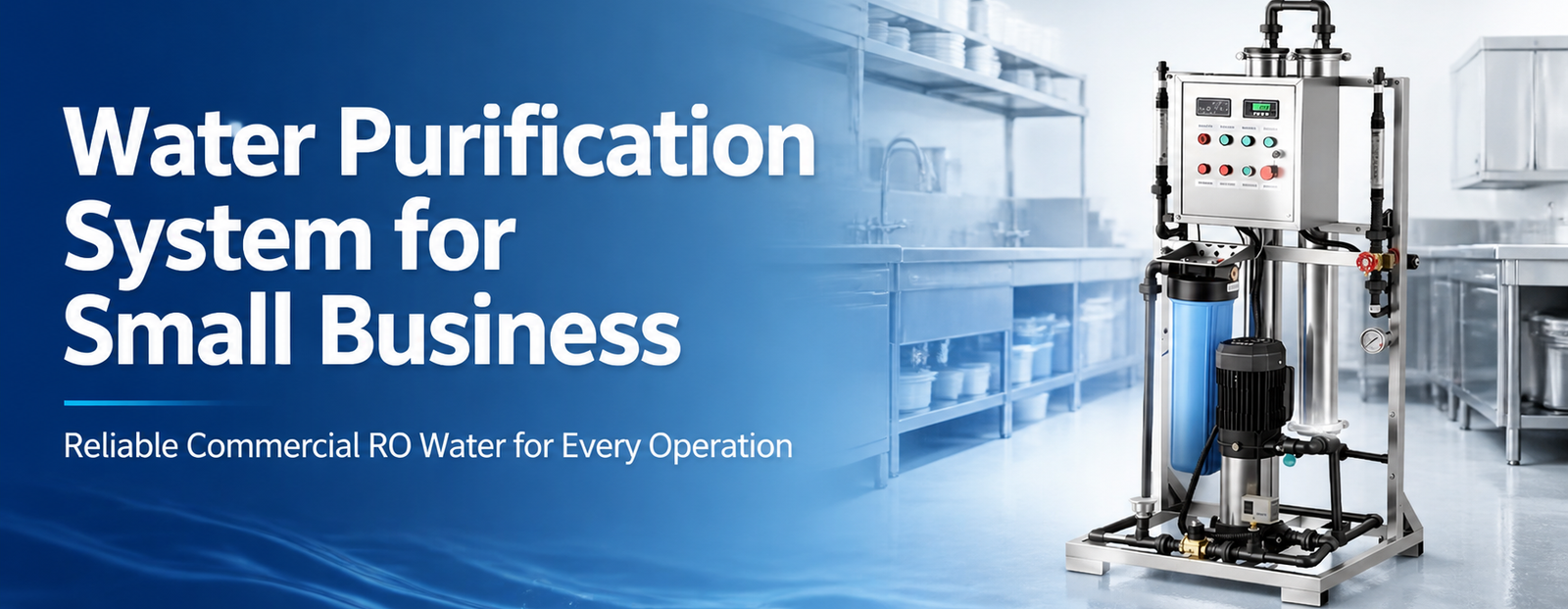
A water purification system for small business use has to solve one thing: protect the one or two machines your revenue actually depends on, without the CAPEX or footprint of a multi-station commercial plant. Before you sign off on a water purification system for small business quote, run it against four checkpoints:
- Right-sized flow for a single espresso machine, ice maker, or dish station — not a facility-scale number you’ll never use
- Scale protection matched to your actual water hardness, not a generic assumption
- A footprint that fits your back room or utility closet, not a floor plan redesign
- A maintenance schedule you can keep on top of without a facilities team
For full technical specs, regional water-source engineering, and POE vs POU cost tables, see our high flow water purification systems breakdown — this guide sticks to what a single-location owner actually needs to decide.
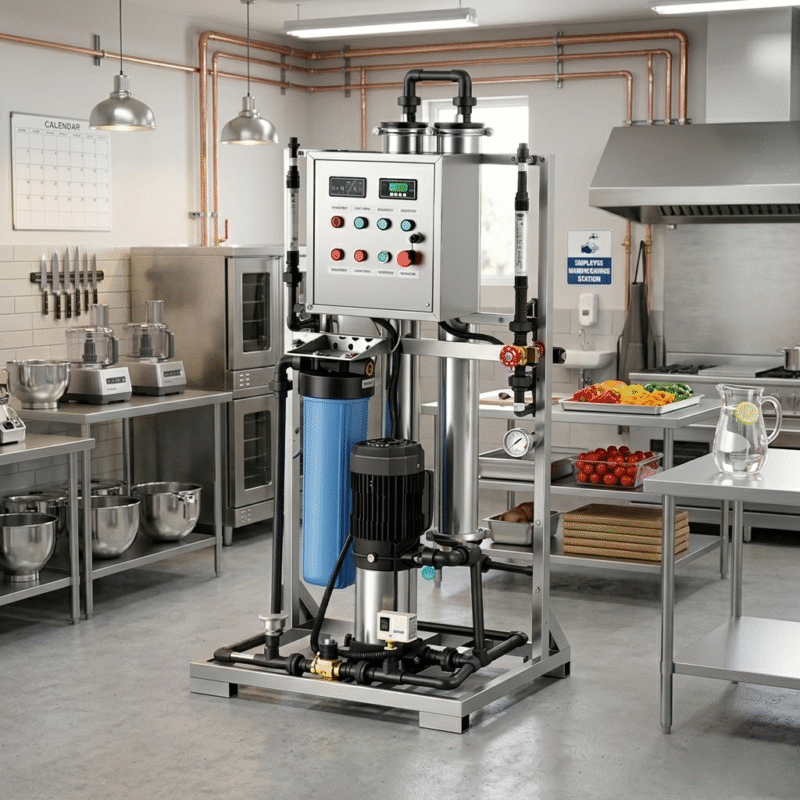
Fast Check Product: https://yourwatergood.com/product/commercial-reverse-osmosis-system/
What a Single-Location Setup Actually Looks Like
Coffee shop: one espresso machine, maybe a cold brew tower. The failure points are boiler scale and steam-wand taste — protect that one line and you’ve protected the whole operation.
Small restaurant: an ice maker, a steamer, and a dish machine often share one supply line. Lose water pressure or quality mid-service and you lose all three at once, not just one station.
Clinic or dental office: sterilization equipment and rinse water are sensitive to hardness and particulate in ways a standard kitchen setup isn’t. Water quality here is a compliance issue as much as a cost issue.
Tea or juice bar: brew and blend equipment doesn’t run as hot as an espresso boiler, but scale buildup in a tea urn or a syrup-and-water dispenser still shows up as off flavor and slower throughput during a rush.
What all four have in common: it’s usually one or two machines carrying the whole operation, not a kitchen full of redundant equipment. A large facility can lose one dishwasher and route around it. A single-location owner running one espresso machine or one ice maker doesn’t have that slack — if that machine is down, that revenue stream is down.
That’s the real difference between sizing for a small business and sizing for a multi-station facility. It’s not a smaller version of the same problem — it’s a single-point-of-failure problem, and the system has to be sized around protecting that one point, not spread thin across capacity you don’t need.
Different failure points, same underlying question: what’s the smallest system that actually covers what you’re protecting?
Standard Small-Business Unit vs. YourWaterGood Configurable Build
| Spec | Typical Off-the-Shelf Small-Business Unit | YourWaterGood Configurable Build |
|---|---|---|
| Flow capacity | Fixed, sized for one fixture | 250–1,000 L/hr (1.1–4.4 GPM), configurable |
| Build | Plastic under-sink cartridge housing | Stainless steel floor-mounted frame |
| Quality monitoring | None — change cartridges on a calendar guess | Integrated online water quality monitor |
| Growth path | Swap the whole unit if you add equipment | Add membrane/pump capacity on the same frame |
| Footprint | Small, but capacity-limited to under-sink | 60 × 60 × 140 cm — sized for a utility closet, not a sink cabinet |
Worth being direct about the tradeoff: the YourWaterGood build is a bigger box than a slim under-sink cartridge unit. What you get for that footprint is a system that doesn’t need replacing the day you add a second machine, extend hours, or open a second location.
Request a Commercial Kitchen Water Layout Design and we’ll confirm whether the base 250 L/hr build fits your utility space before you commit.
Payback Period: What This Actually Saves a Single-Location Operator
For a one-machine setup, the return isn’t a facility-wide efficiency number — it’s the cost you stop paying.
- Fewer emergency service calls. Descaling an espresso boiler or clearing a scaled solenoid valve mid-shift is a same-day repair bill most operators would rather not have.
- Longer equipment life. Espresso boilers, ice machine evaporators, and steamer generators all fail earlier when they’re running on hard or high-chlorine water — replacement, not repair, becomes the cost.
- Fewer flavor complaints. Chlorine taste, off ice, or flat espresso extraction from unbalanced water chemistry show up as customer complaints and wasted product before anyone traces it back to the water.
Most single-machine operators find the system pays for itself against the cost of avoiding one or two of those service calls a year — not a multi-year facility ROI model.
Think about it against your machine’s own warranty terms, too. Most commercial espresso machine and ice maker manufacturers require documented water treatment to keep the warranty valid on boiler and evaporator components. A voided warranty on a machine that costs more than the water system itself is its own line item in the payback math, separate from the repair-avoidance case above.
There’s a downtime cost that’s easy to underweight as well. A scaled-up ice maker or a boiler throwing an error mid-rush doesn’t just cost the repair bill — it costs the covers you can’t turn or the drinks you can’t make until a technician shows up. For a single-location business, that’s revenue with no backup system to cover it.
Water Source, Filtration Depth & Full Specs
Quick version: municipal water usually needs chlorine/odor and disinfection-byproduct reduction; well water usually needs hardness, iron, and manganese reduction instead — the two aren’t interchangeable treatment problems.
For a single fixture, point-of-use (POU) protection ahead of just that machine is typically the right call rather than a whole-facility central system — the full POE vs POU cost breakdown is in the technical guide linked above if you’re weighing both.
The core media is the same either way: a polypropylene sediment pre-filter ahead of the treatment stage, sized to your fixture’s draw rather than a whole kitchen’s.
Maintenance for a Single-System Install
Small-business setups protecting one machine commonly run a softener stage with a brine (salt) tank rather than a full RO plant — simpler to maintain when you’re only protecting one piece of equipment from scale.
Salt tank refills run on a cadence tied to your water hardness and volume — check monthly until you know your actual usage pattern, then set a recurring reminder around whatever interval that settles into. Sediment pre-filters on the front end still need their own check, independent of the salt level.
A simple maintenance routine for a single-machine install usually covers three things:
- Salt level — a quick visual check, refill before it runs dry rather than after
- Pre-filter condition — swap on the 2–4 month schedule rather than waiting for a visible flow drop
- Output taste/quality spot-check — a fast way to catch a failing stage before it shows up as a customer complaint
None of this requires a facilities team. It’s closer to a recurring calendar reminder than a maintenance program.
One field note worth flagging if espresso is part of your setup: don’t chase 0 TDS output. Water that’s too pure pulls too hard on coffee solubles and flattens extraction, and it’s aggressive enough to corrode a copper boiler over time. A blending valve dialing finished water to roughly 30–50 ppm TDS protects the boiler and keeps the shot tasting right.
Get your technical parameter sheet and we’ll spec the right combination of pre-filter, softener, and blending setup for your one-machine or two-machine line.
FAQ
What size system does a single coffee shop need? Most single-espresso-line shops are covered by the base configuration — the question is water hardness and machine model, not square footage.
Is a water purification system for small business worth it for just one machine? Usually yes if that machine is central to revenue. The comparison isn’t the system cost against nothing — it’s the system cost against one avoided emergency repair call and a longer equipment life on the machine you can’t afford downtime on.
Do I need central (POE) filtration or just one point-of-use unit? For a single fixture, point-of-use is typically enough. Central (POE) systems make more sense once you’re protecting three or more pieces of equipment off the same line — see the technical guide linked above for that comparison.
How much space does a small-business unit need? The base build is 60 × 60 × 140 cm — plan on a utility closet or back-room spot, not an under-sink cabinet.
How often does maintenance need to happen? Sediment pre-filters typically need checking every 2–4 months; a softener’s brine tank runs on a hardness-dependent refill cycle you’ll settle into after the first few months.
Does my water need different treatment on a well vs city water? Yes — well water usually needs hardness/iron/manganese reduction, while city water usually needs chlorine and odor reduction. Confirm which you’re on before sizing pre-treatment.
Can I upgrade later if I add a second machine or location? The configurable build is designed for that — capacity adds onto the same frame rather than requiring a full swap-out.
Will this affect my equipment’s manufacturer warranty? Documented water treatment is often a warranty requirement for commercial espresso machines and ice makers, not just a nice-to-have — check your equipment’s warranty terms if you haven’t already.
What’s the difference between this and a home water filter? A home filter is sized for occasional household draw. A commercial-grade unit is built for continuous daily duty cycles behind a revenue-generating machine, with parts (pumps, valves, monitoring) rated for that load.
Get Priced and Speced
Whether it’s one espresso machine or a two-station line, don’t guess at sizing. Request a Custom Commercial Quote, a technical parameter sheet, or B2B wholesale pricing for a water purification system for small business built to protect exactly what you’re running today — with room to grow into if you’re not.