
The Ultimate Guide to Compact RO Water Purifiers for Commercial Kitchens

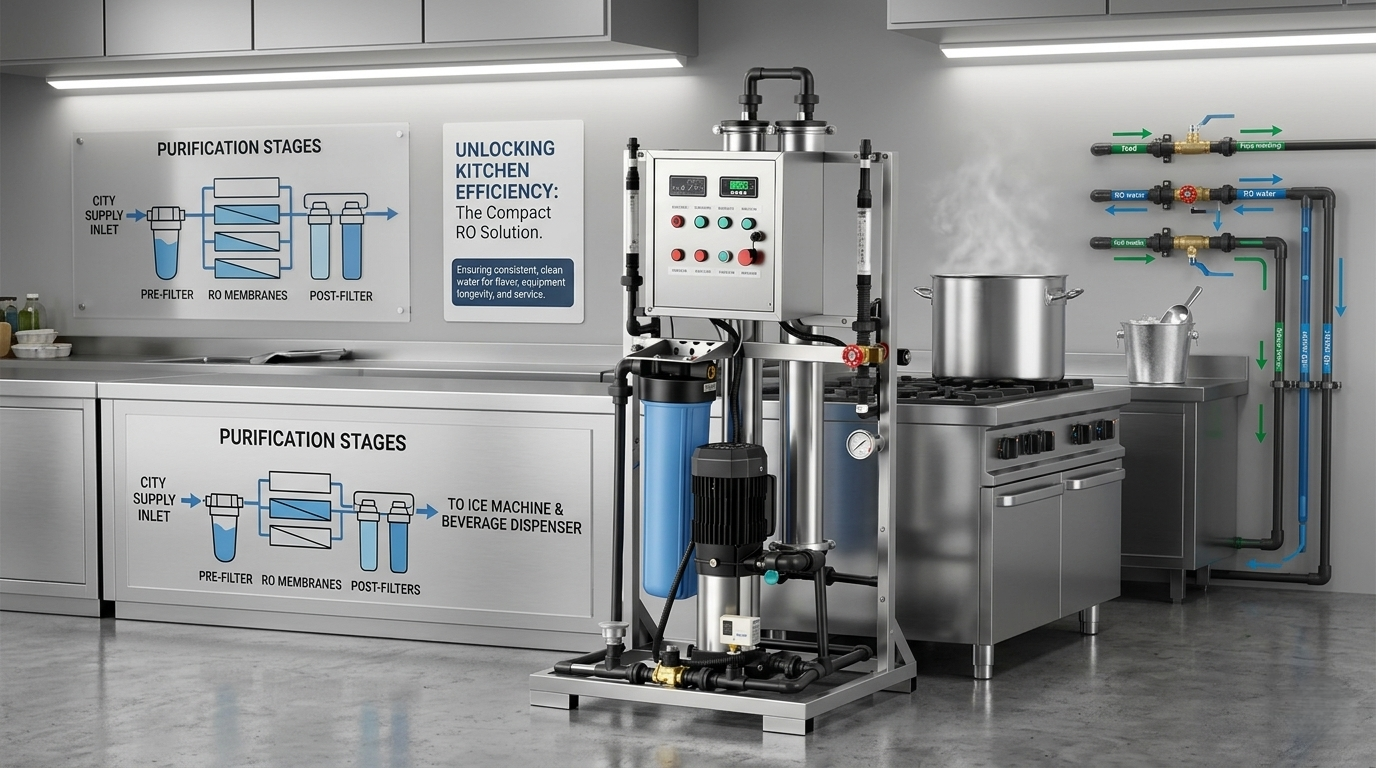
The best compact ro water purifiers for commercial kitchens provide high-flow, tankless filtration that fits within limited prep spaces while delivering 66 to 265 gallons per day (GPD). For small businesses like cafes and restaurants, the most recommended solution is a multi-stage Reverse Osmosis (RO) system with a high-rejection membrane. These systems ensure a steady 0.5 to 1.5 GPM flow rate, specifically engineered to remove 99% of total dissolved solids (TDS) and scale-forming minerals, thereby protecting sensitive equipment like espresso machines and ice makers from costly downtime.
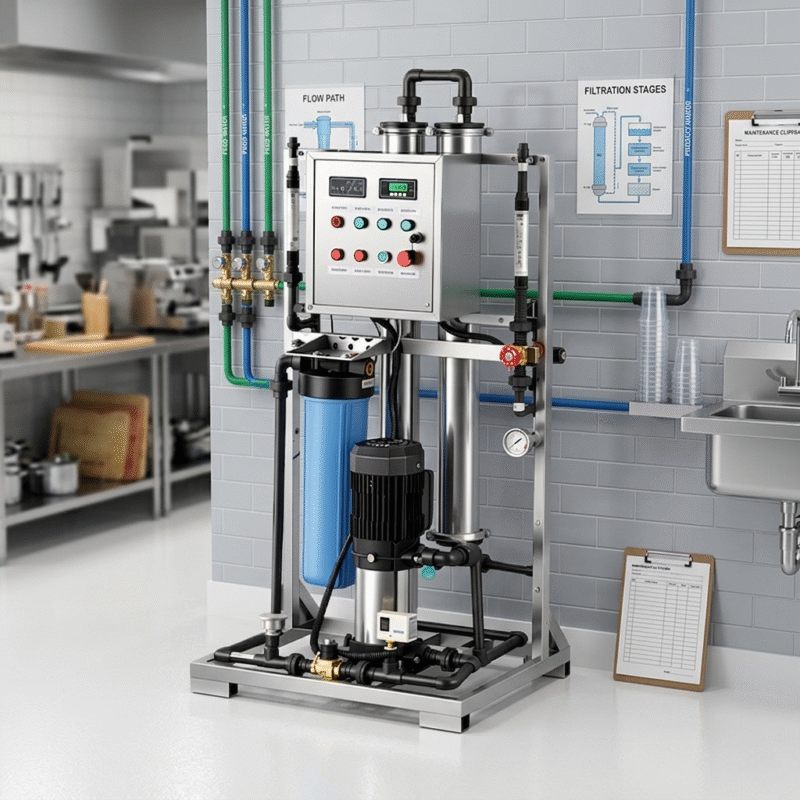
Compact Reverse Osmosis (RO) systems for commercial kitchens are specialized high-flow filtration units designed to fit in space-constrained environments while delivering high-purity water. These systems, such as those provided by YourWaterGood, typically utilize a multi-stage process—including high-density PP cotton pre-filtration—to remove up to 99.9% of TDS, chlorine, and heavy metals. This ensures the protection of sensitive kitchen machinery and consistent culinary results.
| Feature | Traditional Commercial RO | Compact RO (Kitchen Grade) |
| Footprint | Large Tank / Floor Mounted | Under-counter / Wall-mounted |
| Primary Filter | Basic Sediment | High-density PP Cotton |
| Recovery Rate | 25% – 50% | Up to 75% (Eco-friendly) |
| Key Benefit | High Volume | Equipment Protection & Space Saving |
| Target Use | Whole Building | Espresso Machines, Combi-Ovens, Ice Makers |
Limescale Mitigation: In hard-water regions like the UK or the US Midwest, compact RO is the primary defense against scale buildup in boiler-based kitchen equipment.
The PP Cotton Advantage: A critical component for any pp cotton household water purifier company expanding into commercial sectors is the depth-loading capacity of the pre-filter. High-quality PP cotton prevents premature membrane fouling in high-sediment urban environments.
What is the Best Water Purification System for Restaurants?
In the highly competitive American B2B hospitality sector, water is not merely a utility; it is a foundational raw material. It is the invisible ingredient that dictates the success of your entire menu, the extraction rate of your coffee, and the longevity of your mechanical assets. The absolute best water purification system for a restaurant is one that can deliver uncompromising chemical purity while seamlessly integrating into the physical limitations of a chaotic, high-heat service environment.
Historically, achieving high-volume reverse osmosis meant dedicating entire utility closets to massive filtration arrays and oversized storage tanks. However, urban commercial real estate is incredibly expensive. In modern establishments—from high-volume restaurants and specialty coffee shops to premium corporate offices—every square inch of space is highly contested territory, needed for refrigeration, storage, and food preparation. This severe spatial limitation is exactly why compact ro water purifiers for commercial kitchens have become the undisputed industry standard for intelligent operators.
These localized, space-saving systems provide the exact same rigorous molecular filtration as large-scale industrial plants but are engineered with sophisticated manifolds and high-efficiency booster pumps to minimize their physical footprint. The ideal system must offer a modular design, allowing service technicians to perform rapid filter exchanges without disrupting the workflow of the kitchen. Most importantly, it must provide “blank canvas” water—water completely stripped of volatile organic compounds, heavy minerals, and municipal chemicals—ensuring that your signature recipes and craft beverages remain perfectly consistent across all your regional franchise locations.
Why Invest in Advanced Water Treatment?
The necessity of implementing superior water treatment goes far beyond simple aesthetics or basic taste improvement. From a strict engineering and material science perspective, municipal water is highly variable and chemically aggressive toward sensitive heating metals, precision valves, and electronic sensors.
The Material Science of Water Contamination
At yourwatergoodcompany, we design our systems based on the rigorous demands of fluid dynamics and material degradation. Unfiltered water carries macroscopic debris, microscopic dissolved rock, and corrosive gases.
The first line of defense in advanced filtration utilizes precision-engineered polypropylene (PP) sediment filters. This dense matrix acts as a physical barrier, capturing suspended solids, pipe scale, and rust. This is an absolute necessity in older American cities with aging infrastructure, where municipal pipe degradation routinely flushes particulate matter into building water lines. Following this, premium catalytic carbon block stages are employed to adsorb chlorine and chloramines. These halogens are necessary for city water disinfection but are devastating to the delicate polyamide material of an RO membrane. Furthermore, they are the primary cause of the “swimming pool” taste that ruins fountain sodas and specialty coffees.
The core of the system is the reverse osmosis membrane itself. Operating under specific pressure, it forces water molecules through microscopic pores, rejecting heavy metals, fluorides, and the dissolved minerals that cause devastating scale build-up. Implementing compact ro water purifiers for commercial kitchens ensures that this multi-tiered defense protects your final product, whether you are pulling a delicate espresso shot or operating a high-capacity steam oven. The water remains chemically stable and perfectly suited for the intense demands of commercial use.
Reverse Osmosis vs. Other Water Treatment Systems
To make an informed and profitable B2B purchasing decision, you must understand the technical trade-offs between available technologies. Simply installing a generic “water filter” is a common and incredibly costly oversight.
Basic carbon filtration systems rely solely on adsorption. While they are adequate for removing chlorine taste and odor for basic drinking water, they provide zero protection against dissolved minerals. They will not stop scale from destroying your equipment. On the other end of the spectrum are traditional water softeners, which utilize ion exchange. Softeners are excellent at preventing scale by replacing calcium and magnesium with sodium. However, this fundamental alteration ruins the extraction process for coffee and leaves a noticeably flat, sometimes salty taste in drinking water. Furthermore, softeners require massive brine tanks, making them entirely unsuitable for tight culinary spaces.
Ultrafiltration (UF) offers a physical barrier to pathogens and large molecules but, like carbon, fails to remove the dissolved minerals that cause hard scale.
This brings us to the superior technology. Reverse osmosis represents total molecular separation. It offers maximum protection against all contaminants, including dissolved solids, without adding sodium to the water. Because modern engineering has condensed this technology, compact ro water purifiers for commercial kitchens provide the absolute best of both worlds: the total equipment protection and flavor neutrality of industrial RO, scaled down to fit discreetly under a counter or adjacent to an espresso machine.
How to Choose the Right System
Sizing and selecting the proper water treatment infrastructure requires a precise engineering calculation based on your specific operational metrics. Guesswork in this phase leads to either devastating water shortages during peak service hours or wasted capital on severely oversized equipment.
Analyzing Your Water Source: City Water vs. Well Water
Your incoming water source dictates your pre-filtration strategy. Most urban restaurants and offices operate on municipal city water, which operates within the broad safety parameters of the EPA standards framework. The EPA regulates maximum allowable levels of contaminants to prevent acute public health crises, but “legally safe” water according to the EPA is rarely optimal for high-end culinary use. City water heavily relies on chlorine, which must be aggressively filtered. Conversely, if your facility operates on well water, you face a entirely different chemical profile: extreme hardness, iron, manganese, and potential biological loads. Well water requires robust, specialized pre-treatment before it ever touches a delicate RO membrane.
Calculating Crucial Metrics: GPM and PSI
The core engineering metrics for properly sizing compact ro water purifiers for commercial kitchens are your dynamic water pressure and your peak flow rate.
First, you must understand your PSI (Pounds per Square Inch). Reverse osmosis relies heavily on incoming pressure to overcome natural osmotic forces. Commercial membranes typically require a minimum of forty to sixty PSI to function efficiently. If your building’s plumbing delivers low pressure, you will experience high wastewater ratios and incredibly slow production times. In these common scenarios, specifying a system with an integrated, high-efficiency booster pump is a mandatory engineering requirement.
Second, you must calculate your GPM (Gallons Per Minute). You must audit your equipment’s peak volumetric demand. An espresso machine may only draw water in short, intermittent bursts, but a high-capacity fountain soda dispenser combined with a high-yield ice maker can demand continuous, heavy flow. You must calculate the simultaneous GPM draw of all connected equipment to ensure your purifiers—and their accompanying hydro-pneumatic storage tanks—can meet the surge without causing a pressure drop that could trigger mechanical error codes.
Point of Entry (POE) vs. Point of Use (POU) for Small Businesses
A critical architectural decision for any food service operator or facility manager is choosing between Point of Entry and Point of Use filtration strategies.
A Point of Entry (POE) system is installed at the main water line entering the building. It treats every single drop of water, routing purified water to the kitchen, the customer bathrooms, and the utility mop sinks. While this offers blanket facility protection, it is an incredibly inefficient use of capital for a small business. Purifying water to an ultra-high culinary standard only to use it to flush toilets wastes expensive filter capacity and requires massive, space-consuming industrial holding tanks.
For maximum efficiency and ROI, compact ro water purifiers for commercial kitchens are designed to be deployed strictly as Point of Use (POU) systems. These specialized units are installed directly underneath or immediately adjacent to the specific equipment that requires ultra-pure water. This decentralized approach ensures that your most critical assets receive the exact water specification they need. It dramatically lowers the overall cost of ownership, extends the life of the consumable filters, and provides operational redundancy. If one specific unit requires routine servicing, the rest of the facility’s water infrastructure remains fully operational.
Costs, ROI, and Commercial Equipment Protection
In B2B industrial equipment procurement, a capital expenditure must always be justified by its direct, measurable impact on profitability. Upgrading to advanced, localized water filtration is not a mere operational expense; it is a high-yield investment designed to actively defend your revenue-generating assets.
Whether you manage a bustling high-volume restaurant, a specialized artisanal coffee shop, or a premium corporate office pantry, the chemical threats to your equipment remain identical. The strategic deployment of compact ro water purifiers for commercial kitchens directly addresses and neutralizes these localized threats, fundamentally protecting your bottom line.
Absolute Protection for Critical Assets
Espresso Machine Preservation: Commercial espresso machines are highly sensitive, expensive thermal instruments. When heated, the dissolved calcium and magnesium present in unfiltered hard water instantly precipitate out of solution, forming a concrete-like scale on the internal boiler walls, heating elements, and delicate flow restrictors. This scale acts as a powerful thermal insulator. The machine must consume significantly more electricity to heat the water to the correct brewing temperature. Eventually, the restricted flow leads to catastrophic pump failure, sensor malfunction, or a cracked boiler. Purified RO water prevents this destructive process entirely.
Preventing Ice Maker Damage: Commercial ice machines are notorious for scale-related breakdowns. As water freezes on the internal evaporator plate, pure water crystallizes first, leaving behind highly concentrated mineral deposits. Over time, these thick deposits cause the ice to physically stick to the plate, forcing the compressor to run continuous, stressful harvest cycles until it eventually burns out. Furthermore, hard water produces cloudy, soft ice that melts too quickly in customer beverages. Purified water ensures perfectly clear, dense ice that drops easily, saving the compressor and the delicate drop sensors.
Reversing Boiler Efficiency Loss: In commercial steam ovens, proofers, and kitchen boilers, efficiency loss is directly correlated to internal scale buildup. Protecting these high-draw units with purified water ensures maximum heat transfer, keeping your kitchen’s energy consumption optimized and your utility bills predictable.
The Return on Investment (ROI) Analysis
The financial return on investment when utilizing proper filtration is aggressive and easily measurable. By eliminating the root cause of scaling and corrosion, you achieve the following:
- Lower Repair Costs: You eliminate the need for expensive, emergency descaling maintenance from specialized technicians, which often carry high hourly rates and trip charges.
- Extended Equipment Life: An espresso machine, combi-oven, or ice maker fed exclusively with purified water will frequently outlast its standard depreciation schedule, effectively doubling your initial investment value.
- Improved Operational Stability: You virtually eliminate the hidden, devastating cost of downtime. You cannot sell premium coffee if the machine is down, and you cannot serve cold drinks without ice. Filtration ensures your business remains open, serving customers, and generating revenue.
Common Mistakes in Commercial Water Treatment
Even with the best intentions, facility managers frequently make critical engineering errors that compromise their water systems, lead to poor beverage quality, and void expensive equipment warranties.
The most frequent mistake is underestimating volume. Installing residential-grade equipment in a high-demand commercial environment is a guaranteed path to failure. Residential systems are designed to process a few gallons a day; a busy restaurant demands continuous output. Overworking a small residential membrane leads to immediate fouling, pressure loss, and premature component failure.
Another major error is neglecting the preventative maintenance schedule. Filters are consumable protective barriers, not permanent fixtures. Waiting until the water pressure noticeably drops or the taste deteriorates means the pre-filters have already failed, and harmful contaminants are actively bypassing the system and entering your expensive machinery. B2B operators must strictly adhere to the scheduled replacement of sediment and carbon blocks to protect the primary RO membrane.
Space constraints are also frequently ignored. Purchasing a massive filtration skid without measuring the under-counter clearances often results in the system being installed in high-heat areas or places entirely inaccessible to service technicians. This is exactly why properly engineered compact ro water purifiers for commercial kitchens are critical—they are designed specifically to fit standard commercial cabinetry tolerances.
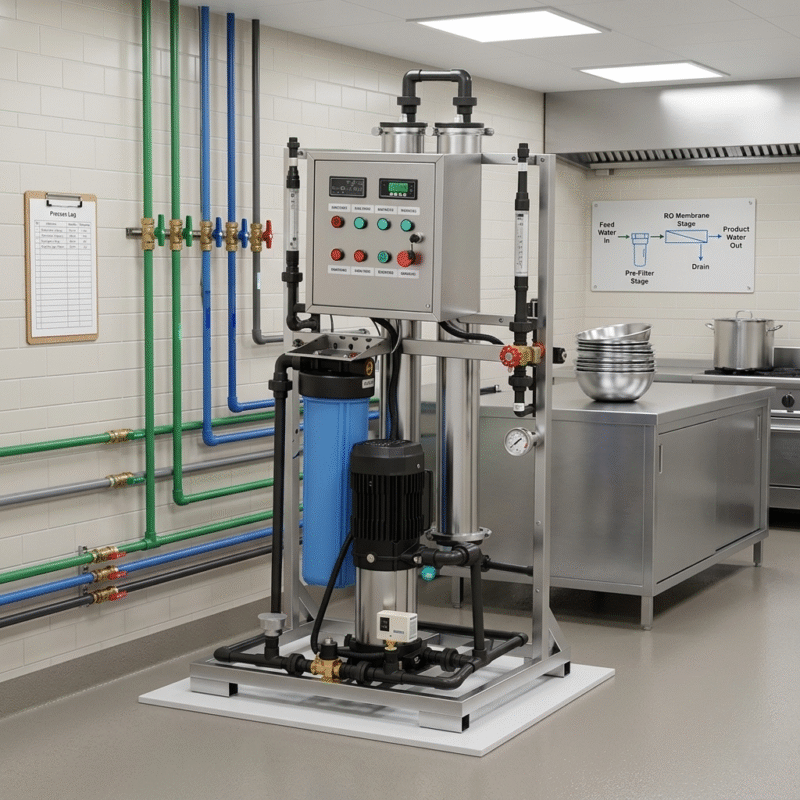
Finally, operators often fail to properly manage the brine line. Reverse osmosis physically separates water, resulting in a purified stream and a reject stream (brine) carrying the concentrated contaminants. Improperly plumbing this drain line without the required sanitary air gap violates local health codes and risks catastrophic bacterial backflow directly into the clean water system.
FAQ: Mastering Your Commercial Water Strategy
To assist operational directors in making swift, informed decisions, we have compiled the most pressing technical questions regarding B2B water integration.
Q: How often do the filters need to be changed in a high-volume commercial setting? A: Maintenance schedules depend entirely on your local incoming water quality and your daily operational gallonage. However, as a general engineering standard in the hospitality industry, the pre-filters (PP cotton and carbon blocks) must be replaced every three to six months. The main RO membrane typically lasts twelve to twenty-four months, provided the pre-filters are strictly and consistently maintained.
Q: Can these compact systems provide enough GPM to run multiple machines simultaneously? A: Yes. By intelligently pairing high-output membranes with an appropriately sized hydro-pneumatic storage tank, a compact system can easily buffer the peak flow demands of an espresso machine, a hot water tower, and a dedicated drinking water faucet operating concurrently.
Q: Do reverse osmosis systems waste a lot of water? A: Traditional, older residential systems can have high waste ratios. However, modern commercial-grade systems utilize integrated booster pumps and precision flow restrictors to maximize the recovery rate. This significantly reduces the amount of water sent to the drain while keeping daily operating costs exceptionally low.
Q: Why does my espresso technician insist on utilizing “re-mineralization” after RO filtration? A: Pure RO water is a highly aggressive solvent. If left completely pure, it can over-extract coffee grounds, leading to bitter, harsh flavors. Additionally, ultra-pure water often fails to trigger the electrical conductivity probes inside an espresso machine’s boiler, leading to overfilling. A specialized blending valve or a re-mineralization cartridge is used to precisely add back a tiny, controlled amount of beneficial calcium and magnesium to achieve the perfect extraction profile and protect the machine’s electronic sensors.
Q: Will installing one of these compact systems affect my building’s overall water pressure? A: No. Because these are highly targeted Point of Use (POU) systems, they draw water only from a specific localized line. They do not restrict the main plumbing trunk, ensuring the rest of the facility’s water pressure remains entirely unaffected.
Q: Are these systems fully compliant with standard health department regulations? A: Absolutely. High-quality commercial systems are constructed with food-grade, highly durable materials and are engineered to easily meet or exceed all local health and safety codes, provided the drain lines are installed properly with the required sanitary air gaps.
Q: Can I install this system myself, or do I need a specialized technician? A: While the systems are engineered for straightforward integration, B2B commercial installations almost always require a licensed plumber or a certified water technician. This ensures strict adherence to local building codes, proper pressure regulation, and the validation of your commercial equipment warranties.
Secure Your Operational Stability with yourwatergoodcompany
In the modern, highly competitive food service industry, you cannot afford to leave your water quality to chance. Unpredictable municipal water is a direct, daily threat to your expensive machinery, your carefully crafted flavor profiles, and your ultimate bottom line. By transitioning to intelligently designed, high-performance filtration, you take absolute control over your most critical raw material.
The compact ro water purifiers for commercial kitchens engineered by yourwatergoodcompany represent the absolute pinnacle of material science and spatial efficiency. They are built strictly to defend your assets, reduce your preventative maintenance overhead, and guarantee that your customers receive a consistently superior product, day in and day out.
Take Decisive Action Today
Do not wait for a catastrophic equipment failure or a sudden drop in beverage quality to address your water infrastructure. Partner with our engineering team to develop a customized, localized water strategy that fits perfectly within your spatial limitations and your financial targets.
- Request a Customized Quote: Contact our B2B sales engineers today to properly size a system specifically for your unique GPM, PSI, and equipment demands.
- Obtain Technical Specifications: Review our comprehensive engineering data sheets to verify membrane performance, physical dimensions, and material safety certifications.
- Unlock B2B Wholesale Pricing: We offer aggressive, highly competitive tiered pricing structures designed specifically for restaurant groups, franchise networks, and commercial kitchen contractors.
Contact yourwatergoodcompany today, elevate your water quality, and safeguard the future of your operations with uncompromising engineering and purity.