Water Purification Systems Manufacturer & Supplier: Matching Commercial and Industrial Capacity to Your Actual Water Demand

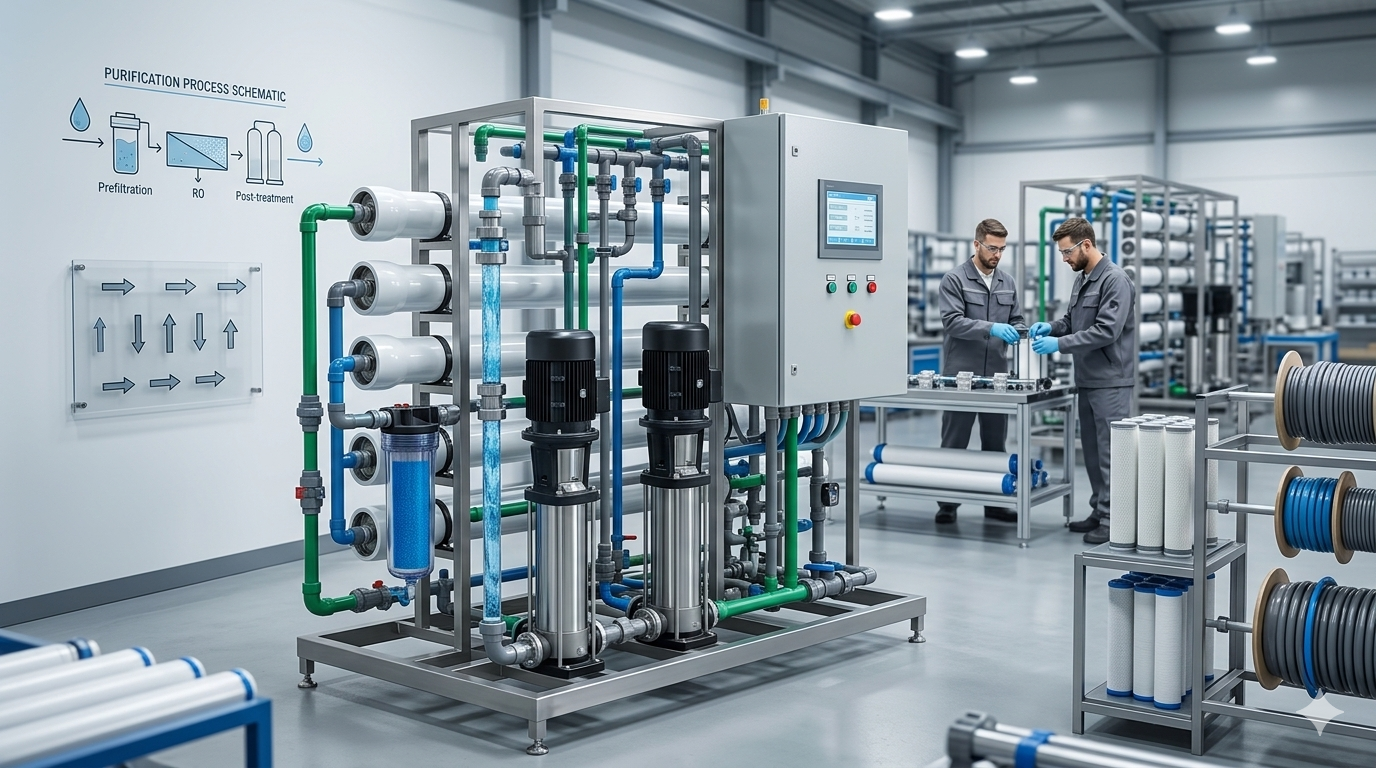
Anyone searching for a water purification systems manufacturer & supplier is actually one of two very different buyers — and the spec sheet that fits one will be badly wrong for the other.
Before requesting a quote, confirm which profile you are:
- Output scale — do you need gallons per minute for a kitchen, or tons per hour for a production line?
- Pretreatment depth — a single sediment cartridge, or a full multi-stage softening and carbon train?
- Duty cycle — 12–16 hours a day, or continuous 24/7 operation?
- Feed water source — municipal tap, private well, or an industrial process stream with a documented TDS load?
- Documentation — CE/industrial design standards, or something else entirely?
Get those five answers first. Everything below is built around them.
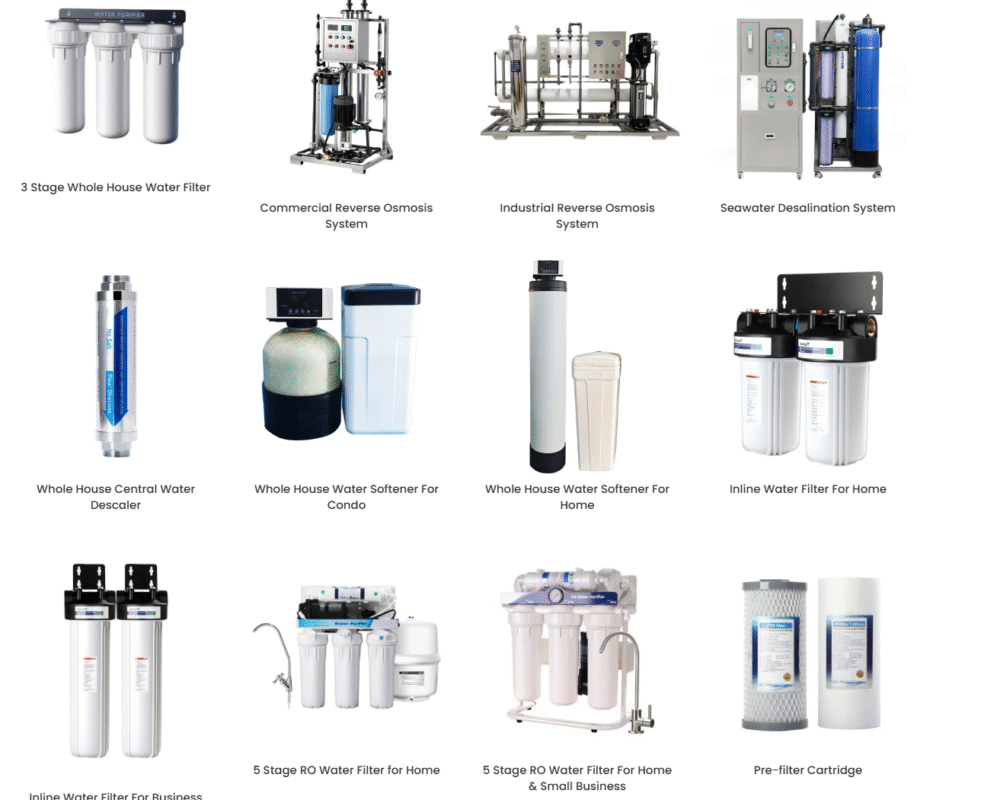
Fast Check Product:https://yourwatergood.com/shop/
Two Very Different Buyers Search This Exact Phrase
“Manufacturer & supplier” content tends to get written as one generic article covering everyone — which is exactly why it’s usually useless to everyone.
A café owner sizing a single espresso line and a plant manager sizing process water for a food production facility are not the same buyer, don’t read the same spec sheet, and shouldn’t land on the same product page.
If you’re outfitting a kitchen, café, or small facility, you want a compact, integrated skid — jump to the small commercial section below.
If you’re running a factory, bottling line, or continuous production process, you want a scalable industrial architecture — jump to the industrial section.
Small Commercial Capacity: What a 0.25 T/H Compact Skid Actually Delivers
A compact 0.25 T/H (250 L/H) commercial skid outputs roughly 1.1 GPM, or about 1,057 GPD across a 16-hour operating window.
That’s sized for a single-bar café, small restaurant kitchen, or food truck — not a production floor. It runs on a single PP sediment pre-filter stage, a stainless steel membrane housing, and a compact stainless frame with a footprint around 23.6″ × 23.6″, about 55″ tall.
Feed conductivity ceiling sits around 800 µS/cm (roughly 400–550 ppm TDS), which covers most municipal water and moderately hard well water without additional softening.
This tier makes sense when: you’re protecting one or two pieces of equipment — an espresso machine, an ice maker, a soda fountain — and your daily volume is measured in gallons, not tons.
See full specs on the commercial reverse osmosis system page.
Industrial Capacity: What 1–10 T/H Scalable Systems Are Actually Built For
Step up to the industrial line and the numbers change by an order of magnitude: configurations run 1 T/H to 10 T/H, which works out to roughly 4.4 GPM to 44 GPM, or 6,300 to 63,400 GPD on continuous operation.
This isn’t the same skid scaled up — it’s a different architecture. The industrial system runs a five-stage pretreatment sequence before water ever reaches the RO membrane:
- Multimedia filter — strips sediment, rust, suspended solids
- Activated carbon filter — adsorbs chlorine and organics before they oxidize the membrane
- Ion-exchange softening (dedicated salt box) — removes calcium/magnesium to stop scaling
- Precision security filter — final micron-level barrier ahead of the RO stage
- RO membrane array — the desalination stage itself
In documented runs, this configuration has taken raw feed water from 1,300 mg/L TDS down to under 20 mg/L in a single pass, and under 10 mg/L in two-stage configurations — north of 98% rejection either way. Recovery rate runs up to 85%, and the system holds a minimum inlet pressure requirement of ≥0.2 MPa (29 PSI), with booster pump integration available for sites that can’t hold that pressure naturally.
Construction uses thickened membrane shells with UPVC or stainless steel piping rated for continuous high-pressure duty, plus automatic backwash/flushing cycles and real-time PSI and flow monitoring built in — the automation a 24/7 line needs to avoid a maintenance tech babysitting the skid.
This tier makes sense when: you’re running food & beverage production, a lab or medical facility needing low-conductivity water, livestock/agricultural water supply, or metal processing lines that need corrosion-free process water.
Running a continuous process and not sure whether 1 T/H or 10 T/H fits your line? Request a custom engineering sizing review before you spec equipment.
Pretreatment Depth Is the Real Line Between “Commercial” and “Industrial”
This is the detail most buyers miss, and it’s the actual dividing line — not the RO membrane itself, which is broadly similar technology at both tiers.
Small commercial feed water is typically municipal or moderately hard well water, and a single PP sediment stage is enough because the RO membrane isn’t fighting heavy scale, iron, or high turbidity.
Industrial feed water is a different problem entirely — raw well water, process wastewater for reuse, or municipal water carrying a heavier mineral or turbidity load at continuous high volume. That’s why the industrial line runs the full five-stage sequence: skip the softening stage and you’re not saving money, you’re pre-scaling a very expensive membrane array.
If you’re not sure which category your water falls into, get it tested before requesting a quote. The pretreatment stage — not the membrane — is where undersized systems actually fail.
POE vs POU — and Why the Math Changes at Industrial Scale
Whole-facility (POE) and single-point (POU) filtration solve different problems at either tier, but the cost math shifts hard once you’re at industrial volume.
| Factor | Small Commercial (POU/single skid) | Industrial (POE, scalable 1–10 T/H) |
|---|---|---|
| Initial CAPEX | Lower — one compact unit per fixture or kitchen | Higher — sized to full production or plant demand |
| Pretreatment cost | Minimal — single PP stage | Substantial — 5-stage system with softening media/salt |
| Ongoing OPEX | Low — one pre-filter + membrane to track | Higher volume of consumables, but lower cost-per-gallon at scale |
| Duty cycle fit | 12–16 hr/day typical | Built for continuous 24/7 operation |
| Space required | ~2 ft × 2 ft footprint | Larger footprint, often a dedicated mechanical/utility room |
The practical read: at commercial scale, POU per fixture is usually simplest. At industrial scale, a centralized POE system sized correctly up front almost always beats bolting multiple undersized units together — the pretreatment cost alone doesn’t multiply well.
Not sure if your facility needs one centralized system or several distributed units? Request a facility water layout review before finalizing a spec.
What Neither Product Line Has — and What to Ask for Instead
Worth saying plainly: neither the small commercial line nor the industrial line here carries formal NSF certification. The industrial system is built to industrial design standards and CE compliance rather than a residential/POU-style NSF listing.
That’s not unusual in this market — plenty of industrial-scale process water equipment is specified on engineering and material standards rather than NSF, since NSF/ANSI 42/53/58 were written primarily around point-of-use drinking water applications, not continuous industrial process streams.
What’s more useful to request regardless of tier:
- Material-grade documentation — piping and housing specs (UPVC vs. stainless), membrane shell construction
- Performance data from documented runs — actual TDS reduction figures, not just percentage claims
- CE compliance documentation where applicable
- A written pressure and capacity spec matched to your site’s actual feed conditions
FAQ
Is “water purification systems manufacturer & supplier” a commercial or industrial search? Neither exclusively — it’s a broad phrase used by both small-scale commercial buyers and industrial procurement teams. Confirm your output scale (GPM vs. T/H) and pretreatment needs first, since those determine which product line actually fits.
What output range separates commercial from industrial systems? As a rough line: under roughly 2 GPM (about 0.5 T/H) with light pretreatment is commercial territory. Above that, into the 4–44 GPM (1–10 T/H) range with multi-stage pretreatment, you’re in industrial territory.
Do industrial water purification systems need more pretreatment than commercial ones? Generally yes. Industrial systems commonly run a five-stage sequence — multimedia filtration, activated carbon, ion-exchange softening, precision security filtration, then RO — versus a single sediment stage on compact commercial units.
What TDS rejection can an industrial RO system achieve? Documented runs have taken raw feed water from 1,300 mg/L TDS down to under 20 mg/L in a single pass, and under 10 mg/L in two-stage configurations.
Do these systems carry NSF certification? No — neither the commercial nor the industrial line carries formal NSF certification. The industrial line is built to industrial design standards and CE compliance instead. Ask for material-grade documentation and actual performance data rather than a certification claim.
Can one supplier really serve both a café and a factory? Yes, if they build both product lines to spec rather than repackaging one skid at different price points — which is exactly why the pretreatment depth and capacity numbers should differ this much between tiers.
Whether your building measures water demand in gallons per minute or tons per hour, the fix for a mis-specified system is the same: get real numbers from the manufacturer before you order, not after installation.
Ready to move forward? Get a custom quote, technical parameter sheet, or B2B wholesale pricing from a water purification systems manufacturer & supplier that builds distinct commercial and industrial lines instead of relabeling one skid twice.