Industrial Reverse Osmosis Systems OKC: Engineering Water Stability for Oklahoma Manufacturing Plants

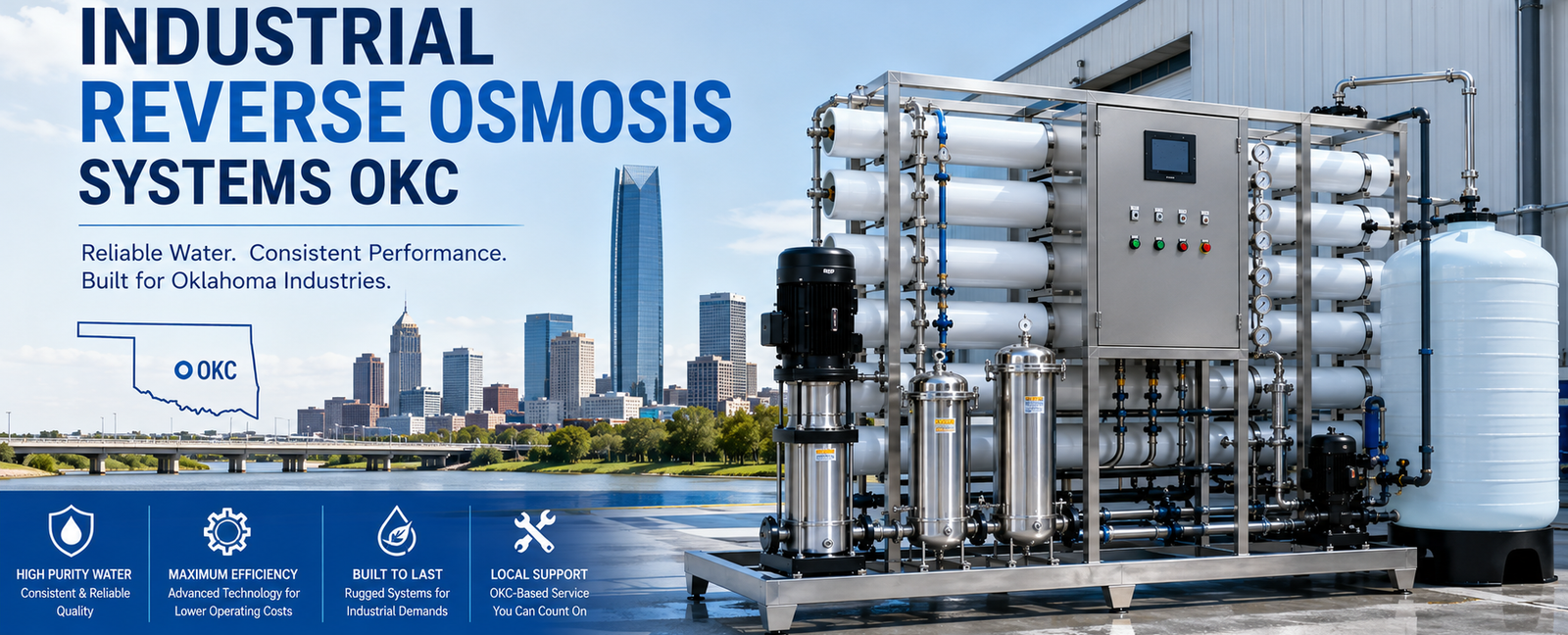
Oklahoma City manufacturing plants pull process water from two fundamentally different sources, and specifying an RO system for the wrong one is the most expensive engineering error a procurement team can make.
Municipal supply across the OKC metro runs moderately hard — publicly reported hardness sits near 154 ppm, roughly 9 grains per gallon — with fluctuating chlorine and chloramine residuals used for disinfection. Facilities drawing from private industrial wells into the Garber-Wellington aquifer face a different chemistry entirely: variable hardness, dissolved iron and manganese, and, in the aquifer’s deeper western zones, naturally occurring arsenic and chromium. A membrane array engineered for one profile will scale, foul, or under-produce on the other.
Before evaluating any supplier of industrial reverse osmosis systems OKC manufacturing facilities can rely on, lock down these five technical specs first:
- Continuous duty-cycle rating — 24/7 industrial motors and pumps, not intermittent commercial-grade components
- Peak GPM design basis — sized to your highest-draw production hour, not your daily average GPD
- Automated CIP integration — Clean-in-Place cycles that run without halting the line
- Temperature-corrected membrane area — flux allowance built in for Oklahoma’s winter feed-water swings
- Redundant train configuration — an N+1 architecture that lets maintenance happen without a production stoppage
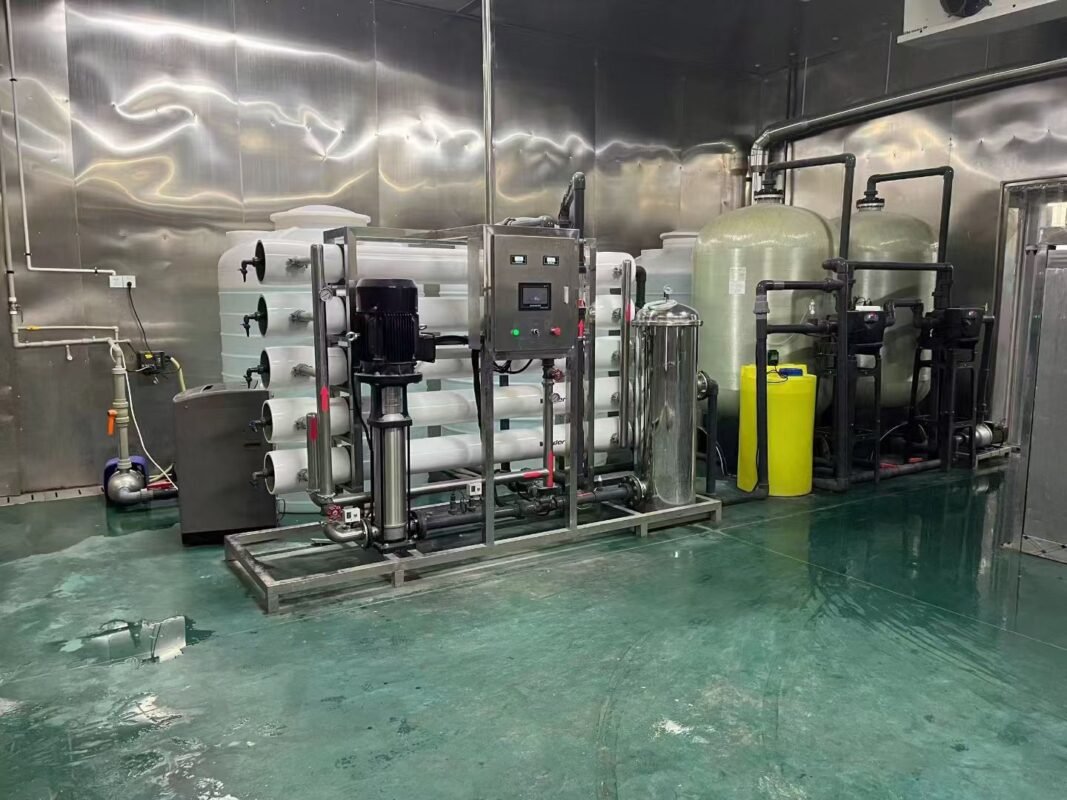
Fast Check Product:https://yourwatergood.com/product/industrial-reverse-osmosis-system/
Why Oklahoma City’s Split Water Supply Demands Two Different RO Engineering Approaches
Oklahoma City itself stopped operating its own municipal wells decades ago; city supply now comes from surface reservoirs, treated and chlorinated for public safety under the EPA Water Quality Framework. That framework is written for human consumption, not for protecting a thin-film composite membrane or a stainless boiler tube — chlorine that’s perfectly safe to drink will chemically break down an RO membrane within hours if it isn’t stripped by activated carbon first.
Facilities outside the municipal grid, or those running supplemental process wells, typically tap the Garber-Wellington aquifer. High-capacity industrial wells in this formation commonly yield 200 to 400 GPM at depths between 100 and 350 feet, and water quality varies sharply by depth and location:
- Shallow and eastern-zone wells generally run hard, with elevated iron and manganese that will blind an RO membrane if left untreated
- Deeper and western-zone wells carry a higher risk of naturally elevated arsenic, chromium, and total dissolved solids as pH climbs
This is why a pre-treatment train copied from a project in Ohio or Ontario doesn’t transfer cleanly to an OKC well site. Municipal-fed lines need carbon filtration and antiscalant dosing sized to a known, relatively stable TDS. Well-fed lines need oxidative media for iron and manganese, tighter pre-filtration ahead of the membrane, and — for facilities in food, beverage, or pharmaceutical production — a design basis that targets FDA/USP Purified Water quality at the permeate outlet, not just EPA drinking-water minimums.
The metro’s industrial base makes this distinction more than academic. OKC’s manufacturing footprint spans aerospace MRO and its supply chain, food and beverage processing, and oil-field equipment fabrication — three sectors with three very different tolerances for TDS, silica, and microbial load in their process water.
Pre-Engineered Skids vs. Fully Customized Turnkey Systems: Sizing OKC Plants Correctly
Not every facility needs a fully engineered-to-order system. A standard pre-engineered skid can be the right call for a single production line with a stable, well-characterized feed water source. A fully customized turnkey system earns its higher price tag when a plant has multiple draw points, variable peak demand, or feed water that swings between a municipal tie-in and a backup well.
| Capability | Pre-Engineered Skid | Fully Customized Turnkey System |
|---|---|---|
| Flow Capacity | Fixed configurations, typically 10–60 GPM | Engineered to spec, 5–500+ GPM |
| CAPEX Position | Lower upfront cost, fixed bill of materials | Higher upfront cost, optimized lifecycle OPEX |
| Lead Time | Shorter — built from standard components | Longer — engineered and fabricated to order |
| PLC Integration | Basic HMI, standalone operation | Full Siemens/Allen-Bradley integration, SCADA-ready |
| Redundancy | Single train (N) | N+1 or N+2 parallel trains |
For a facility running one shift on one product line, a pre-engineered skid sized with margin for peak GPM is usually the more capital-efficient choice. For continuous 24/7 operations where an unplanned outage stops the entire plant, the redundancy and automation depth of a turnkey system typically pays for itself in avoided downtime alone.
The Cold-Weather Flux Penalty: Sizing Membrane Area for Oklahoma Winters
Here’s the detail that catches procurement teams every year: membrane flux is temperature-dependent, and the failure doesn’t show up until winter.
As feed water — particularly well water — drops toward 50°F (10°C), viscosity increases and membrane permeability falls. A system that comfortably hits its rated GPM output in August can fall well short in January on the exact same membrane array, because nothing in the design accounted for the seasonal swing.
The fix is a Temperature Correction Factor applied at the design stage, not after the first cold snap. In practice, this usually means building in 30% to 40% additional membrane area above what summer conditions alone would require. Skip this step, and the high-pressure pump is forced to run at excessive PSI to chase the flow target — which spikes energy draw and accelerates irreversible scaling and fouling on the membrane surface, sometimes crippling output within a single week of continuous operation.
The same design-stage discipline applies to antiscalant dosing. Silica and calcium concentrations shift by well depth and location across the OKC metro, so a dosing pump calibrated against one site’s raw water chemistry will either underdose — and allow scale to form — or overdose and waste chemical, inflating OPEX for no benefit. Dosing pump throughput has to be calculated against the specific feed water report for that site, not carried over from a generic spec sheet.
Already have a water analysis in hand? Request a custom CAD skid diagram or a full water analysis review before you finalize your RO specification — undersized winter margin is one of the most common causes of a production line going dark in February.
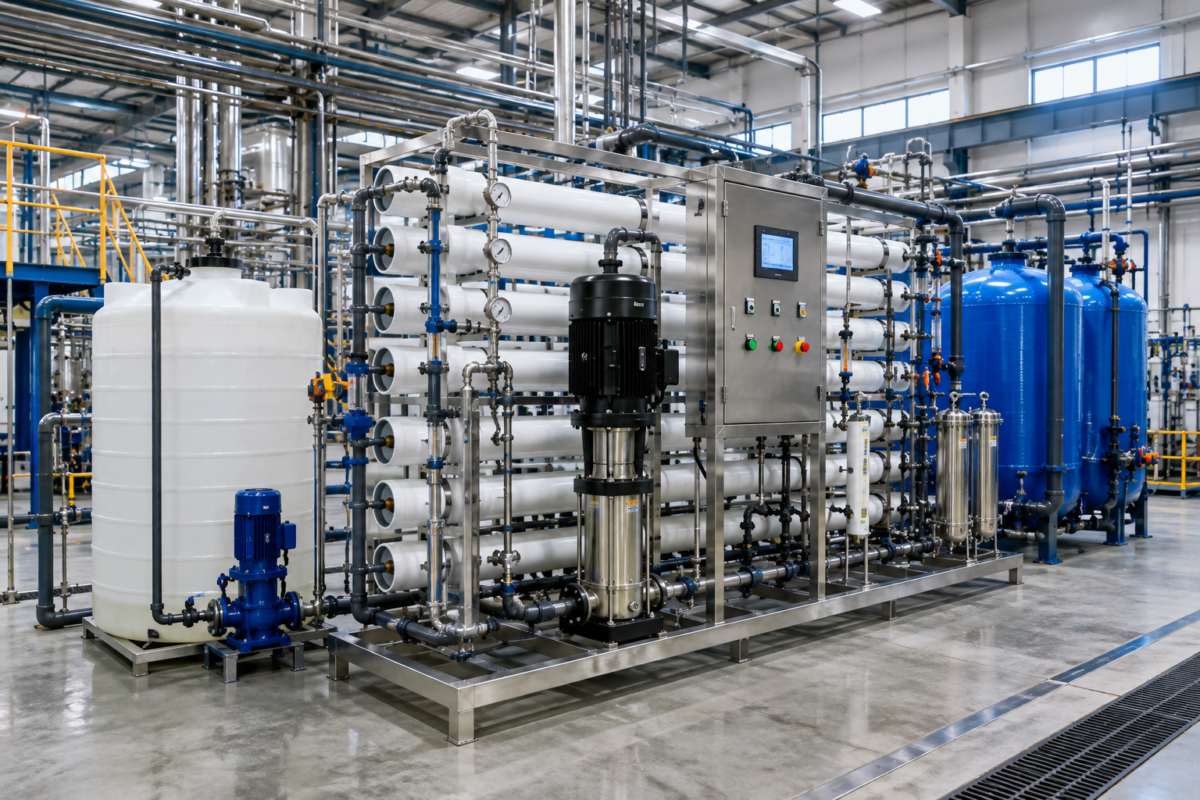
PLC Automation and 24/7 Duty-Cycle Architecture for Continuous Manufacturing Lines
An industrial skid built for continuous OKC manufacturing duty looks different from a light-commercial unit in every material choice:
- 316L stainless steel skid framing and wetted piping, rated for continuous high-pressure operation without micro-fracturing over years of duty
- Siemens or Allen-Bradley PLC control logic, giving maintenance teams real-time visibility into TDS creep, pressure differentials, and pump status
- VFD-driven booster pumps that hold optimal PSI across the membrane array even as municipal inlet pressure fluctuates
- Automated backwash and CIP sequencing, so pre-filters and membranes get cleaned on schedule without a manual shutdown
- NEMA-rated electrical enclosures, built for a factory floor environment rather than a climate-controlled office
Skipping any one of these to save on upfront cost is how a system rated for continuous duty ends up running on borrowed time within its first year.
CAPEX vs. OPEX: The Financial Case for Right-Sizing Your OKC Industrial RO Investment
Procurement teams that evaluate an industrial RO system purely on sticker price are looking at the wrong number. The real financial case sits in four places:
Plant maintenance costs. Untreated hard water precipitates scale inside boilers, cooling towers, and heat exchangers. A thin scale layer inside boiler tubes acts as a thermal insulator, forcing burners to work harder for the same output and driving up both fuel consumption and the frequency of costly blowdown cycles.
Capital equipment lifespan. High-TDS feed water accelerates corrosion and metal fatigue in boilers, chillers, and precision machining equipment. RO-treated water removes that stressor, extending the useful life of assets that often represent a plant’s largest capital line items.
Operational uptime. Scaling failures rarely happen on a convenient schedule. A properly sized RO system with N+1 redundancy converts unplanned, production-halting failures into planned, off-shift maintenance windows instead.
Water quality consistency. For food, beverage, and precision manufacturing processes, a stable water baseline means fewer rejected batches and less reactive chemical dosing to compensate for whatever the municipal supply happens to be doing that week.
Facilities that source directly from a manufacturer — bypassing distributor markups — typically see the combined savings from energy efficiency and reduced maintenance offset the system’s CAPEX within 12 to 18 months.
Frequently Asked Questions
What GPM range do most OKC industrial facilities need? It depends on peak-hour draw, not daily average. Small to mid-sized OKC manufacturing plants commonly specify systems in the 10–60 GPM range, while larger continuous-process facilities may require 100+ GPM across multiple parallel trains.
Is Oklahoma City municipal water or private well water harder to treat? Municipal supply is more predictable — moderately hard at roughly 154 ppm with known chlorine residuals. Garber-Wellington well water is more variable: expect elevated iron, manganese, and hardness, with a risk of naturally occurring arsenic or chromium in deeper western wells.
How much extra membrane area do I need for winter operation? As a design rule of thumb, budget 30% to 40% additional membrane area above summer-only sizing to offset the flux loss that comes with feed water dropping toward 50°F (10°C).
What’s the real difference between a pre-engineered skid and a custom turnkey system? A pre-engineered skid is a fixed configuration built from standard components, typically covering 10–60 GPM with shorter lead times. A custom turnkey system is engineered to your exact flow, redundancy, and automation requirements, and scales well beyond 100 GPM.
How often do industrial RO membranes need replacement in Oklahoma conditions? With correctly engineered pre-treatment and consistent CIP scheduling, industrial membranes typically run 2 to 4 years before replacement. Frequent fouling well short of that window usually points to an undersized pre-filtration stage, not a bad membrane.
Can one RO system serve multiple production lines in the same plant? Yes, through a Point-of-Entry configuration feeding a distribution manifold. For plants where only specific equipment needs ultra-pure water, a Point-of-Use design targeting just that equipment is often the more capital-efficient path.
Do you offer factory-direct B2B pricing for multi-site OKC deployments? Yes. Facilities and EPC contractors managing more than one Oklahoma location can request tiered wholesale pricing alongside individual technical specification sheets for each site.
Get Your Custom Engineering Quote
Unplanned downtime from scaling, fouling, or an undersized winter margin costs far more than the RO system that would have prevented it. Whether you’re specifying a new line or replacing an aging skid that can’t keep up with OKC’s water profile, the sizing decisions above are where the ROI is actually won or lost.
Contact our engineering team to request a technical data sheet, P&ID drawings, and factory-direct B2B wholesale pricing for your industrial reverse osmosis systems — sized to your facility’s exact GPM, PSI, and seasonal demand, not a generic spec sheet.