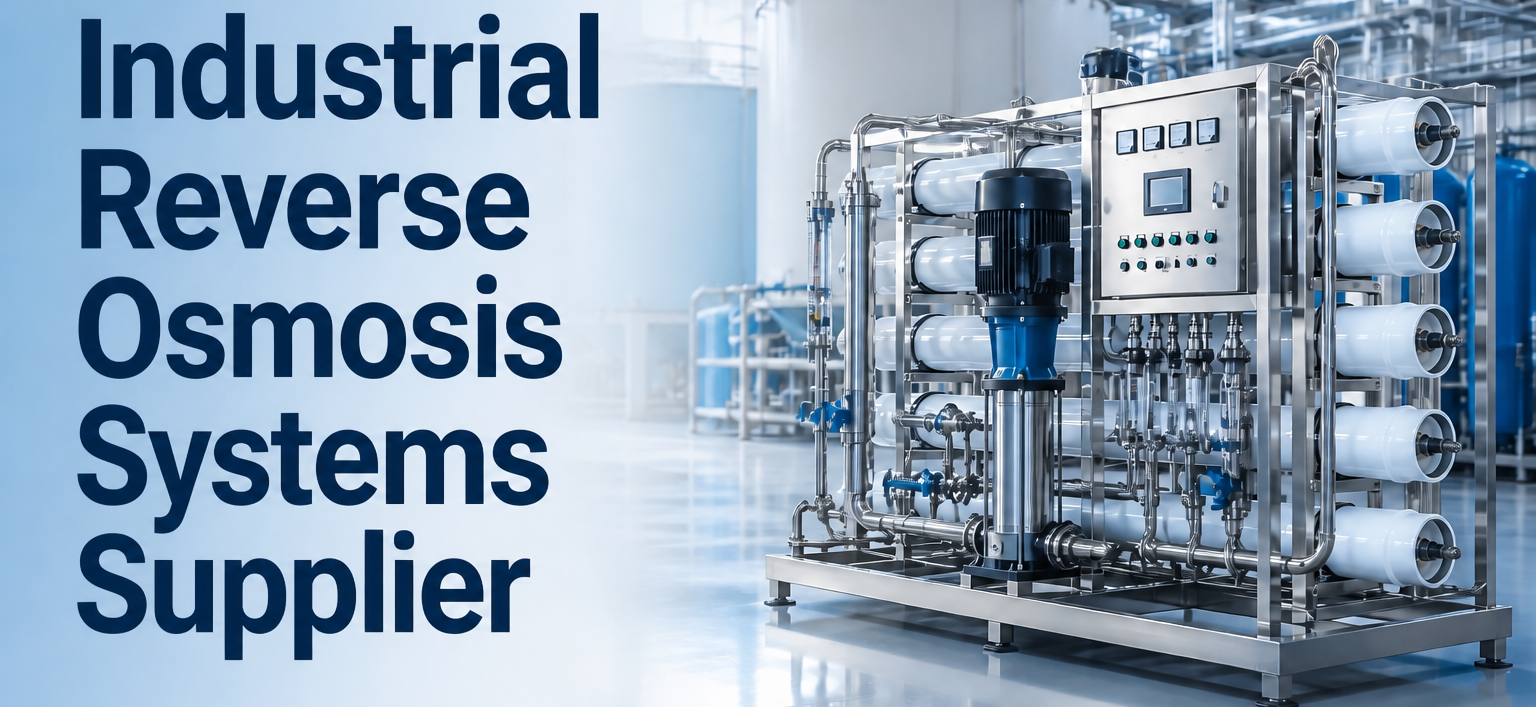
Industrial Reverse Osmosis Systems Supplier: Engineering the CAPEX-to-OPEX Balance

A feedwater source that drifts even slightly — a TDS spike on a municipal main, a metals excursion in a well — can put an entire production line at risk within hours.
Before comparing a supplier’s price sheet, confirm the design covers these five non-negotiables:
- Continuous duty cycle rating in GPM, not a peak burst number
- Automated CIP (Clean-in-Place) integration on a dedicated dosing skid
- Flux decay compensation engineered into the membrane array from day one
- Redundant train configuration (N+1 or N+2) so scheduled maintenance never halts output
- Full PLC data logging for QA traceability and audit documentation
Choosing an industrial reverse osmosis systems supplier on price alone, without confirming these five items, is how a facility ends up re-engineering the system within two years of installation.
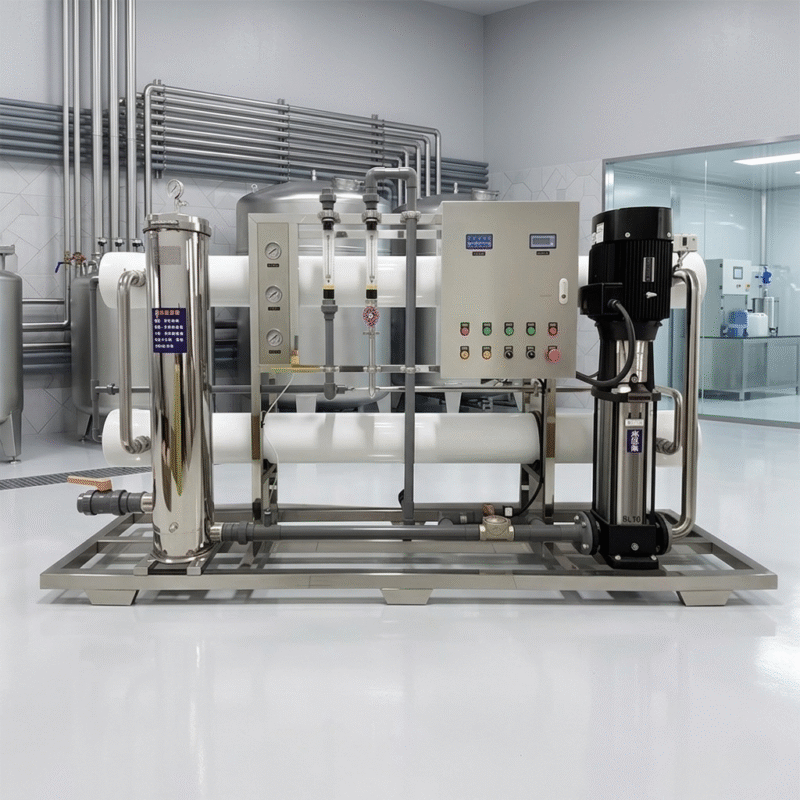
Fast Check Product:https://yourwatergood.com/product/industrial-reverse-osmosis-system/
The CAPEX-to-OPEX Balance Point: What Actually Drives Total Cost of Ownership
The lowest quote is rarely the lowest total cost. Total cost of ownership (TCO) on an industrial RO system is driven by three ongoing line items:
- Energy draw from the high-pressure pump, which climbs sharply if the array is undersized for the feedwater
- Membrane replacement frequency, driven by scaling and fouling rate
- Downtime cost, which for a continuous production line can dwarf the original system CAPEX in a single incident
A system engineered with adequate design margin costs more upfront and less over a 10-year service life. That’s the balance point a serious supplier should walk through with actual numbers, not a single “efficient” line item on a brochure.
Plant maintenance costs fall accordingly: fewer emergency service calls on boilers, cooling towers, and power-house equipment downstream of a stable water source.
Anti-Corrosion Design: Protecting Boilers, Heat Exchangers & Cooling Towers Downstream
Water quality doesn’t stop mattering once it leaves the RO skid. It determines how long the capital equipment downstream survives.
Inconsistent permeate quality — TDS swings, chloride slip, or dissolved oxygen variation — accelerates corrosion in:
- High-pressure boiler tubes and feedwater systems
- Shell-and-tube heat exchangers
- Cooling tower piping and condenser surfaces
316L stainless steel skid frames and interconnect piping resist chloride-induced pitting far better than 304 stainless, particularly on higher-TDS municipal or well feed. That material choice on the skid itself is a small fraction of total system cost against the replacement cost of a corroded heat exchanger bundle.
Consistent permeate quality is what extends the service life of that downstream capital equipment — not a maintenance schedule.
Multi-Media Pre-Filtration: The First Line of Defense Before the Membrane Ever Sees Water
Every RO membrane’s service life is decided upstream of the membrane housing.
Municipal feedwater and deep well feedwater demand entirely different pretreatment logic:
- Municipal supply is engineered around chlorine/chloramine removal and moderate, relatively stable soluble salt loads
- Deep well supply is engineered around iron and manganese oxidation, hardness reduction, and silica scaling risk that increases with well depth and season
A multi-media pre-filtration train sized for municipal chemistry will foul prematurely on well water — and the reverse is equally true. Sizing starts from a current water analysis, not a standard catalog configuration.
Skipping this step is the single most common reason a new RO system underperforms its rated GPM within the first six months.
Fail-Over Engineering: Redundant Train Configurations That Keep Lines Running During Maintenance
Operational uptime stability on a 24/7/365 production schedule depends on redundancy, not on a single well-built train.
- An N configuration (single train) means any membrane cleaning or service event stops production
- An N+1 configuration adds one standby train, allowing maintenance without a production interruption
- An N+2 configuration adds a second layer of redundancy for facilities where any water interruption is unacceptable — semiconductor rinse water and injectable-grade pharmaceutical water are common examples
Redundancy is a CAPEX decision made once, at the design stage. Retrofitting a second train into an existing skid footprint later is rarely straightforward.
Pre-Engineered Skids vs. Fully Customized Turnkey Systems
Not every facility needs a fully custom build, and not every application can run reliably on a catalog skid.
| Parameter | Pre-Engineered Skid | Fully Customized Turnkey System |
|---|---|---|
| Flow Range | 10 – 150 GPM | 150 – 2,000+ GPM |
| CAPEX Profile | Lower entry cost, fixed configuration | Higher upfront investment, engineered to feedwater and load |
| Lead Time | 4 – 8 weeks | 12 – 24 weeks |
| PLC Integration | Standard HMI, basic alarm set | Full SCADA/historian integration, custom control logic |
| Redundancy | Single train (N) | Configurable N+1 / N+2 |
A pre-engineered skid fits a single line with stable, well-characterized feedwater. A turnkey build earns its higher CAPEX when downtime cost, redundancy requirements, or feedwater variability make a fixed configuration too risky.
PLC control on Siemens or Allen-Bradley platforms governs both configurations, but only a fully customized build integrates directly into an existing plant SCADA or historian.
The Silent Flux Killer: How Feedwater Temperature Erodes Rated Output
This is the detail that separates a designed system from a resold catalog unit: membrane flux is temperature-dependent, and most quotes don’t correct for it.
As feed temperature drops toward 50°F (10°C) — routine for well water and municipal supply in winter — water viscosity rises sharply. Without correction, the same skid produces measurably less permeate at the same operating pressure.
Two design steps prevent this:
- A temperature correction factor applied at the design stage, typically adding 30–40% additional membrane area to hold rated GPM across the site’s seasonal temperature swing
- Antiscalant dosing rates calculated against the feed’s actual silica and calcium concentration — not a generic default dosing pump setting
Skip either step, and the high-pressure pump gets pushed to compensate. PSI climbs, energy draw spikes, and irreversible scale begins forming on the membrane surface. Output can fall off within a single week of continuous operation under those conditions.
If your current system underperforms every winter, that’s a design margin issue, not a membrane issue. Request a custom CAD skid diagram or a water analysis review before replacing membranes that aren’t actually the problem.
Frequently Asked Questions
What flow range do industrial reverse osmosis systems cover? Skids typically range from 10 GPM for a single process line to 2,000+ GPM for full-facility systems, sized to feedwater chemistry and production demand.
What recovery rate is standard for an industrial RO system? Municipal-fed systems typically run 75–85% recovery. High-silica well water often limits recovery to 50–65% to control scaling risk.
How is redundancy typically configured? N+1 adds one standby train for maintenance without downtime; N+2 adds a second layer for applications where any interruption is unacceptable.
How much membrane area is added for cold feedwater? Design teams typically add 30–40% additional membrane area when feed temperature approaches 50°F (10°C) to offset viscosity-driven flux decay.
What’s the practical difference between a pre-engineered skid and a custom turnkey system? Flow range, lead time, PLC integration depth, and redundancy configuration — see the comparison table above.
What lead time should I plan for? Pre-engineered skids ship in 4–8 weeks. Fully customized turnkey systems typically run 12–24 weeks depending on redundancy and PLC scope.
What regulatory frameworks apply to industrial process water design? The EPA Water Quality Framework governs source and discharge water quality. Facilities producing food or pharmaceutical products should evaluate system design and materials against applicable FDA/USP Purified Water requirements for their own process.
Feedwater chemistry, duty cycle, and redundancy needs are specific to your facility — no supplier can size a system accurately without them.
Get an industrial engineering quote, request full technical data sheets and P&ID drawings, or ask about B2B wholesale and factory-direct pricing on a fully specified industrial reverse osmosis systems supplier build sized to your actual water analysis.