Industrial Reverse Osmosis System Manufacturers & Supplier Selection: Engineering the CAPEX Decision

Feedwater variability is a production risk, not a water-quality footnote. A raw water TDS swing from 400 ppm to 1,300 ppm, or an unannounced spike in influent iron or silica, can push a high-pressure pump past its design envelope within hours.
Before comparing vendors, lock these five specs into your RFQ:
- Continuous duty-cycle rating — confirm the skid is built for 24/7/365 operation, not intermittent commercial use.
- Documented salt rejection performance — ask for real influent-to-permeate TDS data, not just a percentage claim.
- Automated CIP and backwash integration — membrane cleaning should run on a schedule, not a maintenance ticket.
- Temperature correction factor in the membrane sizing calc — critical for well-water sites in cold climates.
- Modular capacity in GPM, with a defined scale-up path — a single skid rating means little if your facility will grow.
Fast Check Product: https://yourwatergood.com/product/industrial-reverse-osmosis-system/
Manufacturer vs. Supplier: Which Procurement Path Fits Your CAPEX Model
“Manufacturer” and “supplier” aren’t interchangeable in industrial procurement, and the distinction changes your project timeline.
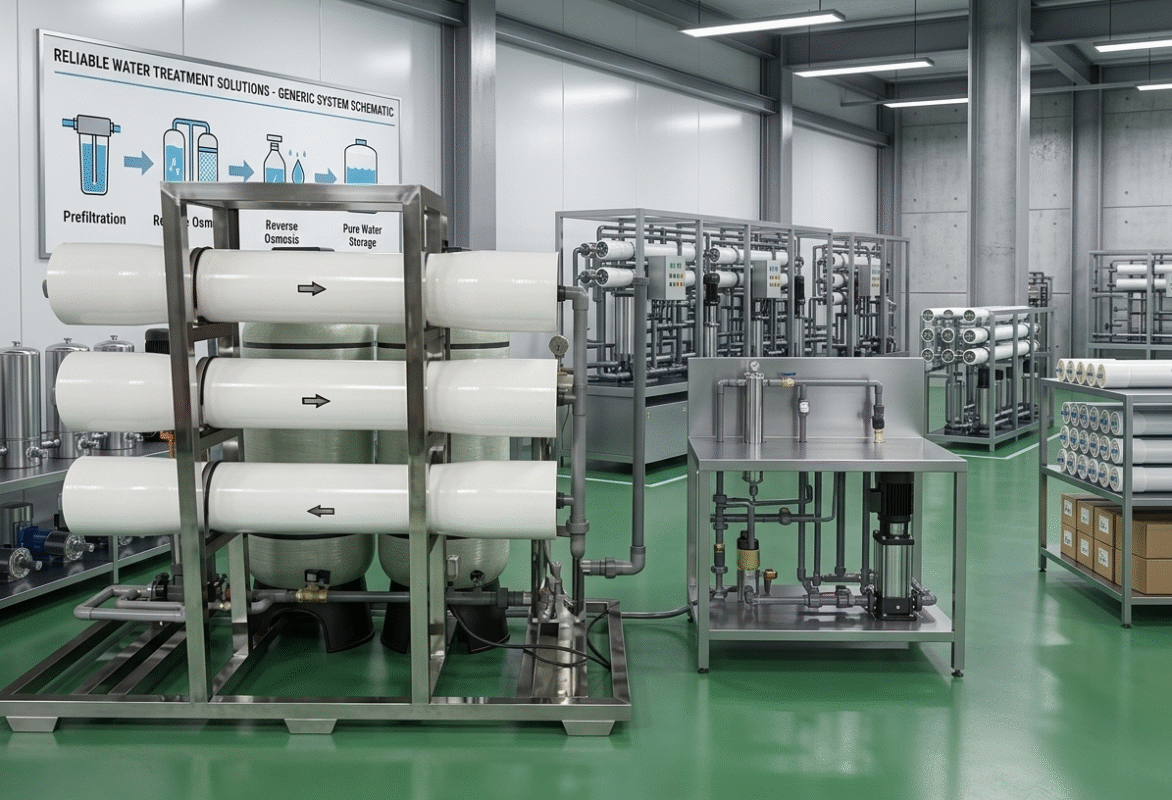
A manufacturer engineers and fabricates the industrial reverse osmosis system manufacturers&supplier itself — the skid, the membrane housings, the control panel. You’re buying factory-direct, which typically compresses cost and gives you direct access to the design engineer of record.
A supplier or systems integrator assembles a turnkey package around that hardware — site engineering, installation, commissioning, and often multi-vendor coordination for pretreatment, storage, and distribution.
When manufacturer-direct sourcing wins:
- Your process engineering team owns the P&ID and just needs qualified hardware.
- Flow requirement fits a standard modular range (roughly 4–44 GPM per skid).
- Lead time and CAPEX efficiency outweigh the need for a single turnkey contract.
When a supplier/integrator model wins:
- You need a single point of accountability across civil, mechanical, and controls scope.
- The project requires multi-train parallel skids beyond a standard catalog configuration.
- Internal engineering headcount is limited and commissioning support is a hard requirement.
Most large-CAPEX facilities run a hybrid: manufacturer-direct hardware sourcing, paired with a local integrator for installation and startup.
Municipal Water vs. Deep-Well Feedwater: Two Different Pretreatment Logics
Your feedwater source dictates the pretreatment train — this isn’t a one-size-fits-all design decision.
Municipal supply feedwater is engineered around residual chlorine/chloramine breakdown (which attacks thin-film composite membranes) and moderate, relatively stable TDS.
Deep-well water brings a different failure mode entirely: elevated hardness, dissolved iron and manganese, and silica levels that drive irreversible scaling if under-treated.
In one documented configuration, raw feedwater at 1,300 mg/L TDS was reduced to below 20 mg/L in a standard single-pass build, and under 10 mg/L in a two-stage configuration — but that outcome depends entirely on correctly specifying the pretreatment stages ahead of the membrane array.
Multi-Stage Pretreatment & Membrane Sizing: What the Spec Sheet Should Actually Show
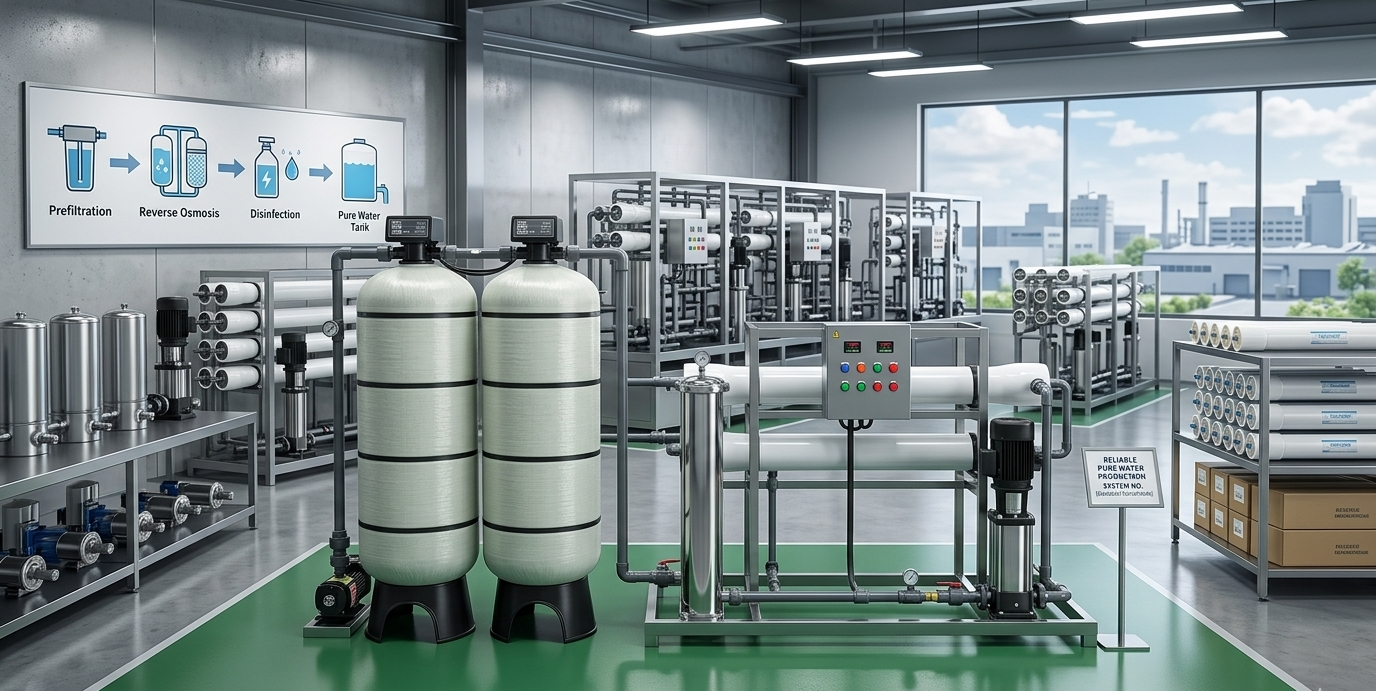
A skid’s pretreatment architecture determines membrane life more than the membrane brand does. A properly specified train includes:
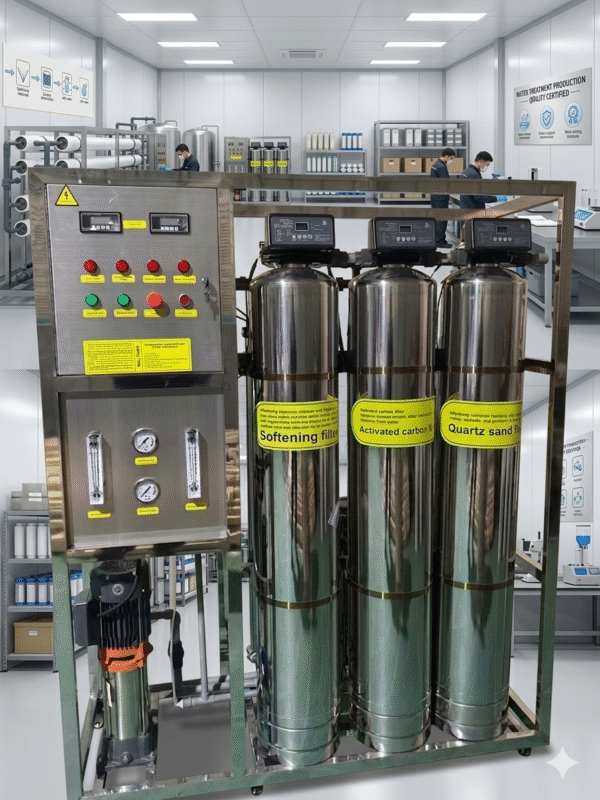
- Multimedia filtration — removes sediment, rust, and suspended solids before they reach downstream media.
- Activated carbon filtration — adsorbs residual chlorine/chloramine and organics that oxidize membrane surfaces.
- Ion-exchange softening — a dedicated resin stage (with brine regeneration) that strips calcium and magnesium before they can precipitate as scale.
- Precision security filtration — a final polishing stage that intercepts fines before the RO array.
- RO membrane array — the high-pressure separation stage where permeate quality is actually produced.
Skip any one of these stages to save on CAPEX, and you’re shifting that cost into membrane replacement frequency and unplanned downtime later.
Automation, Monitoring & Uptime: Control Without the Guesswork
Facility managers aren’t buying a filter — they’re buying total cost of ownership control. That means the automation layer matters as much as the membrane spec:
- Automatic backwash and flushing cycles, scheduled rather than reactive, to prevent membrane flux decline from fouling.
- Real-time PSI differential and flow-rate monitoring, so pressure drift across the membrane array is visible before it becomes a failure.
- PLC-based control logic driving pump staging, backwash sequencing, and alarm thresholds — the mechanism that turns “check the skid” into predictive maintenance instead of a plant walk.
This is also where plant maintenance cost, capital equipment lifespan, and 24/7/365 uptime stability actually connect: a membrane array running outside its design PSI window degrades boiler feed quality, heat exchanger efficiency, and cooling tower chemistry simultaneously — not just the RO skid itself.
Request a Custom CAD Skid Diagram or Water Analysis Review if your current feedwater data hasn’t been run against a membrane sizing calculation in the last 12 months — TDS and temperature both drift seasonally.
Pre-Engineered Skids vs. Fully Customized Turnkey Systems
| Criteria | Pre-Engineered Skid | Fully Customized Turnkey System |
|---|---|---|
| Capacity Range | 1–10 t/h (~4–44 GPM), catalog configurations | Engineered to flow target, multi-train arrays common |
| CAPEX Profile | Lower upfront cost, standardized BOM | Higher upfront investment, scope-driven pricing |
| Lead Time | Shorter — built from existing design library | Longer — site engineering and custom fabrication |
| PLC Integration | Standard control sequence, factory pre-programmed | Custom logic for multi-skid staging and plant-wide SCADA tie-in |
| Redundancy | Single-train, optional standby pump | N+1 or full parallel-train redundancy by design |
Neither option is universally “better” — the decision hinges on whether your flow requirement and redundancy tolerance fit a standard modular range, or require true custom engineering.
Field Engineering Insight: Winter Flux Decay and Antiscalant Dosing
Here’s a detail that separates a correctly specified system from one that fails within a season: membrane flux is temperature-dependent, and that relationship is nonlinear.
When well-water temperature drops toward 50°F (10°C) in winter, water viscosity increases substantially. If the membrane sizing calculation doesn’t apply a temperature correction factor — typically adding 30–40% additional membrane area for cold-climate sites — the high-pressure pump compensates by running at elevated PSI to hit the same output.
That elevated PSI accelerates irreversible scaling and fouling on the membrane surface. Left uncorrected, output can degrade sharply within weeks, not months.
The second half of this equation is antiscalant dosing logic: the dosing pump’s flow rate needs to be calculated against actual influent calcium and silica concentration — not a generic default rate. Under-dosing during a hard-water spike is a common, preventable cause of premature membrane replacement.
FAQ: Industrial RO Manufacturers & Suppliers
What GPM range do industrial RO systems typically cover? Standard modular skids run roughly 4–44 GPM (1–10 t/h) per unit. Higher-flow facilities scale via parallel skid arrays or a custom multi-train design.
What’s the real difference between an RO manufacturer and an RO supplier? A manufacturer engineers and fabricates the hardware directly. A supplier/integrator typically packages that hardware into a turnkey project with installation and commissioning included.
What TDS reduction should I expect from an industrial RO system? In documented configurations, raw water at 1,300 mg/L TDS has been reduced to below 20 mg/L in a single-pass build, and below 10 mg/L in a two-stage configuration.
What minimum inlet pressure does an industrial RO skid need? A stable inlet pressure of at least 0.2 MPa (~29 PSI) is required. Sites with insufficient municipal or well pressure need a pre-boost pump integrated ahead of the skid.
How much extra membrane area does cold well water require? As a general engineering rule, sites where feedwater drops toward 50°F (10°C) should size in a 30–40% temperature correction factor to avoid forcing the high-pressure pump into an elevated PSI range.
What materials should the skid piping and housings use? Look for thickened membrane housings and corrosion-resistant piping — commonly UPVC or stainless steel — rated for continuous high-pressure operation.
Should I choose a pre-engineered skid or a fully custom turnkey system? If your flow target fits a standard 4–44 GPM range and your team owns the surrounding P&ID, a pre-engineered skid is faster and more CAPEX-efficient. Facilities needing multi-train redundancy or full SCADA integration typically require a custom turnkey build.
Feedwater doesn’t wait for a maintenance window to change, and neither should your sizing calculation. Whether your facility needs a catalog-configuration skid or a fully engineered multi-train system, get the underlying water analysis right first.
Get an Industrial Engineering Quote, request Technical Data Sheets & P&ID Drawings, or ask about B2B factory-direct pricing on a custom industrial reverse osmosis system manufacturers&supplier sized to your actual feedwater profile.