Water Filtration for Food and Beverage Industry: Engineering Product-Contact Water Safety at Scale

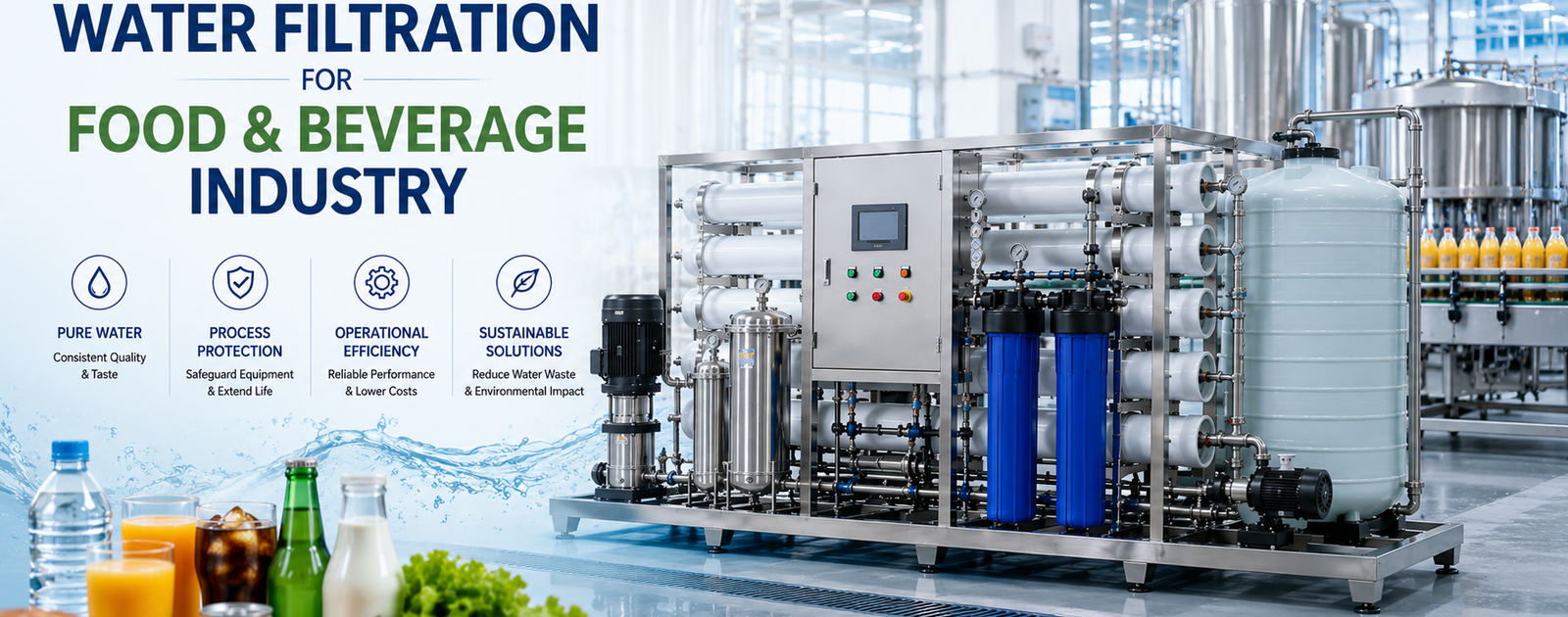
A TDS spike from a municipal main or a microbial excursion from a well feed doesn’t stay contained to the utility room — it reaches the product. For a food or beverage plant, water-quality variation is a recall risk before it’s ever a maintenance ticket.
Before evaluating any vendor, lock these specs into the RFP:
- Which stage of production the water is for — ingredient water, CIP/sanitation, or boiler/cooling makeup each carry different quality targets, not one blanket spec.
- A defined microbial barrier, not just a dissolved-solids target — turbidity and pathogen control require a different technology than TDS reduction.
- Continuous duty-cycle rating at real peak GPM demand, with automated CIP integration that doesn’t interrupt production.
- 316L stainless steel or high-grade UPVC wetted materials — the same food-contact material standard the rest of the plant already runs.
- A temperature-correction margin built into membrane sizing, hedging against seasonal flux decay.
Sourcing the right water filtration system for a food and beverage facility starts with matching technology to production stage — not applying one filtration method to every water use in the plant.
Fast Check Product: https://yourwatergood.com/product/industrial-reverse-osmosis-system/
Why Food-Grade Water Requirements Vary by Production Stage
A single plant typically has three or four distinct water-quality targets running simultaneously, and treating them identically is the most common over- or under-engineering mistake.
- Ingredient and process water — water that becomes part of the final product needs the tightest dissolved-solids and microbial control, since it directly affects taste, shelf life, and formulation consistency.
- CIP and sanitation water — high-volume, needs consistent quality to avoid mineral residue interfering with cleaning chemistry, but doesn’t always need full demineralization.
- Boiler feed and cooling tower makeup — primarily a scaling and corrosion concern; hardness and silica control matter more here than microbial barrier.
- Product-contact rinse water — for produce washing, container rinsing, or equipment contact, where microbial barrier is the dominant requirement.
Food process water quality sits inside the FDA’s current Good Manufacturing Practice framework, which references potable water standards for water that contacts food or food-contact surfaces — a design target the engineering team sizes toward, not a certification claim about any specific facility’s compliance status.
The Filtration Technology Stack: Matching Method to Contaminant
Not every water-quality problem in a food and beverage plant calls for the same technology. The table below is the decision framework most RFPs skip.
| Technology | Removal Mechanism | Best Fit | TDS Reduction | Microbial Barrier |
|---|---|---|---|---|
| Multimedia Filtration | Physical straining | Turbidity, suspended solids pretreatment | None | Minimal |
| Ultrafiltration (UF) / Microfiltration (MF) | Membrane size exclusion | Pathogen/turbidity barrier without full demineralization | None to minimal | High — absolute barrier for bacteria and cysts |
| Ion-Exchange Softening | Ion exchange | Hardness removal ahead of boilers or RO | Partial (hardness only) | None |
| RO / NF Membranes | Size and charge rejection | Ingredient water, full TDS and mineral control | High — typically to single-digit ppm | High |
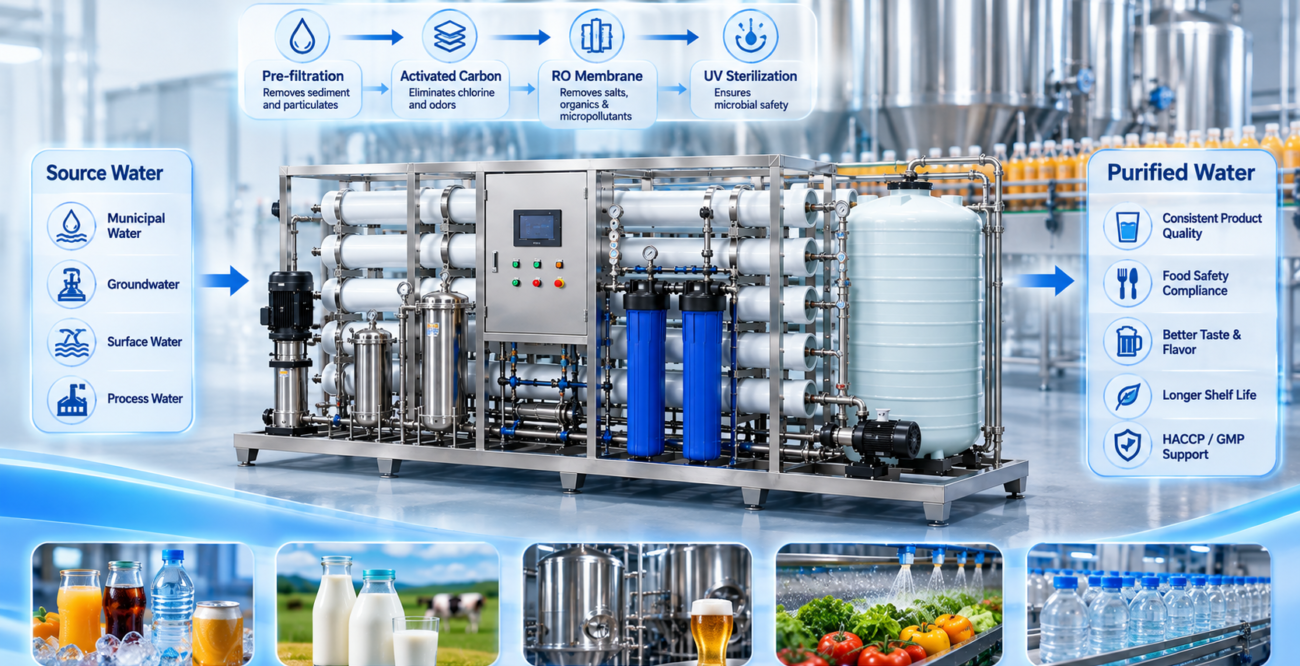
UF/MF is frequently the right call for CIP makeup or rinse water, where a microbial barrier matters more than full demineralization and the CAPEX of a full RO train isn’t justified. RO earns its place where the water becomes part of the product or where both mineral control and microbial barrier are required in the same stream — an industrial reverse osmosis system sized to ingredient-water demand is what most formulation-sensitive plants standardize on.
Municipal vs. Well Feed: Pretreatment Design Logic for Food and Beverage Plants
Feed water source still dictates the pretreatment architecture ahead of whichever technology handles the final barrier.
Municipal potable feed:
- Chlorine and chloramine removal protects downstream membranes and prevents chlorinated off-notes in ingredient water.
- Soluble inorganic salts set the RO sizing baseline where full demineralization is required.
Well feed:
- Hardness, dissolved iron and manganese, and silica each need a dedicated pretreatment step — softening, oxidation/filtration, or antiscalant dosing — before the final treatment stage.
- Well chemistry shifts seasonally, and a food safety program built around consistent water quality needs that variability engineered out, not caught during a routine test.
A resilient architecture runs a five-stage sequence ahead of the final barrier: multimedia filtration, activated carbon for chlorine and organics, ion-exchange softening, a precision security filter, and the RO or UF membrane stage matched to the water’s end use.
Standard Pre-Engineered Skids vs. Fully Customized Turnkey Systems
Not every packaged system marketed to food and beverage plants is engineered to the same standard. The table below separates a catalog skid from a system built for continuous production.
| Engineering Parameter | Standard Pre-Engineered Skids | Fully Customized Turnkey Systems |
|---|---|---|
| Flow capacity (GPM) | Fixed, single-train sizing | Custom-sized, multi-train scalable |
| CAPEX structure | Lower upfront, single-technology | Higher upfront, engineered across production stages |
| Lead time | Shorter — built to stock configurations | Longer — engineered to your water analysis and production schedule |
| PLC integration | Basic relay logic or standalone HMI | Siemens or Allen-Bradley platform, SCADA-ready |
| Redundancy | Typically none — single point of failure | N+1 or 2N engineered across the train |
A standard skid fits a plant with a single, well-defined water use and stable municipal feed. A fully customized turnkey system fits a facility running multiple water-quality tiers simultaneously — ingredient water, CIP, and boiler feed all drawing from the same treatment train.
Request a Custom CAD Skid Diagram or Water Analysis Review to confirm which production stages need which technology before the system is fabricated — not after a line is running on the wrong water spec.
Automation, CIP Integration, and Uptime: Protecting Product Consistency and Capital Equipment
The automation layer is what protects both product consistency and the equipment sitting downstream of the water system.
- Automatic backwash and flushing cycles maintain flux and turbidity control without an operator manually initiating every cycle.
- Real-time PSI and flow monitoring feeds a PLC control loop — Siemens or Allen-Bradley platforms are the industrial standard — catching pressure drift before it becomes a fouling or breakthrough event.
- Auto CIP cleans membranes on a defined schedule without pulling the system offline for manual servicing, keeping ingredient-water supply uninterrupted during production runs.
This automation is what protects capital equipment downstream — boilers, heat exchangers, and cooling towers all see fewer emergency descaling cycles when feed water quality holds steady through every shift, every season, at true 24/7/365 duty.
Field Engineering Insight: Cold-Water Flux Decay and Seasonal Water Quality Swings
This is the detail that catches plants off guard heading into their first winter on a new system.
When well feed temperature drops toward 50°F (10°C), water viscosity increases measurably. If the RO or UF system wasn’t sized with a temperature correction factor — typically 30%–40% additional membrane area for RO trains — it can’t hit rated GPD output at that lower temperature, right when production schedules rarely slow down to compensate.
The usual compensation is the wrong one: the high-pressure pump gets pushed to a higher PSI to force the same flow through less-efficient membranes. That drives energy costs up and accelerates scaling and fouling, especially if the antiscalant dosing pump wasn’t calibrated to the feed water’s actual silica and calcium concentration. In a food or beverage plant, that fouling curve doesn’t just cut output — it reintroduces the exact water-quality variability the system was installed to eliminate from the product in the first place.
Water Filtration for Food and Beverage Industry FAQs
What water filtration technology is best for food and beverage ingredient water? Reverse osmosis is typically standardized on for ingredient water, since it delivers both full TDS reduction and a high microbial barrier in a single stage — important where the water becomes part of the final product.
Do all water uses in a food plant need reverse osmosis? No. CIP makeup and rinse water often only need a microbial barrier, which ultrafiltration or microfiltration can provide at lower CAPEX than a full RO train sized for demineralization.
What flow capacity does a food and beverage facility need from an industrial system? Most modular skids cover 4–44 GPM (roughly 6,300–63,400 GPD) per train. Facilities running multiple simultaneous water-quality tiers typically move to multi-train, custom-engineered configurations.
How much TDS can an industrial RO system remove for food and beverage water? In documented field cases, raw feed TDS has been reduced from 1,300 ppm to under 20 ppm in a single pass, and under 10 ppm in a two-pass configuration.
What regulatory framework governs food and beverage process water? Food process water sits inside the FDA’s current Good Manufacturing Practice framework, which references potable water standards for water contacting food or food-contact surfaces — a design target the engineering team sizes toward.
Does cold well water affect filtration system performance? Yes. Below 50°F (10°C), viscosity increases enough to reduce flux. Systems without a temperature correction factor (typically 30%–40% extra membrane area for RO) tend to compensate with higher PSI, which accelerates scaling.
What inlet pressure does an industrial water filtration system require? A minimum of roughly 0.2 MPa (~29 PSI) at the booster pump inlet. Sites below that threshold need a pre-boost pump stage specified at design time.
Get an Engineered Quote for Your Facility
Matching the right filtration technology to each water-quality tier in your plant — rather than over- or under-engineering a single blanket solution — is what protects both product consistency and CAPEX.
- Get an Industrial Engineering Quote: send your water analysis and production water-use breakdown for a sized proposal.
- Request Technical Data Sheets & P&ID Drawings: get the full engineering submittal package for your project file.
- Get B2B Wholesale / Factory-Direct Pricing: request competitive pricing sourced through our vetted manufacturing network.
Where ingredient-water quality is the requirement, the industrial reverse osmosis system architecture above is engineered to hold TDS rejection, flux, and uptime together — protecting the product, not just the equipment.