
Best Mineral Solutions for Industrial Wastewater Filtration: Engineering the CAPEX-to-Compliance Balance

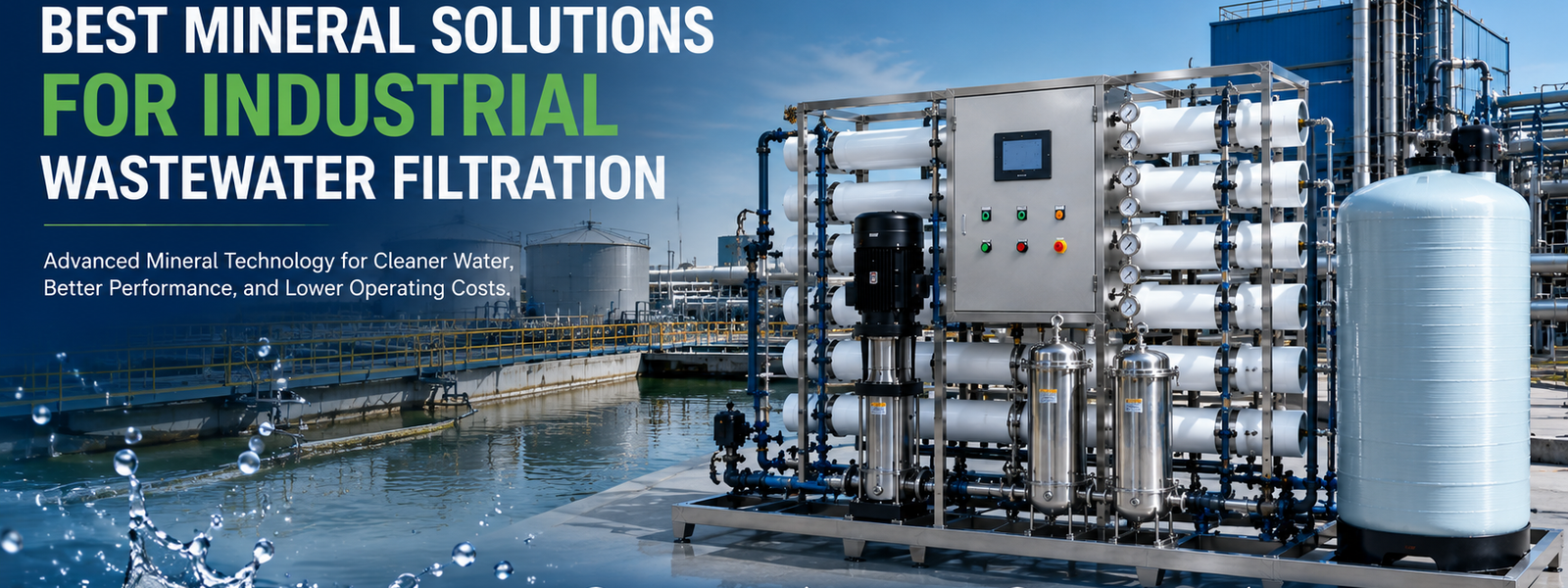
Industrial wastewater doesn’t carry a fixed mineral signature. A CIP discharge cycle, a cooling tower blowdown event, or a shift in incoming well water can push calcium, silica, iron, or heavy-metal concentrations well past the range your best mineral solutions for industrial wastewater filtration train was originally sized for.
That swing shows up as a scaled heat exchanger, a fouled RO membrane, or a failed discharge sample — usually before anyone reviews a lab report.
The exposure looks different by facility type. A food or beverage plant is protecting product-contact water quality and CIP cycle consistency. A semiconductor or electronics site is protecting ultrapure feed specs downstream. A chemical or metal-finishing operation is protecting a discharge permit against heavy-metal and silica excursions. The mineral chemistry differs, but the engineering question is the same: what’s actually in the stream, and is the treatment train sized for its worst week, not its average one.
Before comparing vendors or treatment trains, lock these specs into your RFQ:
- Mineral load profile reported separately — hardness, silica, iron/manganese, and heavy metals broken out, not lumped into a single TDS figure.
- Continuous duty-cycle rating for 24/7/365 service, not intermittent batch operation.
- Automated CIP and backwash integration running on a schedule, not a maintenance ticket.
- Temperature correction factor built into the membrane or resin sizing calculation.
- Discharge-side monitoring that reports against your actual permit limits, not a generic pass/fail light.
Fast Check Product: https://yourwatergood.com/product/industrial-reverse-osmosis-system/
Reading the Mineral Load: Why Hardness, Silica, and Heavy Metals Need Different Chemistry
Not every dissolved mineral responds to the same treatment stage — and specifying one technology for all of them is the most common design error we see in RFQs.
Hardness (calcium, magnesium) scales heat exchangers and boiler tubes. It’s typically handled with ion-exchange softening ahead of the membrane array, or controlled with a calibrated antiscalant dose if softening isn’t in scope.
Silica is the harder case. Above roughly 150 ppm reactive silica, it precipitates irreversibly on membrane surfaces once concentrated past its solubility limit — pH and temperature control matter as much as the membrane itself.
Heavy metals (chromium, nickel, zinc, lead) common in plating, semiconductor, and metal-finishing effluent generally need a precipitation or coagulation stage upstream. RO alone is not a substitute for that chemistry.
A lab-verified mineral panel — not a single TDS meter reading — is what should drive the treatment-train design.
Misdiagnosing the load is the single most expensive mistake in this category. Sizing a softener for a stream that’s actually silica-limited buys you a system that protects boiler feed but still fouls the membrane bank within a season, because the softener never touched the mineral that was actually causing the failure.
Multi-Stage Removal Architecture: Sequencing Pre-Filtration, Softening, RO, and Polishing
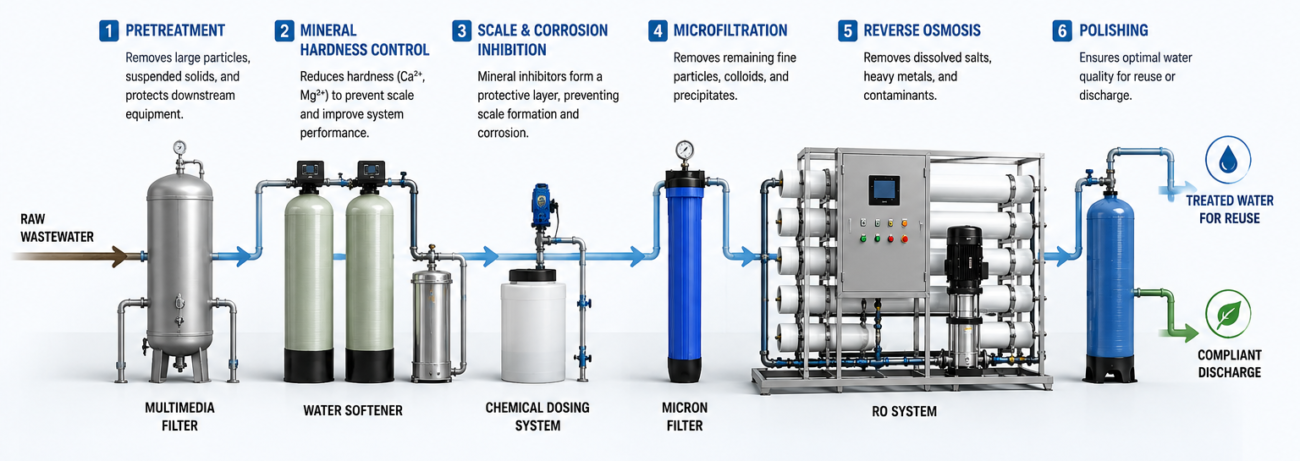
Skid architecture determines mineral removal performance more than the membrane brand does. A properly specified train sequences:
- Multi-media pre-filtration — strips suspended solids and particulate before they load downstream media.
- Ion-exchange softening — a dedicated resin stage with brine regeneration to pull calcium and magnesium out before they can precipitate.
- RO membrane array — the high-pressure stage that reduces bulk dissolved mineral content, typically achieving 98%–99.5% rejection at properly maintained operating pressure.
- Polishing filtration — a final security stage ahead of discharge or reuse.
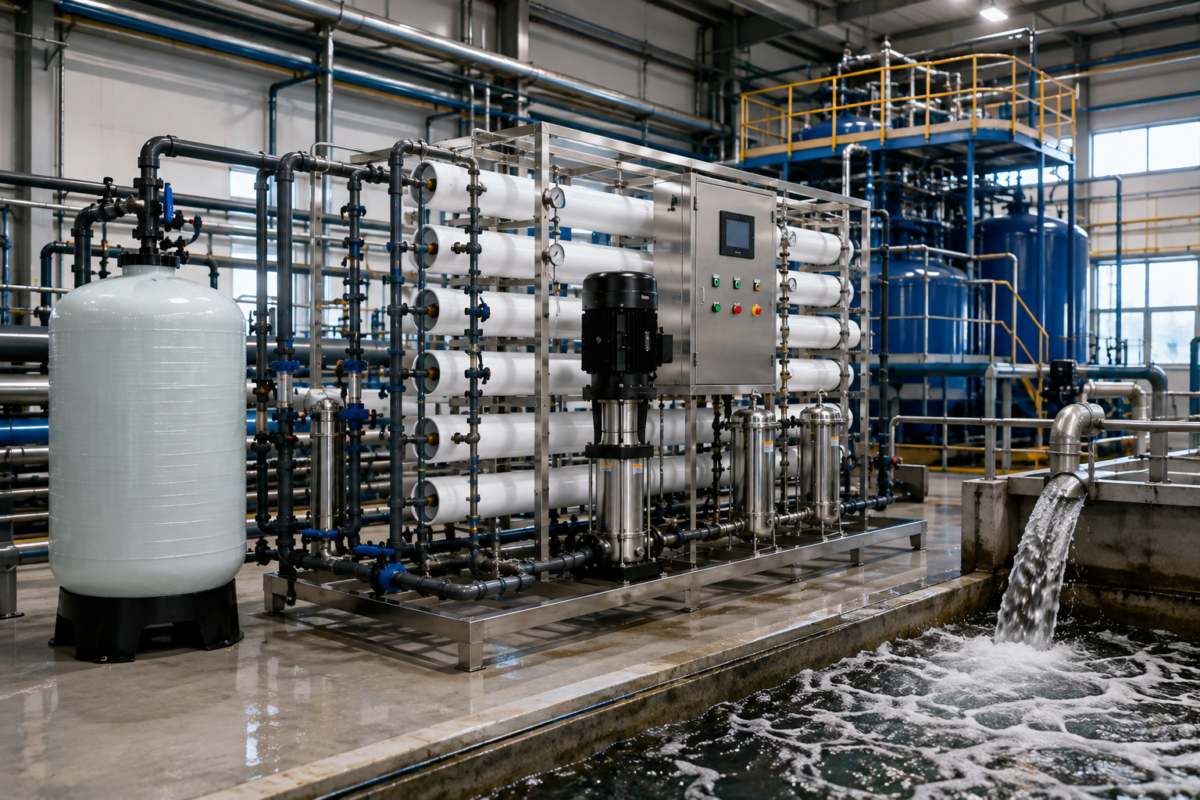
These stages run on a skid-mounted system, typically framed in 316L stainless steel for corrosion resistance against mineral-laden streams, with an automatic CIP (Clean-in-Place) loop for periodic membrane and resin cleaning without manual teardown.
Pre-Engineered Mineral Removal Skids vs. Fully Customized Turnkey Systems
| Criteria | Pre-Engineered Skid | Fully Customized Turnkey System |
|---|---|---|
| Capacity Range | 4–44 GPM (1–10 t/h), catalog media/resin/membrane configuration | Engineered to actual effluent flow; multi-train arrays beyond 100+ GPM common |
| CAPEX Profile | Lower upfront cost, standardized bill of materials | Higher upfront investment, scope-driven pricing |
| Lead Time | Shorter — built from existing design library | Longer — site engineering plus custom fabrication |
| PLC Integration | Standard control sequence, factory pre-programmed | Custom logic for multi-skid staging and plant SCADA tie-in |
| Redundancy | Single-train, optional standby pump | N+1 or full parallel-train redundancy by design |
The right column isn’t automatically “better” — it’s the correct answer only when your mineral load, flow variability, or redundancy tolerance exceeds what a catalog configuration can absorb.
Automation and CIP: Stopping Scale Before It Reaches the Boiler or Cooling Tower
Facility managers aren’t buying a filter — they’re buying control over total cost of ownership. That’s where the CAPEX-to-OPEX balance actually gets decided:
- Scheduled backwash and CIP cycles, not reactive ones, to prevent flux decline from mineral fouling.
- Real-time PSI differential and flow-rate monitoring, so pressure drift across the membrane or resin bed is visible before it becomes a failure.
- PLC-based control logic (Siemens or Allen-Bradley platforms are common) driving pump staging, backwash sequencing, and alarm thresholds.
A mineral removal train running outside its design pressure window degrades boiler feed quality, heat exchanger efficiency, and cooling tower chemistry at the same time — not just the skid itself.
Request a Custom CAD Skid Diagram or Water Analysis Review if your current effluent hasn’t been run against a mineral-specific sizing calculation in the last 12 months — hardness, silica, and TDS all drift seasonally.
Discharge Compliance and Water Reuse: Designing to the EPA Pretreatment Framework
Reducing hardness, silica, and heavy-metal concentration before discharge is standard practice for meeting local pretreatment limits under the EPA Water Quality Framework — though the receiving authority, not the equipment vendor, sets the exact permit numbers for your site.
For facilities recovering treated effluent as process water — food, beverage, or pharmaceutical operations — permeate quality also needs to hold against FDA/USP purified water criteria where the reuse stream contacts product.
In documented configurations, raw streams at 1,300 mg/L TDS have been reduced to below 20 mg/L in a single-pass build, and below 10 mg/L with a two-stage configuration, once mineral-specific pretreatment is sized correctly ahead of the membrane.
Recovery rate is the other half of the CAPEX-to-OPEX equation. A well-designed mineral removal train can push water recovery up to roughly 85%, which directly reduces both incoming water draw and the volume of concentrate that has to be hauled, discharged, or further treated. On a facility running continuous shifts, that recovery differential compounds into a measurable line item over a single fiscal year — not just a sustainability talking point.
Field Engineering Insight: Cold-Water Viscosity and Antiscalant Dosing Logic
This is the detail that separates a system that survives a full winter from one that doesn’t: membrane flux is temperature-dependent, and the relationship isn’t linear.
When feedwater temperature drops toward 50°F (10°C), viscosity increases substantially. Without a temperature correction factor — typically 30%–40% additional membrane area for cold-climate sites — the high-pressure pump compensates by running at elevated PSI to hold the same output.
That elevated PSI accelerates irreversible scaling on the membrane surface. Left uncorrected, output can degrade sharply within weeks.
The second half of the equation is antiscalant dosing logic: the dosing pump’s rate has to track actual influent calcium and silica concentration, not a generic default. Under-dosing during a hard-water spike is a common, preventable cause of premature membrane replacement.
FAQ: Mineral Removal for Industrial Wastewater
What is the best mineral filtration solution for industrial wastewater? No single technology covers every mineral. Hardness typically needs ion-exchange softening or antiscalant-dosed RO; silica needs pH- and temperature-controlled membrane operation; heavy metals generally need a precipitation or coagulation stage ahead of any membrane array.
What GPM range do industrial mineral removal skids cover? Standard modular skids run roughly 4–44 GPM (1–10 t/h). Facilities above that range typically scale through parallel skid arrays or a custom multi-train design.
How much TDS reduction can a properly designed system achieve? In documented configurations, raw streams at 1,300 mg/L TDS have been reduced to below 20 mg/L in a single-pass build, and below 10 mg/L in a two-stage configuration.
What minimum inlet pressure does a mineral removal skid need? A stable inlet pressure of at least 0.2 MPa (about 29 PSI) is required ahead of the high-pressure array. Sites without that baseline need an integrated pre-boost pump.
How does cold water affect mineral filtration performance? Viscosity increases as feedwater approaches 50°F (10°C), reducing membrane flux. Systems without a temperature correction factor compensate by running the pump harder, which accelerates scaling.
Does removing minerals from wastewater help with EPA discharge compliance? Yes — reducing hardness, silica, and heavy-metal load before discharge is standard practice under the EPA Water Quality Framework, though exact limits are set by the receiving authority.
What skid materials hold up against mineral-heavy, corrosive streams? 316L stainless steel framing with corrosion-resistant UPVC or stainless steel piping is standard for continuous high-pressure service against mineral-laden effluent.
Mineral load doesn’t wait for a maintenance window to shift, and a sizing calculation built on last year’s water analysis won’t hold through this winter’s well-water temperature drop.
Get an Industrial Engineering Quote, request Technical Data Sheets & P&ID Drawings, or ask about B2B factory-direct pricing on an industrial reverse osmosis system sized to your actual mineral profile.