
Restaurant, Hospitality & Foodservice Water Filtration: What Actually Protects Your Equipment

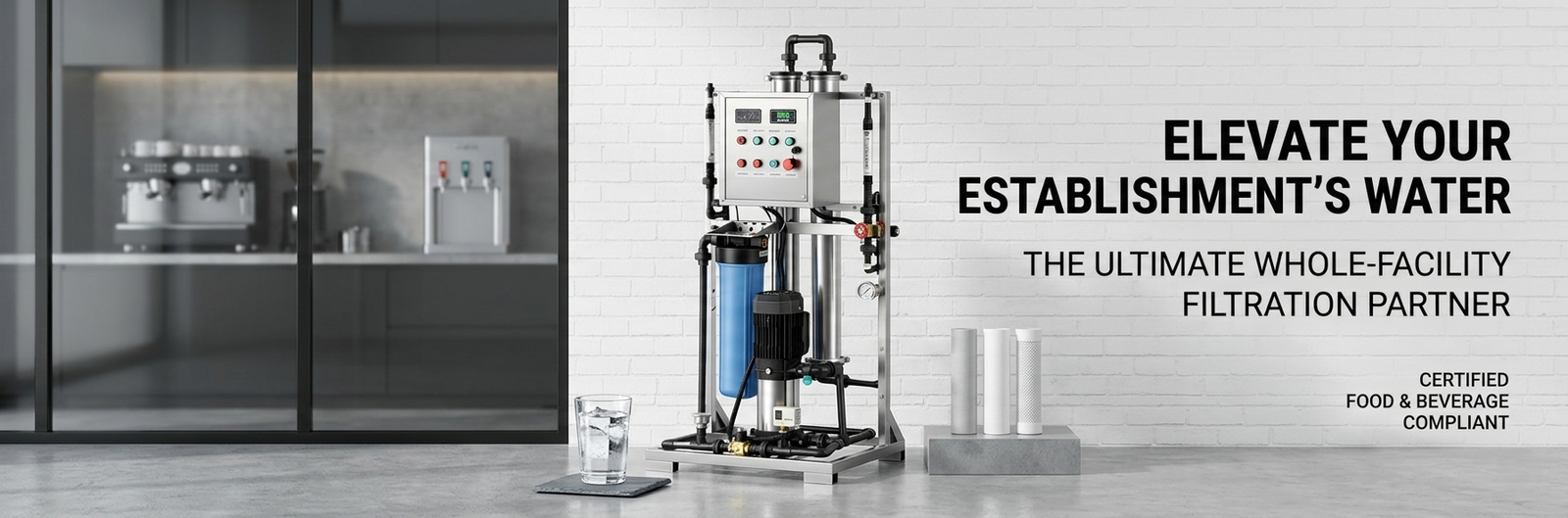
Zero-TDS water is not the goal in a commercial kitchen — it’s often the mistake. A restaurant hospitality food beverage water filtration supplier worth a contract can explain why “purer” and “better” aren’t the same word here. Before you sign anything, confirm:
- Peak-hour GPM capacity — rated for your busiest shift, not a daily average
- Equipment-specific descaling — espresso boilers, ice machines, and combi ovens each have different tolerances
- TDS output range — a specified ppm target, not a blanket “removes everything” claim
- Filter/cartridge replacement cadence — stated in months, tied to your actual water volume
- Footprint fit — confirmed against your existing under-counter or utility-room space before quoting
A supplier who can’t answer all five with numbers is quoting a residential product into a commercial job.
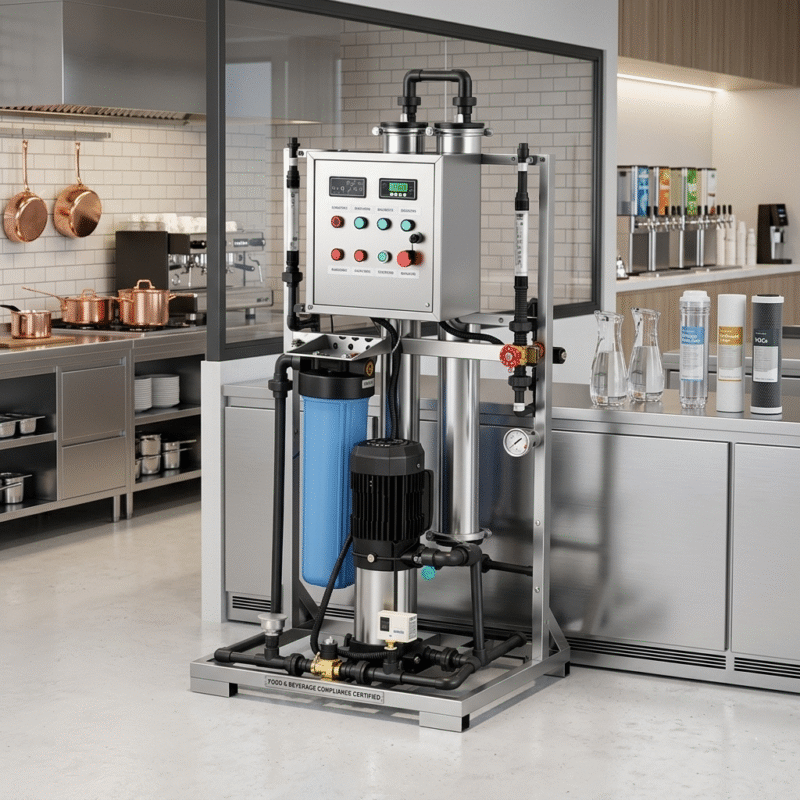
Fast Check Product: https://yourwatergood.com/product/commercial-reverse-osmosis-system/
What Actually Breaks When Kitchen Water Quality Is Wrong
Scale and chlorine don’t announce themselves. They show up as a service call.
Espresso machines lose heating efficiency as scale builds on the boiler element, then fail expensively when the element finally gives out. Commercial ice machines show the damage first in cloudy, off-tasting cubes, then in a shortened compressor life as the evaporator plate scales over. Combi ovens — often the single most expensive piece of equipment in the kitchen — lose steam-generation efficiency and rack up avoidable descaling labor charges.
None of this is a slow business problem. It’s a maintenance-budget problem that compounds every quarter you don’t address the water feeding these machines.
A scaled combi oven doesn’t fail all at once — it fails gradually, in rising utility bills and slower cook times, until a technician finally flags a boiler element that should have lasted years longer. By the time it shows up as a line item, the water problem behind it has usually been running for a year or more.
Central POE Filtration vs. Point-of-Use POU Systems
The first real decision isn’t which brand — it’s where the filtration sits in your building.
| Factor | Central POE (Whole-Facility) | Point-of-Use POU (Per-Equipment) |
|---|---|---|
| CAPEX | Higher upfront, one system | Lower per unit, scales with equipment count |
| OPEX (Cartridges) | Fewer, larger cartridges | More frequent, smaller cartridge swaps |
| Plumbing Retrofit | Significant — single main-line install | Minimal — taps into existing equipment lines |
| Footprint | Dedicated utility-room space required | Fits under-counter, near the equipment itself |
A single-location independent restaurant often gets faster payback from POU units placed directly at the espresso machine and ice maker. A hotel or commissary kitchen running multiple pieces of equipment off one water line usually justifies the POE investment.
Most working kitchens don’t run one technology in isolation — they run a stack. A central descaler ahead of the main line handles hardness before it ever reaches individual equipment. Multi-stage combination cartridges — sediment, carbon, and polishing stages bundled into one housing — sit closer to the point of use, protecting the finer components a standalone descaler was never designed to filter. A commercial RO system sits at the top of that stack wherever dissolved-solids control matters most, typically the beverage and ice line.
Request a Commercial Kitchen Water Layout Design — get a footprint plan matched to your actual equipment lineup before you commit to POE or POU.
Municipal City Water vs. Commercial Well Water
The failure mode changes completely depending on what’s coming out of your wall.
Municipal tap water is dosed with chlorine and chloramine for public safety — necessary at the treatment plant, corrosive to copper boilers and heating elements by the time it reaches your kitchen. Older municipal pipe networks can also introduce trace metals your equipment never sees on a spec sheet.
Commercial well water brings a different set of problems: hardness that accelerates scale formation, dissolved iron and manganese that stain ice and discolor beverages, and inconsistent odor that shows up in nothing else on your menu quite like it shows up in a glass of water.
A supplier quoting your location should ask which one you’re on before quoting equipment, not after.
An operator running a chain across multiple cities often assumes one system spec covers every location. It rarely does — a location on a decades-old municipal main can face a completely different trace-metal profile than a newly built location two towns over, even on the same city water utility.
The TDS Number Nobody Explains
Most buyers assume lower TDS is always better. In a specialty coffee program, that assumption ruins the product.
Espresso extraction depends on mineral content — water stripped down to near-zero TDS pulls a flat, under-extracted shot no barista can fix downstream. At the same time, unregulated tap water at high TDS accelerates scale inside a copper boiler.
The engineering answer is a TDS blending valve — a bypass that blends a small amount of raw feed water back into the RO output, dialing the final TDS into roughly 30–50 ppm. That range holds off scale while keeping enough mineral content for a full-flavored extraction.
A supplier who only sells “100% pure” RO without ever mentioning a blending valve hasn’t worked a coffee program before.
The same logic extends past coffee. A soup base or a signature cocktail program built around a specific water profile will taste noticeably different once the mineral content changes — consistency, not maximum purity, is usually the actual specification a beverage or culinary team is trying to hit.
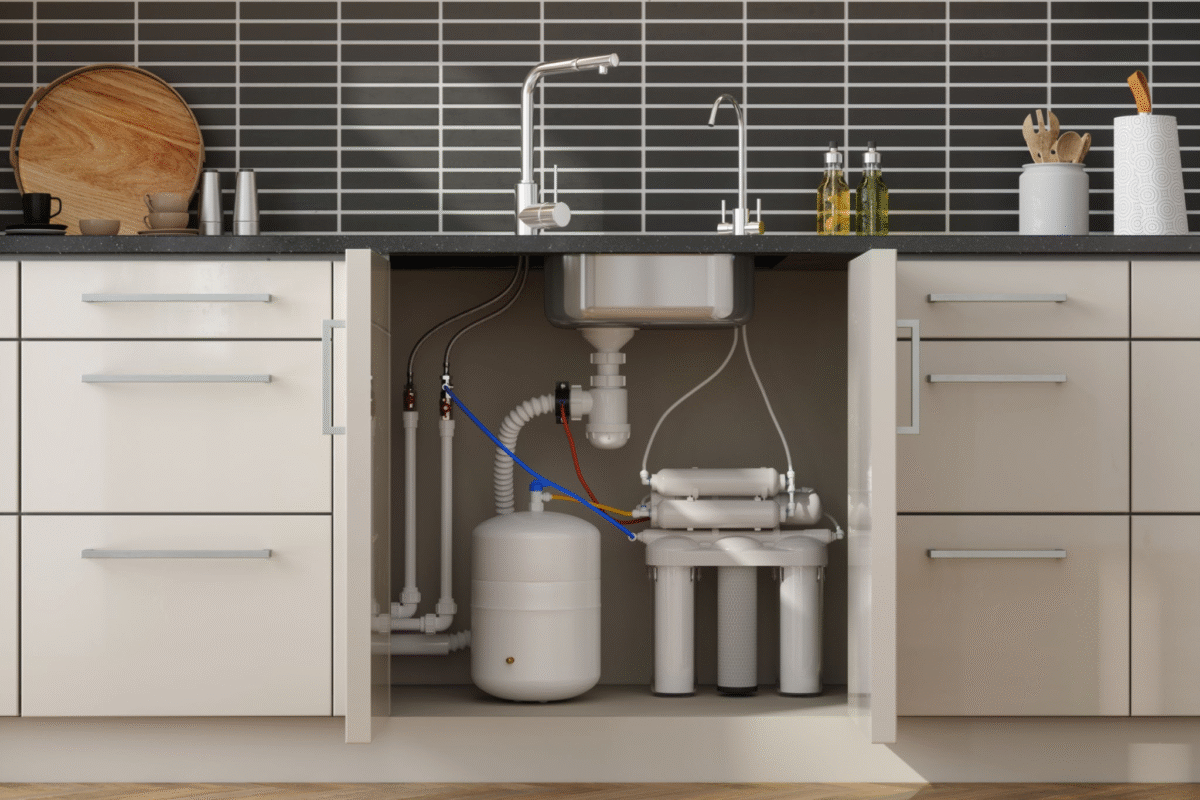
Request a Technical Parameter Sheet — confirm blending valve availability, target TDS range, and per-equipment flow specs before your next install.
Peak-Hour Flow Rate: Why GPM Matters More Than Daily GPD Totals
A system sized on average daily gallons (GPD) will still fail during a Saturday brunch rush.
Ice machines, dishwashers, and espresso machines don’t draw water evenly across the day — they draw in short, overlapping bursts during service windows. GPM (peak flow rate) is the number that determines whether your equipment gets water on demand or waits behind a slow-recovering tank.
Feed pressure matters just as much. Standard commercial buildings frequently see municipal supply drop below the PSI a membrane needs to perform, especially during a neighborhood’s own peak-demand hours — which tend to line up with yours.
A supplier who sizes your system on GPD alone is quoting for a quiet Tuesday morning, not your busiest Saturday.
This is where a booster pump earns its cost. A membrane that receives inconsistent feed pressure during a demand spike doesn’t just slow down — its rejection rate drops too, meaning the water on the other side of it is measurably less consistent exactly when your kitchen is busiest and least able to notice.
FAQ
What’s the difference between a POE and POU water filtration system for a restaurant? POE treats the entire building at the main water line. POU treats water at the specific piece of equipment — espresso machine, ice maker — that needs it, without a full plumbing retrofit.
Why would lower TDS ever be a bad thing for a coffee shop? Espresso extraction needs some mineral content. Water stripped to near-zero TDS pulls a flat shot — a TDS blending valve dials output into roughly 30–50 ppm for full flavor without inviting scale.
How do I know if my location is on hard well water or municipal supply? Check your utility bill or well report for hardness (grains per gallon) and TDS — municipal supply is chemically consistent, while well water varies by season and region.
What replacement cadence should I expect on commercial cartridges? It depends on water volume and feed quality — ask your supplier for a schedule tied to your actual daily gallons, not a generic “every 6 months” answer.
Does a central descaler replace the need for RO filtration? No — a central descaler manages hardness and scale, while RO addresses dissolved solids, chlorine, and taste. Many commercial kitchens run both in sequence.
What should I ask about peak-hour performance before buying? Ask for the system’s rated GPM under sustained draw, not just its daily GPD figure, and confirm feed pressure requirements against your building’s actual PSI.
Can one system serve both an ice machine and an espresso machine? Yes, with correct sizing and a distribution manifold — but each piece of equipment may need its own TDS target, which is where a blending valve setup matters.
Get Your Custom Commercial Quote
A restaurant hospitality food beverage water filtration supplier earns a contract with documentation, not adjectives. Before your next equipment order, request:
- A Custom Commercial Quote scoped to your equipment lineup and peak-hour flow needs
- Full Technical Parameter Sheets covering GPM, feed PSI range, and TDS blending options
- Current B2B Wholesale Pricing for multi-location or chain rollouts
Compare those documents against your current restaurant hospitality food beverage water filtration supplier before your next equipment order ships.