
Vetting a Whole House Water Filter Supplier for B2B Wholesale

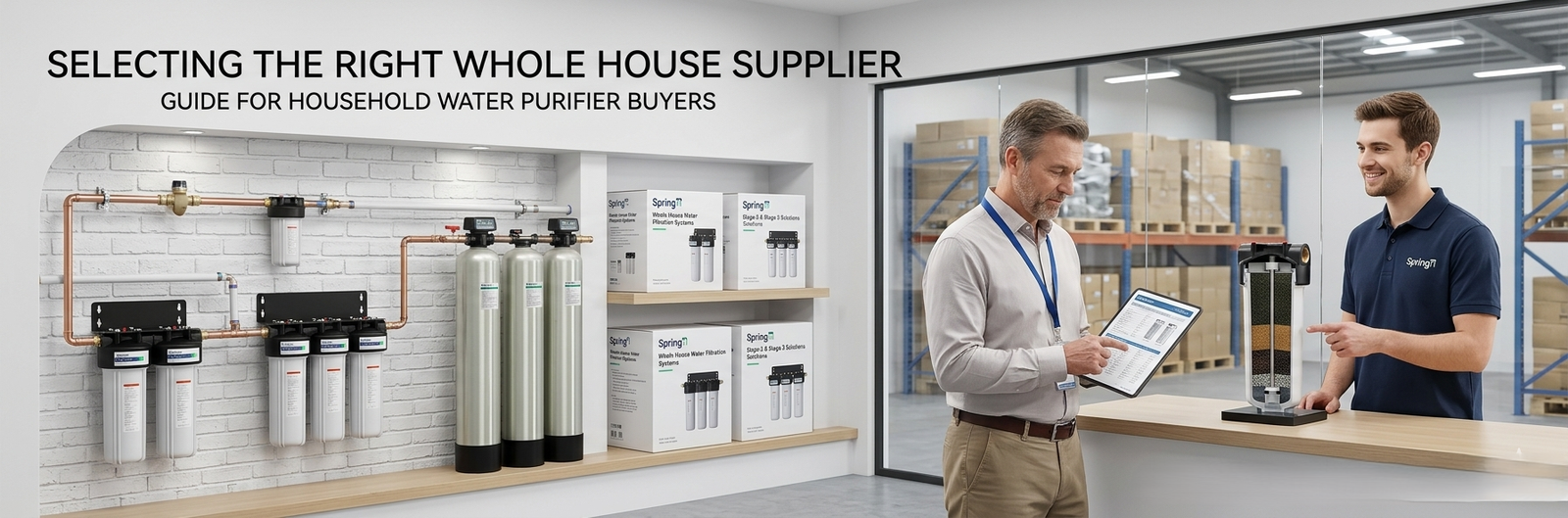
Choosing the right whole house water filter supplier is a sourcing decision, not a product decision — you’re not buying a unit, you’re buying a company’s ability to deliver the same water performance on unit #1 and unit #10,000. Before you sign, confirm the supplier can show you:
- Lot-Level Certificates of Analysis (CoA) for every incoming PP cotton and carbon block batch, not just a one-time factory audit
- Documented micron rating and chlorine-reduction performance tied to the exact SKU you’re ordering, not a generic catalog claim
- Documented lead times for both open-mold and custom-tooled orders, with penalties for slippage
- A named quality contact who owns warranty claims — not a sales rep who forwards emails to a factory
Fast Check Product:https://yourwatergood.com/product/whole-house-water-filtration-system-for-home/
Supplier vs. Manufacturer: Why the Distinction Changes Your Risk Profile
A manufacturer owns the production line. A supplier owns the relationship — and sometimes that relationship spans more than one factory.
That difference matters more than most importers realize:
- Single-factory manufacturers give you direct engineering access but limited flexibility if that one line is backlogged.
- Multi-factory suppliers can pool capacity and smooth out lead times, but only if they run centralized quality control across every plant they use.
- Trading agents posing as suppliers do neither — they forward your PO to whichever factory quotes lowest that week, with no consistency guarantee.
Ask directly: how many production sites does your supply run through, and who signs off on quality across all of them? A vague answer is your first red flag.
How a Verified Supplier Structure Protects Water Consistency Across Batches
Here’s the failure mode most importers never see coming: a supplier passes your initial sample inspection, then quietly shifts 30% of a reorder to a secondary sub-factory to hit your deadline.
The sample tests fine. The batch three months later doesn’t.
- Activated carbon has an iodine number that varies by feedstock and burn cycle. Two “identical” carbon blocks from different sub-factories can have meaningfully different chlorine and VOC adsorption capacity.
- PP cotton density drifts between production runs unless a supplier enforces a single spun-bond spec across every line making your product.
- Neither defect shows up in a five-unit sample check — it only appears as a statistical spread across a full container, usually reported back to you as scattered field complaints, not a clean recall.
A reliable whole house water filter supplier runs incoming lot testing on every shipment batch, not just the initial qualification sample, and can hand you a CoA per lot on request.
Request a Verified Supplier Audit Report to see how lot-level testing is documented before you commit to a reorder schedule.
What Supplier Accountability Actually Protects Downstream
The cost of a weak supplier relationship rarely shows up on the first invoice. It shows up eighteen months later, spread across four line items:
- Warranty Claims: Inconsistent components mean a rising claims rate you can’t forecast. A supplier running lot-level QC turns warranty spend into a predictable cost of goods, not a recurring surprise.
- Operational Stability: Retailers and installers stop trusting a brand that ships a good batch in Q1 and a problem batch in Q3. Supplier consistency is what keeps your reorder cadence — and your shelf placement — stable.
- Water Consistency: The end customer never sees your factory. They only see whether the water tastes and tests the same every time they change a cartridge. That perception is built entirely upstream, at the supplier’s QC bench.
- Brand Equity Protection: Every unverified sub-factory swap your supplier makes without telling you is a risk transferred silently onto your brand name. You absorb the reputational cost of a decision you never approved.
None of this shows up in a spec sheet comparison. It shows up in your return rate twelve months after launch.
Engineering Specs Your Supplier Must Confirm Before You Sign
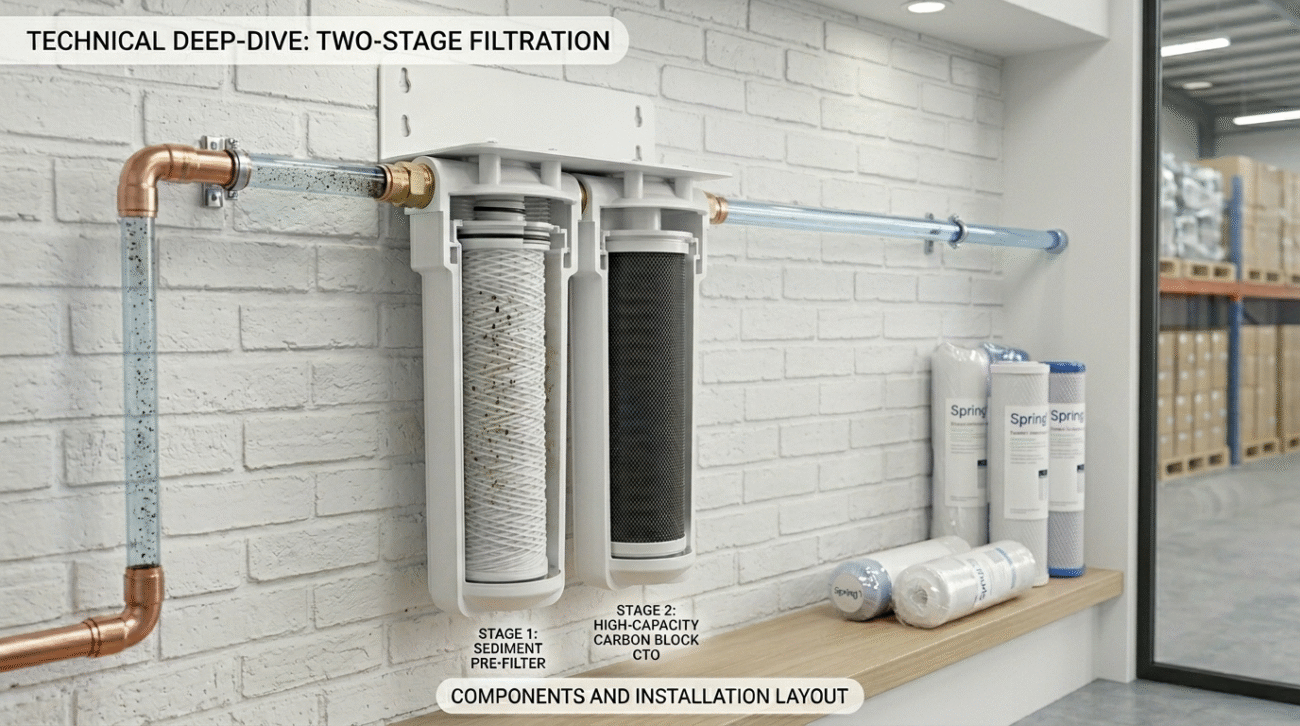
A supplier’s job is to guarantee the stated performance holds up on every unit — not just repeat a spec sheet. For a two-stage whole-house configuration, confirm these details against the actual SKU, not a generic catalog:
- Sediment Stage Rating: The PP cotton pre-filter should carry a clearly documented micron rating (commonly 5-micron at this stage) — get written confirmation of which figure is accurate if your supplier’s own materials list more than one number.
- Chlorine & Odor Reduction: A CTO carbon block stage should carry a tested reduction rate (95%+ chlorine reduction is the benchmark to ask for), not just “removes chlorine” with no percentage.
- Configuration Match to Water Source: A sediment + carbon block duo suits municipal (city) water. A sediment + scale inhibitor (Siliphos/polyphosphate) duo suits hard water protection for water heaters and appliances. These are two different builds — confirm which one you’re actually quoting.
- Flow Rate and Pressure Tolerance: If your supplier doesn’t publish GPM or PSI ratings for this SKU, ask for them directly in writing before you commit to an installation spec sheet for your market.
- Certification Status: Don’t assume NSF/ANSI listings apply — ask your supplier which certifications, if any, cover this specific SKU, and request the listing number.
If a supplier can’t produce documentation for these details on the actual SKU (not a sister product), you’re buying a promise, not a spec.
Supplier Accountability Table: Trading Agent vs. Factory-Backed OEM Supplier
| Accountability Factor | Trading Agent / Broker | Factory-Backed OEM Supplier |
|---|---|---|
| Who owns defect resolution | Passes claim back to an unnamed factory | Direct engineering team handles root-cause analysis |
| Lot-to-lot consistency control | Not tracked; sourced per lowest quote | Centralized CoA testing per production batch |
| Technical drawing access | Basic PDF spec sheet only | Full CAD/SolidWorks files on request |
| Custom tooling turnaround | Cannot commit — depends on subcontractor | Direct mold-shop scheduling, typically 45–60 days |
| Price transparency | Margin stacked and hidden | Landed cost broken out by component |
Off-the-shelf wholesale orders through either channel usually run a 100–200 unit MOQ. Custom tooling for a proprietary housing or bracket typically requires 500–1,000+ units to justify a $15,000–$50,000 mold investment — the accountability table above is what determines whether that investment is actually protected once it’s made.
Supply Chain Red Flags: Signs Your Supplier Can’t Scale With You
- No named factory on the contract — only a trading company entity, with no disclosed manufacturing address.
- Certificates that predate your PO by more than 12 months, suggesting NSF listings haven’t been re-verified for the current production run.
- Silence on well water vs. municipal adjustments — a sign the supplier is reselling one fixed configuration regardless of your end market.
- Seal and O-ring sourcing left unspecified. Suppliers who consolidate orders across multiple molders sometimes mix EPDM compounds from different lots — every unit passes a shipping leak test, but long-term thermal cycling performance is inconsistent because the rubber formulation isn’t locked.
- No lead-time commitment in writing for reorders, only for the first sample run.
Request Lot-Level Certificates of Analysis from any supplier before scaling a reorder past your initial container.
FAQ
What’s the actual difference between a whole house water filter supplier and a manufacturer? A manufacturer runs the production line directly. A supplier manages the sourcing relationship, which may span one dedicated factory or several — the value of a supplier depends entirely on whether they enforce consistent quality control across every plant they use.
How do I know if my supplier sources from more than one factory? Ask for the manufacturing site address on your purchase contract, not just the supplier’s company address. A supplier unwilling to disclose the actual production location is usually reselling across multiple unverified subcontractors.
What proves batch-to-batch consistency across wholesale shipments? A Certificate of Analysis per production lot, covering carbon adsorption capacity and PP cotton density, not just a one-time sample report from your initial order.
Does the same whole-house system work for both city water and hard water? Not as one fixed build. A sediment + carbon block configuration is designed for municipal (chlorinated) water, while a sediment + scale inhibitor configuration targets hard water protection — confirm which duo your supplier is actually quoting before you order.
What’s a reasonable lead time to expect from a wholesale supplier? Open-mold reorders using existing components typically ship in 15–25 days. Custom OEM/ODM tooling projects run 45–60 days, including mold validation cycles.
How should a supplier handle warranty claims on a defective batch? A qualified supplier assigns a named technical contact for root-cause analysis and ships replacement components under a documented claims window — not a generic customer service queue with no engineering follow-up.
What paperwork should a supplier provide before I place a bulk order? NSF/ANSI 42 and 58 listings tied to your specific SKU, CAD or structural drawings on request, a written lead-time commitment for reorders, and a sample CoA from a recent production lot.
Lock In a Supplier Who Can Prove Consistency, Not Just Sample Quality
Your brand’s warranty costs are set the day you pick a whole house water filter supplier — long before the first container ships. Lot-level accountability, not a clean sample unit, is what protects your reputation at scale.
Contact our sales engineering team to request a Custom OEM Quote, review our Technical Parameter Sheets, or lock in tier-one B2B Wholesale Pricing for your next production run.