
Best Osmosis Water Filter System Manufacturer: How to Actually Vet the Claim

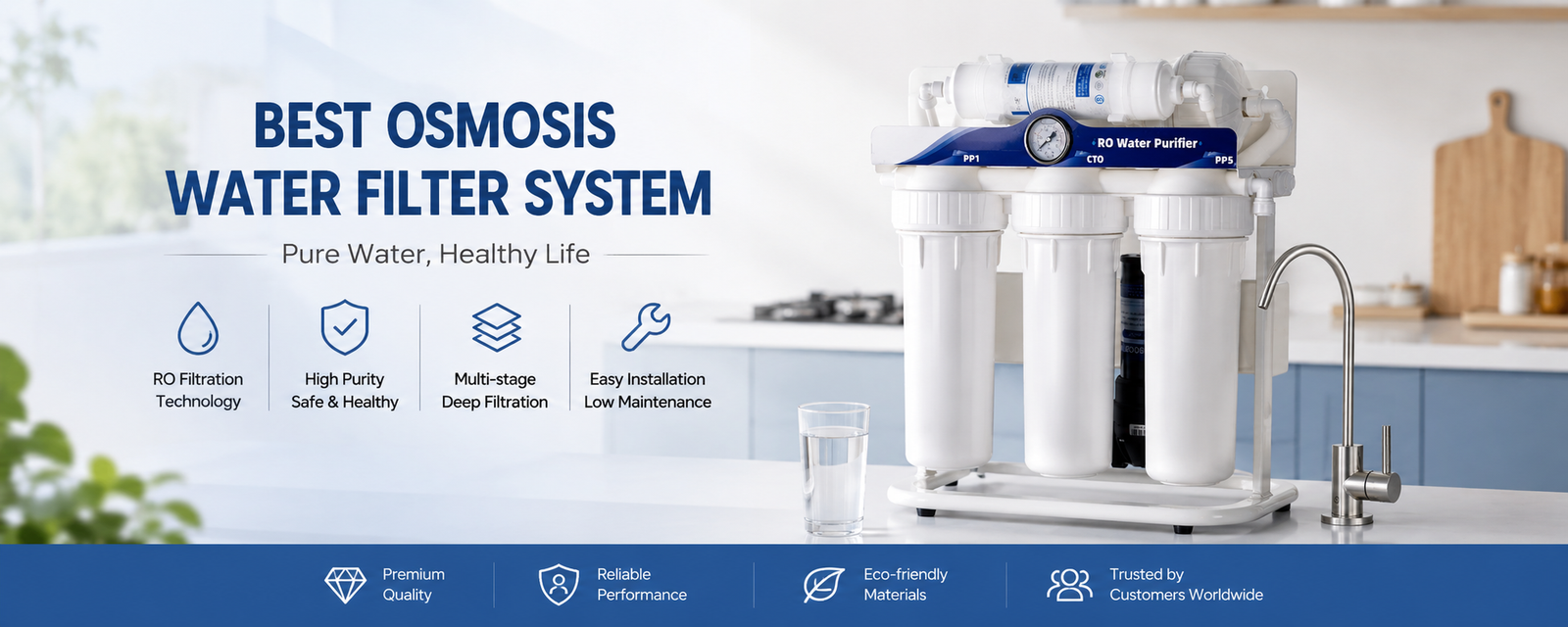
Every factory calls itself the best osmosis water filter system manufacturer in their sales deck. The claim only means something once it’s backed by documentation. Before a purchase order moves, confirm:
- Duty-cycle validation — tested for both intermittent home use and sustained small-business draw, not one and not the other
- Membrane rejection data — stated percentage at a specified feed TDS, not a marketing range
- Tank pre-charge pressure — confirmed and documented, not assumed correct out of the box
- Tooling and MOQ transparency — mold cost, amortization schedule, and minimum order quantity disclosed up front
- Factory-of-record clarity — one confirmed production line, not a rotating pool of subcontracted assembly shops
A manufacturer that answers all five with paperwork is worth a second conversation. One that answers with adjectives isn’t.
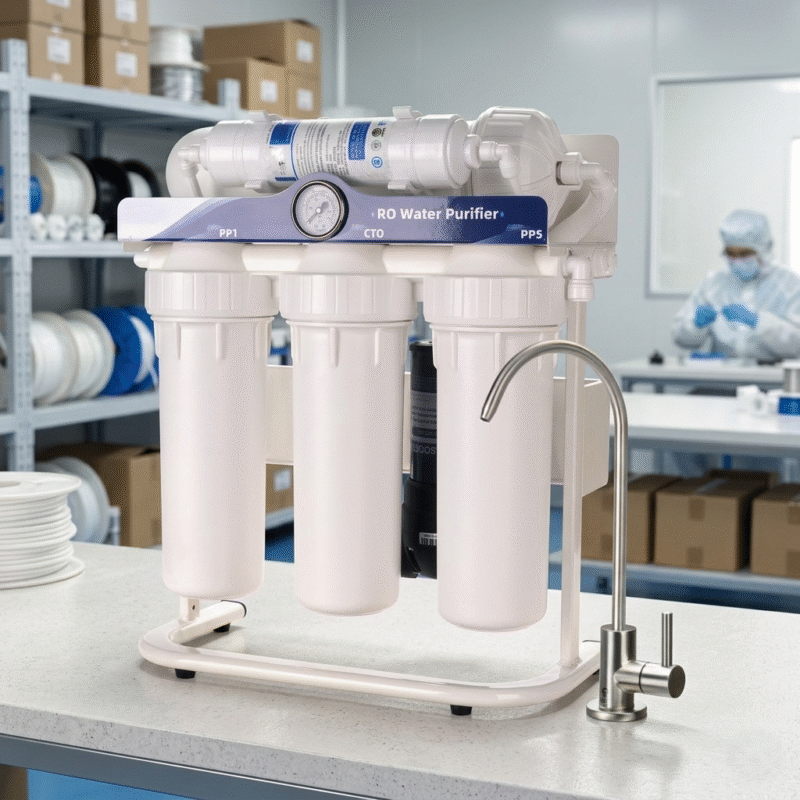
Fast Check Product: https://yourwatergood.com/product/5-stage-ro-water-filter-for-home-busines/
What “Best” Actually Means for an RO Manufacturer
“Best” is not a certification — it’s shorthand for a specific set of engineering commitments a buyer should be able to verify.
A manufacturer earns the word through duty-cycle range (validated for more than one draw pattern), documentation depth (CAD drawings and pressure data, not a one-page flyer), and batch consistency (the fifth container performing like the first).
None of that shows up in a product photo. All of it shows up in the paperwork a manufacturer either hands over readily or stalls on.
Two manufacturers can list identical specs on paper — same GPD figure, same membrane rejection percentage — and still perform differently once installed. The difference is usually in what wasn’t tested: sustained draw, well-water feed, or a tank pre-charge setting nobody double-checked on the line.
Sizing for Dual Duty: Household Kitchens vs. Small Restaurant Break Rooms
A system marketed for both home and small-business use is only as good as its weakest duty cycle, and the two draw patterns are not the same problem.
Household use is intermittent — a few gallons at a time, hours apart. Tank recovery has plenty of idle time to catch up between draws.
Small-restaurant and cafe use is sustained — an espresso machine or ice maker can pull water in back-to-back cycles with almost no idle time. If tank recovery can’t keep pace, the fifth cup of the morning rush tastes different from the first.
A manufacturer marketing a “high-flow” system for dual duty should be able to state the sustained GPM figure under continuous draw, not just the tank’s static gallon capacity. That single number is what separates a system that holds up in a foodservice setting from one that only ever got tested in a quiet kitchen.
Picture a small cafe running the system behind an espresso machine during a Saturday morning rush. Draw is near-continuous for twenty or thirty minutes at a stretch — nothing like the intermittent pattern a residential kitchen produces. A tank sized and tested only for household use will show its limits exactly there, at the worst possible moment for the buyer’s own customer experience.
Request a Factory Component Blueprint — see membrane housing specs, tank sizing, and sustained-flow data before committing to a PO.
Off-the-Shelf Components vs. Full OEM/ODM Engineering Support
Every RO manufacturer sells at two different levels of engagement, and the gap between them is where buyers lose margin or lose customers.
| Factor | Off-the-Shelf Components | Full-Scale OEM/ODM Support |
|---|---|---|
| MOQ | 300–800 units, fixed tank size | Negotiable from pilot batch, custom tank/faucet branding |
| Lead Time | 20–25 days, shared production queue | 40–60 days, dedicated line scheduling |
| Tooling / Mold Fee | None — shared mold and standard housing | One-time fee, amortized into unit cost over volume |
| Duty-Cycle Documentation | Generic spec sheet, home-use only | Sustained-flow data for both home and foodservice draw patterns |
| Technical Drawings | Spec sheet only | Full CAD drawings, membrane housing cross-section, pressure-test data |
Off-the-shelf sourcing is fine for a single-market test order. Full OEM/ODM support is what protects consistency once a brand sells into both residential and small-commercial channels at once.
Confirming Real Capacity: GPD Output, PSI Feed Range, and TDS Rejection
Capacity claims are where marketing copy and engineering reality diverge fastest — especially on a system positioned for two different draw patterns.
- GPD (gallons per day): output tiers vary by membrane size and configuration — ask for the tested GPD rating of the specific model, not a category-wide number
- Feed pressure (PSI): confirm the manufacturer’s tested minimum and maximum PSI rather than assuming standard municipal tap pressure is automatically sufficient
- TDS rejection: ask for the percentage reduction at a stated feed TDS level — a rejection rate quoted at low feed TDS won’t hold at high feed TDS
- Sustained GPM: for foodservice-adjacent use, this matters more than tank size — it’s the number that determines whether the tenth cup of coffee tastes like the first
A manufacturer that hands this over as a one-page sheet has tested their own product against both markets. One that hasn’t, hasn’t.
Request a Technical Parameter Sheet — compare GPD, sustained GPM, and TDS rejection against your current supplier’s documentation.
Municipal vs. Well-Water Feed: Where Dual-Duty Systems Succeed or Fail
Municipal tap water and well water are different design briefs, and a system built for one doesn’t automatically perform on the other.
Municipal supply is chemically consistent, so pre-filtration mainly manages chlorine, sediment, and taste ahead of the membrane. Well water introduces variables municipal testing never sees — iron staining, sediment spikes after rain, and hardness swings that accelerate membrane fouling.
A manufacturer serving both residential and small-commercial buyers should state which feed-water range the system was validated against, and whether that changes for a well-water install feeding a small-restaurant location. If they can’t answer that, the “best” claim was only ever tested on one water type.
This matters more for a small-restaurant install than a household one. A residential system feeding hard well water shows up as a slow scale build-up over months. The same feed water pulling continuous volume through a foodservice unit fouls the pre-filtration stages and shortens membrane life on a much faster timeline.
Field Engineering Insight: The Detail Most Buyers Never Check
Buyers ask about the membrane rejection rate. Almost none ask about tank pre-charge pressure.
A storage tank’s bladder needs to be pre-charged to a specific empty-tank pressure — typically in the low single-digit PSI range — before water ever enters it. Factories under production-line pressure sometimes ship tanks with the pre-charge set incorrectly, which quietly reduces usable stored capacity by a meaningful margin without changing anything visible on the outside of the tank.
The result looks like a “slow” system, and most buyers blame the membrane or the pump. The actual cause is a five-second pressure check that never happened on the line. Ask your manufacturer whether pre-charge pressure is verified per unit or per batch — the answer tells you a lot about their quality-control discipline.
It’s a cheap check for the factory and an expensive miss for the buyer. A five-second gauge reading at the end of the line costs nothing to add to a QC checklist; a support ticket six months later, from a customer who thinks the unit is defective, costs a great deal more.
Neither this detail nor duty-cycle data shows up on a catalog spec sheet. Both are worth asking about before a mold is cut.
FAQ
What makes a manufacturer the “best” choice for an osmosis water filter system? Verifiable duty-cycle data, documented membrane rejection rates at a stated feed TDS, and batch-to-batch consistency — not marketing language.
Can the same RO system really serve both a household and a small restaurant? Yes, if the manufacturer can state a sustained GPM figure under continuous draw, not just static tank capacity — that number determines foodservice-duty performance.
What GPD output should I ask for in a wholesale quote? GPD ratings vary by membrane size and configuration — request the specific tested figure for the exact model you’re quoting rather than a general category number.
What MOQ should I expect from a reverse osmosis manufacturer? Off-the-shelf configurations typically start around 300–800 units. Full OEM/ODM programs negotiate lower pilot volumes in exchange for tooling amortization.
How does tank pre-charge pressure affect real-world performance? An incorrectly pre-charged bladder reduces usable stored capacity even though the tank looks identical from the outside — it’s a common but rarely checked cause of “slow” systems.
Can a dual-duty system handle well water as well as municipal water? Only if pre-filtration was specifically validated against well-water sediment and hardness ranges — municipal-only test data doesn’t confirm well-water performance.
What warranty terms should a wholesale buyer negotiate? Ask for claim-rate data from existing production runs, and confirm whether warranty terms differ between residential and small-commercial duty cycles.
Get Your Custom OEM Quote
The best osmosis water filter system manufacturer earns that reputation with documentation, not adjectives. If a manufacturer can’t produce the paperwork covered above on request, treat that as your answer. Before your next purchase order, request:
- A Custom OEM Quote scoped to your target MOQ and dual-duty requirements
- Full Technical Parameter Sheets covering GPD output, sustained GPM, feed PSI range, and TDS rejection
- Current B2B Wholesale Pricing across off-the-shelf and full OEM/ODM configurations
Compare those documents against your current best osmosis water filter system manufacturer before you commit to your next container.