
Containerized Water Treatment Plant for Data Center: Weatherproof, Outdoor, and Deployed in Days

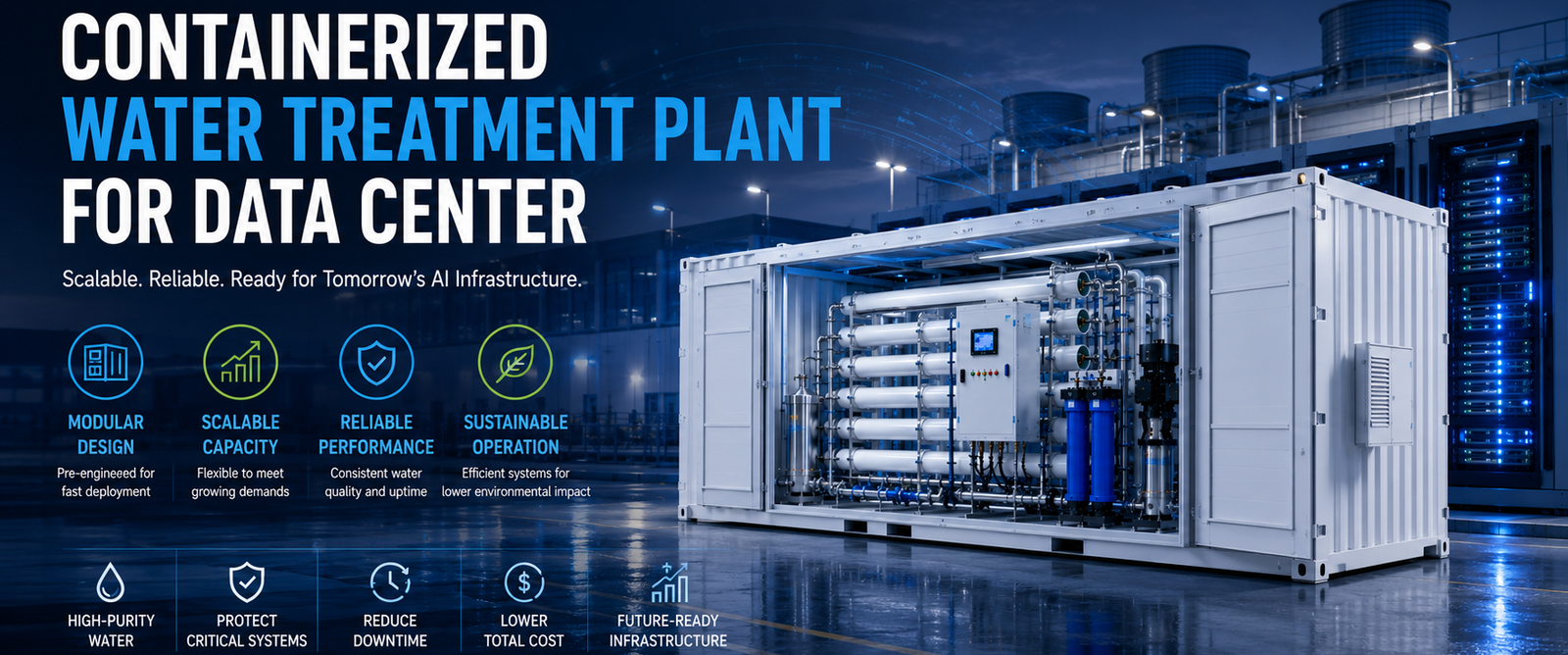
A containerized water treatment plant moves the entire water system out of the data hall and onto a pad outside — a self-contained, weatherproof building that arrives as a single freight unit and connects in days. For space-constrained and fast-build sites, it is the format that frees interior space and compresses the schedule.
It is also more than a skid in a box. The container is the enclosure, the structure, and the weather protection, with the treatment train pre-integrated and tested inside — a plant that ships, sites, and starts as one unit.
A containerized water treatment plant for data center deployment is engineered for outdoor placement, rapid installation, and the edge — provided the enclosure is built for the water plant inside it, not just for freight.
Before sourcing, lock these container-specific specifications:
- Fully enclosed, weatherproof ISO container — structure and weather protection, not equipment on an open frame.
- Climate-controlled for the water plant — freeze protection and heat management rated to the site.
- Standard freight dimensions (20ft / 40ft) — craned onto a pad, sidestepping indoor rigging.
- Plug-and-play utilities — water in, treated water out, power, and BMS, factory-integrated.
- Secondary containment and drainage — inside the enclosure, isolating spills from electrical.
The sections below break down what containerized delivers and the outdoor reality it must survive.
Fast Check Product: https://yourwatergood.com/product/industrial-reverse-osmosis-system/
What “Containerized” Means: A Self-Contained Plant, Not Just a Skid
The defining feature of a containerized water treatment plant for data center use is that the treatment system is built inside a shipping container — a complete, weatherproof plant rather than equipment on an exposed frame.
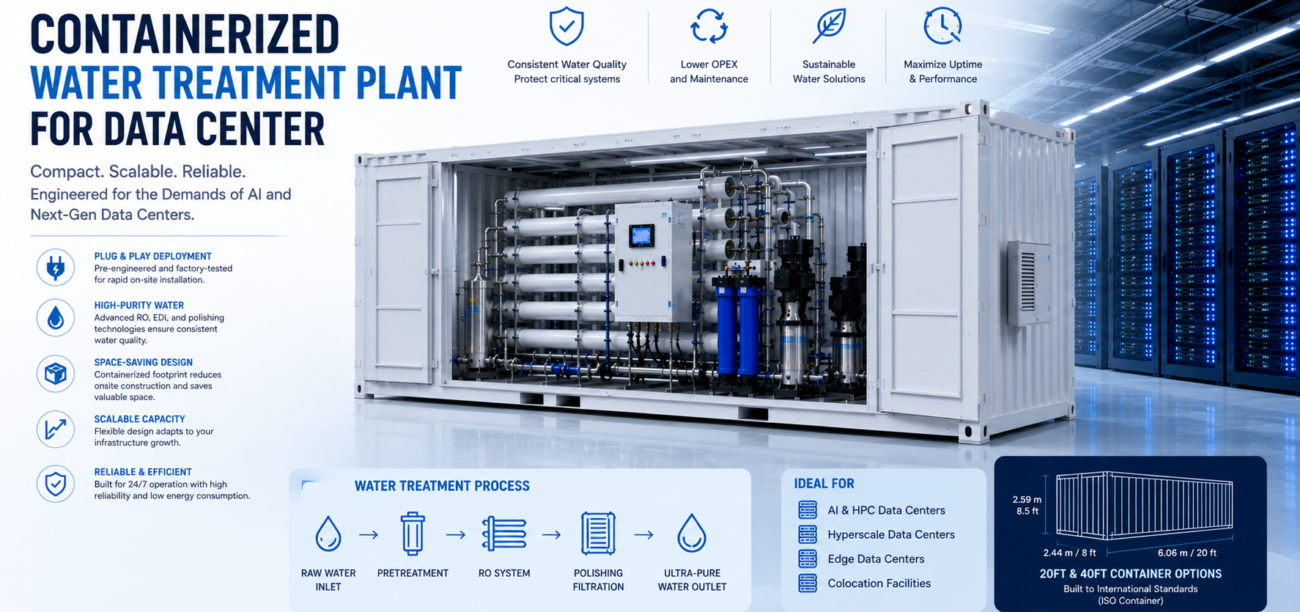
A containerized plant integrates everything in one enclosure:
- The treatment train — pre-filtration, softening, RO, EDI, and dosing, mounted and piped inside.
- The structure — an ISO container providing the building, weatherproofing, and structural support.
- Internal services — lighting, walkway access, climate control, and leak containment.
- Utility connections — single points for water inlet, treated outlet, power, and BMS.
This differs from a skid-mounted system, which is equipment on a frame installed inside a building. A containerized plant is the building — it sits outdoors and needs no interior data-center space. The container is both the package and the structure, which is what makes outdoor, standalone deployment possible.
Why Containerized for a Data Center: Space, Schedule, and the Edge
The containerized format solves three problems that matter most to data center projects: interior space, build schedule, and remote or edge deployment.
The advantages it delivers:
- Frees interior white and grey space — the water plant sits on an outdoor pad, returning valuable conditioned floor area to compute and electrical.
- Compresses the schedule — the plant is built and tested at the factory in parallel with site work, then craned into place and connected.
- Ships as standard freight — 20ft and 40ft containers move by road, rail, or sea as standard units, and crane onto a pad without the indoor rigging that constrains large skids.
- Suits the edge — self-contained deployment fits edge data centers, remote sites, rapid or temporary capacity, and disaster recovery.
- Relocatable as a unit — the whole plant can be lifted and moved to a new site.
For a facility racing to energize compute, or one with no spare interior space, the container turns the water plant into a deployable module. It arrives complete, sits outside, and starts — which is why containerized has become a default for edge and fast-build deployments. The result protects the schedule while holding 99.999% uptime once connected.
The Outdoor Reality: Climate Control, Freeze Protection, and Containment
A containerized plant’s biggest advantage — outdoor placement — is also its biggest engineering demand. The enclosure must protect a water plant from ambient extremes, not just house it.
What the enclosure has to provide:
- Insulation and heat tracing — to keep water-filled lines, membranes, and chemicals above freezing in cold climates.
- Active cooling or ventilation — to keep the interior within the temperature range membranes and electronics tolerate, critical in hot climates such as Phoenix, AZ.
- Secondary containment and drainage — so a chemical or water leak is contained and routed away from control panels and electrical.
- Weather sealing — to keep rain, dust, and pests out of the treatment space.
The temperature requirement cuts both ways and is the subject of the field insight below. A standard freight container is not climate-controlled; a water plant inside one will freeze in winter or overheat in summer without active protection. The enclosure must be engineered for the water plant and the site climate, which is the difference between a containerized plant that runs for years and one that fails at the first temperature extreme — consistent with ASHRAE TC 9.9 guidance for the equipment it houses.
Feed Water Still Sets the Design: Municipal vs Reclaimed in a Container
The container is the enclosure, not a change to the treatment requirement. The feed water still determines what goes inside — and municipal versus reclaimed supply requires different trains within the container.
Municipal potable feed:
- A lighter internal train — cartridge pre-filtration, carbon for chlorine/chloramine, softening, and single- or two-pass RO.
- Chloride control in materials to protect 316L from pitting.
Reclaimed and recycled feed — increasingly mandated for WUE targets in Ashburn, VA and Phoenix, AZ:
- A heavier internal train — multimedia filtration, softening, and antiscalant dosing ahead of the RO.
- Fouling-resistant membranes and lower recovery for high TDS and silica above ~150 ppm.
- May require more than one container as the train grows.
A containerized plant configured for municipal feed will foul on reclaimed water regardless of the enclosure quality. The feed-water analysis sets the train inside the container, and the format simply delivers it pre-integrated and weatherproof — consistent with ASHRAE TC 9.9 and EPA frameworks.
Standard Skids vs Data-Center-Grade Containerized Plants
A basic containerized unit and a data-center-grade one differ in climate engineering, redundancy, and integration — the features that let it run unattended outdoors on a mission-critical loop.
| Engineering Parameter | Standard Pre-Engineered Skids / Units | Data Center Grade Containerized Plants |
|---|---|---|
| Enclosure | Open skid or basic container | Climate-controlled, weatherproof container |
| Freeze / heat protection | Minimal | Insulation, heat tracing, HVAC to site climate |
| Flow capacity (GPM) | 10–50 GPM | 100–1,000+ GPM, multi-container |
| Redundancy | Single train | N+1 / N+2 / 2N |
| Purity | Single-pass | Two-pass + EDI to 18.2 MΩ·cm |
| Containment | None | Secondary containment and drainage |
| Integration | Basic panel | Online analyzers, BMS (Modbus/BACnet/SNMP) |
| Deployment | Indoor install | Outdoor pad, crane-set, plug-and-play |
The enclosure and climate rows are decisive: a basic container without freeze and heat protection cannot survive outdoors year-round, while a climate-engineered, redundant plant runs unattended through temperature extremes. A container alone does not make a plant data-center-grade — the climate engineering and redundancy inside it do.
To pressure-test a vendor, ask how the container is climate-controlled for your site’s temperature extremes. A standard freight container quoted without freeze and heat protection is not built for outdoor mission-critical duty.
Field Engineering Insight: The Container Sits Outdoors — Freeze and Heat Will Find the Weak Spec
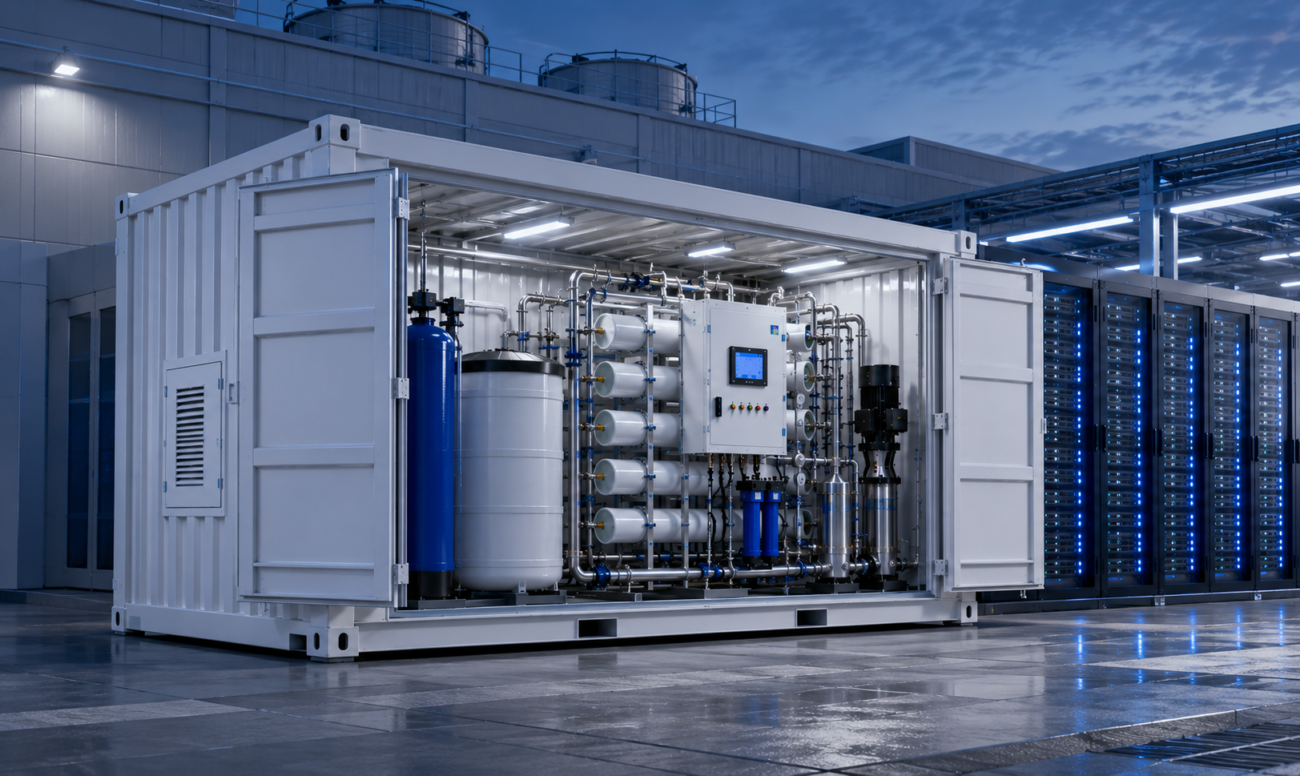
Here is the detail that destroys containerized plants: the container sits outdoors, so the water plant inside is exposed to ambient extremes — and inadequate freeze or heat protection fails the plant suddenly and completely.
The container’s defining advantage, outdoor placement, puts water-filled pipes, RO membranes, resin, and chemical totes within reach of the site’s worst weather. Two failure modes follow:
- Freezing — in cold climates, without sufficient insulation and heat tracing, water in the lines and membranes freezes. Freezing cracks pipes and permanently destroys RO membranes — a ruptured membrane cannot be recovered. One freeze event can write off the plant.
- Overheating — in hot climates such as Phoenix, AZ, the container interior climbs well above ambient under solar load. Excess heat degrades membranes and electronics and accelerates biofouling in the warmer water.
A standard freight container offers neither protection. The plant runs fine through commissioning in mild weather, then fails on the first hard freeze or peak summer day — a sudden, total loss, not a gradual decline.
The defense is to engineer the enclosure for the site climate, not the freight:
- Specify insulation R-value, heat tracing, and HVAC or ventilation rated to the site’s design high and low temperatures.
- Freeze-protect every wetted line, including dosing and sample lines, not just the main headers.
- Confirm membrane and chemical storage stay within rated temperature year-round, summer and winter.
- Account for solar load on the container in hot climates when sizing cooling.
This is the kind of detail that never appears on a flow-rated quote but decides whether a containerized plant survives its first year outdoors. It is also where correct climate engineering pays back: a plant that holds temperature protects its membranes and the loop, avoids the catastrophic freeze or heat failure, lowers OPEX, and holds 99.999% uptime through every season.
Containerized Water Treatment Plant for Data Center FAQs
What is a containerized water treatment plant? A complete water treatment system built inside an ISO shipping container — a weatherproof, self-contained plant with pre-filtration, softening, RO, EDI, and dosing integrated and tested, designed to install by connection and deploy outdoors.
How is it different from a skid-mounted system? A skid is equipment on an open frame installed inside a building. A containerized plant encloses the equipment in a weatherproof container that sits outdoors, ships as standard freight, and needs no interior data-center space.
Why use a containerized plant for a data center? It frees interior space, ships and installs fast, deploys at edge and remote sites, and can be relocated as a whole unit — ideal for fast-build, space-constrained, or distributed facilities.
Can a containerized plant be installed outdoors? Yes — that is its purpose. But it must be climate-controlled with insulation, heat tracing, and HVAC rated to the site, or water and membranes inside freeze in winter or overheat in summer.
What sizes do containerized plants come in? Typically 20ft and 40ft ISO containers, with capacity scaled by adding containers. Larger trains may occupy multiple containers connected on site.
Does the container change the treatment design? No. The feed water — municipal versus reclaimed — still sets the membranes, pre-treatment, and recovery. The container is the enclosure and delivery format, not a change to the treatment requirement.
Is a containerized plant suitable for edge data centers? Yes. Its rapid, self-contained deployment suits edge, remote, temporary, and disaster-recovery capacity, where a standalone outdoor plant is faster and simpler than a built-in room.
Deploy a Plant Built for the Pad and the Climate
A containerized water treatment plant for a data center delivers a complete, weatherproof system that frees interior space and deploys in days — provided the enclosure is engineered for your feed water and your site’s temperature extremes. The format protects the schedule only when the climate engineering is designed in.
Whether you need a single container or a multi-container plant for a larger buildout, YourWaterGood sources the right system through our manufacturing partner and a network of vetted factories — containerized water treatment plant for data center configurations cover containerized and skid-mounted RO, EDI, softening, and dosing, with quality inspection, logistics, and English-language support handled for you.
- Get an Infrastructure Engineering Quote: send your capacity, site, and climate for a configured containerized proposal.
- Request Technical Data Sheets: container dimensions, climate specs, capacity, and BMS integration detail for your planning.
- Get Competitive B2B Pricing: sourced through our supplier network, with QC and shipping managed end to end.