
Water Softener for Data Center Cooling: Removing the Hardness That Scales Cold Plates

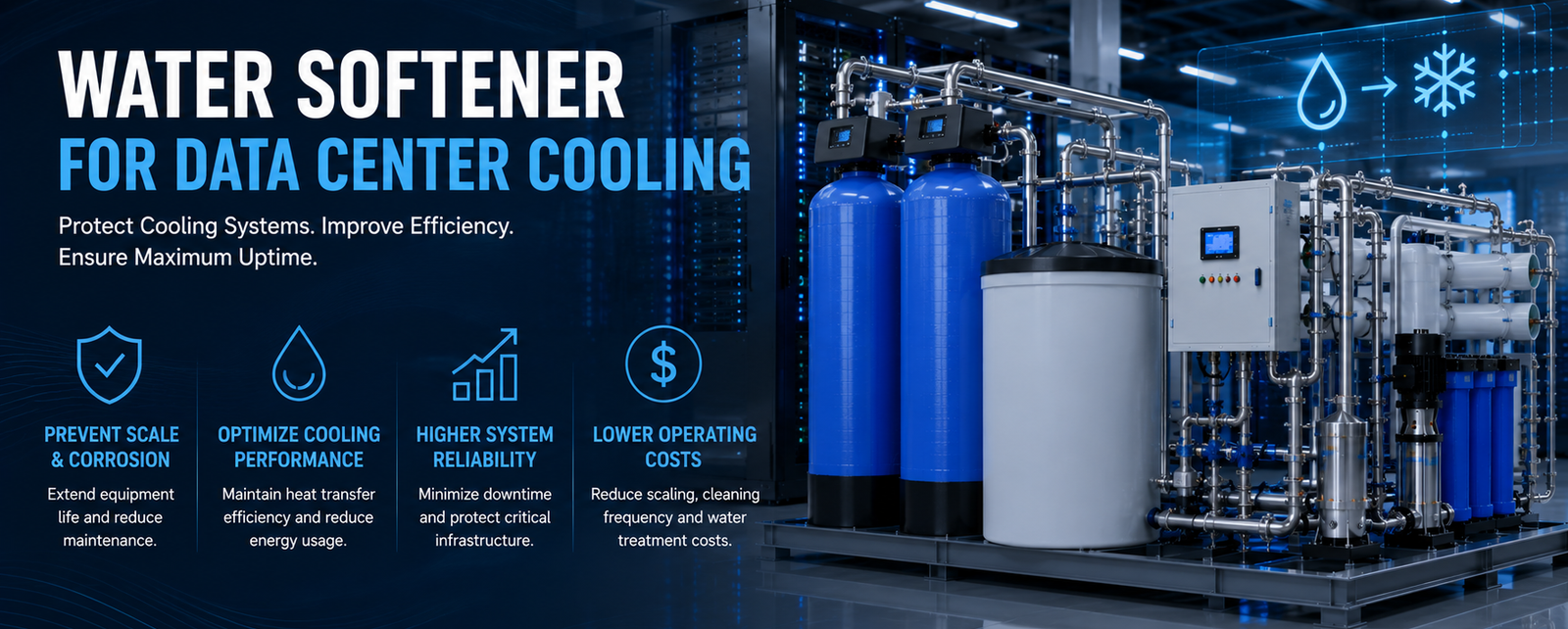
Hardness is the most common cause of scale in a data center cooling loop, and a water softener is the first line of defense against it. Calcium and magnesium that pass untreated deposit as scale on cold plates, heat exchangers, and cooling-tower fill — insulating the very surfaces that must reject heat.
A thin scale layer is enough to raise approach temperature, drive a hot spot, and push a high-density rack toward thermal throttling. Of all the contaminants in cooling water, hardness is the one most cheaply and reliably removed at the source.
Specifying a water softener for data center cooling correctly means sizing it for the hardness load and the flow, and configuring it so soft water never stops — even during regeneration.
Before sourcing, lock these softener-specific specifications:
- True ion-exchange softening — not a salt-free “conditioner,” which does not remove hardness.
- Sized by grain capacity and peak flow (GPM) — the hardness load and the throughput, not flow alone.
- Twin / duplex configuration — alternating units so soft water is uninterrupted on a 24/7 loop.
- Meter-initiated regeneration — triggered by volume or hardness, not a fixed timer.
- Near-zero hardness output — ahead of RO and cooling-tower makeup to protect both.
The sections below break down what the softener does, how it is sized, and where it fails on the floor.
Fast Check Product: https://yourwatergood.com/product/industrial-reverse-osmosis-system/
Why a Cooling Loop Needs Softening: Hardness Is the Scale You Can Prevent
The defining role of a water softener for data center cooling is removing the hardness that would otherwise scale every heat-transfer surface downstream.
Hardness causes problems at several points in the loop:
- Cold-plate microchannels under 100 µm — where calcium scale narrows the passage and stalls flow against the chip.
- Heat exchangers and CDUs — where scale insulates the surface and degrades heat transfer.
- Cooling-tower fill — where scale builds as the water concentrates, robbing the tower of capacity.
- RO membranes — where hardness scales the membrane surface and shortens its life.
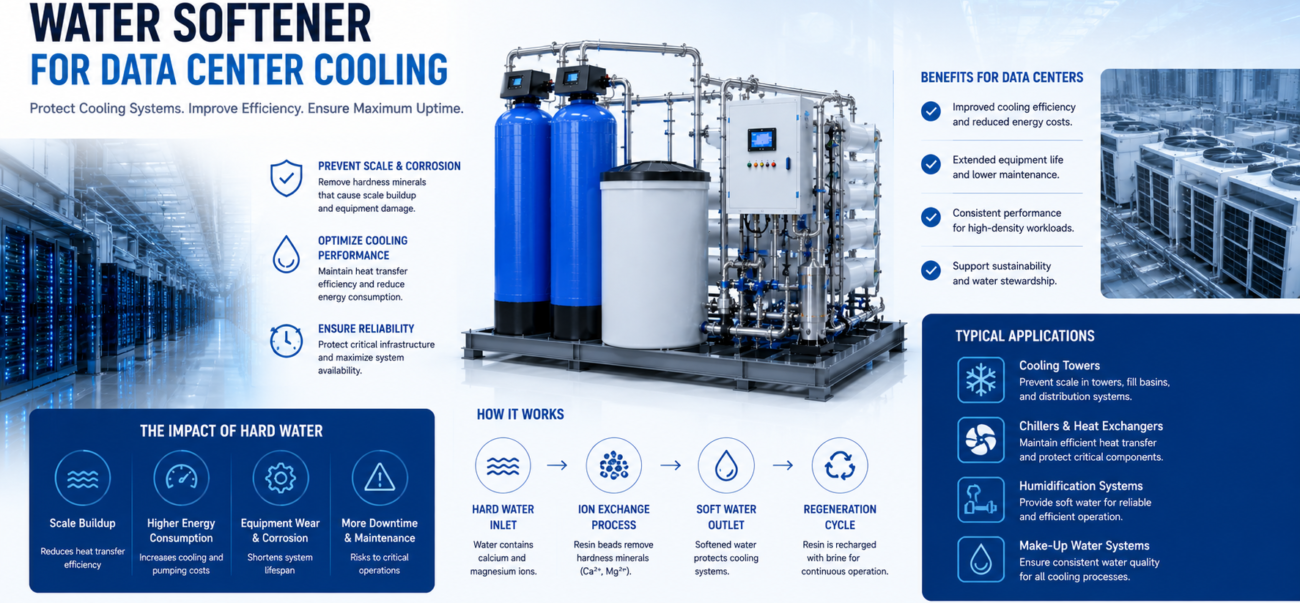
Softening removes calcium and magnesium before any of this happens, by exchanging them for sodium on an ion-exchange resin. The payoff is direct:
- Lower OPEX from less descaling, cleaning, and fill or membrane replacement.
- Extended asset life for cold plates, CDUs, pumps, and exchangers.
- Higher Cycles of Concentration on cooling towers, since softened makeup scales far less.
The principle: hardness is preventable scale, and the softener is where you prevent it. Removing it at the source is cheaper than removing scale from a cold plate later — which is often impossible.
How a Water Softener Works and How It’s Sized
A water softener is an ion-exchange vessel, and sizing it correctly means matching both the hardness load and the flow. Undersize either and the softener breaks through, sending hard water downstream.
The two sizing parameters that matter:
- Grain capacity — how much hardness the resin bed can remove between regenerations, set by the resin volume and the feed hardness in grains per gallon (gpg) or ppm.
- Service flow rate (GPM) — the peak throughput the bed can treat without channeling, set by the vessel size.
When the resin nears exhaustion, it regenerates:
- Backwash to lift and reclassify the bed.
- Brine draw to recharge the resin with sodium and flush off the captured hardness.
- Rinse to clear residual brine before returning to service.
Regeneration should be meter-initiated — triggered by the volume of water treated or a hardness sensor — not a fixed timer, so it matches actual usage rather than wasting salt and water or breaking through early. A softener is sized by load and flow together, and regeneration must be controlled, not assumed.
Softening vs RO vs Antiscalant — and the Salt-Free Trap
A softener is one tool among several for scale control, and choosing correctly means knowing what each does — and what a salt-free “softener” does not.
How the options compare:
- Ion-exchange softening — removes hardness completely, protecting downstream RO and enabling high cooling-tower CoC. It does not remove silica or TDS.
- Reverse osmosis — removes dissolved solids including hardness, but softening ahead of it protects the membranes and extends their life.
- Antiscalant dosing — holds minerals in solution at high CoC, used alongside softening rather than instead of it.
The trap to avoid is the salt-free “softener”:
- Salt-free systems are conditioners (template-assisted crystallization), not softeners.
- They alter how scale forms but do not remove hardness from the water.
- For high-CoC cooling-tower duty or RO pre-treatment, a conditioner does not deliver the hardness removal the loop needs.
For mission-critical cooling, specify true ion-exchange softening, not a salt-free conditioner sold under the same name. Softening, RO, and antiscalant are complementary stages — the softener removes hardness, RO removes dissolved solids, and antiscalant manages what remains in solution.
Municipal vs Reclaimed Feed: How Softening Duty Changes
The softener’s workload depends on the feed water, and municipal versus reclaimed supply changes both the hardness load and how the softener fits the train.
Municipal potable feed:
- Moderate, relatively stable hardness, allowing predictable regeneration intervals.
- Softening pairs with carbon for chlorine/chloramine and chloride control for 316L.
Reclaimed and recycled feed — increasingly mandated for WUE targets in Ashburn, VA and Phoenix, AZ:
- Higher and more variable hardness, so the softener works harder and regenerates more often.
- Carries high TDS and silica above ~150 ppm that softening alone cannot address, so the softener sits ahead of RO rather than replacing it.
- Demands more robust multimedia pre-filtration to protect the resin from fouling.
A softener sized for municipal hardness will exhaust early on reclaimed water. The feed-water hardness and quality set the resin volume and regeneration frequency, and on reclaimed feed the softener is one stage in a larger train — consistent with ASHRAE TC 9.9 and EPA frameworks.
Standard Skids vs Data-Center-Grade Softening
A commercial softener and a data-center-grade softening system differ in continuity, control, and construction. The gap is what allows uninterrupted soft water on a mission-critical loop.
| Engineering Parameter | Standard Pre-Engineered Skids | Data Center Grade High-Redundancy Softening |
|---|---|---|
| Configuration | Single softener | Twin / duplex (alternating) for continuous duty |
| Soft water during regen | Interrupted / hard bypass | Uninterrupted |
| Flow capacity (GPM) | 10–50 GPM | 100–1,000+ GPM, parallel trains |
| Regeneration control | Timer | Meter / hardness-initiated |
| Redundancy | None | N+1 at the softener stage |
| Construction | Light-duty | Continuous-duty, BMS-monitored |
| Integration | Standalone | Feeds and protects RO and cooling-tower makeup |
| Support | Generic spares | Documented P&ID, standardized spares |
The configuration row is decisive: a single softener cannot deliver soft water while it regenerates, while a twin/duplex system can. A single softener on a 24/7 loop is a scaling event waiting for its next regeneration cycle — the failure mode detailed below.
To pressure-test a vendor, ask whether the softening is twin/duplex and how regeneration is triggered. A single, timer-based softener is a commercial unit, not a mission-critical one.
Field Engineering Insight: The Single Softener That Leaks Hard Water Every Regeneration
Here is the detail that catches teams sizing softening on cost alone: a single softener produces no soft water while it regenerates — so every regeneration cycle sends hard water to the loop, and a 24/7 cooling system cannot tolerate that gap.
A softener must periodically regenerate — backwash, brine draw, and rinse — a process that takes roughly one to two hours. During that window, a single-unit system either stops producing water or bypasses hard water straight to the loop.
On a mission-critical cooling system, that hardness slug deposits scale on cold plates, exchangers, and fill during every regeneration. The operator sees intermittent scaling and blames the antiscalant or the membranes, when the real cause is the regeneration gap in a single softener.
The defense is configuration, not a bigger single unit:
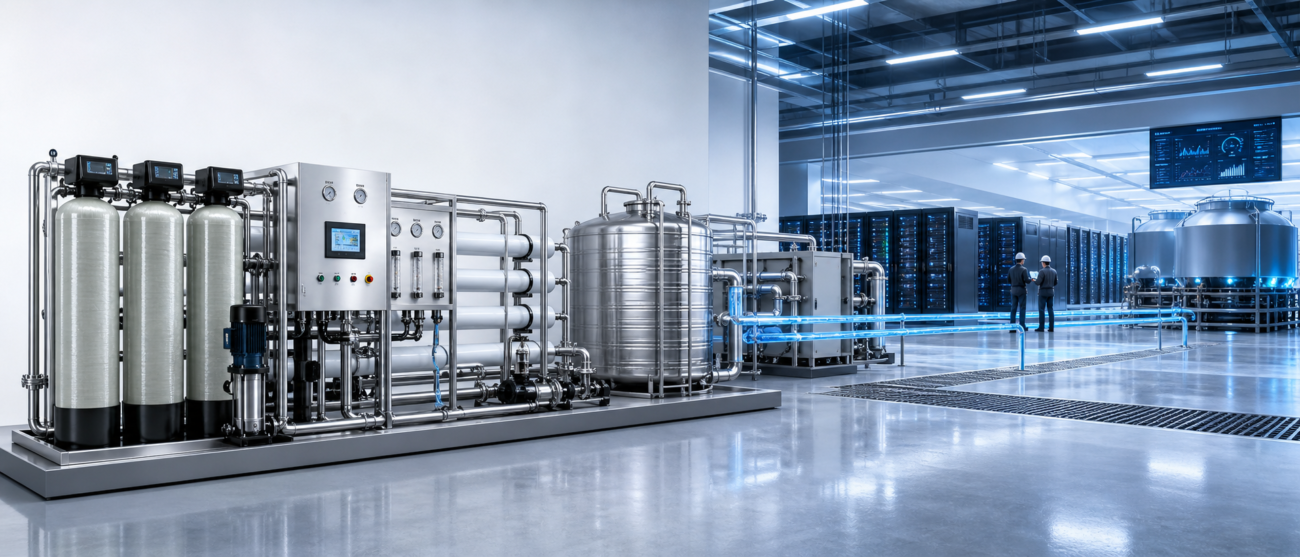
- Specify twin / duplex (alternating) softeners — one stays in service while the other regenerates, so soft water is continuous.
- Size for peak flow with one unit offline — apply N+1 logic at the softener stage, so capacity holds during regeneration.
- Use meter-initiated regeneration — so a unit regenerates on actual volume, not a timer that may fire mid-demand.
- For large loads, use triplex or progressive-flow configurations to hold both flow and continuity.
This is the kind of detail that never appears on a flow-rated quote but decides whether the loop sees clean soft water continuously or a hardness slug every regeneration. It is also where correct softening compounds: uninterrupted soft water lowers descaling and membrane OPEX, protects cold plates and CDUs, enables higher cooling-tower CoC, and holds 99.999% uptime.
Water Softener for Data Center Cooling FAQs
Why does a data center cooling loop need a water softener? To remove calcium and magnesium hardness that scales cold plates, heat exchangers, and cooling-tower fill, insulating heat-transfer surfaces and risking hot spots. Hardness is preventable scale, removed cheaply at the source.
How is a water softener for cooling sized? By grain capacity (the hardness load the resin removes between regenerations) and peak service flow (GPM) together. Regeneration frequency follows from the volume treated between cycles.
What is twin/duplex softening and why does it matter? Two alternating softeners so one regenerates while the other stays in service, giving uninterrupted soft water. A single softener sends hard water to the loop during every regeneration, scaling the system.
Is a salt-free water softener suitable for a data center? No. Salt-free systems are conditioners (template-assisted crystallization), not true softeners — they do not remove hardness. High-CoC cooling and RO pre-treatment require ion-exchange softening.
Does a softener replace reverse osmosis? No. Softening removes hardness but not silica or TDS; RO removes dissolved solids. They are complementary — softening also protects the RO membranes and extends their life.
How often does a water softener regenerate? It depends on feed hardness and throughput. Meter-initiated regeneration (by volume or hardness) is preferred over a timer for continuous loops, so regeneration matches actual usage.
How does softening differ for reclaimed water? Reclaimed feed has higher, more variable hardness plus high TDS and silica, so softeners regenerate more often and sit ahead of RO rather than replacing it, with stronger pre-filtration to protect the resin.
Specify Softening That Never Stops
A water softener for data center cooling is the cheapest, most direct defense against hardness scale — provided it is sized for the load and the flow and configured so soft water never stops. The loops that stay scale-free are the ones with twin/duplex softening and meter-initiated regeneration, not a single timer-based unit.
Whether you need a single skid or a duplex softening train for a larger buildout, YourWaterGood sources the right system through our manufacturing partner and a network of vetted factories — water softener for data center cooling configurations cover skid-mounted twin/duplex softeners, industrial RO, EDI, and dosing, with quality inspection, logistics, and English-language support handled for you.
- Get an Infrastructure Engineering Quote: send your feed hardness and peak flow for a configured softening proposal.
- Request Technical Data Sheets: resin volume, grain capacity, regeneration, and BMS integration detail for your review.
- Get Competitive B2B Pricing: sourced through our supplier network, with QC and shipping managed end to end.