
Sustainable Water Management for AI Data Centers: Reuse, Recovery, and Resilience at the Skid Level

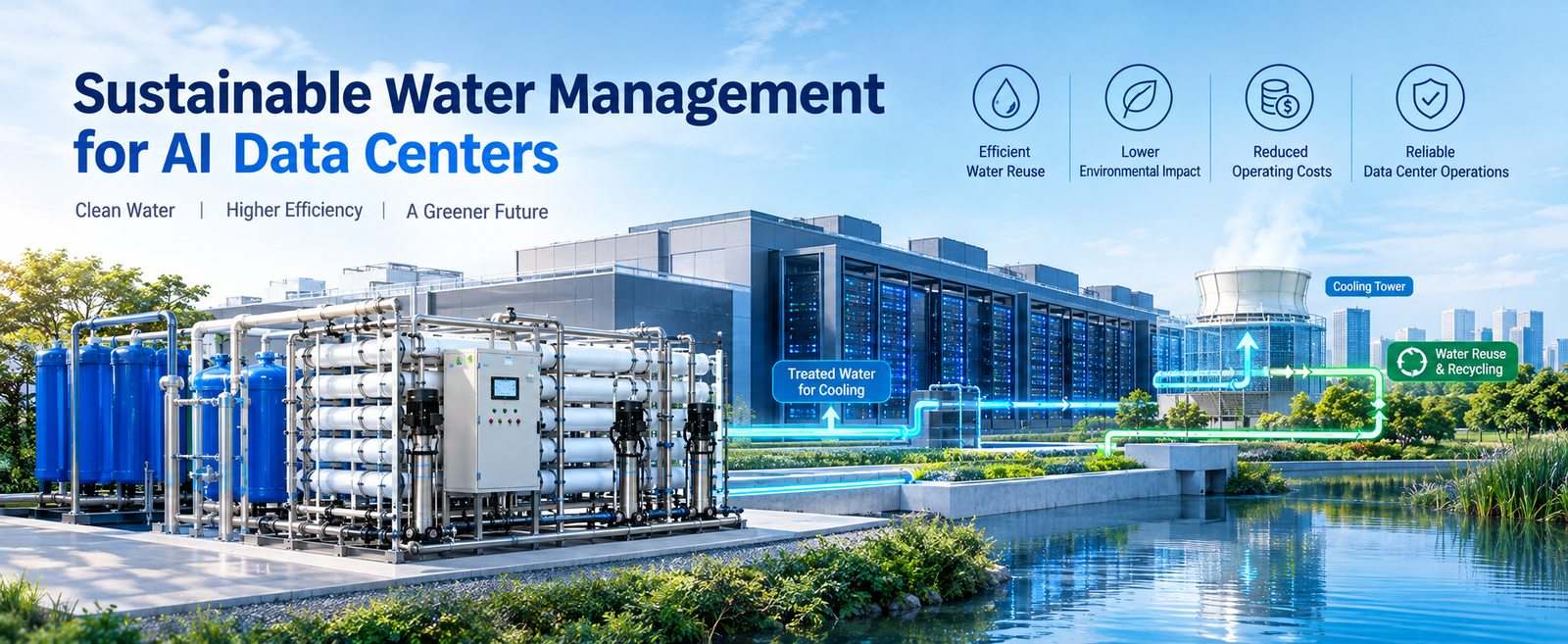
Before “sustainable” becomes a slide in the ESG report, the water plant behind it needs to clear these checkpoints:
- A documented RO recovery rate compatible with high-reuse or zero-liquid-discharge design — not a system built around a single-pass, potable-only assumption
- Pretreatment engineered specifically for reclaimed or municipal reuse water, with a real TDS and silica tolerance spec, not a generic potable-water skid relabeled for reuse duty
- Disclosed chemical dosing rates (antiscalant, biocide) per gallon treated, since that number feeds directly into supply-chain and Scope 3 water-stewardship reporting
- Membrane life and replacement interval data, because membrane lifecycle is the single biggest lever on a treatment train’s total lifecycle chemical and energy footprint
- Modular GPM capacity that can absorb a jurisdiction’s non-potable water mandate without triggering a full plant redesign
Miss any of these and “sustainable” is a claim, not an engineered outcome.
Fast Check Product: https://yourwatergood.com/product/industrial-reverse-osmosis-system/
The Water Stress Backdrop Behind Every Site Selection Decision Now
Roughly two-thirds of data centers built since 2022 sit in water-stressed regions, per a widely cited Bloomberg News analysis — a shift that has turned water allocation into a site-selection variable on par with power and land.
Loudoun County, Virginia — the densest data center market in the world — reported data center water demand of roughly 1.6 billion gallons in 2023, the most recent full-year county figure publicly available, up more than 250% over the preceding several years and approaching 10% of total county water consumption. Loudoun Water has since expanded its reclaimed-water pipeline network, delivering more than 750 million gallons to data center customers in 2025, though most facilities in the market still draw primarily from treated drinking water.
Phoenix is tracking a sharper trajectory by more than one estimate. A Ceres sustainability-nonprofit analysis projects area-wide data center cooling water demand climbing from roughly 385 million gallons a year toward 3.7 billion, against a backdrop of record-low Colorado River storage; a separate 2026 estimate cited by Arizona’s Attorney General puts planned-project growth at over 450% if every proposed Phoenix-area site is built. Either figure points the same direction. Several Arizona municipalities have already responded with hard limits — daily use caps tied to facility square footage, requirements to source supplemental non-potable supply, and in at least one case, an outright ban on potable water for data center cooling.
Sustainable water management for AI data centers has moved from a reporting exercise to a permitting gate: in a growing number of jurisdictions, the treatment plant design determines whether a project gets a water allocation at all.
Where High-Recovery RO Fits in a Site’s Overall Water Strategy
High-recovery RO is the engineering foundation that makes every other sustainability move viable. A higher recovery rate reduces the reject volume per gallon of usable permeate, which does two things simultaneously: it lowers total freshwater withdrawal, and it shrinks the volume a reclaimed or non-potable source actually needs to supply.
That second point matters more than it looks. A site trying to shift to reclaimed water without first maximizing recovery rate is sizing a reclaimed-water intake for a demand figure that’s larger than it needs to be — which raises both the reclaimed infrastructure cost and the pretreatment burden downstream.
On a five-stage industrial RO platform, raw feed water running around 1,300 ppm TDS comes down to under 20 ppm in single-stage configuration, or under 10 ppm with a two-stage pass. Capacity scales 4.4 to 44 GPM (1–10 t/h) per skid in modular increments, with a minimum 29 PSI (0.2 MPa) inlet pressure requirement — booster pumps are specified where site pressure can’t guarantee that at the skid. That range covers everything from a single-row liquid cooling retrofit to a multi-train hyperscale campus without changing the underlying architecture.
For sites facing the tightest allocations — the Marana-style all-non-potable mandates now appearing in parts of Arizona — high-recovery RO is typically the first stage in a broader zero-liquid-discharge strategy, where the reject stream itself is further concentrated and managed rather than sent to blowdown. That’s a separate engineering conversation worth having early, before a site plan gets fixed around a water source that may not clear permitting.
Request a Sustainable Water Strategy Consultation if your site is evaluating a shift toward reclaimed or non-potable makeup water ahead of a permitting deadline.
Five-Stage Pretreatment as a Lifecycle Lever, Not Just a Quality Step
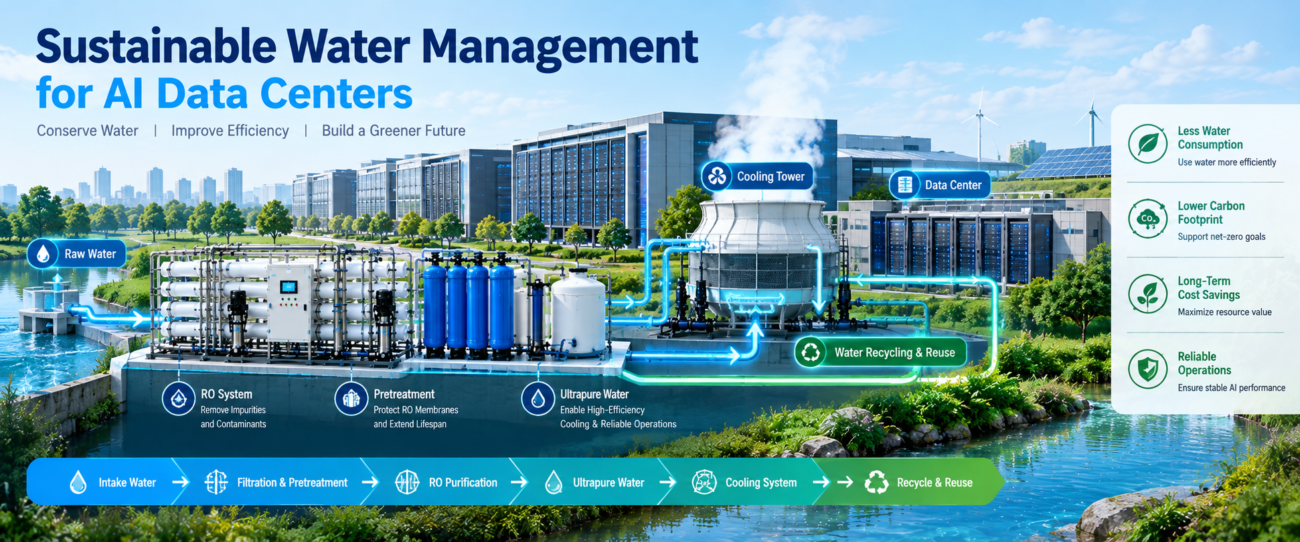
Multimedia filtration, activated carbon, ion-exchange softening, precision security filtration, and the RO membrane array each do more than protect water quality — done right, staged pretreatment is what keeps the system’s chemical and energy footprint low over its operating life.
Softening ahead of RO reduces the antiscalant dosing the membrane stage would otherwise need to prevent hardness scaling. Carbon filtration ahead of the membrane cuts oxidative damage from chlorine or chloramine, extending membrane service life and reducing how often a full chemical clean-in-place cycle is required. Fewer CIP cycles means less cleaning chemical discharged and less downtime pulled from the maintenance calendar.
None of this shows up directly in a WUE or PUE number, but it’s the difference between a treatment train that holds its performance for years and one that needs escalating chemical dosing to compensate for pretreatment gaps — a hidden lifecycle cost that undercuts the sustainability case on paper.
Municipal Supply vs. Reclaimed Water: Two Different Sustainability Designs
Municipal water and reclaimed water aren’t interchangeable feed sources, and treating them as if they are is where reuse projects run into trouble.
Municipal supply carries chlorine or chloramine residual requiring carbon-based dechlorination ahead of the membrane, with moderate, fairly predictable fouling potential.
Reclaimed or recycled water — the direction Loudoun Water and similar utilities are actively building toward — typically carries higher baseline TDS and dissolved silica, along with more variable organic loading depending on the source. A pretreatment train sized for municipal water and simply pointed at a reclaimed source will foul faster and force recovery rate down, which is the opposite of the sustainability outcome the reuse strategy was meant to deliver.
Designing for reclaimed water from the start — stronger upstream filtration and softening capacity, sized to the specific reuse source’s chemistry — is what keeps a high-recovery target achievable once potable water is no longer the default feed.
Field Engineering Insight: A Sustainability Metric That Ignores Cold Plate Risk Isn’t Sustainable
There’s a failure mode specific to sites optimizing hard for a low freshwater-withdrawal number: pushing cycles of concentration or reclaimed-water reuse rates up without matching silica and hardness control at the pretreatment stage.
The scaling risk that creates doesn’t stay in the cooling tower basin. It travels downstream to the tightest tolerances in the loop — cold plate microchannels running under 100 microns on current-generation accelerator hardware — where fouling shows up as reduced heat transfer long before anyone notices a water-quality trend line moving the wrong way.
A sustainable water management for AI data centers program that trades cooling reliability for a marginally better withdrawal number hasn’t actually reduced the site’s risk profile — it’s shifted the risk from a water bill to a thermal-throttling event on a GPU row that costs far more to remediate.
Standard Pre-Engineered Skids vs. Data Center–Grade High-Redundancy Systems
| Parameter | Standard Pre-Engineered Skid | Data Center–Grade High-Redundancy System |
|---|---|---|
| Flow control | Fixed GPM band, manual valve trim | Automated GPM trim across parallel trains |
| Redundancy | Single train (N); service requires downtime | N+1 or 2N parallel trains; hot-swap capable |
| Reclaimed-water pretreatment depth | Sized for municipal-grade fouling potential | Engineered softening/filtration margin for variable reclaimed-source chemistry |
| BMS / SCADA integration | Local PLC + HMI, standalone alarms | PLC-to-BMS/SCADA handoff, remote alarm escalation, historian logging |
| Delivery lead time | Shorter — standard configuration | Longer — engineered-to-order for site redundancy |
| Filtration precision | 5-stage baseline (multimedia → carbon → softening → security filter → RO) | Same 5-stage baseline, duplexed critical components, tighter alarm bands |
A single-source, potable-fed site can often run a standard skid with strong results. A campus blending municipal and reclaimed sources under a local water-use ordinance is a different engineering problem, and generally needs the deeper pretreatment margin the higher-redundancy configuration is built around.
FAQ
Why is sustainable water management now a site-selection factor for AI data centers? Because a growing number of water-stressed jurisdictions — including parts of Virginia and Arizona — now cap or restrict potable water use for data center cooling, making treatment plant design a permitting requirement rather than an optional ESG initiative.
What role does RO recovery rate play in a sustainable water strategy? A higher recovery rate lowers total freshwater withdrawal and reduces the volume a reclaimed or non-potable source has to supply, making the rest of a reuse strategy smaller and easier to permit.
Can reclaimed or recycled water fully replace potable water for AI data center cooling? In some jurisdictions it’s becoming a requirement rather than an option, but it requires pretreatment engineered specifically for reclaimed water’s higher TDS and silica load — a municipal-water-sized system won’t hold recovery rate on that feed.
How does five-stage pretreatment reduce a system’s lifecycle environmental footprint? Proper staging reduces downstream antiscalant and biocide dosing, extends membrane service life, and cuts the frequency of chemical clean-in-place cycles — all of which lower the total chemical and energy footprint per gallon treated over the system’s life.
What’s the difference between high-recovery RO and zero liquid discharge? High-recovery RO minimizes reject volume from a single treatment pass; zero liquid discharge goes further, further concentrating and managing that reject stream so effectively no liquid effluent leaves the site — typically layered on top of a high-recovery RO front end.
Do local water-use ordinances affect what treatment system a site needs? Yes — ordinances that cap potable use or mandate non-potable supplemental sources directly determine whether a site needs municipal-grade or reclaimed-grade pretreatment capacity, and that decision needs to be made before construction, not retrofitted after.
Does chasing a sustainability metric ever conflict with cooling reliability? It can, if cycles of concentration or reuse rates are pushed up without matching silica and hardness control — the resulting scaling risk shows up first at cold plate microchannels, trading a water metric for an uptime risk.
A water strategy that holds up under both a permitting review and a full year of AI training load starts with real engineering: an Infrastructure Engineering Quote sized to your site’s specific feed water and reuse targets, full Technical Data Sheets for your sustainability and mechanical teams, and B2B wholesale / factory-direct pricing on the skid and control package. Request all three before your site plan gets locked around a water source that hasn’t been engineered for yet.