
The Strategic Necessity of Commercial Food Service Water Filtration: Protecting Assets and Brand Consistency in the US

In the highly competitive American hospitality landscape, from the artisanal coffee shops of the Pacific Northwest to the busy farm-to-table diners in the Midwest, operational excellence is the bedrock of profitability. Small business owners and restaurateurs invest heavily in premium ingredients, high-grade kitchen equipment, and interior design. However, one critical ingredient—water—is often overlooked despite being the foundation of nearly every beverage and dish served. Implementing a robust commercial food service water filtration strategy is not merely an operational choice; it is a fundamental business protection strategy that secures your return on investment and guards your brand reputation.
The Strategic Importance of Commercial Food Service Water Filtration
In the modern foodservice landscape of Today, commercial food service water filtration is recognized as a vital infrastructure investment that directly impacts both product quality and operational ROI. For restaurants and cafes across the United States and Europe, water is the most frequent ingredient used; therefore, its chemical consistency is paramount.
The Three Pillars of Foodservice Water Quality
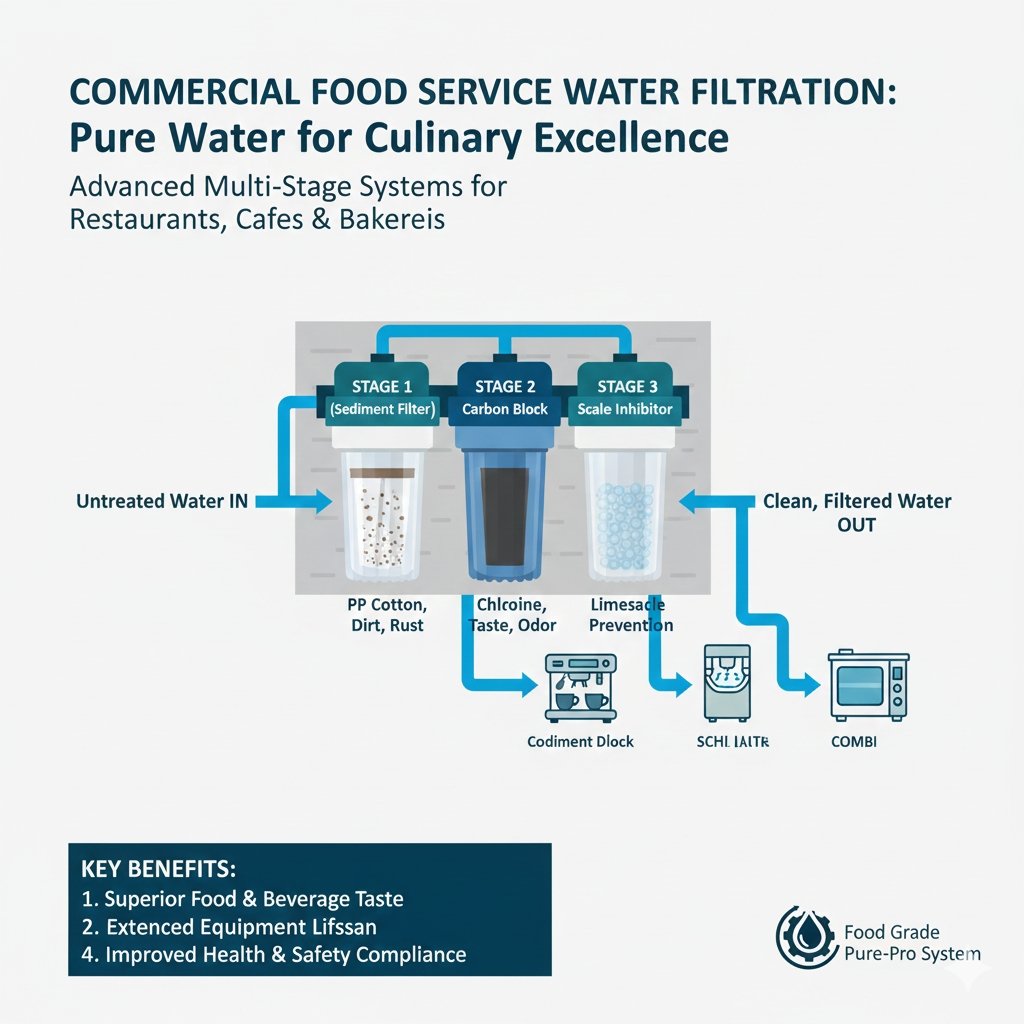
- Equipment Longevity & Protection: Scale buildup is the primary cause of failure in expensive espresso machines and steamers. Advanced filtration systems neutralize minerals before they can cause “mechanical fatigue,” reducing unplanned maintenance costs by up to 35%.
- Flavor Standardization: Chlorine, chloramines, and organic compounds can alter the delicate flavor profiles of specialty coffee and fountain beverages. High-flow carbon filtration ensures a “neutral baseline,” allowing your ingredients to shine.
- Regulatory & Safety Compliance: Modern systems provide a certified barrier against 99.99% of waterborne bacteria and cysts, ensuring that your establishment meets the highest public health standards.
Fast Check Product:https://yourwatergood.com/product/5-stage-ro-water-filter-for-home-busines/
Premier Solutions for the Foodservice Industry
For small businesses looking for the reliability of a global leader with the agility of a niche specialist, YourWaterGood offers a comprehensive suite of high-performance products. As a premier pp cotton household water purifier company, they have leveraged their precision technology to create commercial-grade solutions for the US and European markets.
Their specialized offerings include:
Multi-Stage RO Purifiers: High-output systems specifically engineered for the rigorous demands of restaurant kitchens.
High-Density PP Cotton Filters: An elite first-line defense that captures sand, silt, and rust, protecting your delicate downstream equipment.
Scalable Commercial Kits: Modular systems that can grow alongside your business, from a small cafe to a full-service restaurant.
To explore technical specifications or to consult on the best filtration strategy for your specific equipment, visit www.yourwatergood.com. Investing in professional water filtration is the most direct path to guaranteeing a superior dining experience and protecting your kitchen assets.
Navigating the American Water Landscape: Regional Challenges and Compliance
The United States presents a complex tapestry of geological and infrastructural challenges. Depending on your geographic location, your facility may face specific contaminants that can cripple high-specification kitchen machinery.
Regional Water Challenges Across the US
- The Midwest and Heavy Metals: In the American heartland, many businesses rely on well water that is often subject to heavy metal intrusion. Agricultural runoff can introduce nitrates and pesticides into the groundwater, while geological deposits can result in elevated levels of lead or iron. Without specialized commercial food service water filtration, these elements can lead to bitter tastes and accelerated corrosion of internal copper piping.
- Texas and the Southwest (The Hard Water Belt): Establishments in Texas, Arizona, and New Mexico frequently contend with extreme mineral hardness. The high concentrations of calcium and magnesium in these regions lead to rapid scale accumulation. When water is heated—as it is in espresso machines and steamers—these minerals solidify, forming a rock-like crust that insulates heating elements and restricts water flow.
- Coastal Regions and Sediment Issues: Coastal areas and older urban centers often suffer from high sediment loads and silt. Aging infrastructure can release rust and micro-particles into the supply line. These abrasive particles act like sandpaper on the internal seals and pumps of commercial machinery, leading to premature wear and catastrophic mechanical failure.
Compliance with EPA Drinking Water Standards
Every professional commercial food service water filtration system must align with the framework provided by the United States Environmental Protection Agency (EPA). The EPA sets national primary drinking water regulations that limit the levels of specific contaminants to ensure safety. For a business owner, ensuring your water meets or exceeds these standards is not only a matter of public health but also a shield against liability. A professional filtration setup provides a secondary, fail-safe layer of protection between the raw source water and your customers’ glasses.
The Economic Engine: ROI Analysis and Asset Protection
For a small business, a commercial food service water filtration system should be viewed as an insurance policy for your most expensive assets. The return on investment (ROI) is realized through three primary channels: extended equipment life, reduced service calls, and energy efficiency.
Defending High-Specification Equipment
Modern commercial equipment is designed with precision, but it is also highly sensitive to water chemistry.
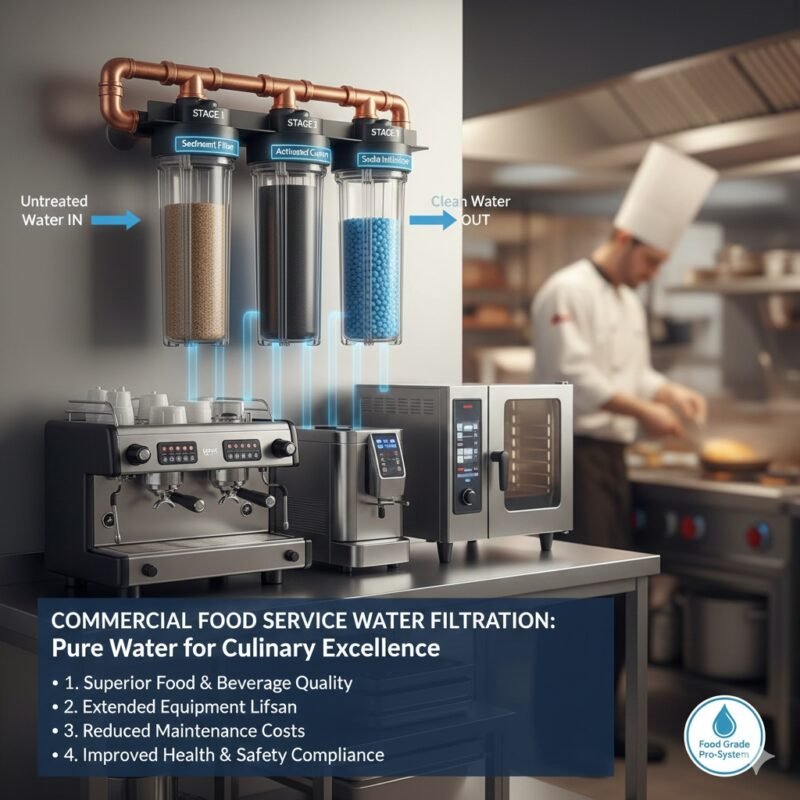
- Espresso Machines: A high-end espresso machine can cost thousands of dollars. Scale buildup from hard water is the leading cause of boiler failure and temperature instability. By removing the minerals that cause scale, you ensure that the machine maintains a consistent brewing temperature and pressure, which is vital for specialty coffee extraction.
- Commercial Ice Makers: Ice makers are notoriously finicky. If the water contains high levels of dissolved solids, the ice becomes cloudy and brittle. More importantly, scale on the evaporator plates prevents the ice from dropping correctly, leading to mechanical jams. A dedicated commercial food service water filtration unit ensures crystal-clear ice and a lower frequency of expensive technician visits.
- Steamers and Dishwashers: In high-volume kitchens, steamers and dishwashers are workhorses. Iron and rust in the water can stain glassware and clog the fine spray nozzles of steamers, resulting in uneven cooking and unhygienic results.
Operational Savings and Energy Efficiency
Scale does more than break machines; it makes them work harder. Even a thin layer of mineral scale on a heating element acts as an insulator, requiring the machine to consume more electricity to reach the desired temperature. By maintaining a clean, mineral-free internal environment, your equipment operates at peak thermal efficiency. Over several years, the savings in utility bills and the avoidance of emergency plumbing fees can easily pay for the initial cost of the commercial food service water filtration system.
Brand Reputation and Consistency: The Sensory Impact
In the hospitality industry, consistency is the hallmark of a successful brand. A customer who visits your cafe expects their favorite drink to taste exactly the same every single time.
Eliminating Off-Tastes and Odors
Municipal water in the US is often treated with high levels of chlorine or chloramines to ensure safety. While effective for disinfection, these chemicals impart a sharp, medicinal odor and taste. If your water has a “swimming pool” scent, it will inevitably mask the delicate flavor notes of your high-quality coffee beans or artisanal teas. Commercial food service water filtration utilizing high-capacity carbon blocks strips away these offensive odors, providing a neutral canvas that allows your ingredients to shine.
The Impact of Nitrates and Iron
In rural settings where well water is common, the presence of nitrates and iron can alter the chemical reactions during baking or brewing. Iron can leave a metallic aftertaste and cause reddish-brown staining on porcelain and glassware, which can lead to a negative perception of your establishment’s cleanliness. Consistency in water quality ensures that your brand reputation remains untarnished across all your service points.
Strategic Comparison: POE vs. POU Systems
When designing a facility-wide water strategy, business owners must choose between Point of Entry (POE) and Point of Use (POU) filtration. The choice significantly affects both maintenance efficiency and initial capital expenditure.
Point of Entry (POE): Whole-Facility Protection
A POE system is installed where the main water line enters the building. Its primary job is to treat all water used in the facility, including bathrooms, mop sinks, and dishwashers.
- Pros: Protects the entire plumbing system from rust and bulk sediment; reduces staining in toilets and sinks.
- Cons: It is often inefficient to treat water used for mopping floors to the same high standard as water used for brewing espresso.
Point of Use (POU): Targeted Precision
POU systems are installed directly at the terminal equipment, such as under the counter for a soda fountain or behind an espresso machine.
- Pros: Allows for specialized filtration (like reverse osmosis) specifically for high-margin beverages; easier to monitor for flavor consistency.
- Cons: Requires maintaining multiple filter sets throughout the building.
The Hybrid Efficiency Model
For most American restaurants, a hybrid approach is ideal. A robust POE sediment filter handles the “heavy lifting” by removing grit and sand that could damage the building’s pipes, while specialized POU commercial food service water filtration units are used at beverage stations to provide the high-purity water required for taste and equipment protection.
The Role of a specialized PP Cotton Household Water Purifier Company
The science of filtration begins with the first stage of the system. As a leading pp cotton household water purifier company, we understand that material science is the foundation of effective filtration. Polypropylene (PP) cotton filters are the unsung heroes of the commercial kitchen.
High-Flow Pressure and Durability
In a commercial environment, water pressure is a constant variable. High-demand periods, like a Sunday brunch rush, require high flow rates measured in Gallons Per Minute (GPM). A filter must be able to withstand significant Pounds Per Square Inch (PSI) without collapsing or allowing “bypass”—where water goes around the filter instead of through it.
- PSI Resilience: Our PP cotton filters are engineered to maintain structural integrity under high PSI, ensuring that even when the municipal pressure spikes, your equipment remains protected.
- GPM Performance: Unlike standard home filters, commercial-grade PP cotton must allow for high GPM output. By utilizing graduated density layers—where the outer layers catch large sediment and the inner layers catch microscopic particles—we ensure that your water flow remains strong and consistent.
Our expertise as a pp cotton household water purifier company allows us to provide pre-filtration solutions that extend the life of more expensive downstream filters, such as carbon blocks and reverse osmosis membranes. By catching the heavy sediment early, you reduce the total cost of ownership for your entire system.
Technical Spotlight: The 5-Stage RO Solution for Small Business
For many boutique cafes and farm-to-table restaurants, the water needs to be of the highest possible purity. Standard carbon filtration is often insufficient when dealing with the high nitrate levels or total dissolved solids (TDS) found in some American well water.
In these cases, we recommend the 5-Stage RO Water Filter for Home and Business. This system is specifically designed to meet the high standards of the US market. It offers:
- High-Flow Delivery: Engineered to provide the GPM required for a busy commercial environment.
- Low Maintenance Costs: By utilizing high-capacity cartridges, it reduces the frequency of replacements.
- Versatile Application: It is the ideal solution for small business owners who want a professional-grade system that is as reliable in a home as it is in a commercial setting.
By integrating this system into your commercial food service water filtration plan, you ensure that every drop of water used for cooking and drinking is stripped of harmful contaminants and minerals, leaving only pure, high-quality water.
Professional Maintenance Guide for US Operators
A filtration system is only as good as its maintenance schedule. In the US, where water conditions can shift seasonally, proactive monitoring is essential to avoid downtime.
Monitoring PSI and GPM
- Pressure Gauges: Every professional system should have pressure gauges installed before and after the filter housings. If you notice a significant drop in PSI between the two gauges, it indicates that the filter is clogged and needs immediate replacement.
- Flow Rate Checks: If your espresso machine is filling slower than usual, check your GPM. A decrease in flow is a sure sign that your sediment filters have reached their capacity.
Scheduled Filter Replacements
- Pre-Filters (PP Cotton): These should typically be replaced every three to six months, depending on the local sediment load.
- Carbon Blocks: These are critical for flavor. If you begin to smell chlorine or notice an off-taste in your water, replace the carbon stage immediately.
- RO Membranes: While durable, reverse osmosis membranes should be tested annually with a TDS meter to ensure they are still rejecting minerals effectively.
FAQ: Addressing Small Business Concerns
Q: Will a commercial food service water filtration system reduce my building’s water pressure? A: If sized correctly, the impact is minimal. We ensure that our systems match your required GPM and can handle the standard PSI of your facility without causing bottlenecks at the tap.
Q: Can I use a standard residential filter for my small restaurant? A: It is not recommended. Commercial environments demand much higher flow rates and total gallon capacities. A residential filter will clog quickly, resulting in frequent downtime and potentially damaging your commercial equipment.
Q: Why should I care about nitrates in my well water? A: Beyond being a health concern under EPA standards, nitrates can be corrosive to certain metal alloys found in commercial kitchen equipment, leading to pinhole leaks over time.
Q: Is it difficult to install a POU system like the 5-Stage RO? A: Not at all. These systems are designed for ease of installation and can typically be integrated into your existing plumbing by a professional plumber in a single afternoon.
Conclusion: Elevate Your Business Infrastructure
Investment in a premium commercial food service water filtration system is an investment in the longevity and quality of your business. By protecting your espresso machines, ice makers, and steam ovens from the destructive forces of scale, rust, and chemical corrosion, you secure your operational future. Furthermore, by providing your customers with the cleanest, most consistent water possible, you build a brand reputation for quality that is undeniable.
In the American market, where consumer expectations are high and equipment costs are rising, you cannot afford to overlook your water quality. From the material science of our pp cotton household water purifier company to our high-flow RO systems, we provide the tools you need to succeed.
Ready to secure your equipment and perfect your flavors? Visit www.yourwatergood.com today to explore our full range of professional filtration solutions. Whether you need a high-capacity system for your restaurant or a reliable RO unit for your home-based business, we have the expertise to guide you. Contact our commercial team today for a consultation tailored to your specific regional water challenges.