
Safeguarding Restaurant Operations with a Commercial Water Filtration System Restaurant Owners Can Rely On

H1. Why Every U.S. Restaurant Needs a Commercial Water Filtration System Restaurant Strategy
Across the United States, restaurant operators and farm-to-table business owners depend on water for almost every part of their service: coffee, tea, ice, soups, sauces, dishwashing, and cleaning. When the source is municipal supply or private wells with variable quality, water becomes a hidden risk factor. Rust, nitrates, sediments, and hard minerals can quietly damage equipment, harm product consistency, and weaken brand reputation.
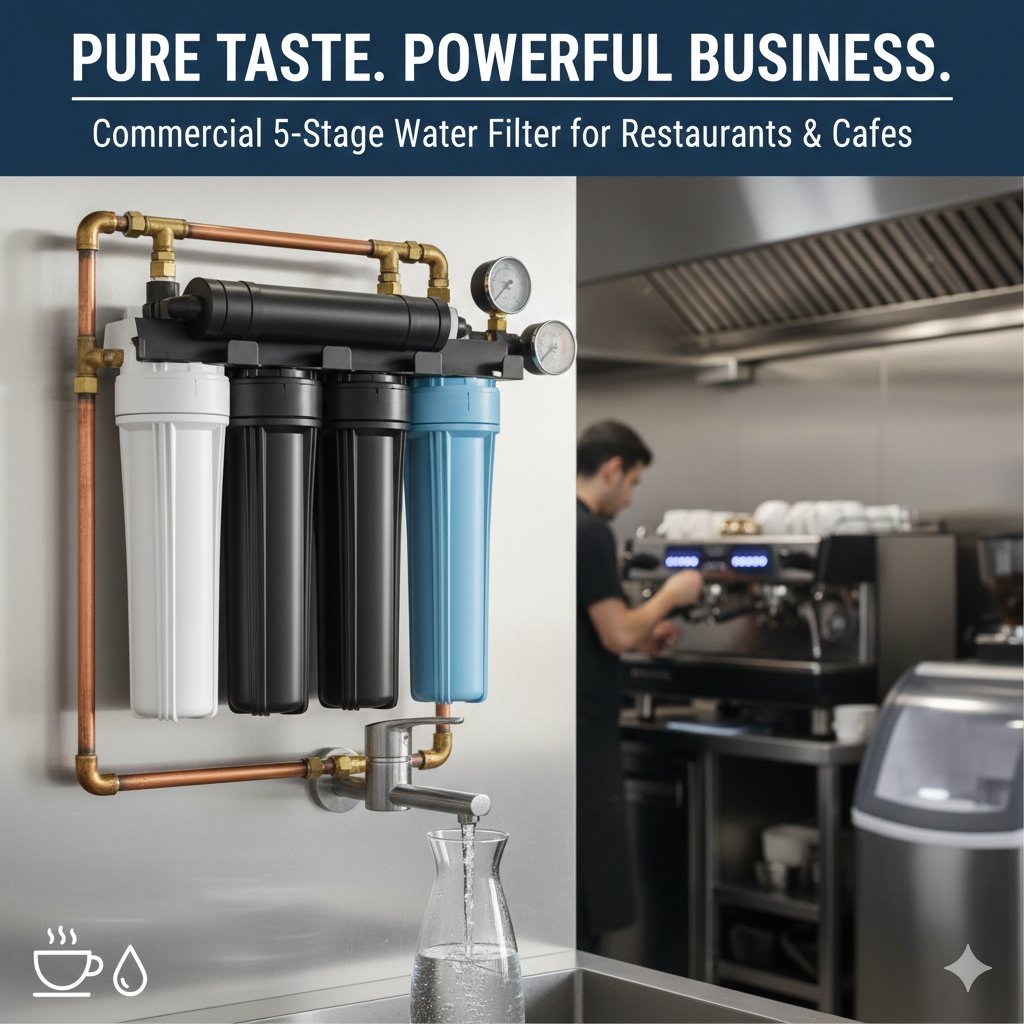
A commercial water filtration system restaurant solution is not just a utility add‑on; it is a core infrastructure component for any serious food service business. By integrating an engineered system that controls flow, pressure, and contaminant removal for the entire operation, restaurant owners can protect expensive equipment, stabilize taste profiles, and meet customer expectations for clean, safe, and great‑tasting water.https://yourwatergood.com/product/5-stage-ro-water-filter-for-home-busines/.
The U.S. Water Reality: Regional Well Water Challenges Restaurants Cannot Ignore
Midwestern Heavy Metals and Their Impact on Kitchen Assets
In the Midwest, many restaurants and rural diners rely on well water that can contain elevated levels of heavy metals such as iron, manganese, and sometimes even lead. These contaminants:
- Discolor sinks, dishware, and stainless surfaces.
- Create metallic or bitter flavors in beverages and soups.
- Accelerate internal corrosion in espresso boilers, ice machines, steamers, and water lines.
For these operators, a commercial water filtration system restaurant configuration must emphasize strong sediment and metal reduction capabilities at the building entry. Without such protection, even high‑end commercial equipment can experience premature failure, leak formation, and emergency downtime that disrupts service.
Texas and Southwestern Hard Water: Scale as a Silent Profit Killer
In Texas and other Southwestern states, high levels of calcium and magnesium produce hard water. The consequences for a busy kitchen include:
- Scale buildup in dishwashers and combi ovens, reducing thermal efficiency.
- Reduced effective GPM (Gallons Per Minute) in lines feeding espresso machines and ice makers due to narrowing passages.
- Increased detergent and descaling chemical usage, eroding profit margins.
A properly designed commercial water filtration system restaurant solution in these regions typically combines sediment pre‑filtration, carbon filtration, and scale control technologies. The objective is to maintain stable flow and PSI (Pounds Per Square Inch) to each piece of equipment, while reducing the tendency of minerals to deposit on heating surfaces and spray nozzles.
Coastal Sediment and Intrusion: Protecting Service Quality Near the Shore
Restaurants along the Atlantic and Pacific coasts often face elevated sediment loads and potential saltwater intrusion into aquifers. For them, the challenges include:
- Cloudy ice and beverages from suspended particles.
- Abrasive wear inside valves and pump seals.
- Unpleasant tastes and odors that undermine premium menus.
Here, a commercial water filtration system restaurant approach must incorporate high‑capacity sediment cartridges and robust carbon media to remove particles and organic contaminants before they reach bar taps, ice bins, and kitchen prep stations. When sediment is controlled at the system level, bar staff see clearer drinks, kitchen staff see cleaner rinse water, and guests perceive higher quality.
Aligning with EPA Drinking Water Standards: Compliance and Confidence
Why EPA Framework Matters for Restaurants
The Environmental Protection Agency (EPA) defines maximum contaminant levels and a broader framework for safe drinking water in the United States. For restaurants, compliance with these standards is about more than passing inspections; it is about trust. Guests assume that the water used in cooking, beverages, and ice is safe and clean.
A commercial water filtration system restaurant design that aligns with EPA guidelines helps:
- Reduce regulated contaminants like nitrates and heavy metals to within safe thresholds.
- Minimize disinfectant byproducts and chlorine tastes from municipal sources.
- Support documentation and testing processes when health departments audit your facility.
Rather than relying solely on the local utility or well testing, restaurant owners can use a properly engineered system as an additional safeguard, reinforcing their commitment to safety and quality.
Flow, Pressure, and Safety in a Commercial Context
Beyond contaminant limits, EPA‑aligned filtration solutions respect the operational realities of commercial plumbing. A fully loaded kitchen may have multiple appliances running simultaneously: ice makers, espresso machines, dishwashers, and prep sinks. The commercial water filtration system restaurant configuration should:
- Maintain design GPM at peak service without choking supply.
- Keep system PSI within stable ranges to prevent pressure shocks and leaks.
- Avoid channeling and bypassing that could compromise filtration performance.
In practice, this means proper sizing, industrial‑grade housings, and media selection tailored to both the chemical profile and the operational demands of the restaurant.
ROI: How a Commercial Water Filtration System Restaurant Investment Pays for Itself
Extending the Life of High‑Value Equipment
Espresso machines, ice makers, combi ovens, and high‑capacity dishwashers represent major capital expenses. When they are fed untreated or poorly treated water, impurities such as iron, rust, and scale‑forming minerals attack internal components. Nitrates and other dissolved solids can contribute to corrosion and buildup over time.
A commercial water filtration system restaurant solution delivers measurable ROI through:
- Fewer service calls for clogged valves, scaled heat exchangers, or failed pumps.
- Longer service life before major rebuilds or replacements are needed.
- More stable operating conditions that reduce energy consumption and chemical costs.
For example, an espresso machine that routinely requires descaling and part replacement due to hard water may only last a fraction of its potential lifespan. With a consistent filtered water supply, it can operate closer to its design life while maintaining brew quality.
Reducing Downtime and Service Interruptions
When a critical device fails during a busy service period, the impact is immediate:
- Lost sales due to limited menu offerings.
- Negative guest experiences that often translate into reviews and social media posts.
- Overworked staff forced to work around missing capabilities.
By preventing scale, rust, and sediment from entering equipment, a commercial water filtration system restaurant configuration reduces unplanned downtime. Instead of reacting to crises, managers can schedule predictable maintenance based on filter change intervals and performance metrics.
Strengthening Brand Reputation Through Consistent Water Quality
Brand reputation in food service is tied to consistency. Guests return when coffee tastes the same every time, ice is always clear, and dishware looks spotless. Poor water quality undermines that consistency by:
- Altering flavor profiles of beverages and broths.
- Causing cloudy ice or off odors in drinks.
- Leaving mineral spots and films on glassware and plates.
With a properly engineered commercial water filtration system restaurant strategy, water chemistry becomes stable, so recipes and beverages deliver the same experience day after day. This consistency supports premium pricing, repeat business, and positive feedback that builds long‑term brand equity.
Inside a Commercial Water Filtration System Restaurant Design: Technical Components That Matter
PP Cotton as the First Line of Defense
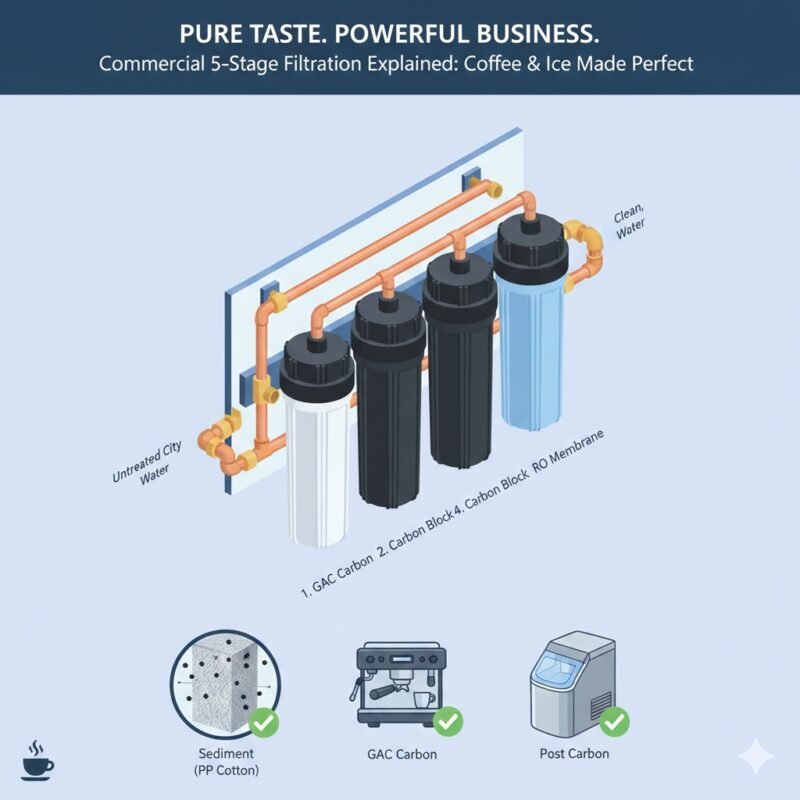
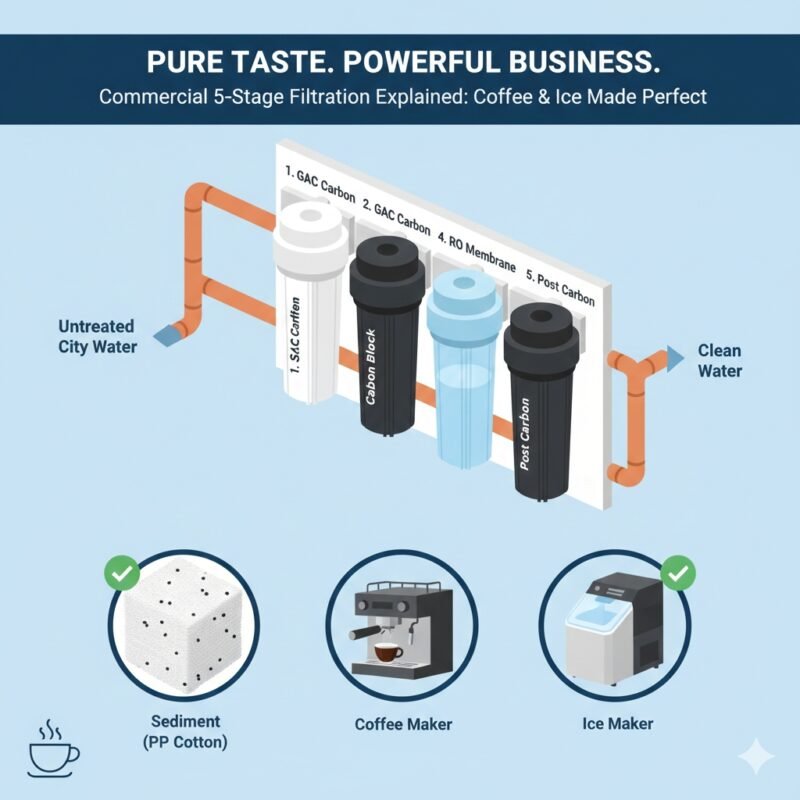
As a material‑science‑driven manufacturer, pp cotton household water purifier company focuses on the backbone of high‑flow filtration in commercial settings: PP cotton sediment cartridges. These filters are engineered with:
- High‑density fiber structures to capture fine sediments, rust, and suspended solids.
- Strong structural integrity to withstand elevated PSI typical of commercial plumbing.
- Optimized pore gradients to support high GPM without excessive pressure drop.
In a commercial water filtration system restaurant configuration, PP cotton cartridges protect downstream stages, such as carbon blocks or specialty media, from premature clogging. This not only improves water clarity but also extends the life of more expensive filter stages, lowering total operating costs.
Carbon Filtration for Taste, Odor, and Chemical Reduction
Activated carbon is central to any commercial water filtration system restaurant that prioritizes beverage quality and customer satisfaction. Carbon stages are used to:
- Remove chlorine and chloramine used by municipalities for disinfection.
- Reduce organic compounds that cause off tastes and smells.
- Support a clean flavor profile for coffee, tea, cold beverages, and soups.
Restaurant operators often notice that once carbon filtration is installed, the difference in their coffee, tea, and even plain water is immediately perceptible. It becomes easier to showcase premium ingredients when the water foundation is neutral and consistent.
Specialty Media for Iron, Nitrates, and Scale Control
For well‑based restaurants or locations with specific contamination patterns, specialty media may be integrated:
- Iron reduction media to prevent rust staining and metallic flavors.
- Nitrate targeting media to help meet EPA‑aligned standards and protect equipment from corrosive influences.
- Scale control media that modify calcium and magnesium behavior, reducing their tendency to precipitate onto heating surfaces.
By combining these elements into one unified commercial water filtration system restaurant layout, operators can address multiple risk factors with a single, cohesive framework rather than a patchwork of small filters.
POE vs POU: Which Strategy Works Best for Restaurants?
Defining POE and POU in a Restaurant Context
- POE (Point of Entry): Filtration installed where water enters the building, treating all downstream uses.
- POU (Point of Use): Filtration installed at specific outlets or equipment, such as a single espresso machine or bar sink.
Both can be useful, but they have very different implications for maintenance, consistency, and long‑term cost. For most serious operators, a blended approach anchored by POE yields the best outcomes.
Commercial Water Filtration System Restaurant Comparison Table
| Aspect | POE – Whole Restaurant Entry | POU – Individual Outlet or Appliance |
|---|---|---|
| Coverage | Entire facility, including kitchen, bar, restrooms, and ice | Single station such as espresso, soda fountain, or prep sink |
| Maintenance | Centralized filter changes, fewer locations to manage | Multiple cartridges scattered across equipment, higher labor |
| Water Quality Consistency | Uniform across all taps and machines | Varies from one location to another |
| Equipment Protection | Protects every connected device | Only protects specific devices with filters attached |
| Flow and PSI Management | Designed at system level for stable GPM and PSI | Localized, may not solve overall system issues |
| Best Use Case | Restaurants with multiple appliances and high throughput | Targeted polishing for specialty beverages or final taste control |
In practice, a commercial water filtration system restaurant solution often uses a strong POE backbone to cover the entire building, then adds select POU filters for premium coffee or special bar applications. This combination reduces overall maintenance complexity while preserving flexibility for specific use cases.
Recommended Solution Highlight: Five‑Stage RO for Restaurant‑Grade Purity
One highly adaptable option for many operators is the 5‑Stage RO Water Filter for Home & Business. While suitable for residential users, it is also engineered to serve as part of a commercial water filtration system restaurant approach for small to medium locations.
Key benefits include:
- Multi‑stage purification that integrates sediment, carbon, and reverse osmosis to address a wide range of contaminants common in both municipal and well water.
- High‑flow design that can be configured to support demanding restaurant tasks while maintaining appropriate GPM levels for connected outlets.
- Low maintenance cost with standardized filter elements and clear replacement schedules, ideal for busy operators who need predictable service routines.
For restaurant owners looking for a bridge between home‑grade and full industrial solutions, this system offers a practical, high‑standard choice that aligns with U.S. expectations for safety and performance.
Maintenance Best Practices in the U.S. Restaurant Environment
Monitoring Flow, Pressure, and Performance
Once a commercial water filtration system restaurant setup is in place, the key to extracting long‑term value is disciplined maintenance. Operators should:
- Track incoming and outgoing PSI to detect early signs of filter clogging or system stress.
- Monitor GPM at critical points such as dishwashers and espresso machines to ensure consistent supply.
- Use simple logs or digital systems to record filter changes, inspections, and test results.
When flow or pressure starts to decline, it signals that sediment or other contaminants are loading the filters. Addressing these issues early prevents nuisance problems like slow dishwash cycles or underperforming coffee equipment.
Filter Replacement and Sanitary Procedures
PP cotton and carbon cartridges should be replaced according to manufacturer guidance and adjusted for real‑world loading. In high‑sediment or heavy‑use environments, replacement intervals may be more frequent. Key practices include:
- Shutting down and depressurizing the system before any filter change.
- Sanitizing housings where appropriate to prevent microbial growth.
- Verifying seals and O‑rings to maintain leak‑free operation under commercial PSI conditions.
These habits transform a commercial water filtration system restaurant from a static install into a managed asset that delivers predictable, measurable value.
FAQ for U.S. Restaurant Owners Considering a Commercial Water Filtration System Restaurant Solution
1. Do I really need a system if I use municipal water?
Yes. Municipal water is treated for safety, but it often contains chlorine, sediments, and minerals that can affect flavor and equipment life. A commercial water filtration system restaurant strategy polishes this water to meet your operational and brand standards.
2. Can one system serve both the kitchen and bar?
In many cases, yes. A properly sized POE system can support both kitchen and bar while maintaining adequate GPM and PSI. You can still add POU units at critical stations for extra polish.
3. How does filtration help my espresso and ice machines?
By reducing scale‑forming minerals, rust, and nitrates, a commercial water filtration system restaurant configuration prevents blockages and corrosion in delicate internal components. The result is more consistent extraction, cleaner ice, and longer machine life.
4. How do I know which media and stages I need?
The best approach is to test your water and work with a supplier that understands local conditions. As pp cotton household water purifier company, we routinely analyze contaminant profiles and then design systems using PP cotton, carbon, and specialty media configured for the specific restaurant environment.
5. What if my restaurant relies on well water?
For well water, a commercial water filtration system restaurant setup is especially important. You may need dedicated stages for iron, nitrates, sediment, and sometimes additional disinfection. A tailored POE system can make well water suitable for food service and beverage applications while helping maintain EPA‑aligned quality.
From Risk to Advantage: Turning Water Quality into a Strategic Asset
For restaurant owners, water can either be an invisible liability or a competitive advantage. Untreated or poorly treated water quietly damages equipment, disrupts service, and erodes the guest experience. In contrast, a well‑designed commercial water filtration system restaurant strategy:
- Protects critical assets from rust, nitrates, and scale.
- Stabilizes taste, clarity, and presentation across beverages and dishes.
- Supports compliance with EPA drinking water standards and health inspections.
- Enhances brand reputation by ensuring every glass, cup, and plate reflects your standards.
In an industry where margins are tight and competition is intense, treating water as a strategic input rather than an afterthought can make a measurable difference. By partnering with a specialist like pp cotton household water purifier company, and leveraging advanced PP cotton filtration and multi‑stage systems, restaurants can transform their water infrastructure into a reliable, profit‑protecting asset.
Strong CTA: Take Control of Your Restaurant’s Water Today
If you operate a restaurant, café, farm‑based kitchen, or multi‑unit food service business in the United States, now is the time to evaluate your water quality. Hidden issues in your source water may already be shortening equipment life, raising maintenance costs, and diluting your guest experience.
A professional commercial water filtration system restaurant design can change that trajectory.
- Protect your espresso machines, ice makers, and dishwashers from rust, nitrates, and scale.
- Deliver consistent, high‑quality water to every prep station, bar, and service area.
- Strengthen your brand reputation by aligning water quality with your menu and guest expectations.
Reach out to a trusted filtration partner with deep materials science expertise and proven PP cotton technology. Build a system that fits your location, your menu, and your growth plans—and turn clean, reliable water into a cornerstone of your restaurant’s long‑term success.
One thought on “Safeguarding Restaurant Operations with a Commercial Water Filtration System Restaurant Owners Can Rely On”