
Commercial Water Filtration System for Restaurant Costs: What Actually Drives the Price and the Payback

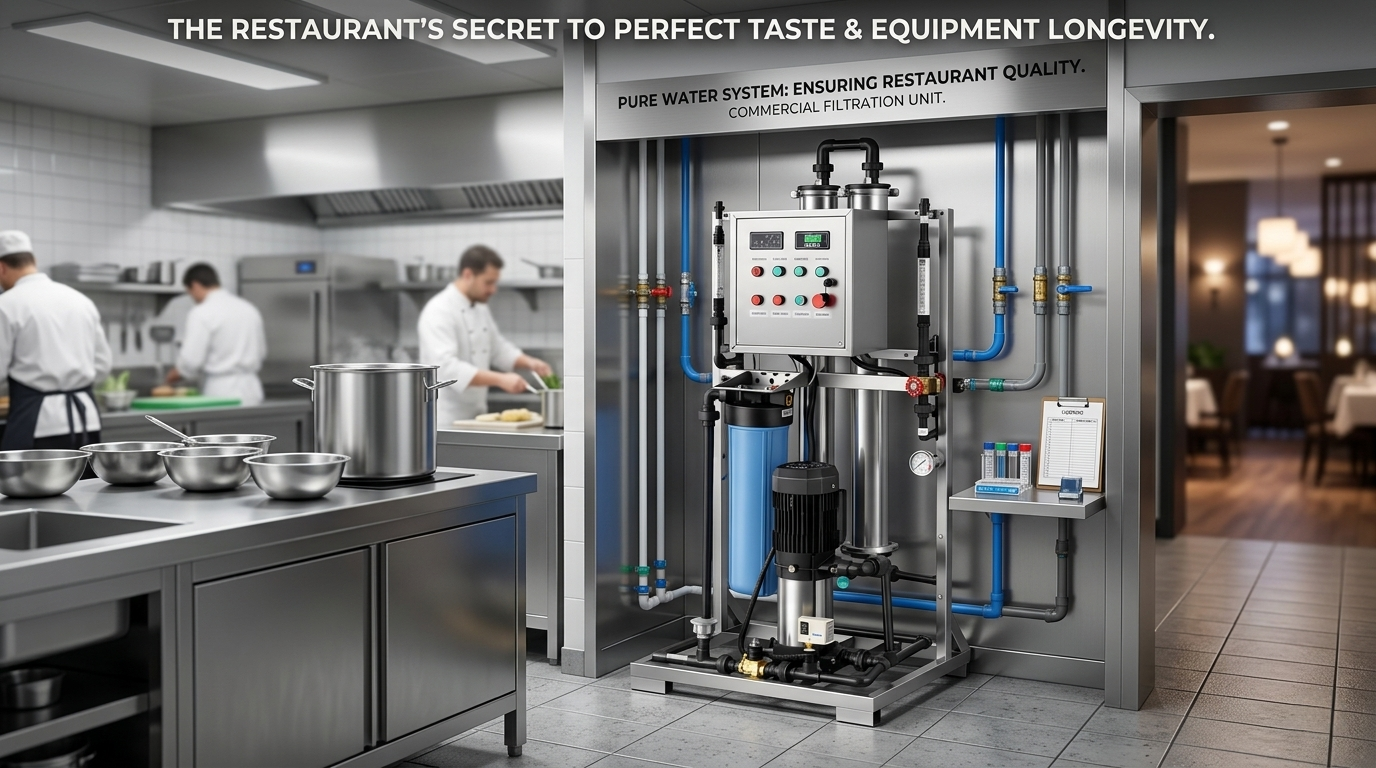
A commercial water filtration system for a restaurant isn’t priced off a single number. It’s priced off flow capacity, pre-treatment stages, and how much of the plumbing has to change to install it.
Before you compare quotes, know what you’re actually comparing:
- CAPEX scales with flow tier (GPM), not brand name — a single-station unit and a multi-station build aren’t in the same price category.
- OPEX is dominated by two recurring line items — pre-filter cartridges and the RO membrane, not a long list of consumables.
- Payback gets measured against downtime and equipment loss, not against the water bill.
- Retrofit and plumbing work is a hidden line item that a low headline price sometimes doesn’t include.
- Footprint affects installed cost when it forces a location change or an extra piping run.
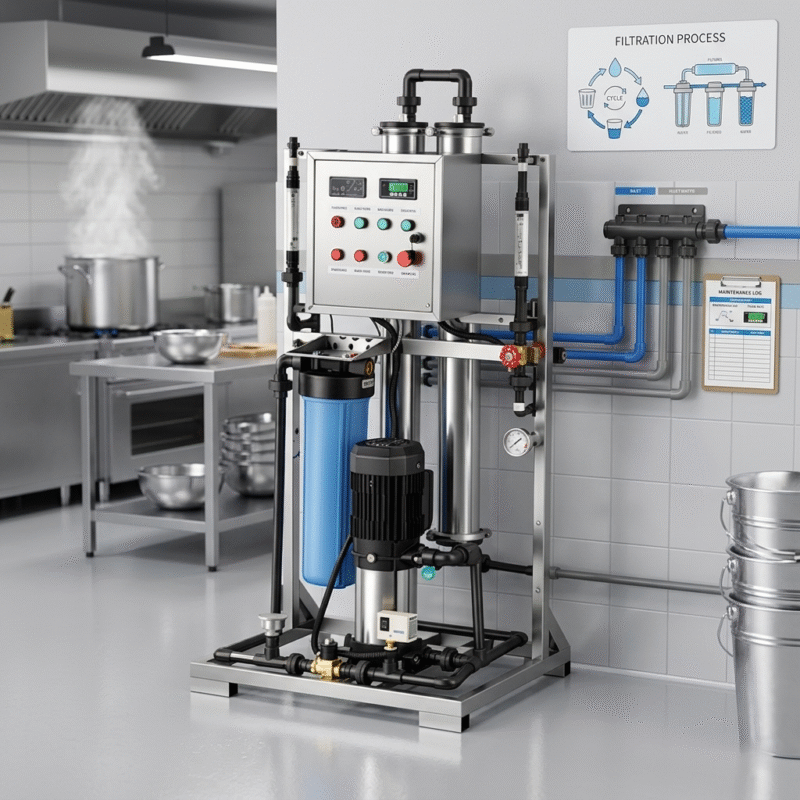
Fast Check Product:https://yourwatergood.com/product/commercial-reverse-osmosis-system/
What a Commercial Water Filtration System for a Restaurant Actually Costs Upfront
Every credible commercial water filter for restaurant quote breaks down the same way: cost tracks flow capacity first, construction quality and automation second.
| Tier | Typical Output Range | CAPEX Position | Annual OPEX Position | Best Fit |
|---|---|---|---|---|
| Entry — Single Station | ~250 L/hr (0.25 ton/hr, ~1.1 GPM) | Lowest in the lineup | Lowest — one cartridge line, smaller membrane | Café, coffee bar, single ice machine |
| Mid — Multi-Station Kitchen | ~500–750 L/hr (~2.2–3.3 GPM) | Mid-range | Mid-range — more frequent cartridge changes | Full-service restaurant, small hotel F&B |
| High-Volume — Commissary / Hotel | up to 1,000 L/hr (1 ton/hr, ~4.4 GPM) | Highest in the lineup | Highest total, lowest cost per gallon produced | Multi-outlet, banquet, high-volume bar program |
Two things move a quote out of its tier: stainless steel construction and control cabinets (durability cost, not decoration) and automatic flush and monitoring components, which cost more upfront but cut labor and premature membrane replacement later.
OPEX You’ll Actually Pay: What the Recurring Costs Look Like
Ignore the unit price for a second — the number that determines your real cost of ownership is what you replace every year.
- Pre-filter cartridges are the smallest, most frequent cost item, typically swapped every 2–4 months.
- The RO membrane is a larger but far less frequent cost — typically about once a year, depending on feed water quality and volume processed.
- Feed water quality changes both numbers. Harder, dirtier, or higher-conductivity source water shortens cartridge life and pulls membrane replacement earlier than the one-year baseline.
That last point is where OPEX estimates go wrong most often. A restaurant on well water with high iron content and one on clean municipal supply can run the identical system and land on very different annual consumable costs.
Request a Commercial Kitchen Water Layout Design before you lock in an OPEX estimate — it’s the only way to price consumables against your actual feed water instead of a generic average.
Payback Period: Weighing System Cost Against What Downtime and Damage Actually Cost You
Payback isn’t a formula you can run on a spec sheet — it’s a comparison between what the system costs and what you’re currently absorbing without it. Weigh the purchase against:
- One emergency service call on a scaled-up steamer or combi oven
- One lost shift because an ice machine went down mid-service
- Repeat guest complaints about flat, over-mineralized, or off-tasting coffee
- Early replacement of a copper boiler or heating element damaged by scale or corrosive water
For most restaurants, the system pays for itself against one or two of those events avoided — not against years of incremental water-bill savings. That’s the honest way to frame ROI, and it’s also why a generic payback number from a blog post is close to useless without your actual equipment and service history behind it.
The Real Cost of Skipping Filtration: What Hard or Corrosive Water Does to Restaurant Equipment
Every piece of equipment on this list has a documented failure mode tied directly to water quality:
- Espresso machines — scale buildup on boilers and group heads reduces heat transfer and eventually forces a costly descale-or-replace decision; overly aggressive, mineral-free water corrodes copper components from the other direction.
- Ice machines — scale reduces ice output, raises energy consumption per pound produced, and shortens compressor life.
- Combi ovens and steamers — scale on heating elements and steam generators is one of the most common warranty-voiding issues manufacturers cite.
- Dish machines — spotting and streaking from hard water is a recurring guest-facing complaint that has nothing to do with the dish crew’s technique.
None of this shows up as a single line item on a P&L. It shows up as maintenance calls, shortened equipment life, and complaints that get blamed on staff instead of water.
Flow Capacity and Price: Why GPM Sizing Is the Cost Lever You Control
Oversizing wastes CAPEX on capacity you’ll never use. Undersizing costs more in downtime and guest complaints than it ever saved upfront — and it’s the more common mistake.
Modular platforms sidestep this by configuring output to the job instead of forcing you into a fixed rating: ours run 250 to 1,000 liters per hour (0.25 to 1 ton/hr, roughly 1.1 to 4.4 GPM), sized to your actual peak, not a catalog default.
One number worth confirming before you request a quote: inlet pressure. Most commercial platforms need 29–58 psi (0.2–0.4 MPa) to run at rated capacity. If your building’s incoming pressure sits below that, a booster pump becomes part of the installed cost — better to know that before the quote than after the install.
Get a Technical Parameter Sheet before you request final pricing — it lets you confirm flow, pressure, and footprint requirements against your kitchen instead of guessing from a price range.
Requesting a Commercial Quote: What Information Gets You an Accurate Number Fast
A generic quote takes days and comes back wrong half the time. An accurate one takes an email if you have this ready:
- Peak simultaneous demand — which pieces of equipment run water at the same time during rush
- Feed water source — municipal or well, plus a conductivity or TDS reading if you have one
- Desired output TDS target — beverage program or general kitchen use changes this
- Available footprint — floor space and ceiling height where the unit will sit
- Rough-in pipe sizes — what’s already in the wall versus what needs to change
If you haven’t settled on a system type yet, start with how RO, softener, and carbon filtration compare — picking the right type first keeps the quote you get back from being priced for the wrong problem.
FAQ
How much does a commercial water filtration system for a restaurant cost? Cost tracks flow capacity and construction quality more than any single feature. Entry-level single-station systems sit at the low end of the range; multi-station, higher-GPM builds with stainless construction and automated flush controls sit at the high end.
What’s included in the OPEX of a commercial RO system? Two recurring items dominate: pre-filter cartridges, typically replaced every 2–4 months, and the RO membrane, typically replaced about once a year. Feed water quality determines how close to those baselines you’ll actually land.
How long does it take to pay back a commercial water filtration system? Payback is measured against avoided costs — an emergency service call, a lost shift from equipment downtime, or an early equipment replacement — not against water-bill savings alone. Most systems pay for themselves against one or two of those events.
What’s the biggest cost driver in commercial water filtration pricing? Flow capacity (GPM). Sizing to your actual peak demand, rather than a fixed catalog rating, is the single biggest lever you control on price.
How much does scale damage cost a restaurant in equipment repairs? It varies by equipment, but scale-related issues are a leading cause of warranty claims on combi ovens and steamers, reduced output and shortened compressor life on ice machines, and premature boiler wear on espresso equipment.
Do larger restaurants need a bigger CAPEX system? Not automatically — they need a system sized to peak simultaneous demand across all stations, which is usually larger, but not always. A single high-volume bar program can outsize a full-service kitchen with lower peak draw.
How do I get an accurate commercial quote fast? Have your peak demand, feed water source, TDS target, footprint, and existing pipe sizes ready. That’s the difference between a same-day estimate and a back-and-forth that takes a week.
Get the Real Number, Not a Ballpark
A price range on a blog post isn’t a quote — it’s a starting point for a conversation about your actual kitchen, your actual feed water, and your actual peak demand.
Request a custom commercial quote, a technical parameter sheet, or B2B wholesale pricing for your location count, and get pricing built around the system your kitchen actually needs — not a generic range.
One thought on “Commercial Water Filtration System for Restaurant Costs: What Actually Drives the Price and the Payback”