Pre Filter for Water Purifier: Protecting RO Membranes and Carbon Stages

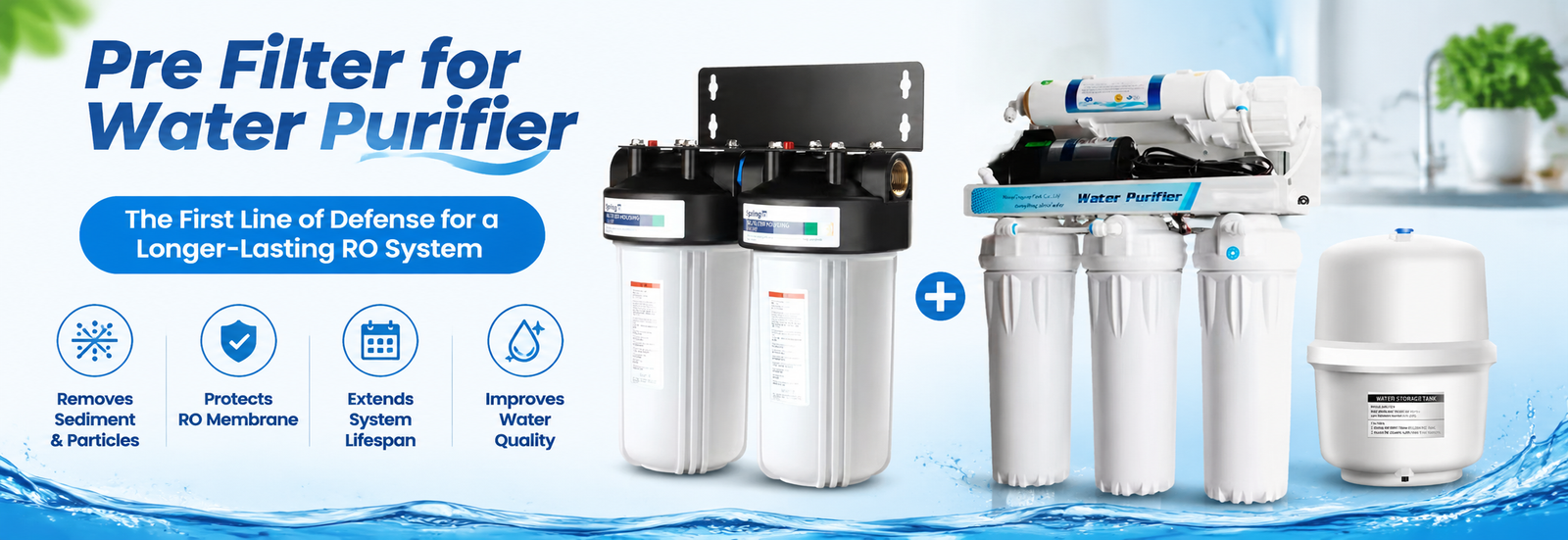
A pre filter for water purifier systems is the stage, or stages, that clean water before it reaches the main treatment: the RO membrane, a carbon block, or a UF membrane. Pre-filters remove sediment that would clog those stages and, in RO systems, chlorine that would damage the membrane. Changing them on time is the single most effective way to make the expensive parts of a purifier last.
What pre-filters protect against:
- Sediment that clogs carbon blocks and fouls membranes
- Chlorine and chloramine that damage most household RO membranes
- Fine particles and carbon fines reaching the membrane surface
- Rapid pressure loss through the main treatment stage
What they do not do: soften water or prevent scale. That takes a scale inhibitor or a softener.
The Pre-Filter Stages in a Typical RO System
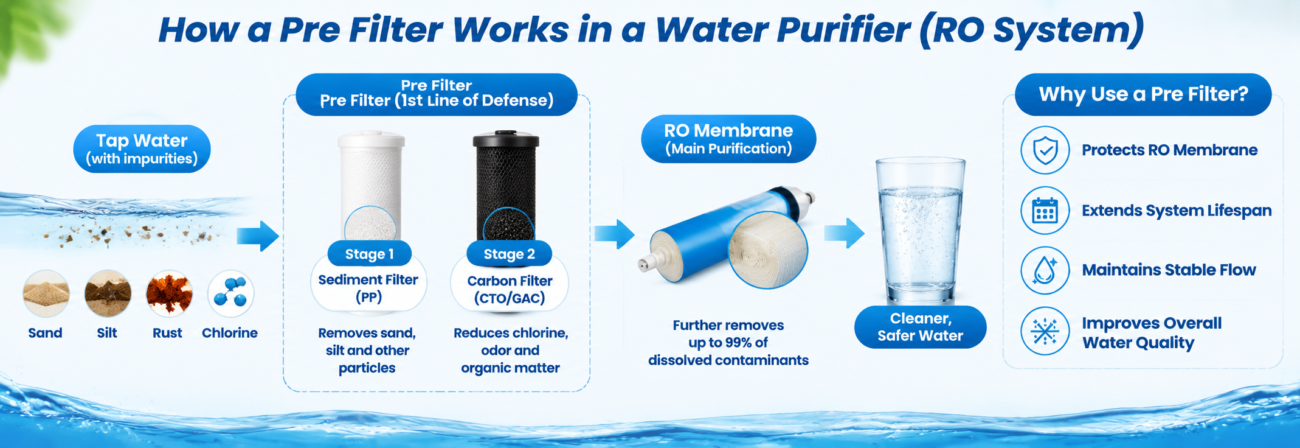
A 5-stage RO purifier uses three pre-filter stages before the membrane:
| Stage | Media | Job | Typical replacement |
|---|---|---|---|
| 1 | 5-micron PP cotton | Removes sand, rust, silt | 3 to 6 months |
| 2 | CTO carbon block | Removes chlorine to protect the membrane | 6 to 9 months |
| 3 | 1-micron PP cotton | Catches fine particles and carbon fines | 6 to 9 months |
These intervals are for our 5-stage system. Dirty water or high chlorine shortens them.
Why the Order Matters
- Sediment first: a carbon block clogs quickly if grit reaches it.
- Carbon second: removes chlorine before the membrane.
- Fine sediment last: catches anything the carbon sheds and the finest particles that got through stage 1.
Swapping the order, or skipping a stage, shortens the life of the stages after it.
Chlorine and the RO Membrane
Most household RO membranes are thin-film composite polyamide, which chlorine damages. The carbon pre-filter is what protects it. Two practical rules:
- Change the carbon stage on schedule, even if water still tastes fine. Exhausted carbon lets chlorine through without any obvious sign.
- On chloramine water, use carbon with enough contact time. Chloramine reacts with carbon more slowly than chlorine.
Choosing Micron Ratings
- 5 micron as the first stage for most city water.
- 1 micron as a later stage, ahead of the membrane.
- Coarser (20 to 50 micron) ahead of everything on sandy wells.
If the first cartridge turns dark on the outside but stays clean inside, it is too fine for your water. See sediment water filter for more on micron choices.
Pre-Filters for Other Purifier Types
UF (ultrafiltration) purifiers: a sediment pre-filter keeps the hollow-fiber membrane from clogging. Many UF units also use a carbon stage for taste, since UF does not remove chlorine.
Carbon-only purifiers: a sediment pre-filter in front of a carbon block prevents early clogging, especially on older city mains or wells.
Countertop purifiers: often have a built-in sediment layer around the carbon. On gritty water, an extra pre-filter on the supply side helps.
Appliances with their own filters: fridges and coffee machines with internal cartridges benefit from a sediment stage upstream on dirty water, so their more expensive cartridges last longer.
Pre-Filtering Well Water
Wells add problems city water rarely has:
- Sand: a spin-down screen or 50-micron cartridge ahead of the purifier’s own pre-filters
- Iron: dissolved iron oxidizes and coats cartridges and membranes orange; treat it at the main line first
- Hardness: scales RO membranes faster; a softener upstream helps
- Bacteria: pre-filters do not disinfect; fix the well and use UV where needed
On a well, the purifier’s built-in pre-filters should be the last line, not the only line.
Timing Changes With a TDS Meter
A handheld TDS meter gives an objective check on an RO purifier:
- Measure tap water and purifier water when the system is new.
- Check again monthly.
- If the purifier reading rises noticeably, check the pre-filters first. An overdue carbon stage that lets chlorine reach the membrane is a common cause.
- If pre-filters are fresh and readings stay high, the membrane is wearing.
Whole House Pre-Filtration
A whole house sediment and carbon system on the main line acts as a pre-filter for everything downstream, including an under-sink RO. It removes most sediment and chlorine before water reaches the kitchen, so the RO pre-filters last longer. See our whole house water filter overview.
Commercial kitchens use the same principle to protect espresso machines and ice makers; see commercial water filter for coffee shop.
Signs Pre-Filters Need Changing
- Slower flow at the purifier faucet
- The tank takes longer to fill
- TDS at the purifier tap creeping up (chlorine may be reaching the membrane)
- A cartridge visibly loaded with sediment
- The scheduled interval has passed
Pre-Filter Mistakes
- Stretching the carbon stage to save money, which risks the much more expensive membrane
- Using one fine cartridge on dirty water instead of staging
- Mismatched cartridge lengths, which let water bypass the media
- Expecting a pre-filter to stop scale, which it cannot
YourWaterGood Pre-Filter Cartridges
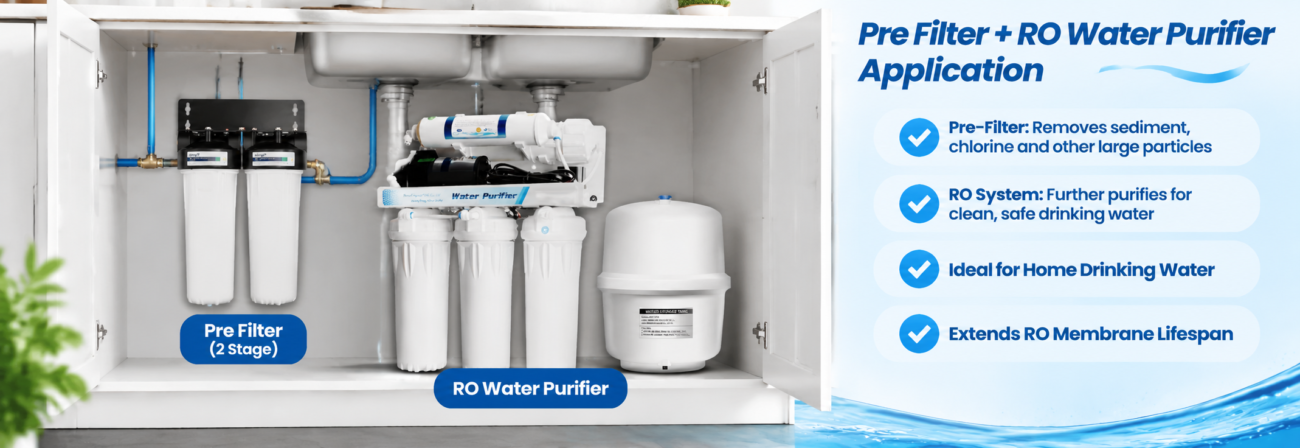
Our pre-filter cartridge range covers the modular cartridges used ahead of purifiers. In our 5-stage RO water filter for home, the pre-filters are a 5-micron PP cotton cartridge, a CTO carbon block, and a 1-micron PP cotton cartridge, protecting an RO membrane that is replaced every 12 to 24 months.
For Installers, Property Managers and Brands
Pre-filters are the most frequently changed parts of any RO system. We supply pre-filter cartridges in volume, with spec sheets and wholesale pricing on request.
FAQ
What is a pre filter for water purifier systems?
The sediment and carbon stages before the main treatment stage. In RO systems they protect the membrane from sediment and chlorine.
How often should RO pre-filters be changed?
For our 5-stage system: the 5-micron sediment stage every 3 to 6 months, and the carbon and 1-micron stages every 6 to 9 months.
Can a pre-filter remove bacteria?
No. Sediment and carbon pre-filters are not disinfection devices.
Does a pre-filter prevent scale?
No. Scale comes from dissolved hardness. Use a scale inhibitor or softener.
Will a pre-filter reduce water pressure?
A little, and more as it loads. That is why changing it on time keeps the purifier’s flow up.
Get the Right Pre-Filters
Tell us your purifier model or send a photo of the housings. We will match the pre filter for water purifier stages you need. Installers can request wholesale pricing from YourWaterGood.