
Data Center Filtration & Strainer Systems: Particulate Control for Sub-Micron GPU Cooling Loops

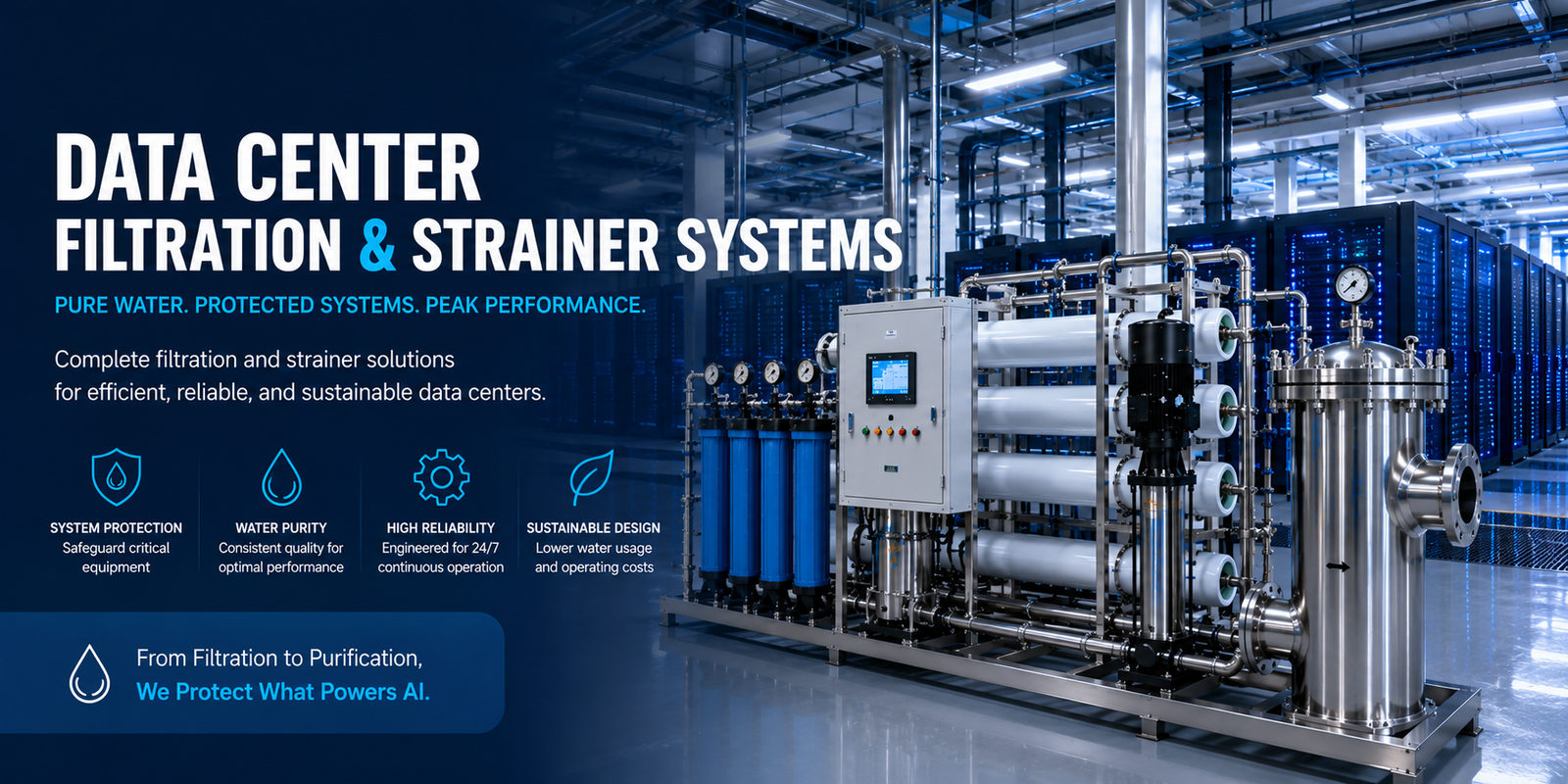
Most water-related downtime in a high-density compute hall does not begin with what is dissolved in the loop. It begins with what stays suspended in it — and with strainers chosen on flow rate instead of particle-capture rating.
A 50-micron basket strainer sized for the correct GPM will still pass debris small enough to wedge inside a cold-plate microchannel under 100 µm wide. The fault then surfaces hundreds of feet downstream, at the rack, where diagnosis is hardest and a stalled channel is most expensive.
AI computing arrays generate intense heat fluxes that air cooling cannot manage, requiring direct-to-chip liquid loops. Server cold plates feature internal fluid microchannels under 100 microns. Standard source water contains suspended solids and hardness minerals that form scaling barriers under high thermal loads. Implementing an automated data center filtration & strainer system—the self-cleaning strainers and EDI+RO plants from YourWaterGood—is required to intercept particles down to the sub-micron level and remove dissolved minerals, keeping cooling lines completely clear.
Open cooling towers continuously accumulate dirt and scale precursors, forcing operators to execute frequent water blowdowns to prevent fouling, which severely degrades Water Usage Effectiveness (WUE). Integrating an automatic self-cleaning strainer allows the facility to backwash and purge captured solids instantly based on differential pressure without interrupting loop flow. This keeps heat exchangers clean to optimize Power Usage Effectiveness (PUE) and permits the plant to run at higher Cycles of Concentration (CoC), saving up to 40% on makeup water.
Engineered data center filtration & strainer systems close that gap. Their job is to intercept particulate at a defined absolute rating before it reaches a heat-transfer surface, and to do it continuously — without breaking loop flow to clean a basket.
Before evaluating any supplier for a mission-critical facility, lock these hard specifications first:
- Absolute micron rating, never nominal — specify β-rated elements (e.g., β₅ ≥ 1000) on technology-loop side-streams. Nominal ratings allow unpredictable particle breakthrough straight to the cold plate.
- Continuous 24/7/365 duty cycle — 316L stainless wetted parts, not intermittent-duty commercial housings. The system never sees an off-cycle.
- Differential-pressure-triggered self-cleaning — automatic backwash on a ΔP rise of 5–7 PSI, so recirculation is never interrupted for manual basket service.
- In-line ΔP and conductivity telemetry — Modbus TCP or BACnet IP output to the BMS, with high-ΔP and high-conductivity trip points wired to alarm.
- Side-stream flow at 5–10% of recirculation GPM — under-sized side-streams never turn loop volume over fast enough to hold a clarity target.
The sections below break down where each of these specifications is won or lost on the floor.
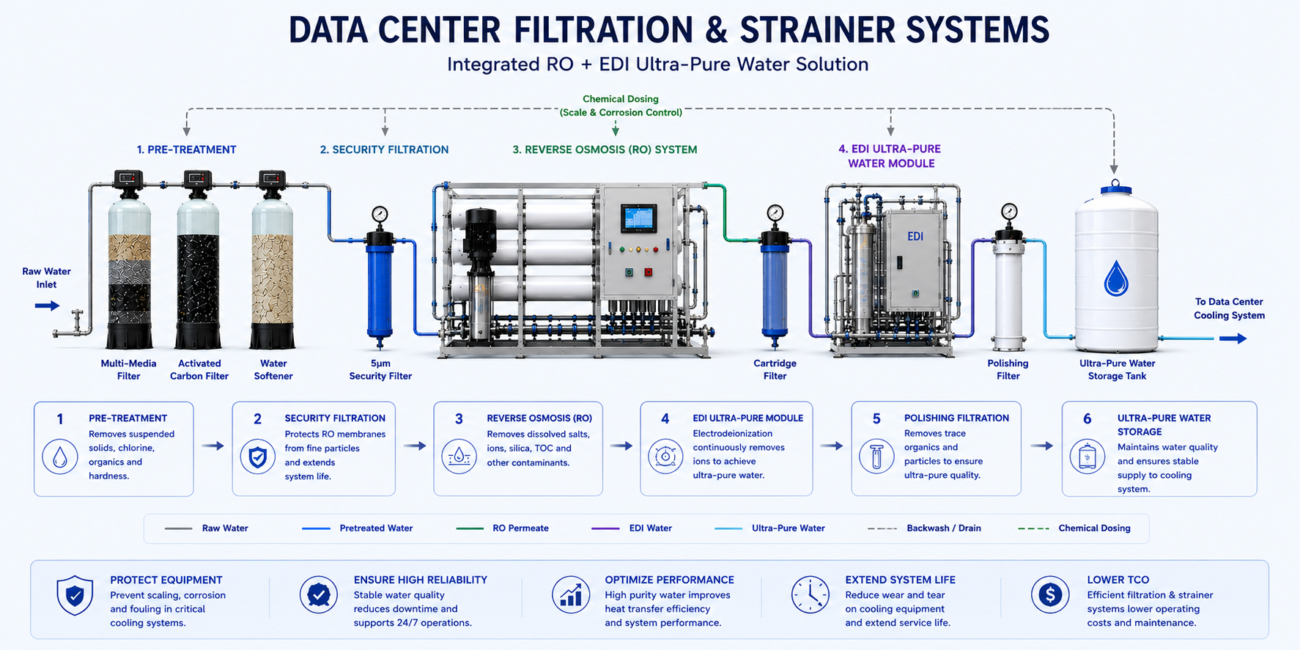
Fast Check Product: https://yourwatergood.com/product/industrial-reverse-osmosis-system/
Nominal vs Absolute: Why a “5-Micron” Strainer Still Clogs Cold Plates
The single most common spec error in data center filtration & strainer systems is treating a nominal micron rating as if it were an absolute one. They are not interchangeable, and the gap between them is exactly the particle size that kills a GPU cold plate.
A nominal rating means an element captures roughly 50% of particles at the stated size. A 5-micron nominal filter passes a meaningful fraction of 5-micron — and larger — particles on every pass.
An absolute rating is defined by a beta ratio (β). A filter rated β₅ ≥ 1000 removes 99.9% of particles 5 µm and larger in a single pass. That is the only rating class that belongs upstream of a direct-to-chip loop.
Cold-plate microchannels run under 100 µm, often 30–50 µm at the fin root, to maximize die contact area. A single 40-micron agglomerate that slips a nominal strainer can bridge a channel, stop local flow, and drive that section of silicon into thermal throttling within seconds.
The practical rule on a technology cooling system (TCS): specify absolute β-rated final filtration, and treat any nominal-rated strainer as bulk debris protection only — never as the last line of defense before the chip.
Self-Cleaning Strainer ΔP Logic and the Hidden WUE Penalty
An automatic self-cleaning strainer backwashes itself when differential pressure across the element climbs to a setpoint. Tuning that setpoint is where facilities engineers either protect uptime or quietly wreck their water bill.
Set the backwash trigger too high, and the element is allowed to load until fines begin to migrate through the cake — particle breakthrough reaches the downstream loop right when the strainer looks “due.” Set it too low, and the unit purges constantly, dumping treated water to drain on nearly every cycle.
That purge volume is not free. Every backwash discharge is makeup water the facility must re-treat and re-pump, which directly degrades Water Usage Effectiveness (WUE) — the metric hyperscale operators in Ashburn, VA and Phoenix, AZ are now measured against.
A defensible operating window for most cooling-tower side-stream strainers:
- Clean ΔP baseline: 2–3 PSI
- Backwash trigger: clean baseline + 5–7 PSI
- Hard ΔP alarm to BMS: 10–12 PSI (indicates a fouled element or stuck valve, not a normal cycle)
- Backwash duration: the minimum that restores clean ΔP, validated on commissioning — not a generic factory default
The field discipline that separates a tuned system from a wasteful one: commission the ΔP setpoint against the actual site water, then trend backwash frequency in the BMS. A creeping backwash count is an early warning of upstream pre-treatment failure long before conductivity or temperature alarms ever trip.
One Loop, Two Filtration Standards: Spec’ing FWS Against TCS
A high-density facility runs two hydraulically distinct water systems, and applying one filtration standard to both is a costly mistake. The Facilities Water System (FWS) and the Technology Cooling System (TCS) demand different micron ladders, different materials, and different treatment chemistry.
Facilities Water System (FWS) — open cooling towers and condenser water:
- Tolerates broader filtration: 35–40 mesh primary strainers with 10–50 µm side-stream media polishing.
- Primary water-quality goal is raising Cycles of Concentration (CoC) safely to cut blowdown and makeup, which lifts WUE.
- Treatment leans on automated side-stream sand/media filters, high-capacity skid-mounted softeners, and automatic biocide/antiscalant dosing.
Technology Cooling System (TCS) — closed direct-to-chip loops:
- Demands absolute sub-5 µm particulate control plus dissolved-solids removal that strainers cannot deliver.
- Makeup water must reach ≤ 10 µS/cm conductivity to protect copper cold plates from galvanic attack and tracking.
- Requires industrial reverse osmosis, continuous electrodeionization (EDI) polishing to push toward 18.2 MΩ·cm resistivity, and absolute-rated guard filtration on the loop.
A strainer protects the FWS and the RO membranes from bulk solids. It does nothing for conductivity, silica, or dissolved hardness — that work belongs to the desalination and polishing train. The two systems share a building, not a specification.
Municipal vs Reclaimed Intake: Diverging Pre-Treatment Trains
Source water dictates the front end of any data center filtration & strainer system, and the two dominant intake types pull pre-treatment in opposite directions.
Municipal potable supply carries residual chlorine and chloramine. Left untreated, these oxidizers attack thin-film RO membranes and shorten element life. The defense is activated carbon adsorption ahead of the membranes, plus tight chloride control — chlorides above low-µg/L thresholds drive pitting corrosion on 316L surfaces under high-velocity flow.
Reclaimed and recycled water — increasingly mandated for WUE targets in water-stressed markets — is a different problem entirely. It arrives with high baseline TDS (ppm), elevated silica (SiO₂), phosphate, ammonia, and organic load.
That chemistry forces a heavier, finer front end:
- Multimedia filtration to strip suspended solids and turbidity before the membranes.
- Ion-exchange softening with automated brine regeneration to pull calcium and magnesium.
- Antiscalant dosing ahead of high-pressure stages, because dissolved silica that crosses ~150 ppm polymerizes into a glassy scale that no acid wash removes once set.
- Tighter absolute strainers, since reclaimed streams carry a finer, more variable particle distribution that loads conventional baskets faster.
The takeaway for procurement: a skid sized for municipal feed is not transferable to a reclaimed-water site. The strainer ratings, the softening capacity, and the dosing architecture all change.
Standard Skids vs Data-Center-Grade Redundancy: Where the Spec Diverges
Mission-critical infrastructure tolerates no single point of failure. A water system feeding a 50 MW compute hall must match the redundancy logic governing the electrical and mechanical plant — something off-the-shelf commercial skids were never built to do.
| Engineering Parameter | Standard Pre-Engineered Skids | Data Center Grade High-Redundancy Systems |
|---|---|---|
| Redundancy configuration | Single train, no failover | N+1 / N+2 / 2N parallel trains |
| Flow capacity (GPM) | 10–50 GPM | 100–1,000+ GPM, scalable |
| Filtration rating | 10–20 µm nominal | Absolute β₅ ≥ 1000 + RO to 0.0001 µm |
| BMS integration | Analog only (4–20 mA) | Modbus TCP / BACnet IP / SNMP |
| Failover automation | Manual valve isolation | Automated actuated failover < 30 s |
| Wetted materials | Standard PVC / Sch. 80 | 316L stainless / thickened UPVC |
| Lead time & support | Stock unit, generic spares | Engineered build, documented P&ID, standardized spares |
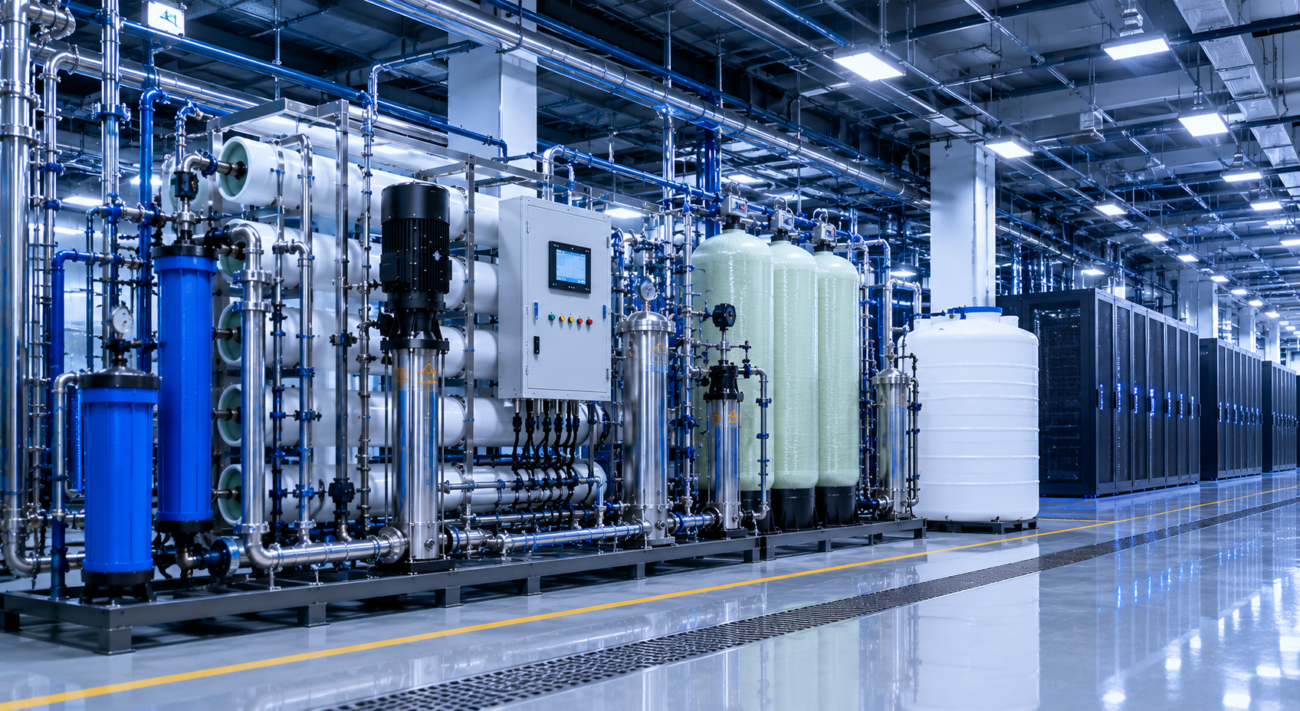
An N+1 design guarantees that when one strainer bank backwashes or an RO train drops for membrane service, a parallel unit ramps instantly. Loop flux and pressure stay flat across the cooling loop, and no rack ever sees a thermal transient from the water plant.
To pressure-test a vendor on this, request the failover sequence and the P&ID, not the brochure. A supplier who cannot show automated valve logic and a redundancy diagram is quoting a commercial skid with a data-center label.
Field Engineering Insight: The Backwash Pulse That Reaches the Chip
Here is a detail only operators who have commissioned these systems on a live floor tend to know: a self-cleaning strainer briefly makes the water dirtier during its own backwash.
When the strainer reverses flow to purge its element, it releases a short, concentrated slug of fines and a transient turbidity spike on the forward side as the cake breaks up. On an FWS side-stream this is harmless. On a TCS feed without a post-strainer absolute guard filter, that pulse travels straight toward the cold plates.
Compounding it, the ΔP gauge across the strainer reads normal immediately after backwash — the operator sees a healthy, low-ΔP number while a sub-micron pulse has already moved downstream. The gauge confirms the strainer is clean; it says nothing about what just passed through it.
The engineering fix is sequence and architecture, not a bigger strainer:
- Install an absolute-rated guard filter downstream of any self-cleaning strainer that feeds a technology loop.
- Stagger backwash cycles across parallel strainer banks so the loop never sees simultaneous pulses.
- Wire a brief post-backwash bypass or hold on the most sensitive branch where loop design allows it.
This is the kind of detail that does not appear on a datasheet but decides whether a system protects silicon or merely protects the RO membranes behind it. It is also why 24/7/365 particulate control lowers OPEX: clean heat-exchanger and cold-plate surfaces cut chemical cleaning, defer fill and membrane replacement, hold pumps in their efficient curve, and extend the service life of CDUs and high-pressure pumps that cost far more than the water plant feeding them.
Data Center Filtration & Strainer Systems FAQs
What micron rating do data center filtration & strainer systems need for direct-to-chip loops? Specify absolute β₅ ≥ 1000 (sub-5 µm) guard filtration on the technology loop, with RO/EDI makeup driving conductivity to ≤ 10 µS/cm. Nominal-rated strainers are bulk-debris protection only and should never sit last before a cold plate.
What differential pressure should trigger a self-cleaning strainer backwash? Set the trigger at the clean ΔP baseline plus 5–7 PSI (typically firing around 7–10 PSI total). Send a hard alarm to the BMS at 10–12 PSI, which signals a fouled element or stuck valve rather than a normal cycle.
How is side-stream filtration flow sized for a cooling tower? Size continuous side-stream flow at 5–10% of total recirculation GPM. Below that range the system cannot turn loop volume over fast enough to hold a stable clarity and CoC target.
Why is reclaimed water harder on strainer systems than municipal water? Reclaimed water carries higher TDS (ppm), silica above ~150 ppm, plus phosphate, ammonia, and organics that drive both scaling and biofouling. It also presents a finer, more variable particle load, so strainers and pre-treatment must run tighter and regenerate more often.
What is the difference between nominal and absolute micron ratings? A nominal rating captures roughly 50% of particles at the stated size; an absolute β-rated element removes 99.9%+ in a single pass. For chip protection, only absolute ratings are defensible.
Can a strainer replace an RO or EDI system? No. Strainers remove suspended solids only. Dissolved ions, silica, hardness, and conductivity require industrial reverse osmosis and EDI polishing. The two functions are complementary, not interchangeable.
What conductivity and chemistry targets apply to the technology cooling loop? Target ≤ 10 µS/cm conductivity for direct-to-chip loops, hold pH in the 7.0–9.0 band to prevent copper corrosion and steel scaling, and keep chlorides ultra-low to eliminate pitting — consistent with ASHRAE TC 9.9 water-quality guidance and EPA discharge frameworks.
Lock In Your Mission-Critical Water Specification
Protecting high-density compute assets is a particulate-control problem before it is a chemistry problem. The difference between 99.999% uptime and a cluster-wide thermal event often comes down to whether the filtration ladder was engineered to an absolute rating and backed by automated redundancy.
Work directly with our infrastructure engineers to deploy ruggedized data center filtration & strainer systems, high-recovery industrial RO, skid-mounted softening and EDI, and automated dosing — configured to your facility’s GPM, rack density, and ASHRAE TC 9.9 targets.
Secure B2B Wholesale / Factory-Direct Pricing: source straight from our manufacturing facility to streamline CAPEX.
Get an Infrastructure Engineering Quote: itemized pricing on custom 1 t/h–10 t/h RO and EDI trains sized to your thermal load.
Request Technical Data Sheets: full filtration ratings, ΔP curves, materials, and BMS integration specs for your engineering review.