
Data Center Water Filtration System Design: Scaling Capacity as Rack Density Climbs

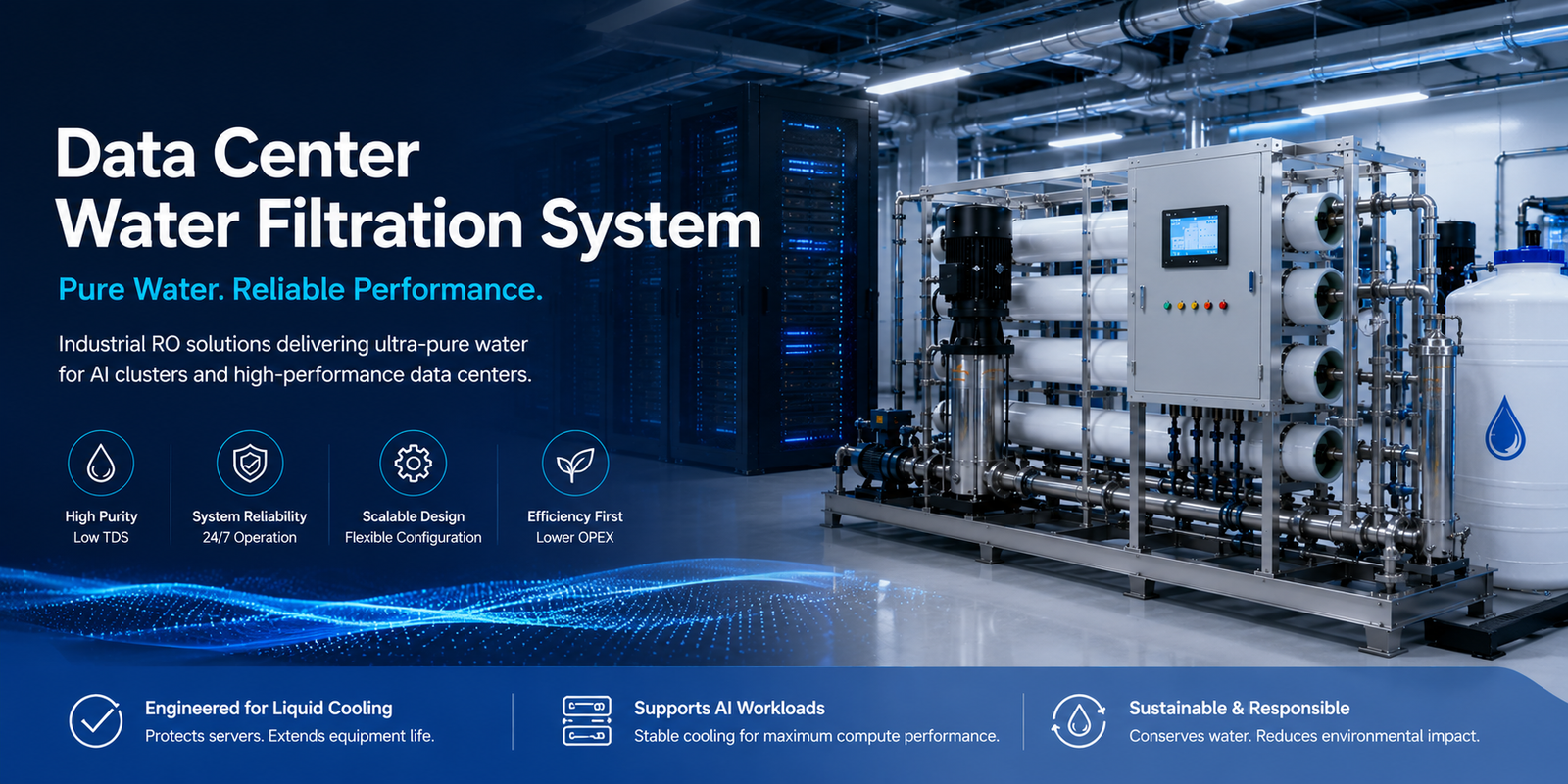
The most expensive mistake in a data center water filtration system is rarely under-treating the water. It is sizing the plant for today’s cooling load, then discovering 18 months later that rack density doubled and the skid cannot follow.
The opposite error costs just as much. Oversizing “to be safe” leaves a reverse osmosis train running far below its design flux — and a membrane that never reaches its rated crossflow velocity fouls faster, not slower.
To prevent sudden thermal throttling or catastrophic hardware leaks, facility operations require ultra-precise water quality control. Implementing a dedicated, custom-engineered data center water filtration system is no longer optional—it is a mission-critical strategy to guarantee 99% uptime.
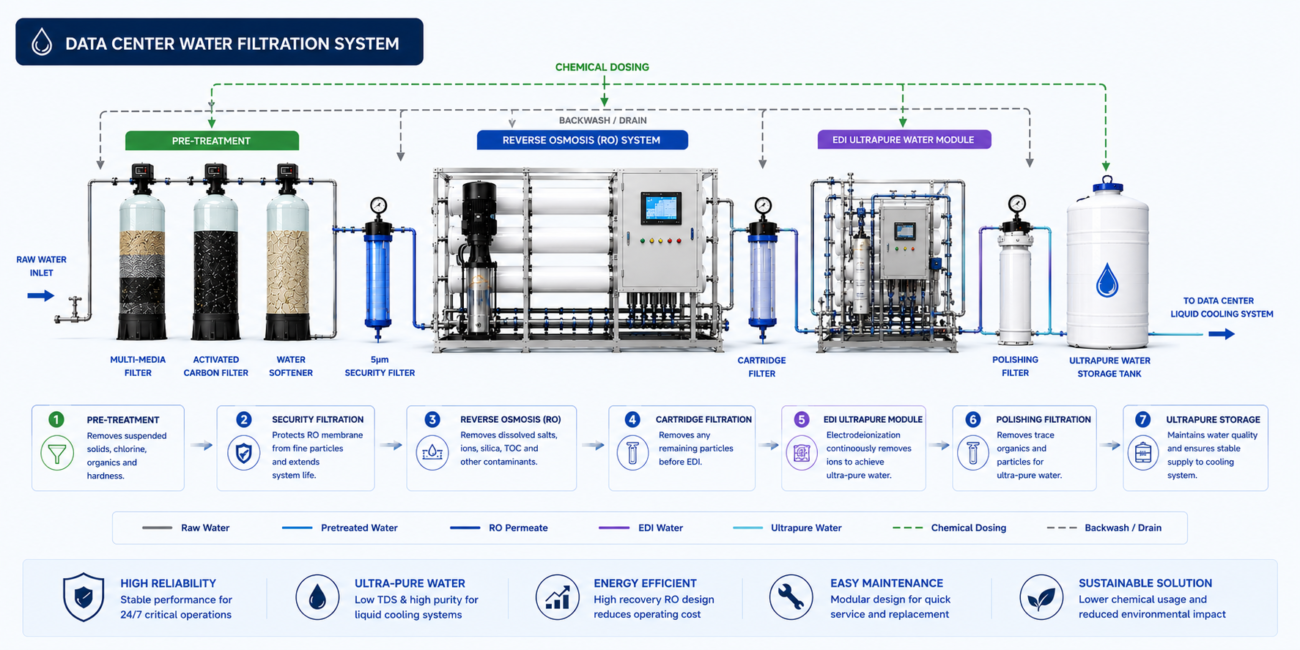
High-density AI clusters generate extreme heat fluxes that require liquid direct-to-chip cooling loops. The copper cold plates have narrow fluid microchannels (often <100 µm) that are highly sensitive to mineral scaling and microscopic particles. A specialized system, such as the 5-stage industrial RO and EDI setups from YourWaterGood, is required to drop inlet TDS to under 10 mg/L and eliminate scaling ions, keeping fluid pathways completely clear to prevent hardware thermal throttling.
High TDS forces data center cooling towers to perform frequent water blowdowns to avoid scale buildup, which severely degrades Water Usage Effectiveness (WUE). Utilizing a double-pass RO system and an EDI polishing stack from YourWaterGood removes 99% of dissolved solids and weak ions (like silica) without relying on traditional mixed-bed chemical regeneration. This chemical-free continuous operation stabilizes loop resistivity at 18.2 MΩ·cm, prevents galvanic corrosion, and allows the cooling system to run at higher Cycles of Concentration (CoC)—slashing freshwater makeup demands and overall operational expenditure (OPEX).
To secure constant permeate flow and protect membrane integrity, the filtration system must maintain a stable inlet water pressure baseline of greater than 0.2 MPa. Integrated pre-boost pumps should be utilized if municipal supply lines fluctuate. Additionally, concentrated wastewater discharge lines must remain completely unobstructed and free of restrictive valves to preserve proper osmotic balance and eliminate membrane blinding risks.
Fast Check Product: https://yourwatergood.com/product/industrial-reverse-osmosis-system/
Before sourcing a system meant to grow with the facility, lock these specifications first:
- Modular, parallel skid architecture — capacity added in trains (1 t/h → 10 t/h each), not one monolithic unit that must be replaced when the hall expands.
- Real turn-down capability — multiple smaller trains plus VFD-controlled high-pressure pumps, so the plant runs near design flux at both partial and full load.
- N+1 redundancy that scales per phase — every added production train carries its own standby logic, not a single shared spare.
- Reserved footprint and utility headroom — floor space, inlet pressure, and drain capacity for phase-2 skids committed at design time, not scavenged later.
- Plant-wide BMS telemetry — flow (GPM), conductivity (µS/cm), and differential pressure (PSI) from every train into Modbus TCP or BACnet IP, with trip points wired to alarm.
The sections below break down where each of these is won or lost as a facility scales.
The Right-Sizing Trap: Why Oversized RO Fouls and Undersized Skids Stall
Sizing a data center water filtration system is a balance between two failure modes that pull in opposite directions, and most procurement specs only account for one of them.
Undersized is the obvious risk. When a single train cannot meet peak makeup demand, loop pressure sags, permeate flow drops, and the cooling system loses its safety margin during exactly the thermal events it was built to survive.
Oversized is the quieter, more insidious risk. An RO skid sized for a future 10 t/h load but running at 2 t/h today operates far below its design crossflow velocity. Low velocity raises concentration polarization at the membrane surface, which accelerates scaling and organic fouling — the oversized “insurance policy” shortens membrane life and drives up cleaning OPEX.
The engineering answer is granular capacity, not a single big skid:
- Deploy capacity as multiple smaller parallel trains sized so that the trains online today run near their rated flux.
- Bring additional trains online in stages as rack density and makeup demand climb.
- Use VFD high-pressure pumps to hold each train inside its efficient flow band rather than throttling one large pump below its minimum.
This is the difference between a plant that ages gracefully and one that fouls itself trying to stay flexible.
Modular vs Monolithic: Designing a Filtration Plant That Grows in Trains
A monolithic plant is engineered once, for one capacity. A modular plant is engineered to be added to — and at hyperscale growth rates, that distinction decides whether expansion is a phased install or a forklift replacement.
Modular, skid-mounted architecture delivers three things a single large unit cannot:
- Phased CAPEX — pay for capacity as the compute load actually materializes, instead of stranding capital in idle treatment capacity on day one.
- Maintenance without shutdown — pull one train for membrane service or media swap while parallel trains hold loop flux and pressure flat. No rack sees a transient.
- Capacity that tracks demand — each added train brings its own pumps, pre-treatment, and N+1 standby, so redundancy scales with production rather than diluting.
The pre-treatment chain ahead of each train stays consistent: multimedia filtration, activated carbon to strip chlorine and chloramine, skid-mounted ion-exchange softening with automated brine regeneration, absolute-rated guard filtration, then the industrial reverse osmosis core, polished by continuous electrodeionization (EDI) toward 18.2 MΩ·cm for direct-to-chip loops.
The design discipline that separates a real modular plant from a marketing claim: the skid layout, manifold, and utility tie-ins are dimensioned for the final phase on the first day — so phase 2 bolts on, rather than forcing a re-pipe of phase 1.
Retrofit Reality: Adding Liquid-Cooling Water Systems to a Live Air-Cooled Hall
Greenfield sites get to design the water plant alongside the building. Most operators do not have that luxury — they are retrofitting liquid cooling into a hall that was built for air, while it is running.
A retrofit imposes constraints a new-build never faces:
- Footprint is fixed — the modular skid set has to fit the space that exists, which favors compact, stackable RO and EDI arrays over sprawling single units.
- Inlet pressure may be marginal — industrial RO needs a stable feed above 0.2 MPa (~29 PSI); aging service mains often cannot guarantee it, so a pre-boost pump skid becomes part of the intake architecture.
- Drain and discharge capacity is limited — reject and backwash flows must fit the existing sanitary and storm infrastructure under EPA discharge limits, which can cap recovery rate and dictate whether concentrate handling is needed.
- The cutover is live — the new technology cooling system (TCS) loop is commissioned in parallel and tied in without dropping the existing thermal load.
For a retrofit, modular wins on every axis: capacity goes in where the space and utilities allow, phase by phase, without staging a single high-risk shutdown of a revenue-generating compute hall.
Municipal vs Reclaimed Feed: How Source Water Changes the Scaling Plan
Source water does not just change treatment chemistry — it changes how much headroom a scalable plant has to carry, because the two dominant feed types foul and load at different rates.
Municipal potable feed is the simpler scaling case. Its chemistry is relatively stable, so pre-treatment and membrane area scale roughly linearly with capacity. The controlling concerns are chlorine/chloramine removal ahead of the membranes and chloride control to prevent pitting corrosion on 316L surfaces under high-velocity flow.
Reclaimed and recycled feed — increasingly mandated for WUE targets in Ashburn, VA and Phoenix, AZ — forces a different scaling math. It arrives with high baseline TDS (ppm), elevated silica, phosphate, ammonia, and organics, all of which load pre-treatment faster and foul membranes sooner.
That means a reclaimed-fed plant must scale with more margin, not less:
- Size softening and antiscalant capacity with extra headroom, because dissolved silica above ~150 ppm polymerizes into a glassy scale no acid wash removes once set.
- Assume faster fouling cycles and shorter intervals between membrane cleanings when projecting OPEX and capacity.
- Reserve additional pre-treatment train capacity, since reclaimed particulate and organic load is more variable than municipal.
A plant sized on municipal assumptions and later switched to reclaimed feed will run short on capacity and foul early. The feed source has to be locked before the scaling plan is, not after.
Standard Skids vs Data-Center-Grade Modular Systems
A commercial water skid is built for one capacity and intermittent duty. A data-center-grade modular system is built to run 24/7/365 and to expand in place — and the gap between them is exactly what decides whether the plant can keep pace with compute growth.
| Engineering Parameter | Standard Pre-Engineered Skids | Data Center Grade High-Redundancy Modular Systems |
|---|---|---|
| Flow capacity (GPM) | 10–50 GPM, fixed | 100–1,000+ GPM, added in parallel trains |
| Expansion path | Replace unit to grow | Bolt-on trains to a pre-sized manifold |
| Redundancy | Single train, no failover | N+1 / N+2 / 2N, scaling per phase |
| Turn-down | One pump, narrow band | Multiple trains + VFD, near design flux at any load |
| Filtration / purity | 10–20 µm nominal | Absolute guard + RO to 0.0001 µm, EDI to 18.2 MΩ·cm |
| BMS integration | Analog (4–20 mA) | Modbus TCP / BACnet IP / SNMP across all trains |
| Lead time & support | Stock unit, generic spares | Engineered build, documented P&ID, standardized spares |
An N+1 modular design guarantees that when one train drops for membrane service, a parallel unit ramps instantly and loop flux stays flat. Scaled across phases, that same logic means the facility never has to choose between redundancy and capacity as it grows.
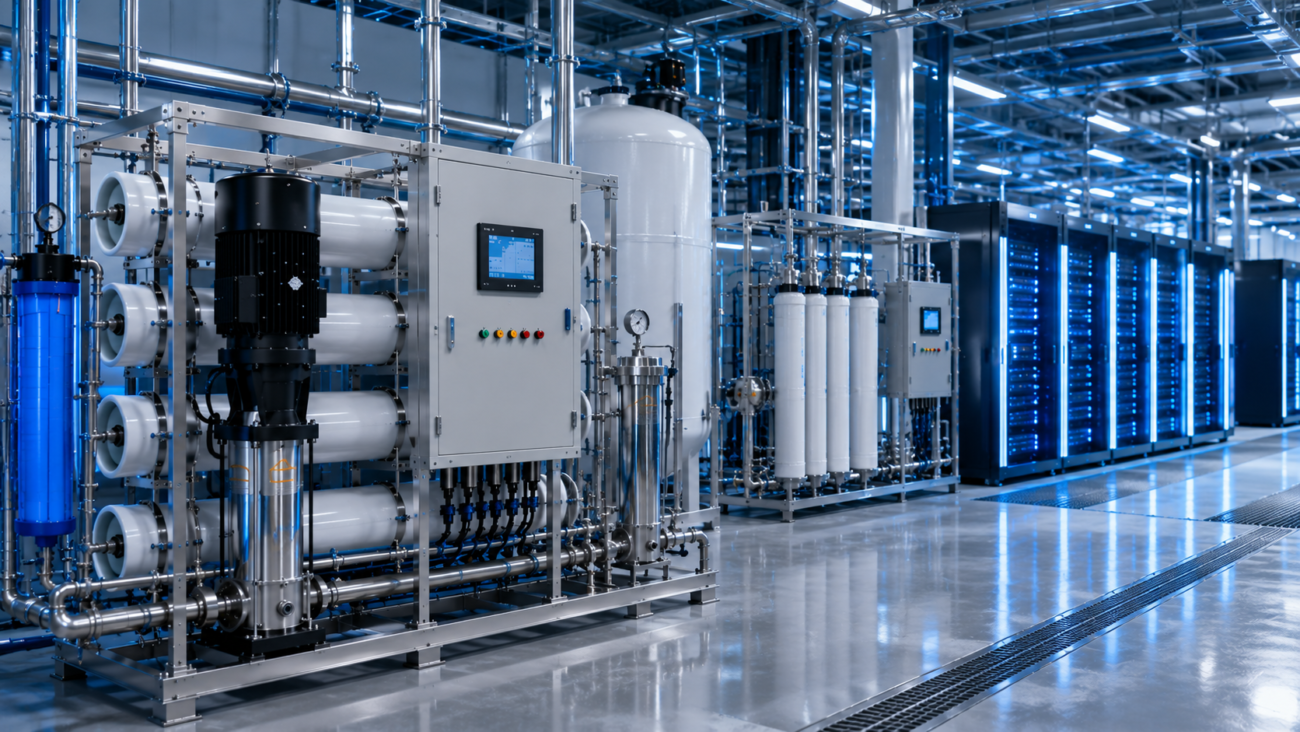
To pressure-test a vendor, ask for the phased train layout and the final-phase manifold drawing — not just the single-skid datasheet. A supplier who cannot show how phase 2 ties into phase 1 is quoting a unit, not a scalable system.
Field Engineering Insight: The Low-Flux Fouling Trap
Here is a detail that catches teams who size for the future instead of the present: an RO membrane running well below its design flux fouls faster than one running at rated load.
The instinct on a scaling project is to install the full future capacity up front “to be ready.” But an RO train sized for 10 t/h and fed only 2 t/h of demand runs at a fraction of its design crossflow velocity. Low velocity lets rejected ions accumulate at the membrane surface — concentration polarization rises, and silica and hardness begin to scale at the wall even though the bulk water chemistry looks fine.
The operator then sees rising cleaning frequency and falling membrane life on a brand-new plant, and blames the water — when the real cause is a skid that never reaches the velocity it was designed to need.
The fix is architectural:
- Size each train so the trains online today run near rated flux, and add trains as demand grows.
- Use VFD high-pressure pumps with a real minimum-flow floor; do not throttle one oversized pump into its inefficient, low-velocity range.
- Stage standby trains for redundancy rather than running every train continuously at a starved partial load.
Compounding the point: high-pressure pumps have a minimum efficient flow of their own. You cannot infinitely turn down one large pump to match a small early-phase load — which is precisely why phased, multi-train capacity beats a single oversized skid on both fouling and energy.
Done right, this is also where a scalable plant pays back: trains held near design flux lower cleaning and membrane OPEX, hold pumps in their efficient curve, and extend the service life of cold plates, CDUs, and high-pressure pumps — protecting 99.999% uptime while the compute load keeps climbing.
Data Center Water Filtration System FAQs
How do you size a data center water filtration system for future rack density? Design modular parallel trains, reserve footprint and utilities for later phases, and size each train so the load online today runs near its design flux. Add N+1 standby per phase rather than relying on one shared spare.
Is it better to oversize an RO system for future growth? No. An RO train running far below design flux loses crossflow velocity, raises concentration polarization, and fouls faster. Use multiple smaller trains plus VFD turn-down instead of one oversized skid.
What flow range do modular industrial RO skids cover? Industrial trains typically run 1 t/h to 10 t/h each and are paralleled for higher output. Sizing is set by permeate demand (GPD), recovery rate, and feed-water TDS, not by a single fixed model.
Can you add liquid-cooling water treatment to an existing air-cooled facility? Yes. Modular skids tie a new TCS loop into a live hall phase by phase. The binding constraints are footprint, stable inlet pressure above 0.2 MPa (~29 PSI), and existing drain/discharge capacity under EPA limits.
What inlet pressure does an industrial RO skid require? A stable feed above 0.2 MPa (~29 PSI). Where municipal supply fluctuates, a pre-boost pump skid is engineered into the intake to protect membrane flux and prevent blinding.
How does reclaimed water change the scaling plan? Reclaimed feed carries higher TDS, silica above ~150 ppm, and organics that foul faster. Size softening, antiscalant, and membrane area with extra margin, and assume shorter cleaning intervals when projecting capacity and OPEX.
What conductivity must the technology cooling loop hold as it scales? Target ≤ 10 µS/cm for direct-to-chip loops, maintained consistently across every added train, with pH held in the 7.0–9.0 band — aligned with ASHRAE TC 9.9 water-quality guidance.
Build a Plant That Scales With Your Compute Load
A data center water filtration system is a capacity-planning decision as much as a water-quality one. The facilities that hold 99.999% uptime through rapid growth are the ones whose water plant was designed to expand in trains — never the ones that oversized on day one or stalled on day 500.
Whether you are equipping a single high-density server room or scaling skids into a larger buildout, YourWaterGood manufactures and ships the modular equipment factory-direct — data center water filtration system trains, high-recovery industrial RO, skid-mounted softening and EDI, and automated dosing — sized to your phased load.
Secure B2B Wholesale / Factory-Direct Pricing: source equipment straight from our manufacturing facility to phase your CAPEX.
Get an Infrastructure Engineering Quote: phased pricing on 1 t/h–10 t/h modular RO and EDI trains matched to your buildout schedule.
Request Technical Data Sheets: flux curves, turn-down ranges, footprints, and BMS integration specs for your engineering review.