
Data Center Makeup Water Treatment System: Sizing Evaporation and Blowdown Makeup for Cooling Tower Loops

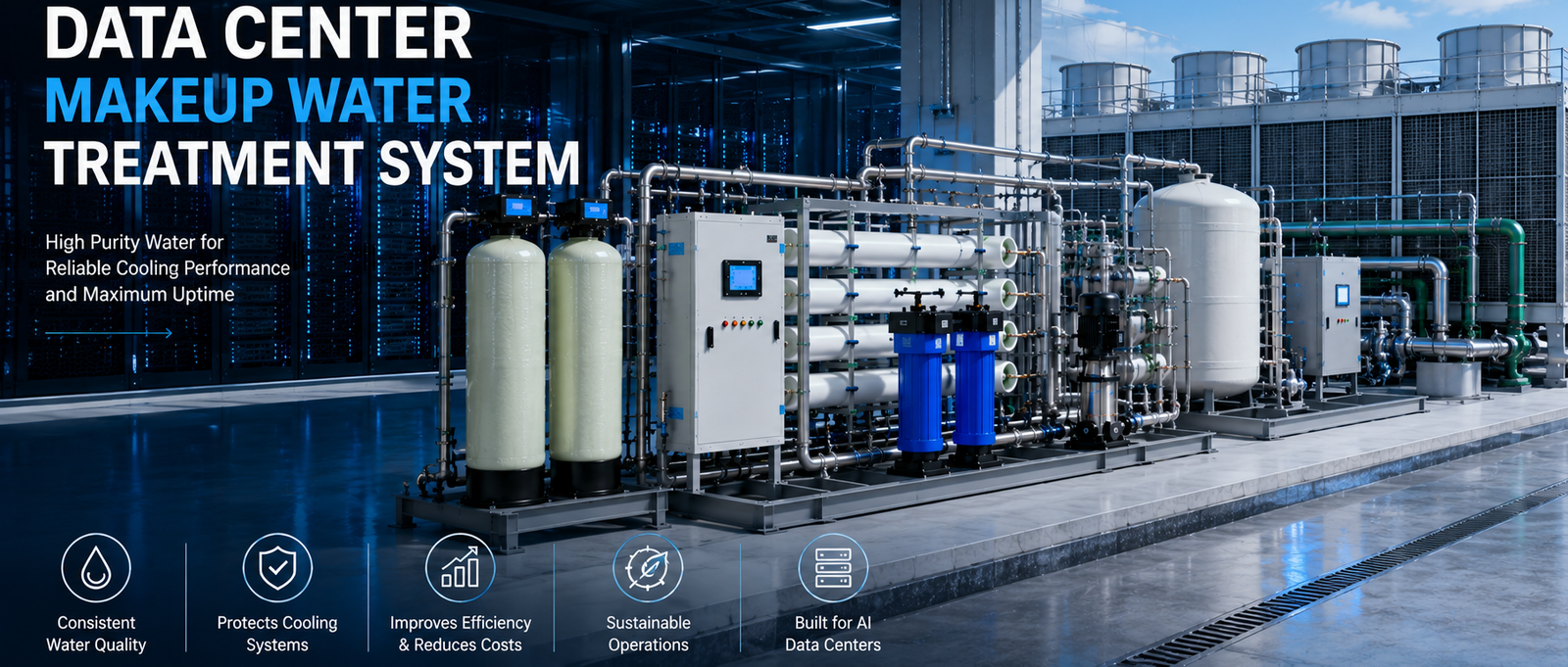
A data center makeup water treatment system is not the same equipment as the chemistry program that treats water already circulating in the tower. It’s the front door — the pretreatment train sized to whatever volume the tower loses, before that volume ever reaches a dosing pump. Lock these before accepting any quote:
- Pretreatment sized to peak evaporation + blowdown load, not average annual demand
- Softening or dealkalization capacity matched to actual makeup hardness, not a generic grain-capacity assumption
- Chlorine/chloramine removal rated to your specific municipal dose, verified against your utility’s water quality report
- N+1 train redundancy on the makeup skid itself, independent from redundancy on the chemistry dosing system
- Continuous hardness-leakage monitoring on softener effluent, not periodic grab-sample testing
Fast Check Product: https://yourwatergood.com/product/industrial-reverse-osmosis-system/
Why Makeup Water Treatment Is a Different System Than Tower Chemistry
Cooling tower water treatment programs get most of the engineering attention — biocide dosing, scale inhibitor ratios, cycles of concentration (CoC) control. All of that assumes the makeup water arriving at the basin is already conditioned correctly.
It frequently isn’t. A tower chemistry program is tuned to compensate for whatever comes through the makeup line, and an undersized or poorly matched data center makeup water treatment system at yourwatergood.com forces that chemistry program to work outside its design envelope every single day.
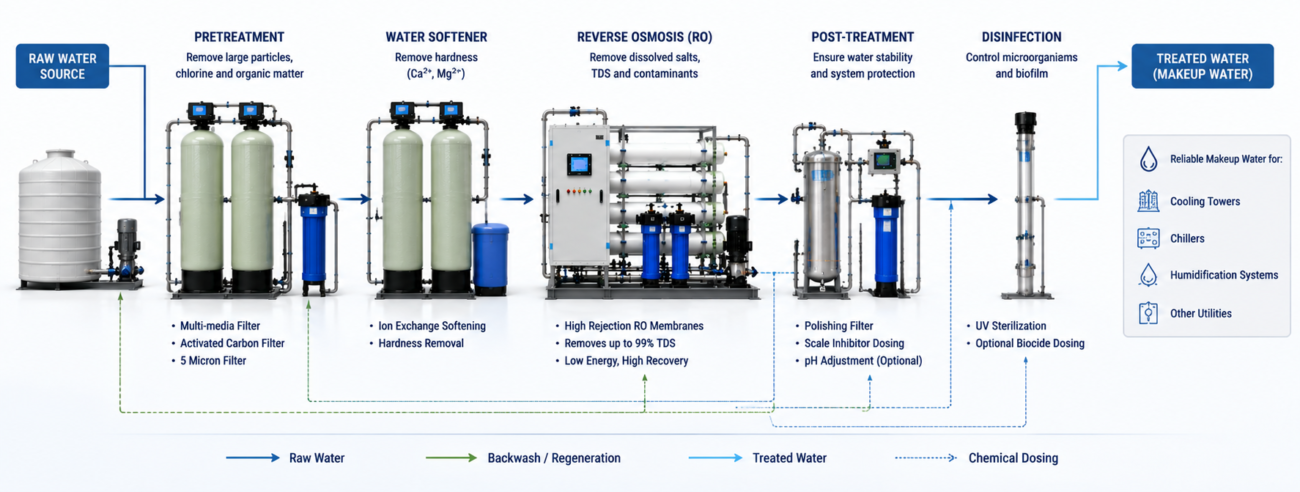
The distinction matters at procurement: a makeup water treatment system is pretreatment hardware — softening, dealkalization, dechlorination, multimedia filtration — sized to a flow rate and a feed water chemistry. It is not the biocide skid, and quoting one in place of the other is the most common scope gap on data center water RFQs.
Sizing the System: Evaporation Loss, Blowdown, and Drift
Makeup demand is driven by three loss mechanisms running simultaneously, and undersizing any one of them shows up as a CoC that never holds where the chemistry program was designed to run it:
- Evaporative loss — water leaving the tower as vapor to reject heat, the largest single contributor and the one that scales directly with heat load and ambient wet-bulb conditions
- Blowdown — the deliberate bleed-off that controls dissolved solids concentration; the tighter the CoC target, the higher the blowdown volume required to hold it
- Drift — mechanical carryover of liquid droplets out of the tower, typically the smallest factor but still a real GPM line item on a properly sized makeup system
We size makeup capacity to the facility’s peak rejected heat load and worst-case ambient wet-bulb condition, not an annualized average — a system sized to average demand runs short exactly when the data hall is hottest and the tower needs makeup water most.
Softening and Dealkalization: Matching Capacity to Real Feed Water, Not a Catalog Default
Multimedia filtration and softening are the two workhorses of a makeup pretreatment train, and both are routinely undersized against a generic hardness assumption rather than the site’s actual feed water.
Softening capacity should be engineered around:
- Actual hardness in grains per gallon, pulled from your utility’s current water quality report, not a regional average
- Twin/duplex resin trains rated to at least 100 PSI working pressure so one vessel can regenerate while the other stays in continuous service — a single-train softener taken offline for regeneration lets hard water bypass straight to the tower basin
- Continuous hardness-leakage monitoring on the effluent side, since resin exhaustion doesn’t announce itself until scale is already forming downstream
Dealkalization or acid feed gets added to the train when source water alkalinity would otherwise force the tower to run at a punishingly low CoC just to avoid scale — trading water consumption for chemistry headroom that a correctly sized makeup system would have provided directly.
Municipal vs. Reclaimed Makeup: Two Different Pretreatment Trains
Feed water source dictates the entire front-end design, and treating both sources the same way is where undersized systems originate.
- Municipal supply carries residual chlorine or chloramine that will degrade softener resin and downstream RO membranes over time — the pretreatment train needs activated carbon or catalytic dechlorination rated to your utility’s actual disinfectant dose, not a nominal assumption
- Recycled/reclaimed water, increasingly required under EPA and state discharge-permitting frameworks in water-stressed markets like Phoenix, arrives with materially higher TDS and silica loading — a pretreatment train sized for municipal feed will foul fast against reclaimed water, and multimedia/coagulation stages need to be engineered for that higher solids load from day one, often paired with a dedicated RO train rated in the tens of thousands of GPD ahead of the tower basin rather than softening alone
Request a Data Center Water Sizing Consultation before finalizing a makeup water package — the feed water source, not just the flow rate, determines whether softening alone is sufficient or whether the train needs RO ahead of the tower basin.
The Field Insight Most RFQs Miss: Undersized Makeup Hides as a Chemistry Problem
An undersized makeup water treatment system rarely fails with an alarm. It fails quietly, by forcing the operations team to compensate somewhere else in the loop.
The pattern we see repeatedly: a facility can’t hold its designed CoC, so operators either run the tower at a lower CoC than engineered — burning far more water and chemical than the design called for — or they push antiscalant dosing well past label rate to chase scale control that pretreatment should have handled upstream.
Both compensations show up on the OPEX line as rising water and chemical spend, not as a maintenance ticket against the makeup skid — which is exactly why the root cause goes unaddressed for months. Anyone auditing water chemistry cost overruns should check the makeup pretreatment sizing before assuming the dosing program itself is the problem.
Standard Pre-Engineered Skids vs. Data-Center-Grade Makeup Water Systems
| Design Parameter | Standard Pre-Engineered Skid | Data-Center-Grade Makeup Water System |
|---|---|---|
| Flow Capacity | Fixed rating, 50–150 GPM | Sized to peak wet-bulb evaporation + blowdown + drift, 100–2,000+ GPM |
| Redundancy | Single train (N) | N+1 or 2N, independent of the tower chemistry dosing skid |
| Softening Configuration | Single vessel, offline during regeneration | Twin/duplex, continuous service through regeneration cycles |
| Monitoring | Periodic grab-sample hardness testing | Continuous hardness-leakage and conductivity sensors (alarm typically set well under 50 µS/cm rise over baseline) tied to BMS |
| Wetted Materials | Carbon steel / standard PVC | 316L stainless steel skid frame, PLC-controlled valve sequencing |
| Delivery Lead Time | 4–8 weeks, catalog configuration | Custom-engineered, FAT-tested, commissioning documentation included |
The redundancy and monitoring rows are what separate a system that survives a Tier III/IV commissioning review from one that gets flagged during the first insurance audit.
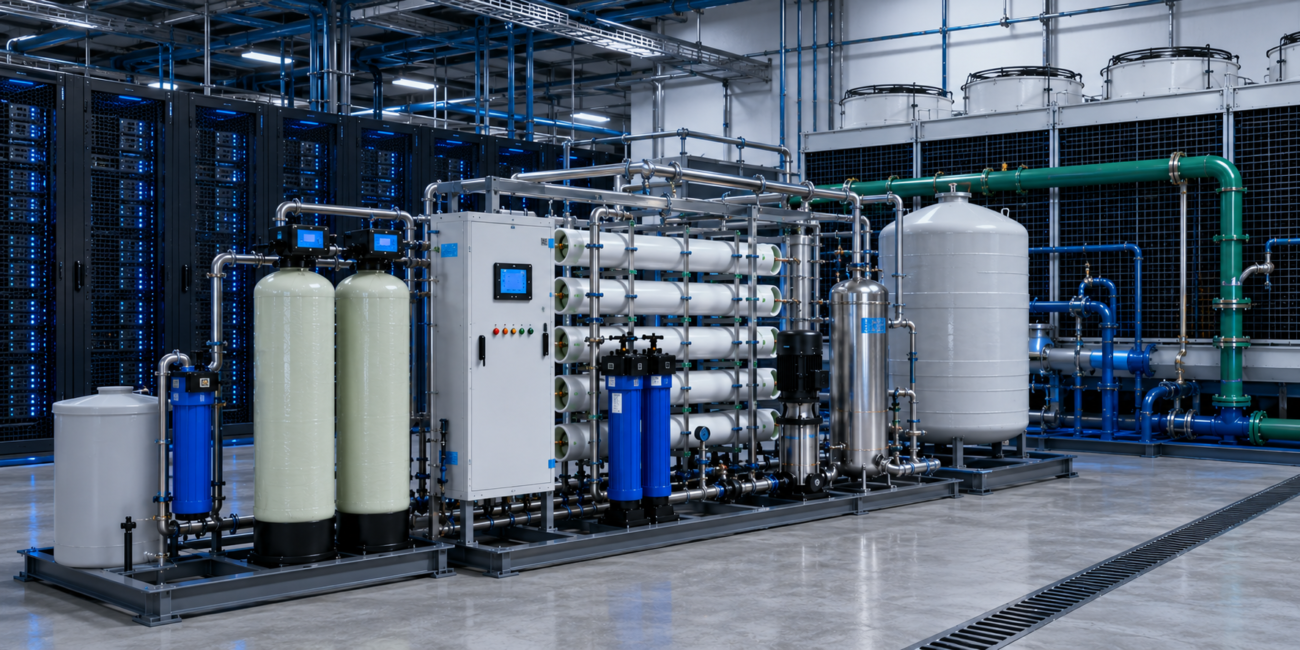
Get an Infrastructure Engineering Quote built around your facility’s actual peak heat rejection load and feed water source, not a generic flow-rate assumption.
A correctly sized data center makeup water treatment system is what keeps every downstream component operating inside its designed chemistry envelope:
- Cooling towers and heat exchangers hold their engineered CoC instead of running compensated low, cutting water and chemical OPEX that a scale event would otherwise force
- Chillers and condenser tubes avoid accelerated scale and corrosion tied to hardness leakage that a properly sized softener train would have caught
- 24/7/365 uptime depends on the makeup system keeping pace with peak demand rather than throttling supply during the hottest hours the data hall actually needs cooling capacity
YWT’s data center product line pairs industrial reverse osmosis systems and skid-mounted softening trains for makeup pretreatment with EDI polishing and automated dosing packages engineered around your actual data center makeup water treatment system requirements — not a single generic skid stretched across two different jobs.
FAQ: Data Center Makeup Water Treatment System
What is a data center makeup water treatment system? It’s the pretreatment equipment — softening, dealkalization, dechlorination, multimedia filtration — that conditions water before it enters a cooling tower or chiller loop as makeup, distinct from the chemistry dosing program that treats water already circulating in the loop.
How much makeup water does a cooling tower actually need? Demand is driven by evaporative loss, blowdown, and drift combined, and should be sized to the facility’s peak heat rejection load and worst-case ambient wet-bulb condition, not an average annual figure.
Do I need softening or RO for cooling tower makeup water? Softening alone is often sufficient for municipal feed with moderate hardness. Reclaimed or high-silica feed water typically requires RO ahead of the tower basin, since softening doesn’t address silica or elevated TDS.
What’s the difference between makeup water treatment and cooling tower chemistry treatment? Makeup water treatment conditions incoming water before it enters the loop. Chemistry treatment (biocide, scale inhibitor, pH control) manages water already circulating. Both are required, and one can’t substitute for the other.
Does reclaimed water need a different makeup water treatment system than municipal water? Yes. Reclaimed water carries higher TDS and silica loading and typically needs heavier multimedia/coagulation pretreatment, while municipal feed’s primary concern is chlorine or chloramine removal ahead of softening.
How is makeup water system redundancy engineered — N+1 or 2N? N+1 covers a single train failure without service interruption. 2N is reserved for facilities where any makeup interruption risks CoC excursion fast enough to threaten uptime, typically high-density liquid-cooled sites.
What happens if the makeup water treatment system is undersized? The tower can’t hold its designed CoC. Operators compensate by running lower CoC (higher water/chemical consumption) or over-dosing antiscalant — both of which show up as OPEX overruns rather than an obvious equipment failure.
Get an Infrastructure Engineering Quote, request detailed Technical Data Sheets sized to your facility’s peak heat rejection load and feed water source, or ask about B2B wholesale / factory-direct pricing on industrial RO, softening, and dosing systems engineered around your actual makeup water demand — not a generic single-loop template.